






Still downloading templates?
There’s an easier way. Try a free AI Agent in ClickUp that actually does the work for you—set up in minutes, save hours every week.
Sorry, there were no results found for “”
Sorry, there were no results found for “”
Sorry, there were no results found for “”
Why do we procrastinate at work? New survey data reveals how ambiguity and overwhelm delay action—and what actually reduces it.
Here’s something that doesn’t get talked about enough in productivity culture. The moment before you start the work often hits harder than the work itself.
You opened the task, read the description, and your brain quietly whispered, “I don’t know where to begin.”
You told yourself you’d circle back after lunch, after that meeting, after you had “more clarity.” Unfortunately, the meeting muddied everything further, and now it’s an “urgent” and unclear task.
That’s a procrastination scenario most knowledge workers are familiar with.
We recently surveyed knowledge workers about how and why they procrastinate at work. The results paint a picture that’s far more nuanced than the usual “just eat the frog” advice suggests.
Procrastination, it turns out, isn’t moral failure. It is a signal that simply tells you exactly where your systems are failing. Here’s what we found.
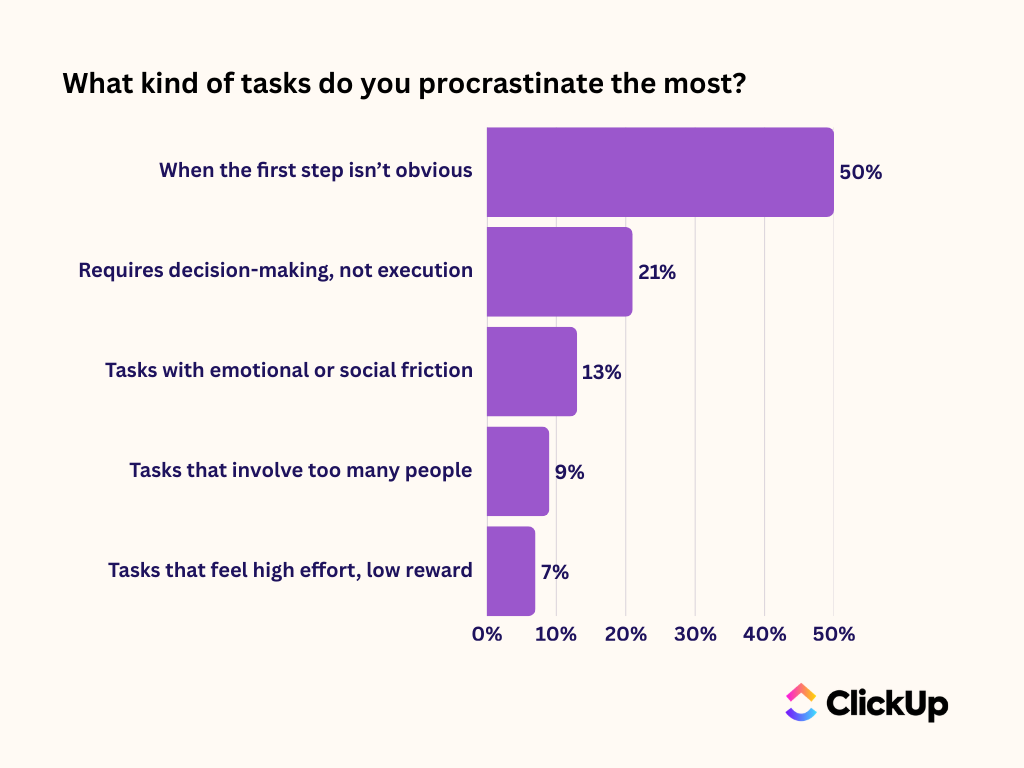
❗️50% procrastinate when the first step isn’t obvious
❗️45% say too many open questions stop them from starting
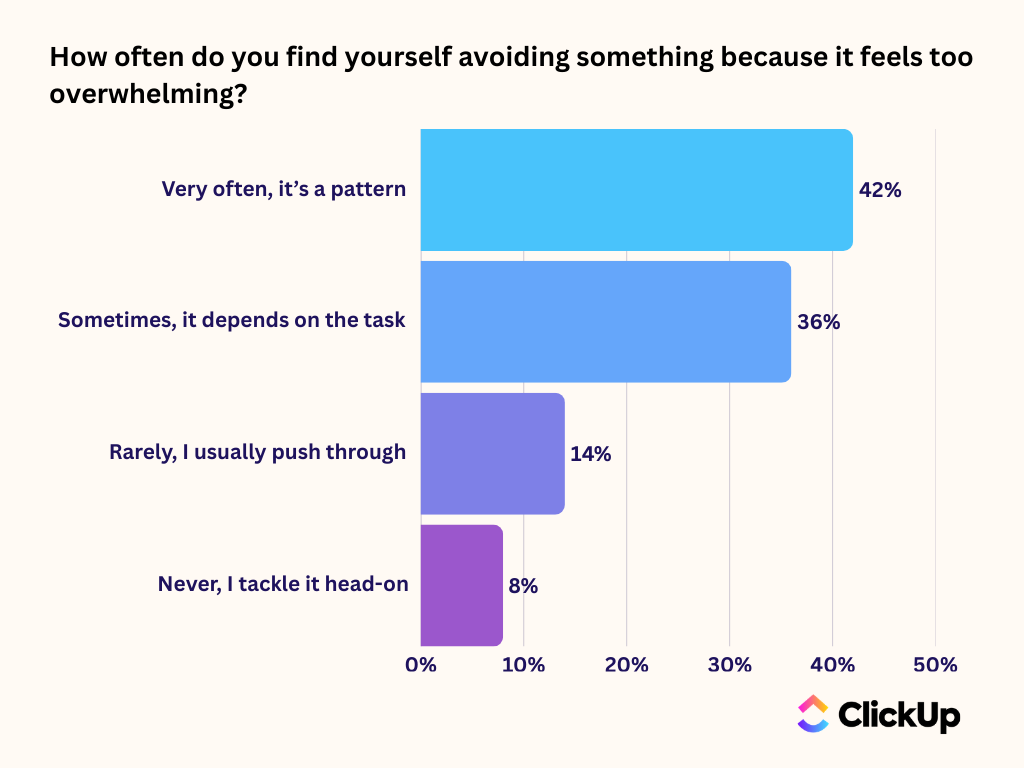
❗️42% say feeling overwhelmed is a recurring pattern
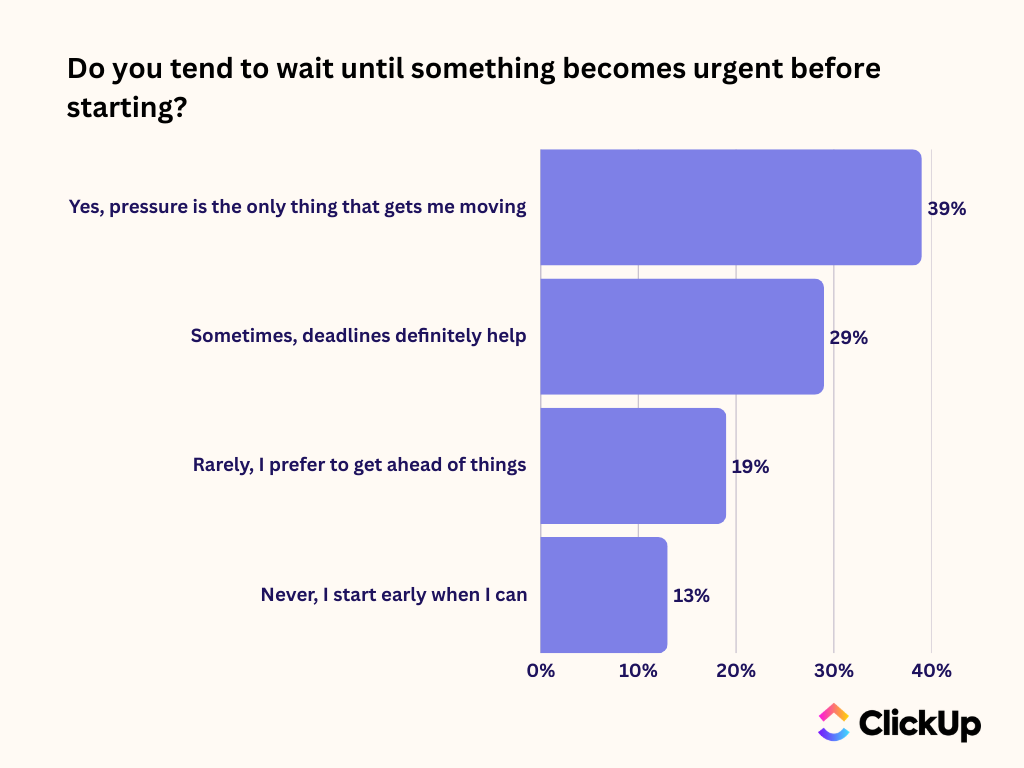
❗️39% rely on urgency to get moving
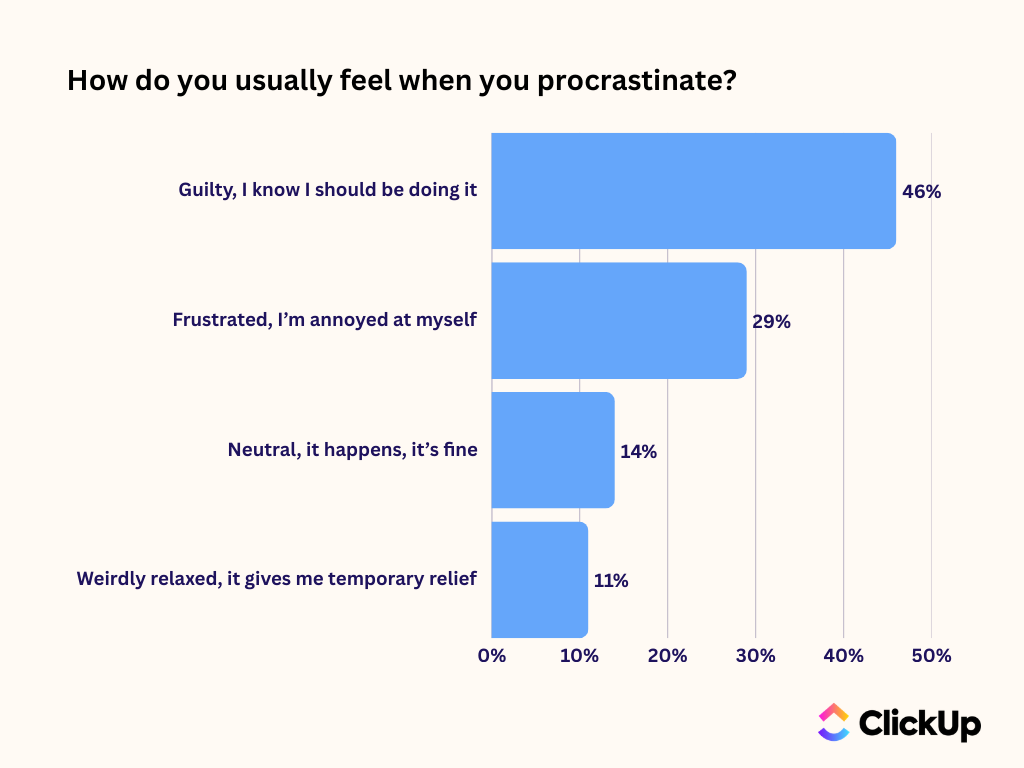
❗️46% feel guilty when they procrastinate
❗️35% say more clarity would help them start sooner
These data points tell a single, coherent story: Procrastination follows ambiguity, as a shadow follows an object. Remove one, and the other has nowhere to exist. Let’s unpack this.
Half of all respondents say they procrastinate most on tasks where the first step isn’t obvious. Another 21% of the delay is due to work that requires decision-making rather than straightforward execution.
Think about what that actually means. The majority of workplace procrastination isn’t happening on simple, well-defined tasks. It’s clustering around the ones that require you to figure out what “doing it” even looks like before you can do it.
And unclear instructions pour fuel on this fire. 64% admit they delay tasks until they understand them better, and 29% say they immediately stall when instructions feel ambiguous.
When the hesitation stems from a lack of context, it fundamentally becomes a different beast.
Here’s why this matters: when work context is scattered across three tools, two Slack threads, and a meeting that happened last Tuesday, “starting” a task doesn’t mean starting the work.
Instead, you’re digging: To excavate the original conversation, revisit half-remembered notes, confirm assumptions no one wrote down, and mentally reconstruct what “done” actually looks like.
Essentially, there’s unpaid cognitive labor happening before the real work even begins. And for most people, it’s enough friction to make “I’ll come back to this later” feel like the rational choice.
The uncomfortable truth? It often is the rational choice. The human brain, after all, is exceptionally good at identifying the cost of what “starting” even means here.
When we asked people what specifically stops them from starting, 45% pointed to too many open questions. Another 26% said there are simply too many steps to hold in their head at once.
And 42% describe this cycle, of feeling overwhelmed at work and defaulting to procrastination, as a recurring pattern in their work life.
Let’s be precise about what’s happening here. People are not saying “I have a lot to do.” This is “I can’t hold the shape of this work in my head long enough to act on it.”
There’s a concept in cognitive psychology called working memory load: the idea that your brain can only juggle a limited number of unresolved items before performance degrades. When a task isn’t broken down, your brain has to simulate the entire project, every step, every dependency, every open question, before it can commit to a single action.
It burns through working memory fast. And when dependencies are unclear or unresolved? Progress feels blocked before it begins.
This is why the same person who procrastinates on a complex project can breeze through 30 emails without hesitation. It comes down to definition. The emails are small, discrete, and self-contained. Whereas the project feels like a fog.
Here’s where it gets sneaky.
Procrastination doesn’t always look like someone staring at a wall. More often, it looks like someone being very, very busy on the wrong things.
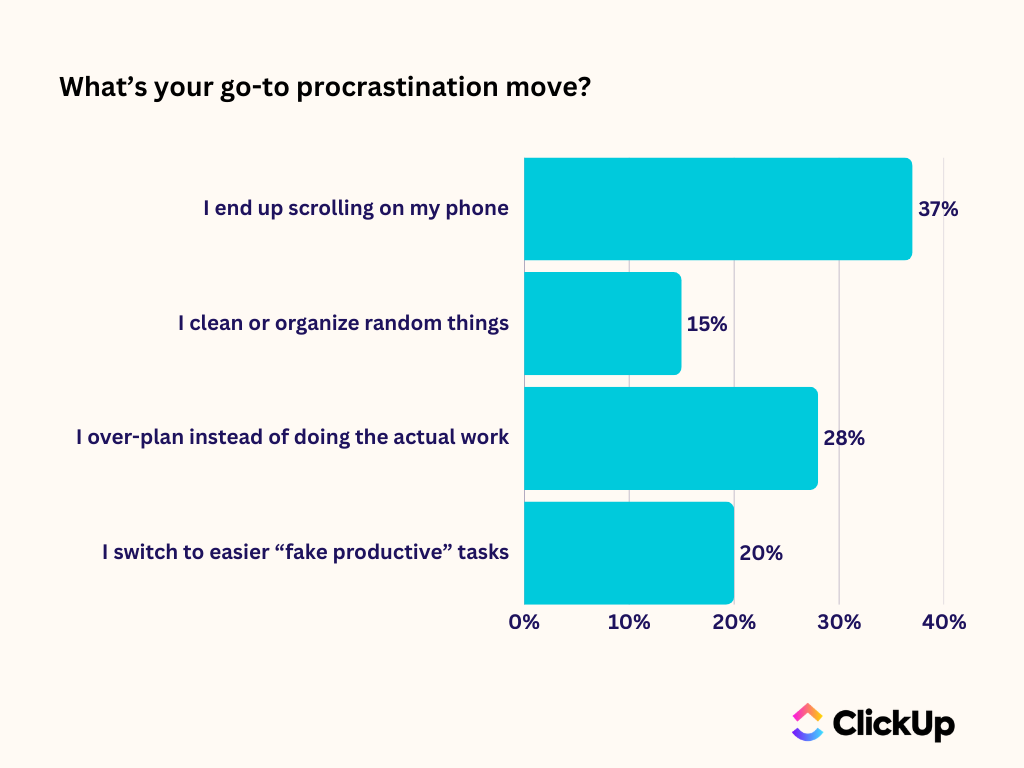
28% of respondents admit they overplan rather than do the actual work. 20% switch to easier, “fake productive” tasks. And 37% said they scroll on their phones instead.
Meanwhile, the harder, less defined task sits untouched. This is procrastination’s real trick. It doesn’t remove the task from your awareness (just keeps offering you something easier to do instead).
And because modern work environments serve up an endless buffet of small, completable actions, emails, messages, quick edits, status updates, there’s always a plausible alternative to the thing you’re actually avoiding.
39% of respondents say pressure is the only thing that reliably gets them moving. Another 29% say deadlines help, which is really just a polite way of saying the same thing.
So let’s call this what it is: in the absence of clarity, urgency becomes the operating system.
And it works. The adrenaline kicks in, the scope narrows to what’s absolutely essential, and you produce something under pressure that’s… fine. Maybe even good.
But here’s what you’re not accounting for: the tax.
Urgency isn’t a productivity strategy. And relying on it consistently is like paying for everything with a credit card; it works until you look at the bill. And we’ve somehow normalized that.
📖 Read More: Eat the Frog: Tackle Your Most Important Work First
Procrastination rarely feels good. But the data here is more revealing than you might expect.
46% of respondents say they feel guilty because they know they should be doing the work. 29% feel frustrated with themselves. These are people who care and feel worse precisely because they do.
This is the detail that dismantles the laziness narrative entirely.
If procrastination were simply a lack of effort or ambition, the emotional signature would be apathy. Instead, the data show an internal conflict: These are people who want to move forward, know that they should, and are genuinely distressed that they’re not.
The problem is that wanting to do the work and being equipped to start the work are two completely different things. And most work environments invest heavily in the first, through goals, incentives, and accountability, while largely ignoring the second.
We keep trying to solve a systems problem with emotional pressure.
If ambiguity and overload are the root causes, the solutions should be structural.
No amount of “just do it” energy fixes a task that doesn’t tell you what to do first. Here’s what actually moves the needle.
This sounds almost insultingly simple, but it’s the highest-leverage change you can make.
Every task should have a clearly visible starting point. A next physical action: “Review data from the last 4 quarters and analyze conversion rates for the top three competitors” or “Brainstorm and build a rough map for the buyer journey, and then let’s workshop that.”
The difference is enormous.
If someone can open a task and immediately see what to do first, without decoding, without searching, without asking three people for context, hesitation drops dramatically. Because you’re removing the barrier before the work.
Large deadlines are procrastination’s best friend because they create the illusion of available time. “Due in two weeks” feels spacious, right up until it doesn’t.
Smaller milestones solve this by replacing one distant finish line with multiple near-term checkpoints. Subtasks, interim check-ins, and shorter feedback loops can provide much-needed cognitive relief.
When you can see progress happening in real time, momentum builds. When the next milestone is two days away instead of two weeks, the cost of delay becomes tangible before it becomes a crisis.
This is the silent killer. When conversations live in Slack, documentation lives in Google Docs, tasks live in a project management tool, and decisions live in someone’s memory, starting any piece of work requires assembly.
That assembly tax compounds invisibly. It’s five minutes here, ten minutes there, a “quick question” that takes 30 minutes to get answered.
Reducing the distance between context and execution removes friction before it compounds. When everything you need to start is already where the work lives, moving forward is easy.
The patterns in this data go beyond individual productivity problems. They’re structural symptoms of what happens when work is spread across too many disconnected systems or work sprawl.
ClickUp addresses this at the architectural level, not by adding another tool to the stack, but by converging tasks, documentation, communication, and AI into a single workspace where clarity is the default, not the exception.
Here’s how that maps to what the data is telling us.
Remember that 50% of respondents stall when the first step isn’t obvious? ClickUp is designed to eliminate that ambiguity at the task level.
Every Task in ClickUp can be broken into subtasks with assigned owners, explicit deadlines, and clear descriptions—so the starting point isn’t something you have to decode, it’s something you can see the moment you open it.
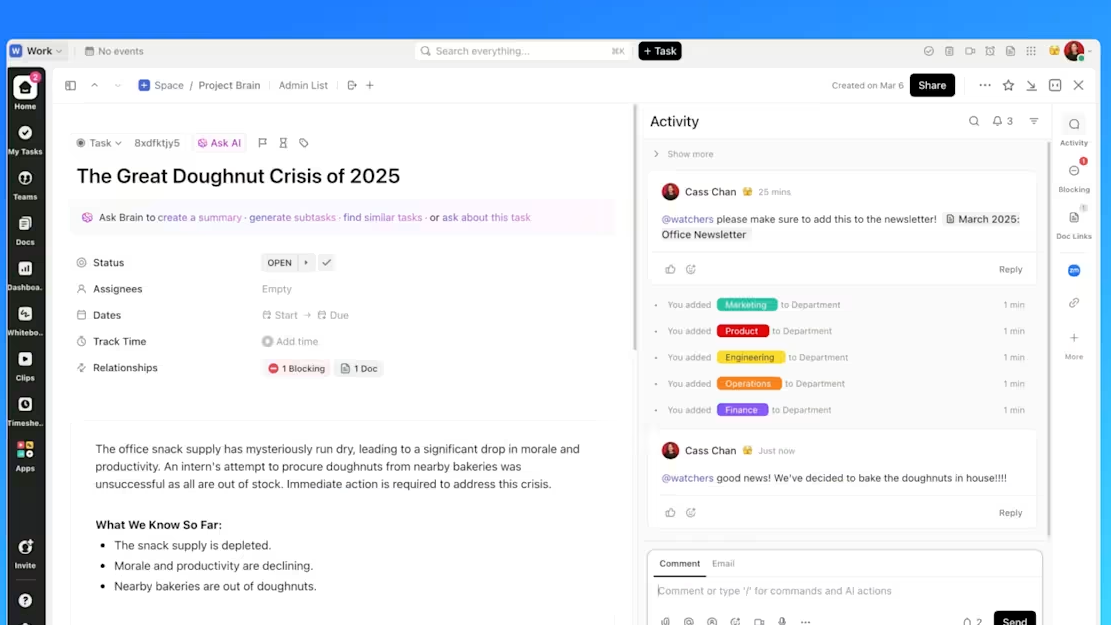
Dependencies are mapped and visible, which means you’re never guessing about what’s blocked or what’s ready to move. When something upstream is unresolved, you know. When the path forward is clear, you know that too.
The goal is to make “what do I do first?” a question the system answers before you have to ask it.
One of the biggest friction points our data surfaced is the cognitive cost of assembling context from scattered sources. Conversations in one tool, documentation in another, decisions trapped in someone’s memory.
ClickUp collapses that distance structurally. Conversations in ClickUp Chat stay connected to the tasks they reference, no more excavating a messaging app to find that one thread from two weeks ago. Documentation in ClickUp Docs sits alongside the projects it supports, not in a separate tool that requires a context switch to access.
Meeting insights captured by AI Notetaker flow directly into your workspace, linked to the relevant tasks and projects. What was discussed, decided, and assigned doesn’t evaporate into a recording nobody rewatches; it becomes part of the living workflow.

The “archaeology” problem we identified earlier? This is how you eliminate it.
The data showed that open questions, unclear priorities, and unresolved dependencies are the primary drivers of procrastination. ClickUp Brain tackles this by acting as a persistent layer of intelligence across your entire workspace.
It can surface what was previously decided in a long thread, summarize conversations you missed, and pull relevant context from across projects, so the cognitive labor of reconstructing “where things stand” doesn’t fall on you every morning.
When a task feels unclear, Brain can help outline the next practical step or generate a structured approach based on your actual workspace data. Instead of generic AI advice, it’s contextual intelligence drawn from your work, your decisions, your team’s patterns.
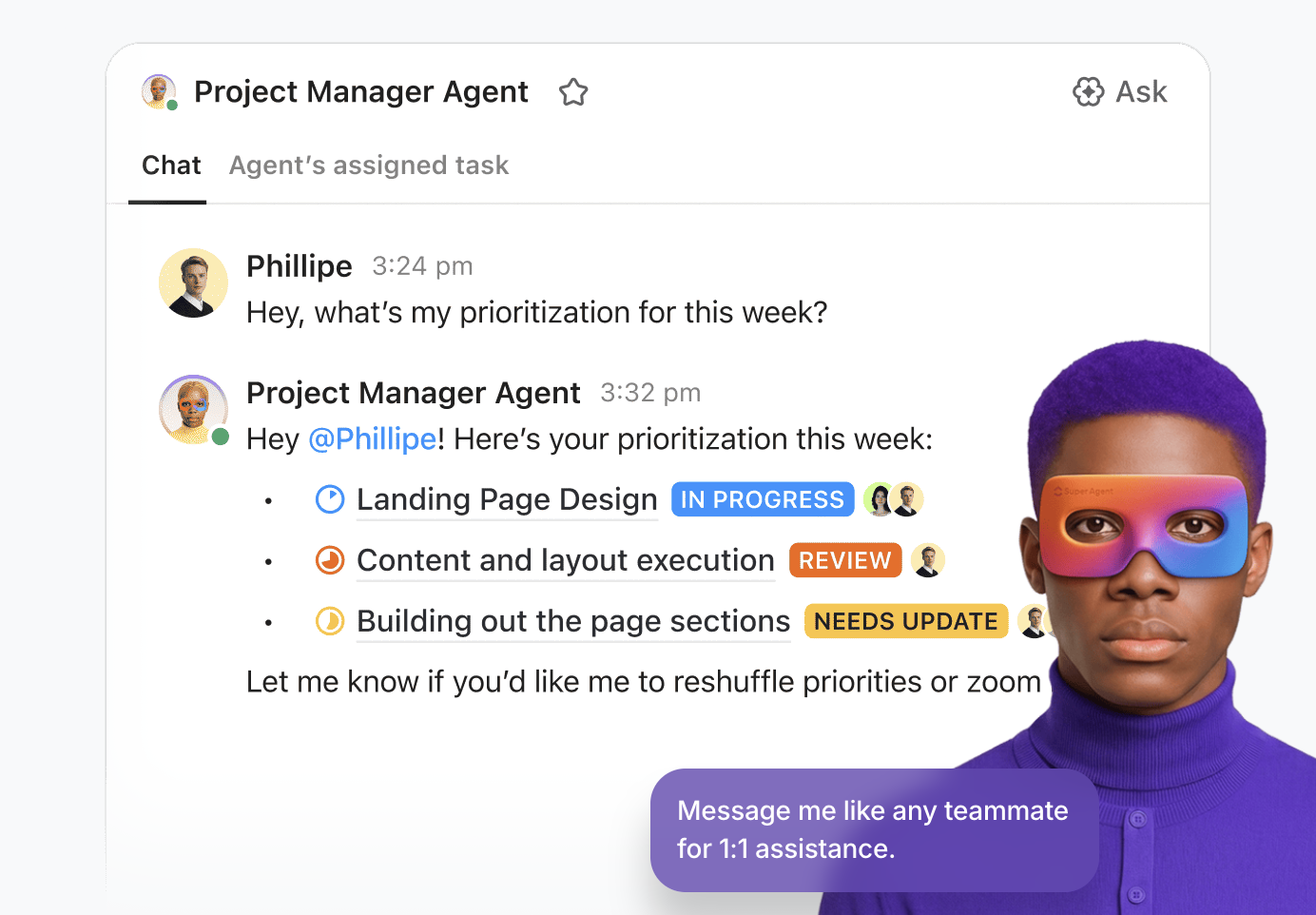
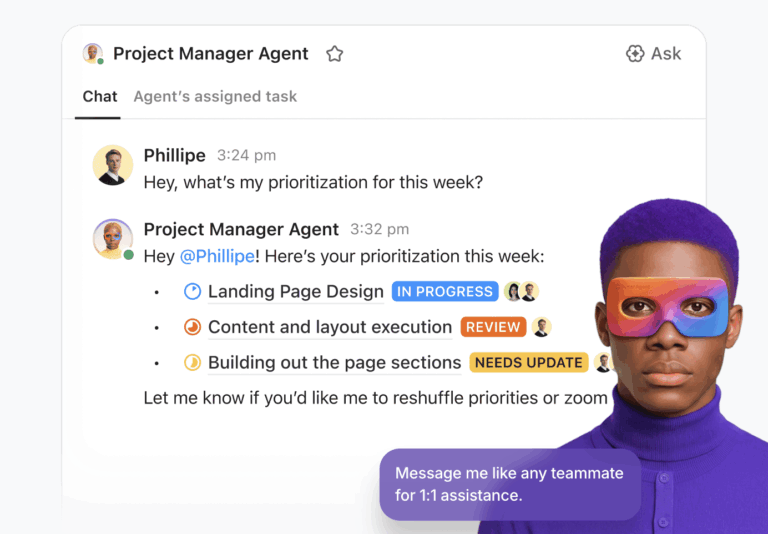
And Super Agents take this further. These configurable AI agents can continuously scan your workspace for stalled tasks, flag items that haven’t progressed, and surface your priorities in a focused summary. Instead of beginning the day with a wall of notifications and the low-grade anxiety of “what should I even start with,” you begin with a clear picture of what matters and what’s stuck.
Each of these capabilities maps directly to what reduces procrastination at work: visible next steps, smaller defined commitments, and centralized context. When those are built into the system itself, hesitation has less room to grow.
In short, with ClickUp, Clarity stops being something you have to manufacture from scratch and becomes something the system continuously provides.
📖 Read More: 25+ Best Time Management Techniques Proven To Work
The data from this survey point in one unmistakable direction: Clarity.
People procrastinate when the first step is unclear. When there are too many unresolved questions. When tasks are cognitively heavy and structurally undefined. When urgency is the only reliable forcing function.
The instinct in most organizations is to respond to procrastination with more accountability: tighter deadlines, more check-ins, more pressure. But you can’t accountability-hack your way out of a clarity problem.
The real leverage is in the environment. When the next step is visible, when context lives where the work happens, when open questions get resolved before they calcify into blockers, starting becomes the path of least resistance instead of a daily negotiation with your own brain.
Bottom line? Procrastination is a signal that your work environment is generating unnecessary friction.
The organizations that learn to read that signal, and design their systems accordingly, will get to see what their people are actually capable of when starting is easy.

© 2026 ClickUp

There’s an easier way. Try a free AI Agent in ClickUp that actually does the work for you—set up in minutes, save hours every week.