Most AI systems today are built around a simple loop: wait for input, generate output, stop. Useful, but fundamentally limited – every step forward requires another prompt from you.
Super Agents change that. Instead of waiting for step-by-step instructions, they interpret your goals and decide how best to achieve them within the boundaries you set.
In this guide, you’ll learn what Super Agents are, how they work under the hood, where they deliver the most value, and how to safely deploy them in ClickUp as real, accountable teammates.
Super Agents plan and execute tasks across connected tools automatically.
They use memory, reasoning, and orchestration to deliver outcomes, not outputs.
ClickUp embeds Super Agents directly in workflows for full context and control.
Teams save time, reduce manual work, and scale intelligent automation fast.
Summarize this article with AI
ClickUp Brain not only saves you precious time by instantly summarizing articles, it also leverages AI to connect your tasks, docs, people, and more, streamlining your workflow like never before.
Summarize this article for me please
What Are Super Agents?
Super Agents are autonomous AI teammates that can understand a goal, break it into steps, choose the right tools, and carry work through to completion while checking their own work and asking for help when needed.
Unlike traditional chatbots or simple automations, Super Agents take responsibility for outcomes rather than individual tasks. They represent the shift from reactive AI that only responds when asked to proactive AI that understands goals, plans the necessary steps, and executes them independently.
Core capabilities of Super Agents include:
Breaking complex goals into clear, actionable steps
Choosing and orchestrating the right tools, apps, and data sources
Maintaining context across tasks, sessions, and conversations over time
Learning from results and refining their approach continuously
Super Agents sit at the leading edge of agentic AI. They are fully customizable, have richer memory than legacy agents, and can be assigned, mentioned, and triggered just like a human teammate.
Think of it this way: if a traditional AI agent can run a quick data analysis, a Super Agent is the analyst who gathers the data, runs the model, interprets the results, and delivers the report in the right format to the right stakeholder without being explicitly instructed on each step.
Summarize this article with AI
ClickUp Brain not only saves you precious time by instantly summarizing articles, it also leverages AI to connect your tasks, docs, people, and more, streamlining your workflow like never before.
Summarize this article for me please
Super Agents vs. Traditional AI Agents
The difference between traditional AI tools and Super Agents isn’t just capability—it’s philosophy. Traditional agents were built to assist; Super Agents are built to own outcomes.
Most AI systems today still fall into one of three tiers of maturity, from simple chatbots to true Super Agents:
Capability
Traditional AI Agents (Chatbots, Single-Task Tools)
Super Agents
Autonomy level
Dependent on user prompts
Operate with minimal human supervision
Task scope
One task at a time (summarize text, answer a question, generate content)
Multi-step workflows across tools, teams, and data sources
Orchestrates multiple tools, APIs, and systems in real time
Error handling
Returns a failed output or asks user to retry
Self-corrects, replans, and retries without human intervention
Adaptation
Doesn’t improve unless retrained
Learns from outcomes, feedback, and system changes
Interaction model
Prompt → Output
Goal → Plan → Execute → Monitor → Improve
Traditional agents think in commands and completions. Super Agents think in goals and strategies.
Summarize this article with AI
ClickUp Brain not only saves you precious time by instantly summarizing articles, it also leverages AI to connect your tasks, docs, people, and more, streamlining your workflow like never before.
Summarize this article for me please
Why Super Agents Matter
This shift from reactive to proactive AI is already reshaping workflows.
Human–AI collaborative teams are reporting significantly higher productivity than human-only teams. In one study, productivity gains reached about 60%. Another survey found that around 62% of organizations deploying agentic AI expect 100%+ ROI, with U.S. companies projecting up to 192% ROI.
ClickUp is among the first platforms to deliver production‑grade Super Agents, fully integrated into your workspace and capable of acting as assignable, mentionable AI teammates.
As ClickUp founder and CEO Zeb Evans notes, one of the fastest-growing new roles will be “Agent Managers”—people who create, deploy, and optimize teams of AI workflows to ensure quality and consistency.
ClickUp Example: From Assistant to Autonomous Teammate
A standard AI command might look like: “Summarize tasks due today.”
A ClickUp Super Agent goes much further. It can:
Scan for overdue tasks
Detect blockers and their causes
Pull context from GitHub, ClickUp Docs, and more
Draft status updates for each owner
Generate a manager-ready weekly performance report
Schedule follow-up tasks automatically
Super Agent execution: from identifying blockers to generating reports
This is the leap from a passive assistant to an autonomous teammate—one that not only understands what’s happening in your workspace but acts on it intelligently.
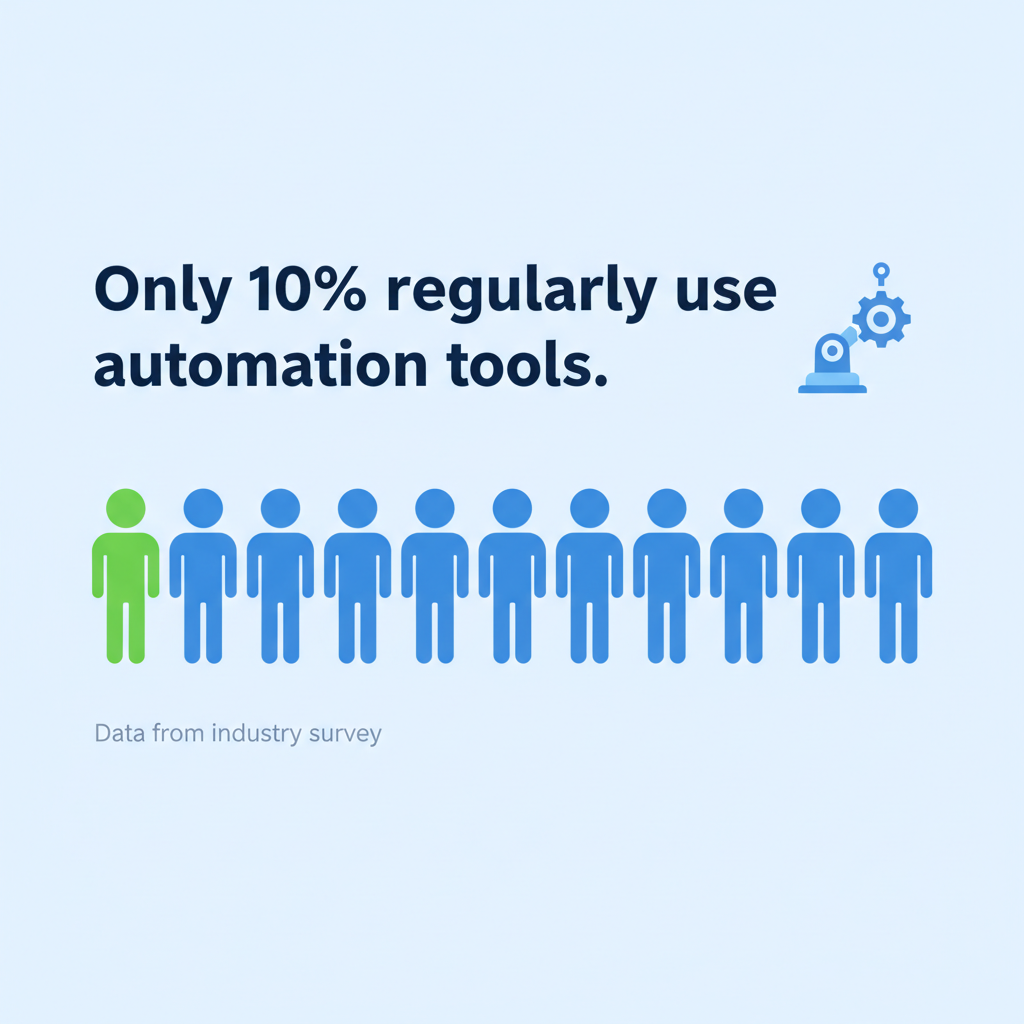
Despite the potential, a ClickUp survey found that only 10% of workers report regularly using automation tools, highlighting a major untapped lever for productivity.
Source: ClickUp Insights
Summarize this article with AI
ClickUp Brain not only saves you precious time by instantly summarizing articles, it also leverages AI to connect your tasks, docs, people, and more, streamlining your workflow like never before.
Summarize this article for me please
How Super Agents Work
Super Agents combine a few powerful ideas—autonomous decisions, multi-tool orchestration, long-term memory, and self-evaluation—into one system. The easiest way to understand them is through the four layers that make this possible.
This is where intention turns into strategy. Give a Super Agent a goal like “Reduce customer ticket backlog by 20%” and it immediately builds a structured plan: analyzing backlog patterns, assigning owners, escalating critical issues, and designing fallback paths if bottlenecks appear.
Because Super Agents think in chains—not single commands—they don’t wait for step-by-step instructions. Each morning, for example, a Super Agent might scan your workspace for blocked tasks, clear what it can, ping the right owners for the rest, and deliver a full status summary before your first standup even starts.
In ClickUp, this happens inside the Agent Builder, where teams set high-level intent and guardrails once. The agent then generates its own plan each time the workflow runs, without micromanagement.
Inside ClickUp’s Agent Builder: Define goals, rules, and context for autonomous execution
2. Orchestration layer (multi‑tool execution)
Once a plan exists, the orchestration layer carries it out across your entire toolstack. After authentication, Super Agents can retrieve data, update records, trigger handoffs, and manage errors across connected systems simultaneously.
Take onboarding: a ClickUp Super Agent can generate welcome docs, assign training tasks, provision access, and notify managers—all from a single workspace. No toggling between systems, no chasing approvals. The same orchestration framework can power incident response, marketing campaigns, or release management.
ClickUp brings every workflow under one roof—tasks, documents, chat, and over 100 integrations—so agents can act directly within the system of record. No middleware. No lag. Just seamless execution from insight to action.
Super Agents orchestrate multi-step workflows across integrated tools and platforms
3. Memory and context systems (short‑term, long‑term, and preference memory)
Memory gives Super Agents continuity. They don’t start from zero every time you ask for help. Instead, they store three types of context:
Short-term memory: What just happened, such as who asked a question, what changed, or which tasks were updated.
Long-term memory: Organizational knowledge from docs, past tickets, rules, dashboards, and naming conventions.
Preference memory: How different people and teams like work presented, including tone, format, or channel.
Ask for a campaign report, and your Super Agent already knows which dashboard to use, who last updated it, and how the results were summarized last quarter.
ClickUp’s Live Intelligence Agent turns this memory into a living knowledge graph drawn from tasks, Docs, Chats, and integrations, keeping the “why” behind your work always within reach.
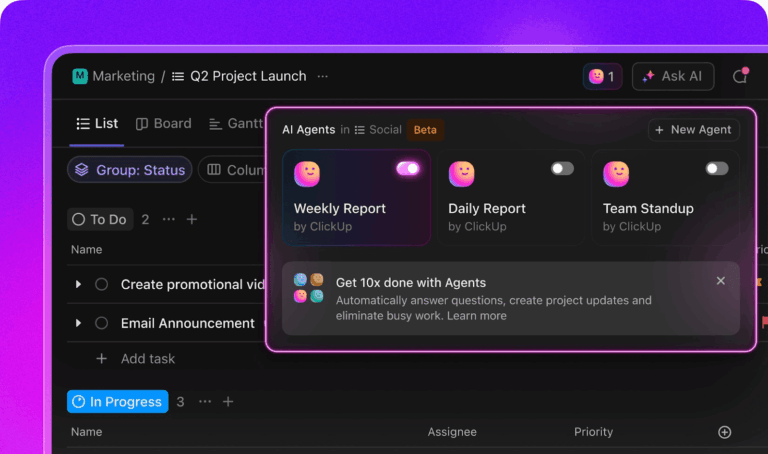
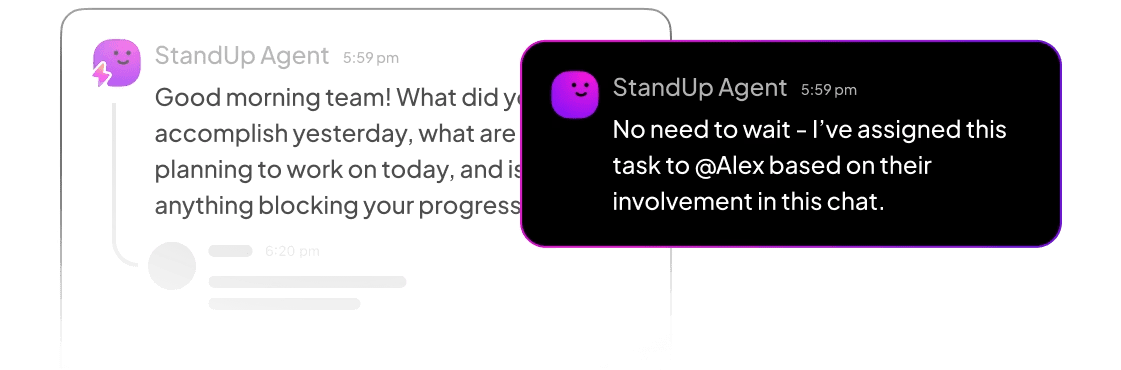
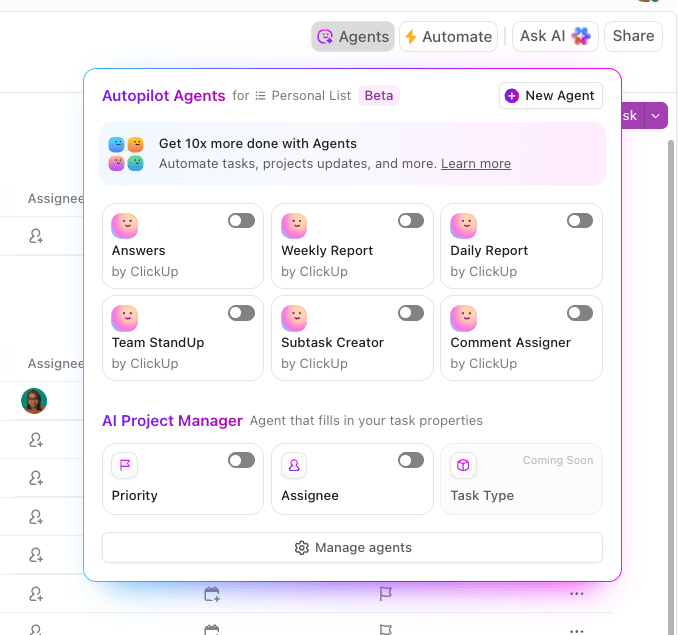
Stay up-to-date on task progress with automated daily and weekly reports and AI standups via ClickUp Autopilot Agents
4. Reasoning and evaluation layer (self‑evaluation and error correction)
This is where autonomy becomes intelligence. Super Agents use multi-step reasoning to evaluate, decide, and adapt. They can test hypotheses like “Is sprint delay caused by capacity or dependencies?”, follow conditional branches such as “If blocked, try an alternate path,” and even self-reflect by asking “Why did this step fail?”
Because they can assess their own work, Super Agents don’t just fail silently. When something breaks—like a data sync timing out—they automatically retry or alert the right person before it snowballs.
For sensitive workflows, you can turn on Approval Mode, which lets the agent prepare drafts but pauses execution until a human reviews and approves them—especially useful before sending client messages or updating important records. ClickUp’s error recovery modes add an extra layer of trust by rerunning the plan with new parameters before escalating.
Each layer strengthens the next. Planning provides direction, orchestration provides reach, memory provides context, and reasoning provides autonomy. Together, they power the next evolution of work inside ClickUp, where AI not only assists but also advances.
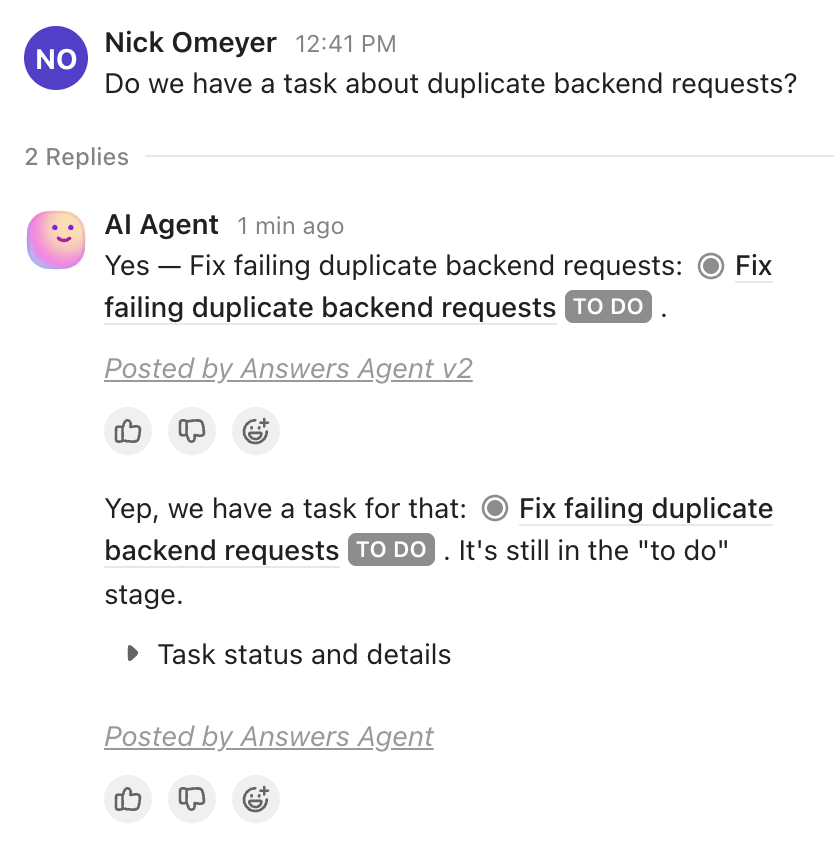
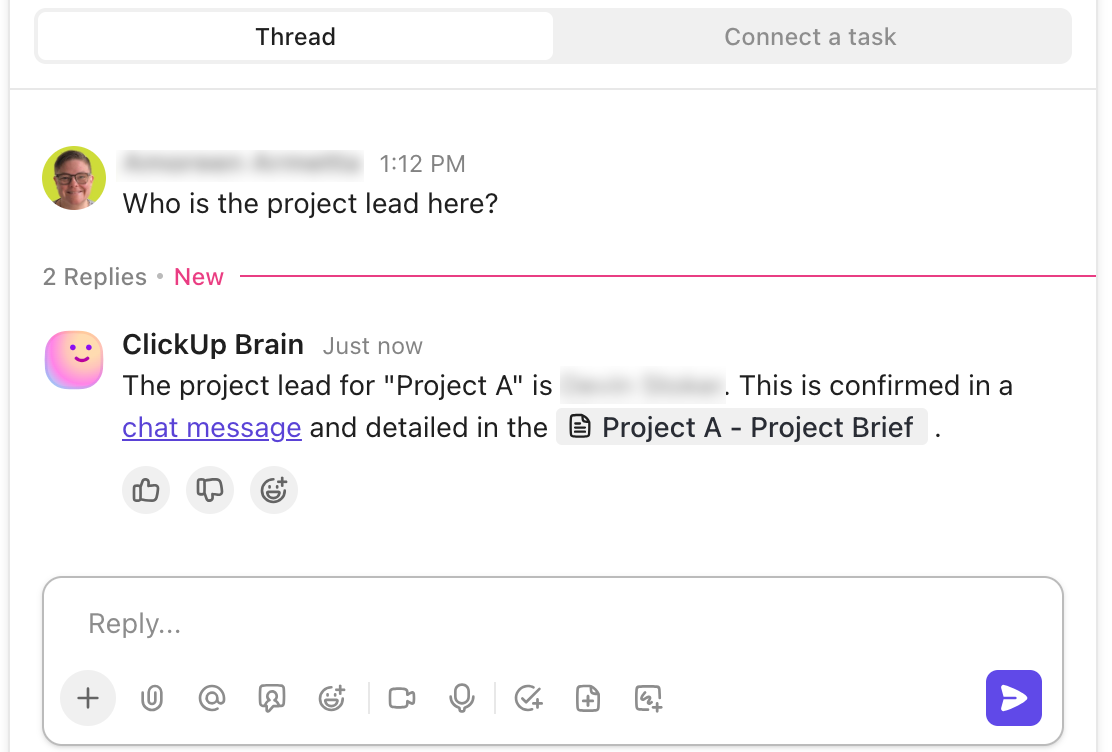
ClickUp Super Agent answering complex workspace questions autonomously
Summarize this article with AI
ClickUp Brain not only saves you precious time by instantly summarizing articles, it also leverages AI to connect your tasks, docs, people, and more, streamlining your workflow like never before.
Summarize this article for me please
Key Capabilities of Super Agents
With the planning, orchestration, memory, and reasoning layers in place, Super Agents show up in organizations through a handful of high‑leverage capabilities—the things your teams actually feel day to day.
1. Complex problem solving
Super Agents go beyond quick answers to handle deep analysis across multiple data sources. They can perform financial modeling using CRM and ERP data, identify the root causes of customer churn, or synthesize market research from PDFs, web pages, and spreadsheets.
In ClickUp, a Super Agent can pull analytics from dashboards, cross-check customer feedback in tasks, and compile a “Q1 Churn Drivers” document complete with insights and follow-up tasks for product and success teams—so leaders see decisions, not just raw data.
2. Autonomous workflow execution
This is where Super Agents move from assistance to full ownership of execution. They can handle recurring workflows end-to-end, such as:
Creating CRM records and assigning onboarding tasks
Monitoring pull requests and updating release notes
Scanning NPS scores and drafting customer responses
In ClickUp, you might assign a Super Agent to handle customer escalations. When a low NPS score appears, it automatically creates a task, tags the right owner, drafts a response email, and logs the issue to your workspace knowledge base. Your team only reviews and refines what has already been handled.
Assign tasks directly through the agent
3. Adaptive learning
Super Agents learn from patterns in your workspace and continuously improve based on user feedback. They notice when you prefer shorter updates, when summaries need more context, or when certain edge cases always need escalation, and adjust automatically.
ClickUp’s Agent Builder allows teams to shape each agent’s personality, tone, and goals without writing code, ensuring they evolve with your organization’s way of working.
4. Cross-domain integration
The real advantage shows up when work crosses departments, tools, and data sources—exactly where traditional, single-app automation falls short.
Docs → Tasks → Campaigns → Analytics → Reports
A ClickUp Super Agent can power marketing automation by analyzing campaign data, generating a content brief, assigning tasks to the right team members, updating performance metrics in real time, and instantly sharing a summary in ClickUp Chat—all from a single place.
Automate tasks in marketing with AI
By bridging every layer of your workflow, Super Agents reduce Work Sprawl and create alignment between people, data, and action.
Before vs. After: What actually changes when you deploy a Super Agent
The real “aha” moment comes when a single workflow runs end-to-end without human touch. What once required multiple tools, pings, and reports now happens automatically.
Before (Human-Driven)
After (Super Agent-Driven)
PM spends 45 min collecting updates before standup
Agent scans workspace, detects blockers, and sends a daily digest
Success lead manually creates follow-ups for low NPS scores
Agent scans surveys, creates tasks, drafts replies, and assigns owners
Ops team copies metrics from 5 tools into a weekly leadership report
Agent pulls data, formats it, and delivers a scheduled report
Dev lead monitors GitHub for merged PRs and updates release notes
Agent tracks merges, runs checks, updates docs, and notifies teams
The biggest shift isn’t just speed—it’s ownership. What changes everything isn’t how fast work gets done; it’s that it no longer stalls. With a Super Agent in the loop, projects don’t pause when people do. The handoff becomes invisible.
Summarize this article with AI
ClickUp Brain not only saves you precious time by instantly summarizing articles, it also leverages AI to connect your tasks, docs, people, and more, streamlining your workflow like never before.
Summarize this article for me please
Real-World Applications of Super Agents
Super Agents remove the manual handoffs that usually slow teams down. Instead of humans copying, pasting, and updating between systems, Super Agents coordinate these actions automatically. What changes isn’t just what is automated, but how much intelligence and orchestration are embedded across the workflow.
1. Enterprise operations
Traditional AI produces outputs. Super Agents deliver outcomes.
They can:
Pull data from CRM, billing, and analytics systems
Detect anomalies, like a spike in churn or revenue dips
Recommend corrective actions, such as reassigning accounts or flagging forecasts
Trigger follow-up workflows automatically
Example: A ClickUp Super Agent monitors sprint burndown charts, unblocks stalled tasks, generates weekly summaries, and delivers snapshots to leadership—all on schedule. No one has to “run reports.” The reports now run themselves.
2. Intelligent document processing and knowledge sync
Docs → Tasks → Wikis → Policies → Projects
Super Agents keep company knowledge in sync. When a policy is updated, they locate related tasks and handbooks and refresh outdated content. When a new product feature launches, they update onboarding flows, internal FAQs, and help center docs. When a new customer story goes live, they push key excerpts into sales enablement materials.
Agents in ClickUp operate within your existing permissions and log every action for transparency and compliance. Sensitive workflows can also use approval modes or fail-safes before publishing updates.
3. Software development
Super Agents can manage entire development cycles—not just isolated actions.
They generate feature branches, track PR statuses, run test summaries, file bugs with stack traces, and automatically update documentation and release notes. Once everything checks out, they notify the right teams so product, QA, and marketing are aligned.
ClickUp connects code, tasks, and communication in one workspace, removing the need for fragile, multi-tool automations.
4. Business intelligence and forecasting
Data → Analysis → Insight → Action
A Super Agent transforms reporting from passive dashboards to proactive strategy. It can monitor metrics like CAC or MRR trends, detect anomalies, pull campaign data, draft recommendations, and assign follow-up tasks—all without human prompts.
Within ClickUp, these workflows are permission-aware, fully logged, and connected directly to the work they affect. Teams move from “checking metrics” to “executing on insights.”
Before you deploy Super Agents, watch for these 3 red flags
Super Agents don’t fail because the tech isn’t ready—they fail because the organization isn’t. If these sound familiar, you’re still in prep mode, not deploy mode.
Workflows live in people’s heads If “Susan, who’s been here 7 years,” is the only one who knows the process, an agent can’t help yet. → Document it once, then automate it.
Data is scattered across tools nobody owns When work lives in nine different apps, agents spend more time finding data than acting on it. → Centralize first. That’s why ClickUp builds agents inside the workspace, not bolted on top.
No clear AI ownership If no one’s accountable for whether the AI “did the right thing,” projects stall. → Assign an AI Owner or Agent Manager early—even for one workflow.
If these sound familiar, don’t scrap the idea—strengthen the base. Fixing these early makes agent deployment faster and trust easier to build later.
Summarize this article with AI
ClickUp Brain not only saves you precious time by instantly summarizing articles, it also leverages AI to connect your tasks, docs, people, and more, streamlining your workflow like never before.
Summarize this article for me please
Common Misconceptions About Super Agents
Many teams still confuse Super Agents with chatbots or narrow AI assistants. A few myths persist:
“You need perfect data.” In reality, Super Agents learn from the systems you already use and improve as your workflows evolve.
“They’re just smarter chatbots.” Super Agents work toward an outcome, not a single response.
“You need a machine learning team.” Platforms like ClickUp’s Agent Builder let you configure behavior without code or model training.
“They replace people.” They remove manual glue work—handoffs, updates, and reports—not human judgment or ownership.
“They only work for tech teams.” Adoption is often fastest in operations, HR, finance, and customer success.
Summarize this article with AI
ClickUp Brain not only saves you precious time by instantly summarizing articles, it also leverages AI to connect your tasks, docs, people, and more, streamlining your workflow like never before.
Summarize this article for me please
Building and Implementing Super Agents
Deploying Super Agents is a journey. Teams typically progress through stages of assistance, supervised automation, and ultimately full autonomy, with each stage unlocking more sophisticated capabilities.
How ClickUp fits here
Instead of existing as external bots, ClickUp Super Agents live inside your workspace. They act as AI teammates you can assign work to and @mention in tasks, chats, and other views.
In return, they can execute real work for you, maintain full context of your work ecosystem and history, and access all your connected tools.
Setting up your first Super Agent in ClickUp
In practice, Super Agents become ideal AI teammates because they:
Can be assigned tasks, mentioned in conversations, or triggered through automations
The best Super Agents, like those within ClickUp, can be fully customized using an Agent Builder so they reflect your team’s processes and guardrails.
Many users describe ClickUp as a “command center” for work—tasks, docs, goals, and calendars live in one place and feel organized rather than overwhelming. Super Agents extend that command center by helping you stay ahead of work instead of constantly reacting to it.
Stages of deployment
Most organizations move through three phases as their agents mature:
1. Assistive: The agent supports human workflows. It completes tasks you manually trigger, such as generating summaries or drafting updates. 2. Semi-autonomous: The agent executes workflows based on schedules or triggers, like sending daily reports or escalating overdue tickets. 3. Fully autonomous: The agent monitors, decides, executes, and escalates without intervention. It learns from outcomes and refines its process with each iteration.
These stages typically unfold over a few weeks to months, depending on workflow complexity and data maturity.
Technical foundations for success
For Super Agents to operate effectively, a few core foundations must be in place:
Identity and permissions: Agents must act as users, not external bots, so their actions respect workspace access and visibility rules.
Access to data and APIs: Agents need reach across your systems to read, write, and reconcile information.
Context sources: Tasks, docs, CRM data, and communication threads fuel reasoning and decision-making.
Monitoring and feedback: Audit logs and feedback loops ensure compliance and help agents improve over time.
ClickUp simplifies this setup by embedding these layers into its existing workspace model. Super Agents operate inside your Converged AI Workspace, inheriting permissions, logging every action, and eliminating the need to rebuild governance frameworks from scratch.
If you only automate one workflow first…
Start with the process that eats the most mental space—the one you check, interrupt, and rebuild constantly.
Examples by team:
Product: Weekly sprint update and blocker detection.
Sales: Lead routing and follow-up sequencing.
Customer Success: Low-NPS auto-escalation and next-step assignment.
HR: New-hire onboarding across tools, docs, and systems.
Finance: Monthly close checklist and variance alerts.
Marketing: Campaign performance digest and action recommendations.
If someone “owns” a process today only because it hasn’t been automated yet, that’s your first candidate.
Pro Tip: Reporting, escalation handling, and documentation upkeep are high-trust starting points for early pilots. They provide measurable wins without risking mission-critical systems.
Governance and control
Autonomy without oversight introduces risk. A production-grade Super Agent framework must include:
Scope controls: Define where each agent can act (for example, “Sales tasks only”).
Approval modes: Require human confirmation before sending client communications or modifying records.
Audit trails: Record every action, trigger, and output for compliance and traceability.
Permission inheritance: Agents mirror user access rules to prevent unauthorized activity.
Fail-safes: If an action fails multiple times, the agent escalates to a human operator.
ClickUp’s Super Agents are built with these controls by design. They act inside your workspace identity system rather than as detached API services. That means governance, security, and transparency come standard—no separate oversight dashboard required.
ROI formula for Super Agents (Workflows × Time × Frequency × Hourly rate) ÷ (AI cost + setup time)
Example: 6 workflows × 45 min × 8 runs × $65/hr → ≈ $2,340 saved per month.
Scaled across teams, this becomes a budget justification for investing in agentic AI, not just an experiment.
Getting started with Super Agents in ClickUp
Once your strategy is defined, building your first Super Agent in ClickUp is straightforward.
Open the Agent Builder in your chosen Space, Folder, List, or Chat.
Choose between a Prebuilt Agent or create a Custom Agent tailored to your workflow.
Configure its triggers, actions, rules, and data sources, along with any specific instructions or goals.
Set permissions and knowledge access so it only operates within approved boundaries.
The hardest part of deploying Super Agents isn’t the AI—it’s the fragmentation. When work lives across half a dozen tools, agents lose the context they need to act intelligently.
ClickUp eliminates that problem by giving agents a single, connected environment—the everything app for work—where tasks, docs, chat, goals, and integrations already live together.
So your Super Agents start with everything they need: context, memory, and control built in.
No stitching data across platforms. No re-creating permission models. No juggling extra governance layers.
Summarize this article with AI
ClickUp Brain not only saves you precious time by instantly summarizing articles, it also leverages AI to connect your tasks, docs, people, and more, streamlining your workflow like never before.
Summarize this article for me please
Challenges and Limitations
Even the most advanced Super Agents face real-world limits. Moving from proof of concept to dependable production use takes time, iteration, and organizational readiness.
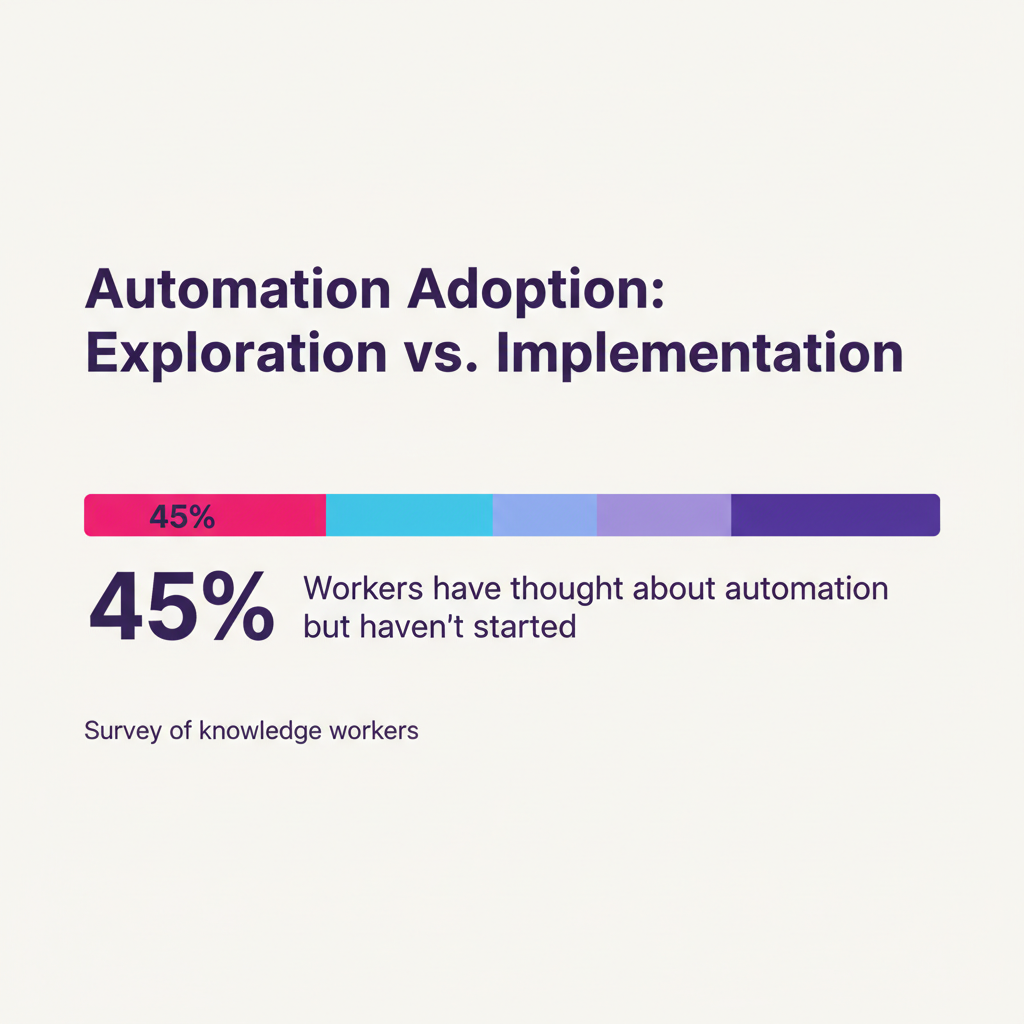
45% of workers have considered automation but haven’t taken the leap, often due to uncertainty about tools or where to start.
Automation adoption is still low among knowledge workers
Technical constraints
Today’s Super Agents can act, but they’re not yet fully dependable without oversight. The main challenges include:
Context and memory ceilings: Long or complex workflows still need to be broken into smaller sequences or occasionally reviewed by humans.
Hallucination risk: Some models still infer missing data rather than verifying it, which can affect reliability.
Execution fragility: APIs fail, data formats change, and workflows drift out of sync with real-world conditions.
Latency and compute costs: Large, multi-step orchestration can be expensive and not always real-time.
These limitations are normal in any emerging technology cycle. The key is designing guardrails early—so your agents operate within predictable, monitored boundaries.
Ethical and governance challenges
As agents move from suggesting actions to deciding them, new questions arise:
Who is responsible for AI-driven outcomes?
How do we prevent bias or ensure fairness in automated decisions?
When should human oversight step in?
A mature AI governance framework includes audit logs, rollback capabilities, and tiered permission controls. Enterprise teams must define acceptable levels of autonomy per workflow and ensure accountability when AI decisions have real-world consequences.
ClickUp’s permission inheritance and action logging make that oversight transparent—every AI decision has a visible trail and a defined owner.
Organizational barriers
Technology is rarely the hardest part—culture is.
Most teams face hurdles like:
Poorly structured data and unclear workflow ownership.
Uncertainty around which department owns AI adoption (IT, Ops, or Product).
Change management fatigue or resistance to process redesign.
Pressure to show ROI before clear metrics exist.
That’s why leadership alignment is critical. Successful organizations treat AI transformation as a strategic capability, not a side experiment.
Summarize this article with AI
ClickUp Brain not only saves you precious time by instantly summarizing articles, it also leverages AI to connect your tasks, docs, people, and more, streamlining your workflow like never before.
Summarize this article for me please
The Future of Super Agents
The next phase of AI won’t be defined by faster prompts or prettier interfaces. It will be defined by autonomous teammates—AI systems with context, memory, and self-improving reasoning loops that work alongside humans as equals.
As the technology matures, five major shifts are on the horizon:
Richer reasoning and simulation: Agents will move from reactive task execution to proactive scenario modeling—testing trade-offs before committing to action.
Multi-agent coordination: Teams of agents will collaborate the way departments do today, sharing context and dividing responsibility for complex goals.
Continuous learning from outcomes: Feedback loops will teach agents to refine their strategies, not just their outputs.
Workflow-native intelligence: AI will no longer be “bolted on” to tools—it will live inside them, where work actually happens.
Persistent, enterprise-level memory: Agents will retain context across projects, people, and time, making institutional knowledge searchable and actionable.
These aren’t distant ideas. The foundations already exist in platforms like ClickUp, where work, data, and collaboration live together in one Converged AI Workspace.
From fragmentation to convergence
The future of AI is not another layer of tools—it’s convergence. When agents operate inside the same system where your tasks, docs, and communication already reside, they stop creating silos and start creating synergy.
Work stops fragmenting across disconnected apps. AI stops feeling like an experiment. And productivity stops being about “doing more,” and starts being about doing what matters, faster and smarter.
ClickUp’s Super Agents are the first step toward that reality—an ecosystem where AI acts, learns, and collaborates as naturally as your team does.
Summarize this article with AI
ClickUp Brain not only saves you precious time by instantly summarizing articles, it also leverages AI to connect your tasks, docs, people, and more, streamlining your workflow like never before.
Summarize this article for me please
Getting Started with Super Agents
AI transformation doesn’t begin with adopting new tools. It begins with codifying how your organization works at its best—and teaching your systems to operate with that same intelligence.
Super Agents make that possible. They capture your team’s expertise, automate decision chains, and bridge the gaps between tools, data, and people. The result is not just faster execution, but a smarter, more adaptive organization.
If your goal is to move beyond automation toward truly intelligent operations, this is where to start:
Discover the AI Transformation Matrix: Assess your organization’s readiness and map your path to autonomous workflows.
See ClickUp Brain in action: Explore how converged context powers trustworthy, business-critical AI outcomes.
Connect with our team: Learn how to codify your expertise and deploy Super Agents across your operations.
ClickUp isn’t just helping teams automate tasks. It’s helping organizations codify their intelligence, eliminate Work Sprawl, and step confidently into the era of Converged AI Workspaces.
So the question leaders should be asking isn’t “Should we use them?”; it’s “Which responsibilities should they handle first?”
Summarize this article with AI
ClickUp Brain not only saves you precious time by instantly summarizing articles, it also leverages AI to connect your tasks, docs, people, and more, streamlining your workflow like never before.
Summarize this article for me please
Frequently Asked Questions
What makes a Super Agent different from GPT or Claude?
Models like GPT or Claude respond to prompts. Super Agents take responsibility for outcomes—planning, executing, retrying, and escalating across multiple tools and systems, not just generating text.
Do Super Agents require special infrastructure?
You need three layers: identity and permissions, access to data sources, and action execution. ClickUp provides these natively, so you don’t need to build agent scaffolding yourself.
How do Super Agents handle errors or unexpected situations?
Good systems include fallback logic, such as retry, branching, escalation, and logging. ClickUp’s roadmap includes self-correction modes, allowing agents to reroute tasks before involving humans.
What industries benefit most from Super Agents?
Any industry with repetitive, multi-system workflows: SaaS, finance, healthcare operations, HR, manufacturing, logistics, support, and enterprise IT.
How are Super Agents priced?
Super Agents consume AI credits based on usage and complexity. Unlimited use of certain agents is included in higher-tier plans; see the ClickUp pricing page for details.
Everything you need to stay organized and get work done.