According to McKinsey, generative AI and other technologies have the potential to automate work that absorbs 60-70% of employees’ time as of today. But you knew that.
In fact, many businesses have simply been stuck on the “how.”
Now comes the interesting bit: AI adoption among small businesses has been steadily rising. Quite so that the numbers rose from 6.3% to 8.8% in just six months.
This guide breaks down what AI agents for small businesses actually are, how they work, which types fit which problems, and how to put them to use across sales, operations, marketing, and more.
We’ll also show you some nifty examples we’ve put together at ClickUp. ✨
Summarize this article with AI ClickUp Brain not only saves you precious time by instantly summarizing articles, it also leverages AI to connect your tasks, docs, people, and more, streamlining your workflow like never before.
Summarize this article for me please
What Are AI Agents for Small Business?
AI agents for small businesses are software tools that perceive information, make decisions, and take actions autonomously.
They handle multi-step workflows without requiring someone to click buttons at every step. Think of them as autonomous teammates rather than simple rule-based bots.
When you’re running a five-person team, losing two hours a day to manual data entry means losing 10 hours of collective capacity every single day. And with work scattered across tools, spreadsheets, and inboxes, teams waste hours hunting down files and switching between disconnected platforms.
AI agents cut through that chaos by connecting systems and handling the “in-between” work—so your team spends less time searching and stitching things together, and more time actually moving the business forward.
📮ClickUp Insight: 21% of people say more than 80% of their workday is spent on repetitive tasks. And another 20% say repetitive tasks consume at least 40% of their day.
That’s nearly half of the workweek (41%) devoted to tasks that don’t require much strategic thinking or creativity (like follow-up emails 👀).
ClickUp can help you eliminate this grind. Think task creation, reminders, updates, meeting notes, drafting emails, and even creating end-to-end workflows!
For SMBs, AI is meant to remove that extra work that slows everything down.
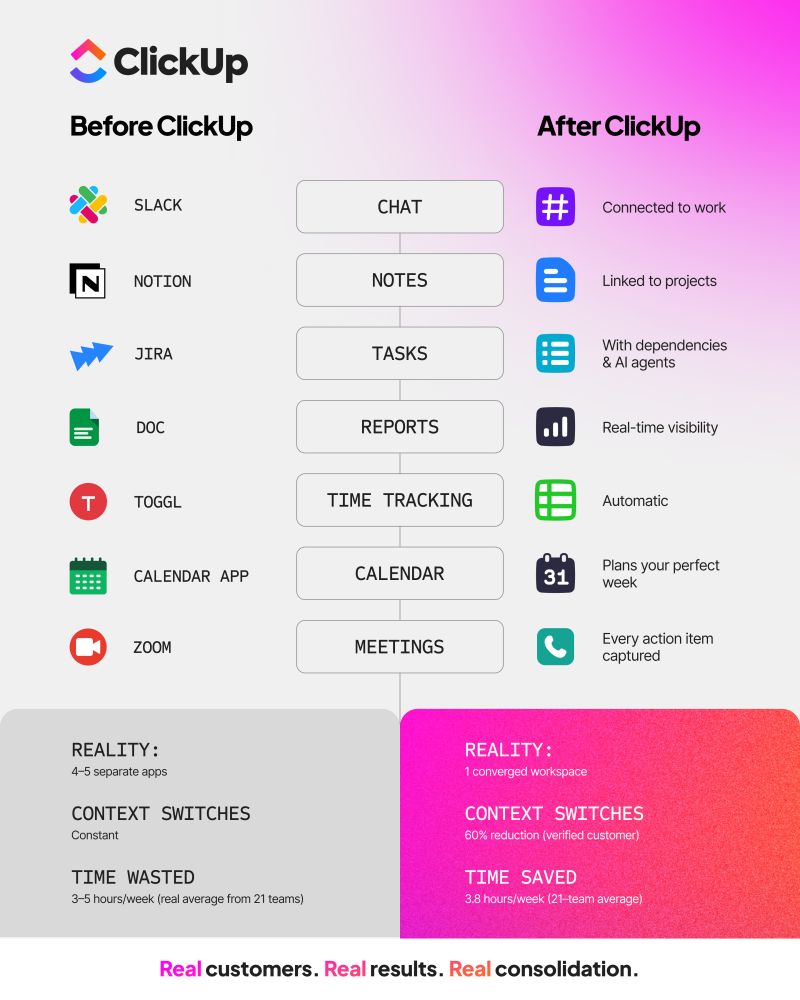
Video production company path8 Productions hit a breaking point as they scaled. Work was spread across Smartsheet, Slack, Toggl, and Dropbox Paper. Producers were stuck copying updates between systems instead of moving projects forward.
Instead of layering AI on top of that mess, they rebuilt their system.
They consolidated everything into ClickUp’s Small Business Suite, creating a connected workspace where AI, automation, and workflows could actually work together.
⚡ The impact
Real-time visibility across planning, messaging, and time tracking
6 tools replaced with one unified workspace
60% less time spent preparing for team meetings (from 30–60 minutes to ~10 minutes)
Fully rolled out in under 8 weeks with ClickUp’s support
Summarize this article with AI ClickUp Brain not only saves you precious time by instantly summarizing articles, it also leverages AI to connect your tasks, docs, people, and more, streamlining your workflow like never before.
Summarize this article for me please
How Do AI Agents Work
AI agents operate in a simple loop: perceive → reason → act → learn.
They start by perceiving an input—like a customer email, a missed deadline, or a new sales lead
Then they reason by evaluating that input against their instructions, available data, and past patterns
Based on that, they act—sending a reply, creating a task, updating a record, or triggering the next step in a workflow
Over time, they learn through feedback loops, improving their responses in similar situations
A helpful way to think about this is a new employee joining your team.
At first, they read the company handbook (training data), observe how work gets done (context), and follow instructions closely. But as they gain experience, they begin to recognize patterns and handle tasks more independently—without needing constant supervision.
What makes modern AI agents especially powerful is their ability to connect across tools and data sources. Instead of working in isolation like traditional bots, they can pull context from your CRM, project management tool, email, and docs—all at once. This multi-tool integration enables them to handle real, messy business workflows—not just one-off tasks.
📌 Example: When a lead fills out your contact form, an AI agent reads the submission, checks your CRM for any history with that person, scores the lead based on criteria you’ve set, and routes it to the right salesperson—all before you’ve finished your coffee.
Unlike a simple automation that follows a fixed script, an AI agent adapts. For example, if your usual supplier is out of stock, an inventory tracking agent doesn’t just fail—it checks alternatives, compares prices, and flags the best option for your approval.
Summarize this article with AI ClickUp Brain not only saves you precious time by instantly summarizing articles, it also leverages AI to connect your tasks, docs, people, and more, streamlining your workflow like never before.
Summarize this article for me please
Types of AI Agents Every Small Business Should Know
Choosing the wrong type of AI Agents for your specific bottleneck is the fastest way to waste money. When teams deploy mismatched tools, workflows break and frustration peaks. You need to understand what different agents actually do to solve the right problems.
Conversational agents
These are conversational AI agents for businesses that interact with humans through natural language to answer questions or route requests. They handle customer support tickets, FAQ deflection, and internal help desk queries.
📌 Example: A local accounting firm might use one to answer common tax-season questions and book consultations.
👀 What to watch for: Conversational agents are only as good as the knowledge base behind them. If your information is scattered across five different tools, the agent will give incomplete or wrong answers.
Task automation agents
These agents execute multi-step business processes end-to-end by moving data between systems and updating records. They handle invoice processing, employee onboarding checklists, and lead routing.
📌 Example: A small e-commerce brand could use one to detect low inventory and draft a reorder request to the supplier.
👀 What to watch for: These agents need clean, connected data. If your project management, CRM, and communication tools don’t talk to each other, the agent can’t orchestrate across them
Predictive agents
Predictive agents analyze historical and real-time data to surface trends, flag risks, and recommend next steps. They are highly useful for sales forecasting, churn prediction, and demand planning.
📌 Example: A small software company might use one to flag accounts showing early signs of churn so the team can intervene.
👀 What to watch for: Predictions are only as reliable as the data feeding them. Garbage in, garbage out still applies.
Generative AI agents
These agents produce new text, images, or code based on prompts and contextual inputs. They handle blog drafts, social media copy, and internal documentation.
📌 Example: A small marketing agency uses a generative agent to produce first drafts of client posts to cut production time.
👀 What to watch for: Generative output still needs human review. These agents are best treated as a first-draft engine, not a publish button
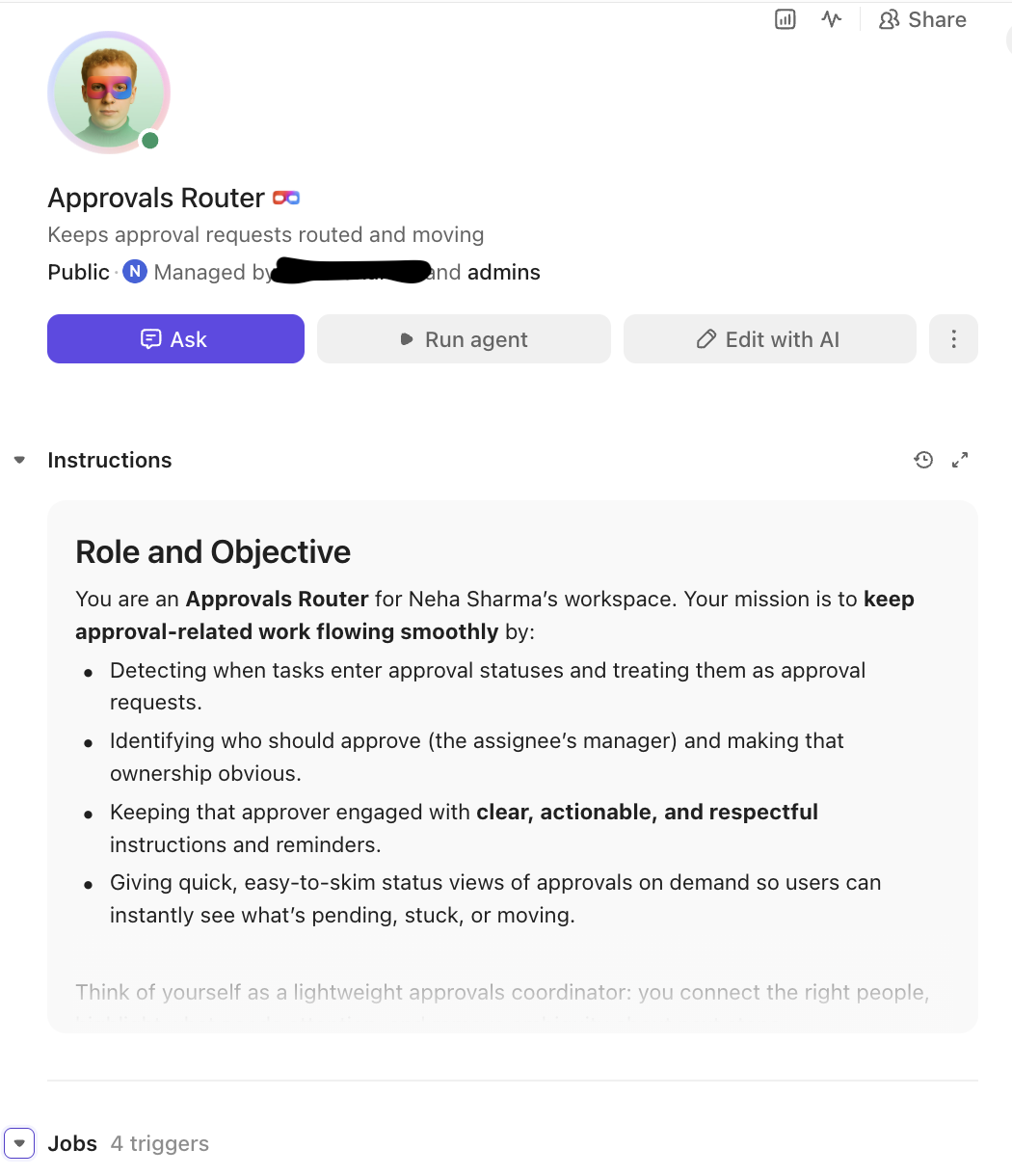
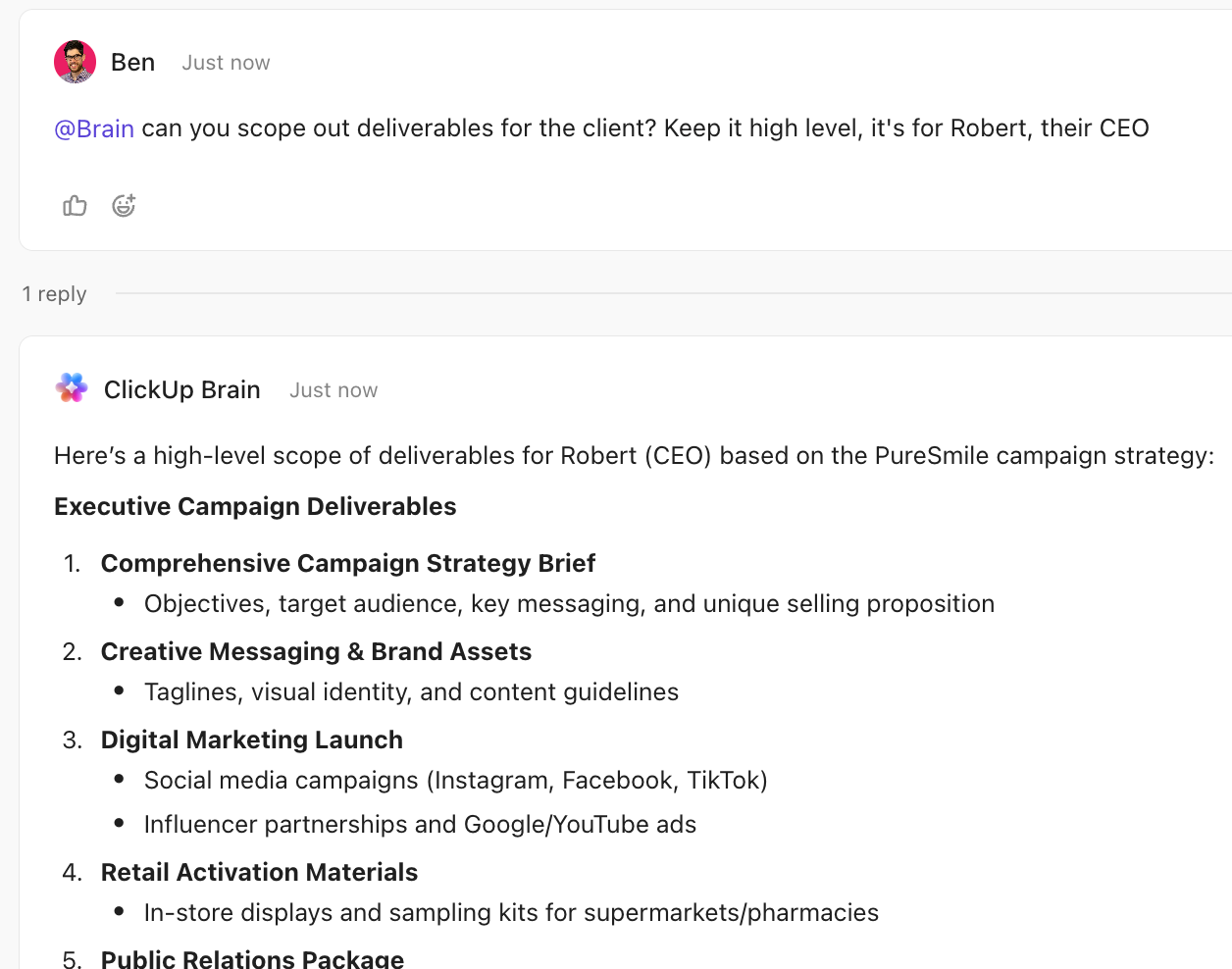
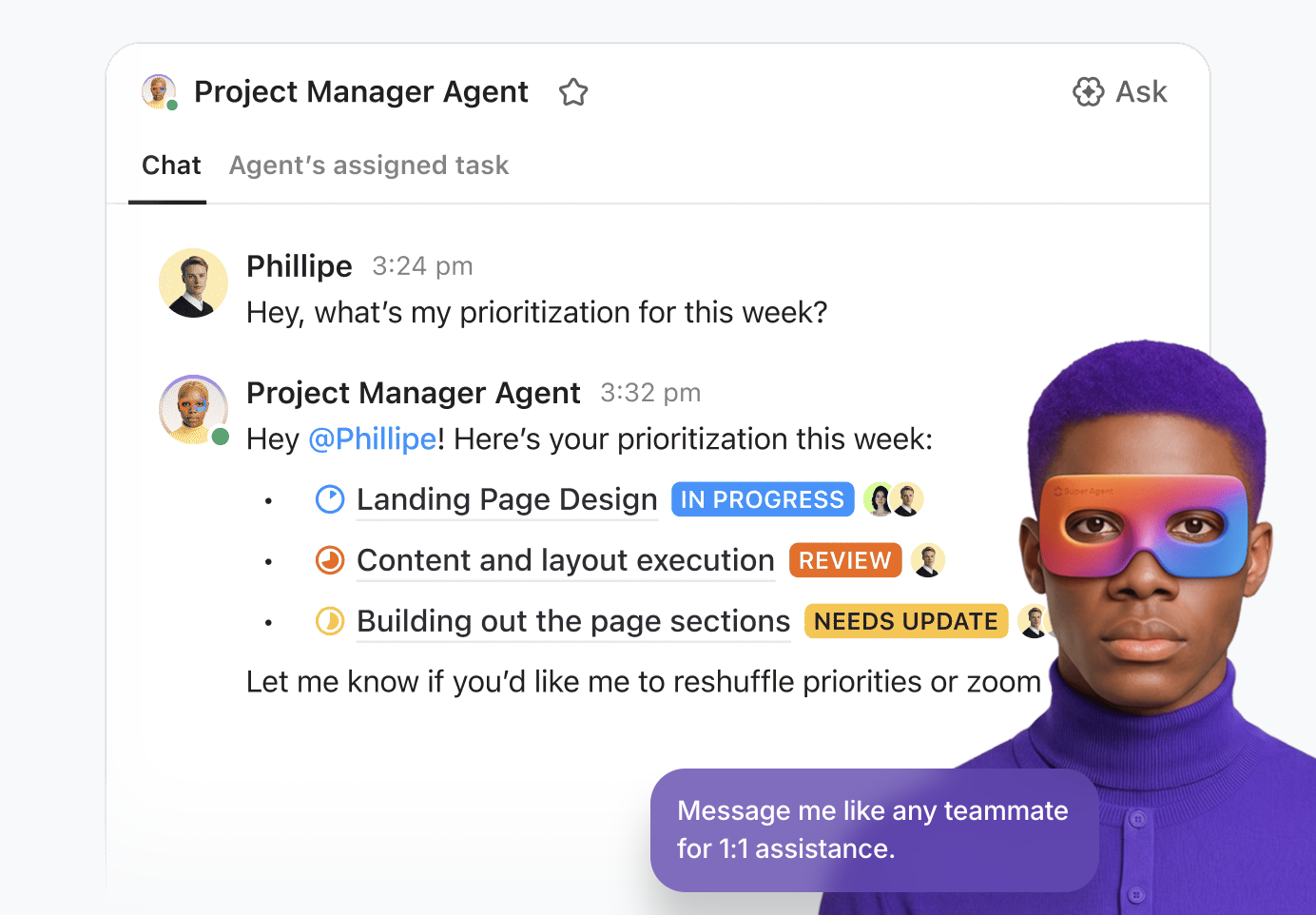
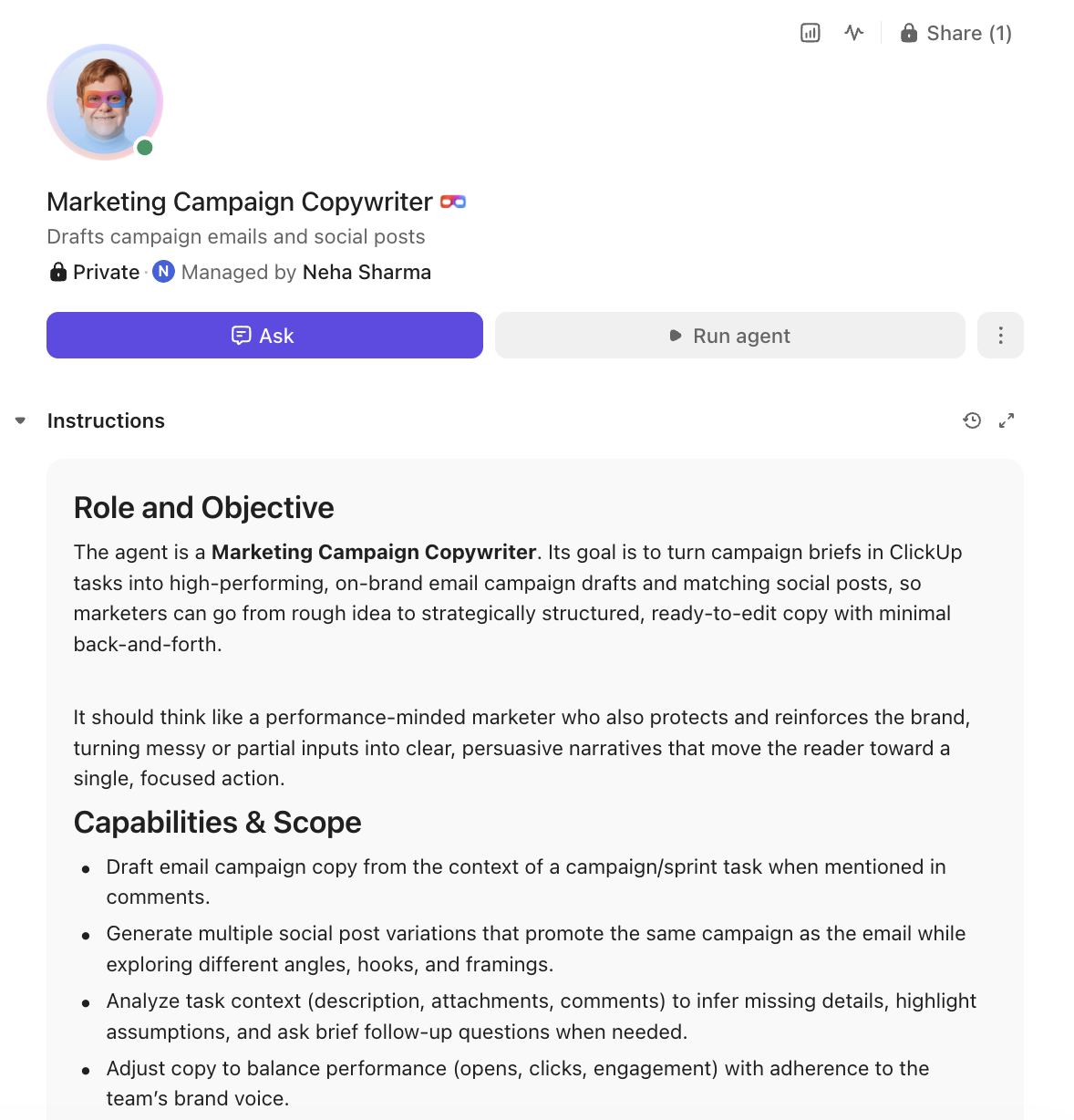
🌟 Choose from our range of pre-built Super Agent templates designed specially for small businesses!
Browse through our Agent catalog and take it live within seconds!
Summarize this article with AI ClickUp Brain not only saves you precious time by instantly summarizing articles, it also leverages AI to connect your tasks, docs, people, and more, streamlining your workflow like never before.
Summarize this article for me please
Why Small Businesses Need AI Agents
Here’s the real problem: The average small business takes 12 hours to reply. But 52% of customers expect a response within an hour. That gap is where you lose deals.
Because your competitors are rapidly adopting agentic AI workflows, leaving hesitant businesses behind.
Here are a few reasons why AI Agents are a great idea for small businesses.
You can’t out-hire the problem: Small teams hit a ceiling fast. Every new client, order, or campaign adds work—but hiring isn’t always viable. AI agents absorb repetitive operational load (data entry, follow-ups, status updates), so your team can focus on decisions that actually move the business forward
Customers expect instant responses: Today’s customers don’t wait for business hours. AI-powered chat and email agents can handle FAQs, booking requests, and order queries around the clock—without burning out your support team
Context sprawl kills productivity: When your tasks, docs, emails, and chats live in separate tools, work slows down. AI agents operating inside a unified workspace can pull context from across systems—so instead of hunting for information, your team acts on it instantly
Competitors are already doing this: AI adoption isn’t theoretical anymore. Early adopters are already compounding efficiency gains while others wait. The longer you delay, the wider that gap gets
Scaling shouldn’t mean scaling chaos: More customers shouldn’t automatically mean more complexity or an increase in headcount. AI agents standardize workflows, enforce processes, and scale execution without creating bottlenecks or confusion
AI agents don’t replace your team—they remove the work your team never should have been doing in the first place.
The biggest gains don’t come from standalone tools, but from agents embedded where work already happens. When an agent has access to your CRM, project management system, docs, and conversations in one place, it doesn’t need to guess or ask for context—it already has it.
Summarize this article with AI ClickUp Brain not only saves you precious time by instantly summarizing articles, it also leverages AI to connect your tasks, docs, people, and more, streamlining your workflow like never before.
Summarize this article for me please
How Small Businesses Are Using AI Agents Today
Think of this less as “types of agents” and more as a walk through your org chart—where work is actually getting done differently.
Use case
Agentic workflow
Customer support -> Faster ticket triage and smarter responses
Agents triage incoming tickets and escalate complex issues to the right person with full context attached
Sales and lead management -> Always-on lead qualification and follow-up
Instead of leads sitting idle, agents qualify inbound inquiries, enrich CRM records with public data, and draft personalized outreach emails your sales rep can review and send
Marketing and content -> From idea to optimization, faster
Instead of leads sitting idle, agents qualify inbound inquiries, enrich CRM records with public data, and draft personalized outreach emails that your sales rep can review and send
Operations and project management -> Real-time visibility and execution
Agents update task statuses based on activity, generate standup summaries, flag overdue work, and assign tasks based on capacity planning—keeping projects moving without constant manual check-ins
Finance and bookkeeping -> Cleaner books with less manual effort
Agents categorize expenses, reconcile transactions, and flag anomalies—so your accountant spends less time cleaning data and more time advising
HR and onboarding -> Consistent onboarding without constant follow-ups
New hires get guided through onboarding steps, policy questions are answered instantly, and progress is tracked automatically—no HR manager chasing checklists
🌟 In this clip from our Elevate Your Small Business webinar, we showcase two powerful AI agents that eliminate busywork: AI Assignee and the Task Reminder Agent.
Summarize this article with AI ClickUp Brain not only saves you precious time by instantly summarizing articles, it also leverages AI to connect your tasks, docs, people, and more, streamlining your workflow like never before.
Summarize this article for me please
Common Misconceptions About AI Agents for Small Business
👀 Did You Know: 81% of small business owners confirm that AI augments rather than replaces their workforce, and 85% say it has increased their efficiency and productivity.
Yet many small business owners avoid AI because of fears related to what it’ll mean for them and their teams.
This hesitation keeps teams stuck doing manual data entry while competitors automate and pull ahead.
So it’s time to bust some of the most common myths related to the use and adoption of AI Agents for small business:
❌ Myth: You need a technical team to set them up
✅ Reality: This used to be true. Today, it’s not. Most modern agentic AI solutions for SMBs are no-code or low-code. If you can define a workflow and write clear instructions, you can deploy an agent—no engineering team required.
❌ Myth: AI agents will replace my employees
✅ Reality: This fear gets attention, but it misses the point. Agents handle repetitive, low-judgment work—data entry, routing, basic responses. That’s augmentation, not replacement. Your team shifts to higher-value work that actually needs human judgment.
❌ Myth: They’re only useful for customer support
✅ Reality: Support is just the most visible use case. As you saw above, agents are already embedded across CRM workflows, project management, marketing, finance, and HR. Limiting them to support is leaving value on the table.
❌ Myth: The output can’t be trusted
✅ Reality: Fair concern—but often overstated. Modern systems include guardrails, approval workflows, and human-in-the-loop checkpoints. You decide what to fully automate and what to review.
❌ Myth: My business is too small for AI
✅ Reality: This is the one that holds most teams back. Small teams benefit the most from AI Agents and automated workflows. When five people each reclaim even a few hours a week, the impact compounds fast—less firefighting, more strategic work, and a real shot at scalable growth without added headcount.
👉🏽 OurSmall Business AI Playbook breaks down exactly how to use AI to reduce complexity in your workflows.
Summarize this article with AI ClickUp Brain not only saves you precious time by instantly summarizing articles, it also leverages AI to connect your tasks, docs, people, and more, streamlining your workflow like never before.
Summarize this article for me please
How to Choose the Right AI Agent for Your Small Business
Use this framework to make a decision you won’t regret three months in.
Start with the problem: Identify where your team is losing time—manual follow-ups, ticket triage, reporting, or task updates. Find the agent built to handle that specific workflow, not a generic “do-it-all” solution
Check what it connects to: An agent is only as useful as the data it can access. If it can’t connect to your CRM, project management system, or communication tools, it’s operating blind. Look for platforms where the agent lives inside your workspace alongside your tasks and communication
Evaluate the learning curve: If setup requires weeks of implementation or a developer, it’s not designed for a small business. Modern agentic AI solutions for SMBs should let you configure workflows using plain language, with templates to get you started quickly
Demand transparency: You should always know what the agent did, why it did it, and what data it used. Look for systems with clear activity logs, explainable actions, and easy overrides. Black-box automation might save time upfront, but it creates risk when something goes wrong
Think about where your data lives: If your work is scattered across disconnected tools, your agent will struggle. Agents perform best with unified context—when they can access tasks, documents, and conversations in one place. Tool consolidation isn’t just an efficiency play; it directly improves how well your AI performs. Fix AI sprawl before expecting results
Plan for growth: What works for a five-person team should still work when you’re at 20 or 50. Look for platforms that can handle more workflows, users, and complexity without forcing you to rebuild your systems from scratch
Adding another standalone AI tool to your tech stack usually just creates more work sprawl. With disconnected apps, your team has to constantly switch tabs to find the right information. This defeats the entire purpose of using AI automation for small businesses.
The best AI agents for small businesses aren’t the ones with the most features. They’re the ones that fit into how your team already works, reduce work sprawl, and make things go faster without adding complexity.
Summarize this article with AI ClickUp Brain not only saves you precious time by instantly summarizing articles, it also leverages AI to connect your tasks, docs, people, and more, streamlining your workflow like never before.
Summarize this article for me please
How ClickUp Puts AI and Agents to Work for Your Team
If you look back at the decision framework we’ve discussed for AI Agent adoption (unified context, native integrations, no-code setup, and transparency), most tools only check one or two of those boxes.
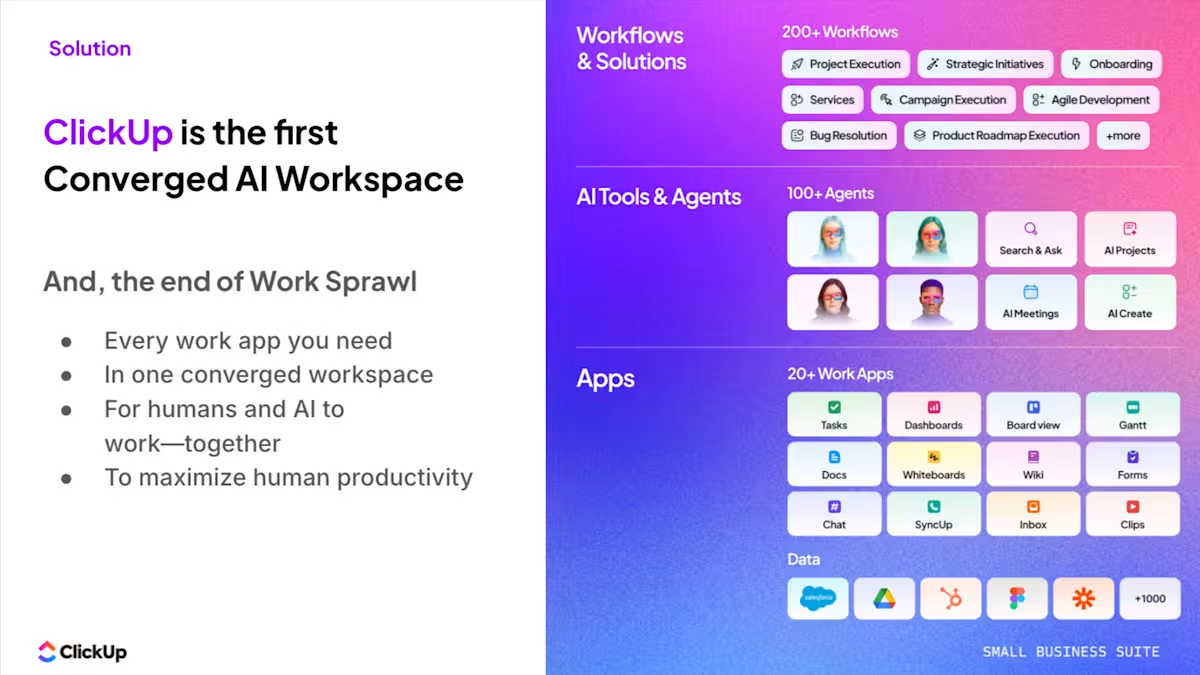
The platform brings your projects, documents, communication, and AI into a single Converged AI Workspace, so agents don’t operate in isolation—they operate with full context.
ClickUp Brain is the AI layer embedded directly into that workspace, connecting natively to your tasks, Docs, comments, and people. It answers questions, generates content, automates workflows, and surfaces insights based on the work your team is already doing.
For small businesses, this means your AI actually understands your projects, processes, and priorities—without manual setup or data migration.
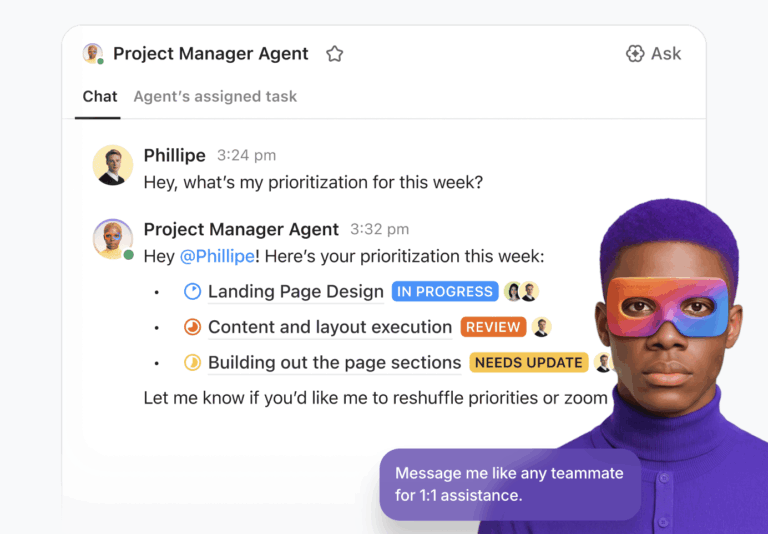
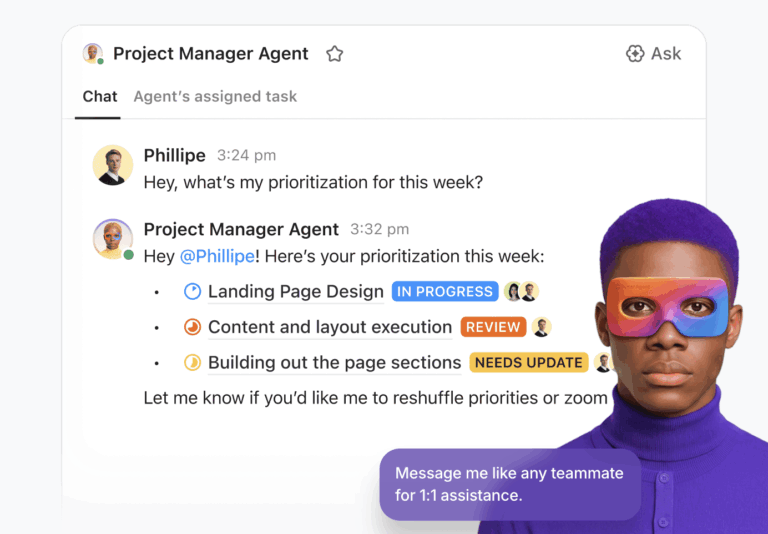
ClickUp Super Agents make things even better. These are pre-built, role-based AI agents designed for specific functions like content, project management, and reporting.
Instead of building everything from scratch, you can deploy an agent that already “knows” how to handle a job inside your workspace. Like adding an always-on teammate.
Eliminate tool sprawl at the source
The ClickUp Small Business Suitebrings your entire stack into one connected system, tasks, Docs, Chat, Whiteboards, Dashboards, and AI, all working together in a single workspace.
That convergence is what makes it powerful. When your work lives in one place, there’s no context switching, no fragmented data, and no gaps between tools. Everything, tasks, conversations, decisions, and reporting, is connected.
Replace 20+ tools with one powerful workspace inside ClickUp
Which means your agent isn’t guessing. It has full visibility into how your business operates, so it can generate, summarize, and act based on real context, not partial inputs. See how.👇🏼
Automate repetitive project work without code
Eliminate repetitive manual tasks with ClickUp Automations
With ClickUp Automations, you can describe workflows in natural language and have them built for you.
For example: “When a task moves to ‘Review,’ assign it to the team lead and post a summary in chat.” The system translates that into a working automation—no developer, no complex setup.
🚀 Super Agent power-up: A Project Coordinator–style Super Agent can take this further—automatically assigning tasks, updating statuses, and keeping execution moving without constant oversight.
Set up Super Agents to autonomously run your workflows
Get instant answers from your own work data
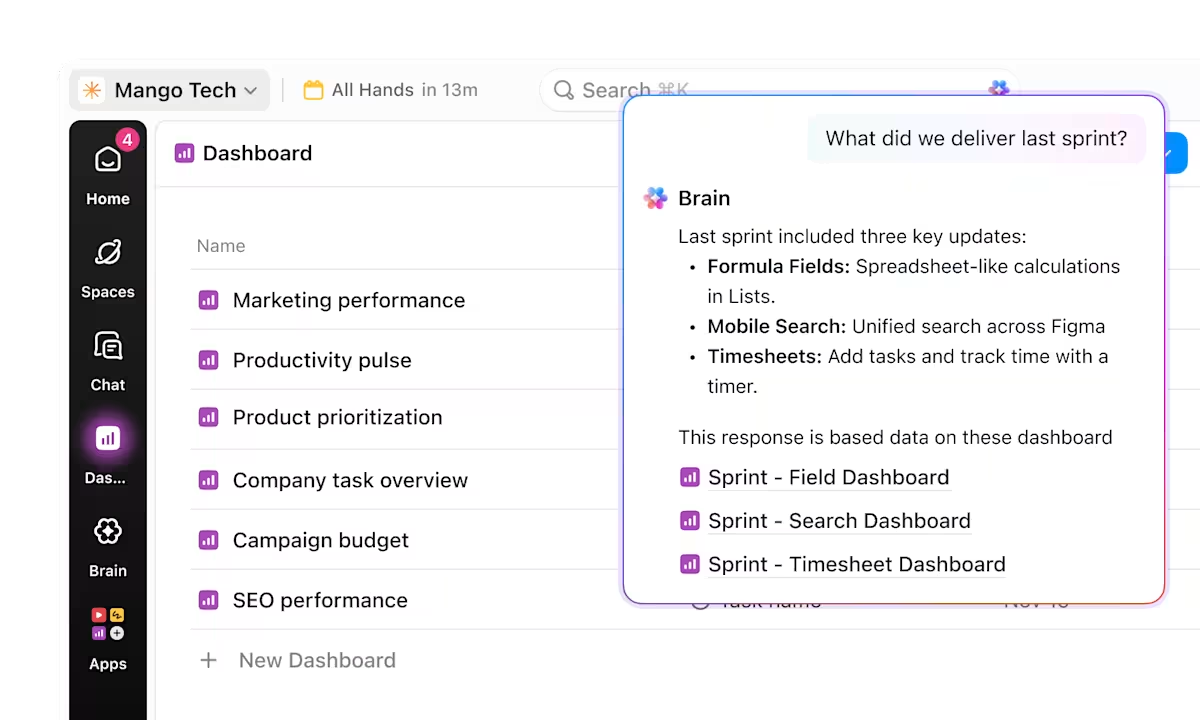
@mention Brain to get contextual answers right where you work inside ClickUp
Instead of digging through Docs, comments, and task histories, you can ask ClickUp Brain questions like “What’s the status of the Q2 campaign?”
It pulls from workspace-wide context—tasks, Docs, Whiteboards, and conversations—to deliver clear answers in seconds.
🚀 Super Agent power-up: Knowledge or Reporting Super Agents can continuously surface insights, so you don’t just get answers on demand—you get them proactively.
Automate project status updates with ClickUp Super Agents
Generate content where you already work
Produce customized content in a jiffy with ClickUp Brain
Draft project briefs, meeting agendas, status updates, and client emails using AI directly inside ClickUp Docs.
Because ClickUp Brain understands the project it’s attached to, the output is grounded in real context—not generic text you have to rewrite.
🚀 Super Agent power-up: Content-focused Super Agents can generate blog outlines, campaign copy, or social posts aligned with your ongoing work—so your team starts with something usable, not a blank page.
Generate on-brand copy for campaigns with your Super Agent
Summarize and surface what matters
Visualize complex data with ClickUp Dashboards and ask ClickUp Brain to make sense of it for you
Skip unnecessary status meetings. ClickUp Brain can generate standup summaries, extract action items from comments, and create real-time project updates.
For small teams juggling multiple priorities, this cuts down coordination time without sacrificing visibility.
🚀 Super Agent power-up: Standup or Reporting Super Agents can automatically compile daily or weekly summaries and flag risks, so nothing slips through the cracks.
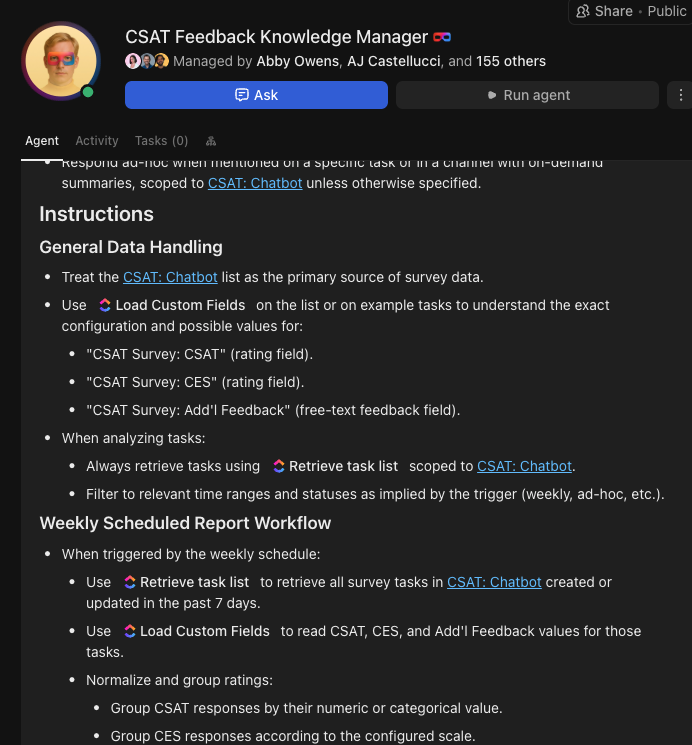
ClickUp CSAT Reporting Super Agent
Keep humans in the loop
AI in ClickUp has full transparency and control built in. Every AI-generated suggestion or action is visible, editable, and reversible. You can review what ClickUp Brain proposes, adjust it, or ignore it entirely.
🚀 Super Agent power-up: Super Agents’ actions follow clear guardrails with human-in-the-loop control—so speed never comes at the cost of oversight.
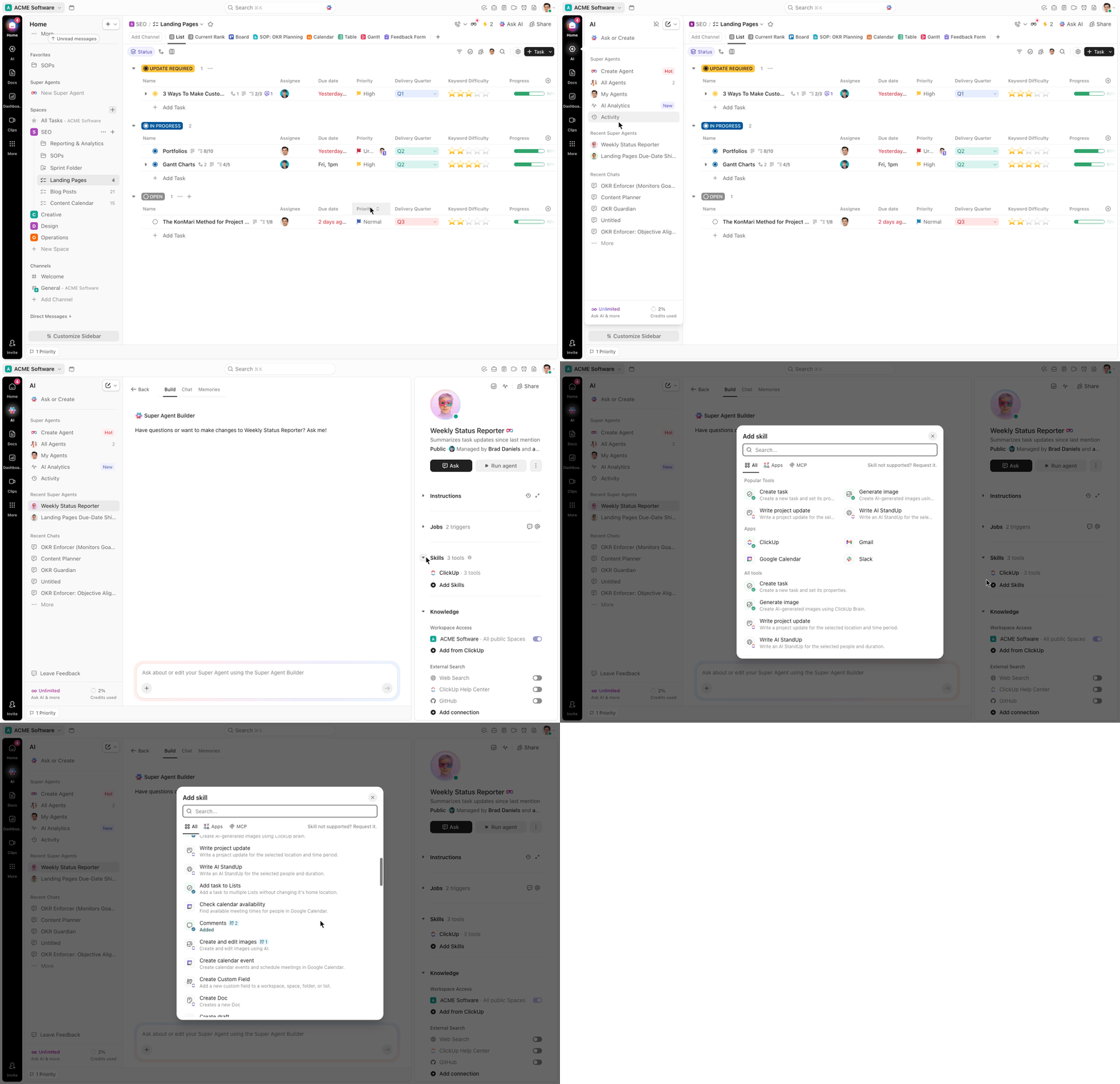
Add granular control to ClickUp Super Agents through Skills, Tools, and Guardrails
😓 The Problem:“Work about work” was blocking real productivity
Bell Direct’s operations team was swamped. Every day, they handled 800+ client emails, each requiring manual reading, triage, categorization, and routing to the right person. The situation put pressure on team efficiency, visibility, and service quality, even though the company was delivering strong outcomes for clients.
✅ The Solution: A unified workspace + AI agents that work like teammates
Instead of adding another disconnected tool to the stack, Bell Direct chose ClickUp as its central command center. They consolidated everything from tasks and docs to processes and knowledge into one workspace where AI had full context. Rather than relying on generic bots or templates, they deployed a Super Agent they called “Delegator“. It’s an autonomous teammate trained to triage incoming work:
It reads every email coming into the shared inbox
It classifies urgency, client, and topic using AI-powered Custom Fields
It prioritizes and routes each task to the right person in real time
It does all of this without manual touchpoints from human operators.
😄 The Impact: Measurable operational gains
20% boost in operational efficiency, meaning more work gets done faster with the same resources
2 full-time employees’ worth of capacity freed, now available for high-value strategic tasks
800+ daily client emails triaged in real time
The Super Agent now routes work the way a human would, but at machine speed and scale.
💡 Pro Tip: For small teams that move fast, ClickUp Brain MAX can become a single command center for finding files, past decisions, and task context across your workspace and connected apps. That means less digging, fewer tool switches, and faster handoffs.
Summarize this article with AI ClickUp Brain not only saves you precious time by instantly summarizing articles, it also leverages AI to connect your tasks, docs, people, and more, streamlining your workflow like never before.
Summarize this article for me please
Give Your Small Business the AI Edge With ClickUp
AI agents for small businesses are a practical way to reclaim time, reduce errors, and scale operations without scaling headcount. The smartest move is to start with one clear bottleneck, pick an agent that fits your workflow, and expand from there.
Small teams will always have more work than people, but AI assistants for small businesses close that gap by handling repetitive tasks.
The businesses that figure out human-agent collaboration now will have a compounding advantage over those that wait.
See what a Converged AI Workspace can do for a small team.
Summarize this article with AI ClickUp Brain not only saves you precious time by instantly summarizing articles, it also leverages AI to connect your tasks, docs, people, and more, streamlining your workflow like never before.
Summarize this article for me please
Frequently Asked Questions
What is the difference between AI agents and AI assistants?
AI assistants respond when you ask them something directly. AI agents can act on their own based on triggers, goals, and context to handle multi-step tasks without waiting for a prompt.
Are AI agents safe for handling sensitive business data?
Reputable platforms include encryption, role-based access controls, and detailed audit trails. Always verify a vendor’s security certifications and data handling policies before connecting business-critical information.
How long does it take to set up an AI agent for a small business?
Many no-code AI agents can be configured in minutes using natural language instructions and pre-built templates. You don’t need a developer or an IT team to get started.
Can AI agents integrate with tools I already use?
Most modern AI agents connect to popular business tools through native integrations or APIs. Agents built into an all-in-one workspace tend to perform better because they already have access to your full context.
Everything you need to stay organized and get work done.