






Still downloading templates?
There’s an easier way. Try a free AI Agent in ClickUp that actually does the work for you—set up in minutes, save hours every week.
Sorry, there were no results found for “”
Sorry, there were no results found for “”
Sorry, there were no results found for “”
When people ask me how we manage to publish 200-250 blog posts per month at ClickUp—with localization bringing our total to around 2,000 monthly blog posts—I tell them it’s equal parts strategy, technology, and accepting that chaos is the default state without the right systems.
An average SaaS company might produce around 50 blogs per month. We’re creating content at 4-5x that volume, coordinating with around 10 agencies, managing 50-100 writers at any given time, and somehow maintaining quality standards that drive meaningful signups and revenue.
Here’s how we built a content machine that scales—and why your content production process might be breaking down without you realizing it.
Before I dive into our solution, let me paint a picture of what content scaling chaos actually looks like. Imagine trying to coordinate a newsroom-level operation using spreadsheets, email threads, and Slack messages. Now multiply that by 200-250 pieces of content per month, each with its own lifecycle, review cycles, and stakeholder feedback.
This was our reality—and probably yours too:
Context gets lost in translation
Handoffs become black holes
Quality becomes impossible to track
Bottlenecks multiply
At our scale, these problems don’t just slow you down—they break your entire operation.
After rebuilding our entire content operation from the ground up, here’s the system that allows us to maintain quality while hitting aggressive volume targets—with ClickUp at the center.
Everything starts with our SEO team identifying keyword opportunities. But here’s where most teams go wrong—they hand off a keyword and expect magic to happen.
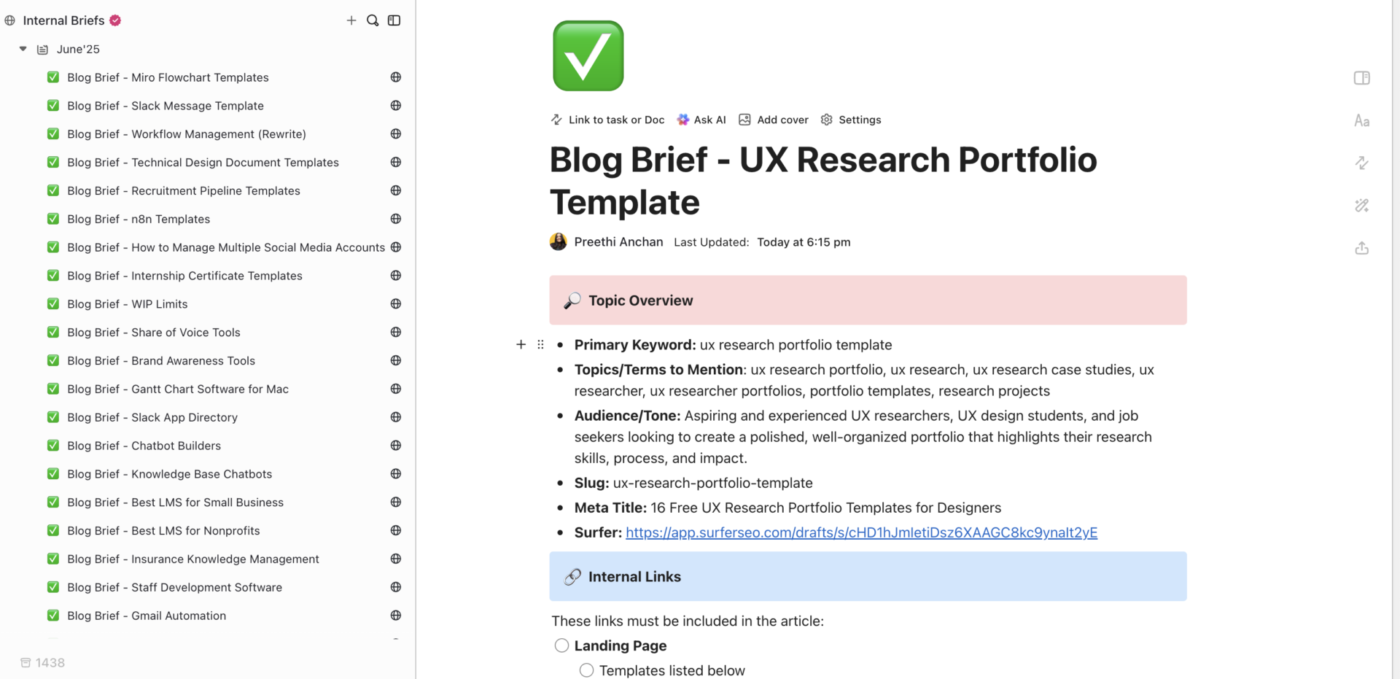
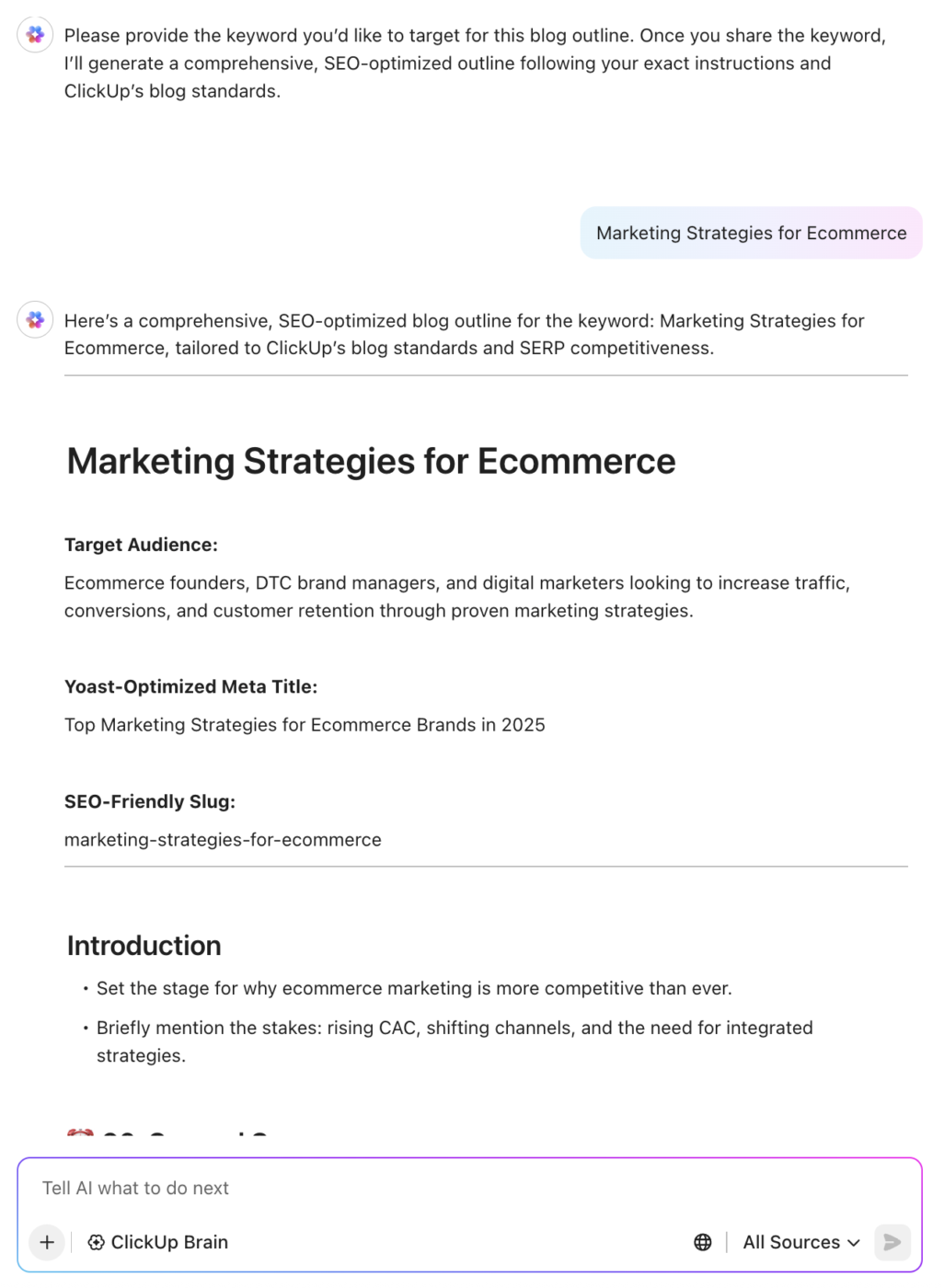
Instead, we’ve built an AI-assisted brief builder using ClickUp Docs and ClickUp AI that takes us from zero to 60% complete on every brief. The AI handles the heavy lifting of research, structure, and initial positioning.
Then our human editors add what I call the “magic dust”—the unique perspective and differentiation that makes our content valuable, not just informative.
Why this matters:
Without systematic brief creation, you’re asking writers to make strategic decisions they’re not equipped to make. The result? Inconsistent messaging and content that misses the mark.
ClickUp Solution:
Here’s where things get complex fast. We work with multiple agencies simultaneously, each handling different content types and volumes. Each agency needs to operate independently while maintaining our quality standards and brand voice.
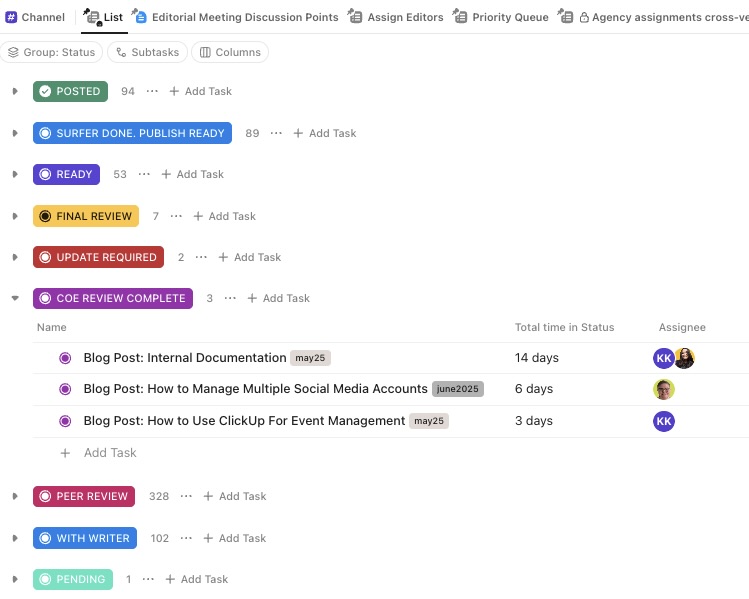
Our solution: Every blog post becomes a ClickUp Task with clear status tracking, managed through Custom Statuses and Automations:

The game-changer:
All communication happens in context using Task Comments and ClickUp Chat.
When an agency submits a draft, they explain their decisions directly in the task directly in the task. When editors provide feedback, the reasoning is captured in the same thread in the same thread. No more lost context, no more endless email chains trying to remember why a decision was made three weeks ago.
ClickUp Solution:

At 200-250 blogs per month, quality control isn’t optional—it’s survival. We’ve built systematic quality tracking into every step using Custom Fields, Checklists, and Dashboards using Custom Fields, Checklists, and Dashboards:
Real impact:
We can identify quality issues at the agency level and address them before they become systemic problems.
ClickUp Solution:
The dashboard that changed everything shows me at a glance:

This isn’t just reporting—it’s operational intelligence. When I see too many pieces stuck “With Writer” at one agency, I know to intervene before it becomes a crisis. When editorial effort spikes for certain content types, we can adjust our brief templates or provide additional training.
ClickUp Solution:
Here’s what we track and why:
Primary North Star:
Free signups generated from blog traffic. Everything else is secondary.
Leading Indicators:

The insight most teams miss:
Content often represents a significant portion of your company’s digital footprint. Every blog post is a representation of how customers will perceive your brand, your expertise, and your trustworthiness.
ClickUp Solution:
Use Custom Fields and Dashboards to track leading indicators and tie them directly to business outcomes.
Let me show you the difference between content chaos and content systems:
Before systematic production:
After building proper systems with ClickUp:
The transformation isn’t just operational—it’s strategic. When you can reliably produce high-quality content at scale, you can be more ambitious with your content strategy.
We can take on competitive keywords, invest in comprehensive topic coverage, and experiment with new content formats because we know our production system can handle it.
I can’t imagine running this operation without ClickUp as our central nervous system. Here’s why traditional tools fail at scale:
ClickUp gives us:
Whether you’re publishing 10 blogs per month or 200+, these principles scale:
Content production at scale isn’t about working harder—it’s about building systems that work smarter. The difference between 50 blogs per month and 200+ isn’t just volume; it’s systematic thinking about every aspect of the production process.
Your content is often the first impression potential customers have of your company. Making that impression consistent, valuable, and authentic requires more than good intentions—it requires good systems.
The question isn’t whether you can scale content production. The question is whether you can scale it without losing the quality and consistency that make content valuable.
Ready to transform your content production process? Start by mapping your current workflow and identifying where context gets lost, bottlenecks form, and quality breaks down. Then build systems that solve those specific problems—using ClickUp’s suite of features——using ClickUp’s suite of features—rather than just pushing more volume through broken processes.

© 2026 ClickUp

There’s an easier way. Try a free AI Agent in ClickUp that actually does the work for you—set up in minutes, save hours every week.