







Still downloading templates?
There’s an easier way. Try a free AI Agent in ClickUp that actually does the work for you—set up in minutes, save hours every week.
Sorry, there were no results found for “”
Sorry, there were no results found for “”
Sorry, there were no results found for “”
“Only 1% of companies believe they’ve reached AI maturity. Yet 98% say the urgency to deploy AI is growing.”
That gap isn’t just about technology. It’s about mindset.
I saw this firsthand at a recent Sales Summit when two senior leaders told me flat out: “We’re over 40 and set in our ways—it’s hard to think about changing things.”
Meanwhile, their younger colleagues were already testing workflows, experimenting with agents, and automating their first few wins.
That’s when it hit me: AI readiness has very little to do with tools—and everything to do with the willingness to face uncomfortable truths.

We surveyed knowledge workers about their AI practices and the data on their implementation. The story gets even more troubling:
That’s not a small gap. That’s a canyon.
Worse, the majority of AI projects don’t survive the pilot phase:
Why? Because people don’t know how to use the tools. The top reasons for failure tell the story:
Of course, there’s skepticism. You can’t expect success when teams are being handed powerful tools without context, coaching, or clarity.
It’s like giving someone who’s only ever used pen and paper a laptop—and expecting them to just know how to navigate the OS, open apps, send emails, and write in Word.
Without training, enablement, or showing them what’s possible, it’s no surprise they struggle.
Most people still think AI is just asking ChatGPT to rephrase an email. That’s it.
Ask around, and you’ll hear the same: “It helps me write emails” or “It answers my questions.”
That’s table stakes.
Few realize AI can plan work, optimize resources, reduce Work Sprawl, and even proactively flag bottlenecks—if it’s deeply integrated into where real work lives.
Our research shows just how narrow the current perception is:
This isn’t a technology problem; it’s an exposure problem. People need to be shown examples and given training wheels/templates on how to use the tools we provide, and then they can go off and build their own.
📊 How mature is your AI strategy, really?
Most teams think they’re further along than they are—but the data says otherwise.
Want a quick, honest check on where your org stands?
👉 Take the AI Maturity Assessment to find out which stage you’re actually in—and what it’ll take to level up.
If lack of knowledge sets pilots up to struggle, lack of AI governance finishes the job.
Here’s what we’re seeing:
Access problems:
Governance problems:
Think about the risk.
You’ve got either people who can’t use AI at all, or people using it without guardrails.
Neither scenario sets you up for a mature, scaled deployment. The trust data backs this up. In high-maturity organizations, 57% of business units trust and are ready to use new AI solutions. In low-maturity organizations, that number drops to 14%.
Trust isn’t built overnight. It’s earned through transparency, enablement, and clear guardrails. When people don’t understand how AI fits into their work or, worse, fear getting it wrong, they hesitate to use it. And without adoption, there’s no scale.
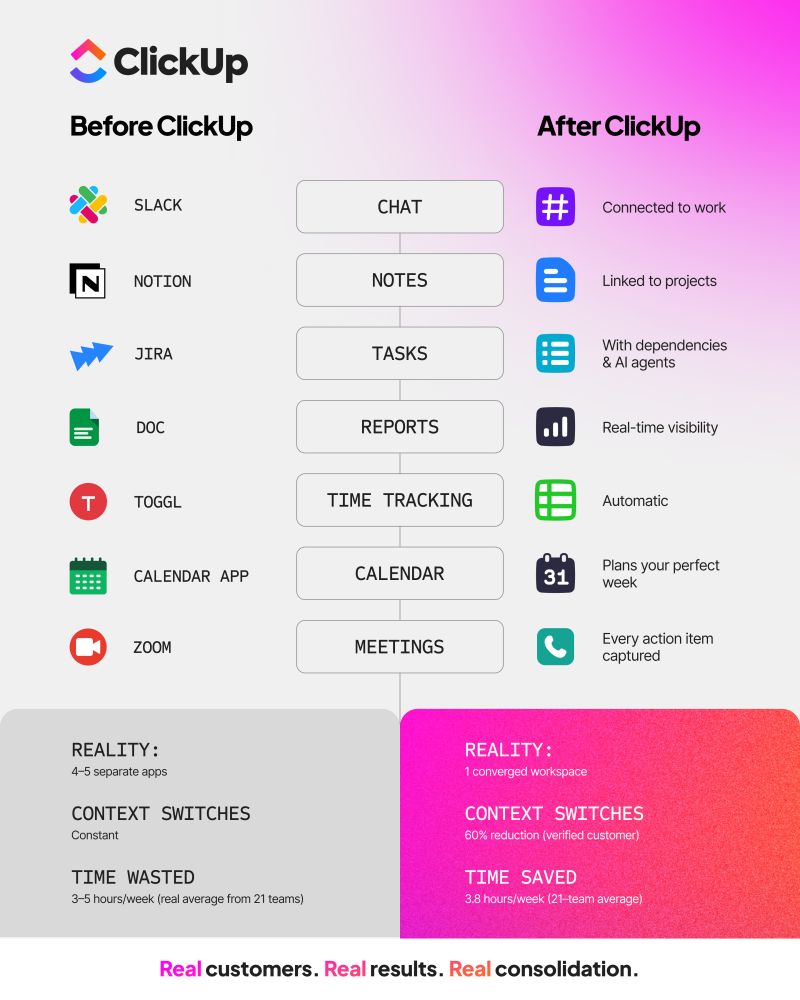
Even motivated teams fail when their systems are scattered.
The data:
You can’t build mature AI capabilities on top of fragmented infrastructure. AI needs context.
If your data is scattered across dozens of tools, your AI will only ever see a tiny slice of the truth. This reinforces our belief our a Converged AI Workspace.
What happens when AI has full context?
Most teams are experimenting with AI in isolation.
Systems like ClickUp BrainGPT only work when the underlying workflows are connected, structured, and visible. When AI can see the actual work, the discussions around it, and the decisions behind it, something shifts:
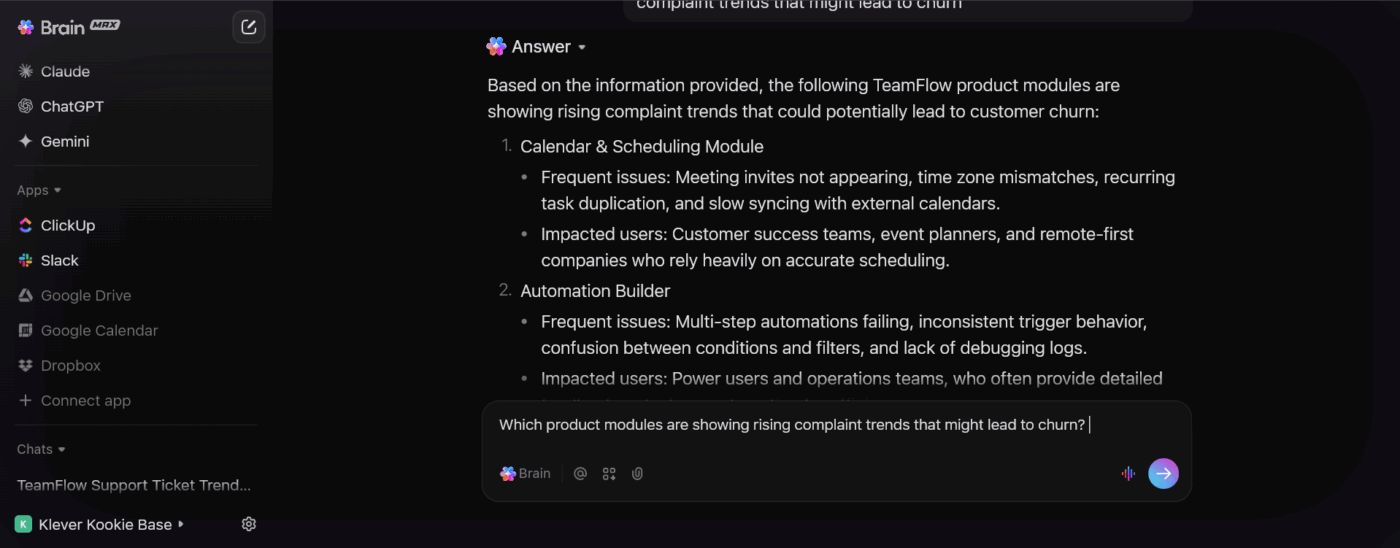
It stops acting like a writing assistant and starts behaving like an analyst.
It can surface trends teams missed, highlight hidden blockers, and show leaders the reality of how work moves through their organization. Add Talk-to-Text on top of that, and suddenly the speed of insight isn’t limited by your typing; you can offload thoughts, questions, and decisions in real time and let the system process the rest.
This is why AI maturity isn’t about having more models; it’s about having more context.
The overwhelming majority of teams are still early in their AI maturity—often stuck in siloed pilot experiments that never scale.
Without shared context or connected systems, even the best models hit a ceiling.
Context matters for AI to work well. When data is scattered across disconnected tools, your AI only sees fragments—and fragmented context leads to fragmented outcomes.
That’s why real progress comes from a coordinated AI strategy built on unified infrastructure, clear governance, and a single source of truth. When context flows across tools and teams, AI doesn’t just assist—it accelerates.
Here’s the truth almost nobody admits:
Most organizations have no idea if their AI investments are working:
That’s not just a red flag—it’s a roadblock.
If you can’t measure success, you can’t prove ROI.
If you can’t prove ROI, you can’t get executive buy-in.
And without buy-in, AI stays stuck in pilot mode—forever.
Pilot purgatory isn’t harmless.
Organizations in the first two stages of AI maturity had financial performance below the industry average. In contrast, enterprises in stages 3 and 4 had financial performance well above the industry average, according to MIT research.
The performance gap isn’t subtle. It’s the difference between lagging behind your competitors and dominating your market. That’s why honest assessment matters so much right now.
Why agentic workflows > Better prompts
One of the biggest misconceptions in enterprise AI right now is that maturity comes from better prompts. It doesn’t.
It comes from systems that can take structured action, not just generate text.
Agentic workflows matter because they reduce the cognitive overhead that keeps teams stuck in pilot mode. Instead of relying on individuals to remember steps, tools like ClickUp Agents push tasks forward, or interpret data, agents handle the procedural work in the background.
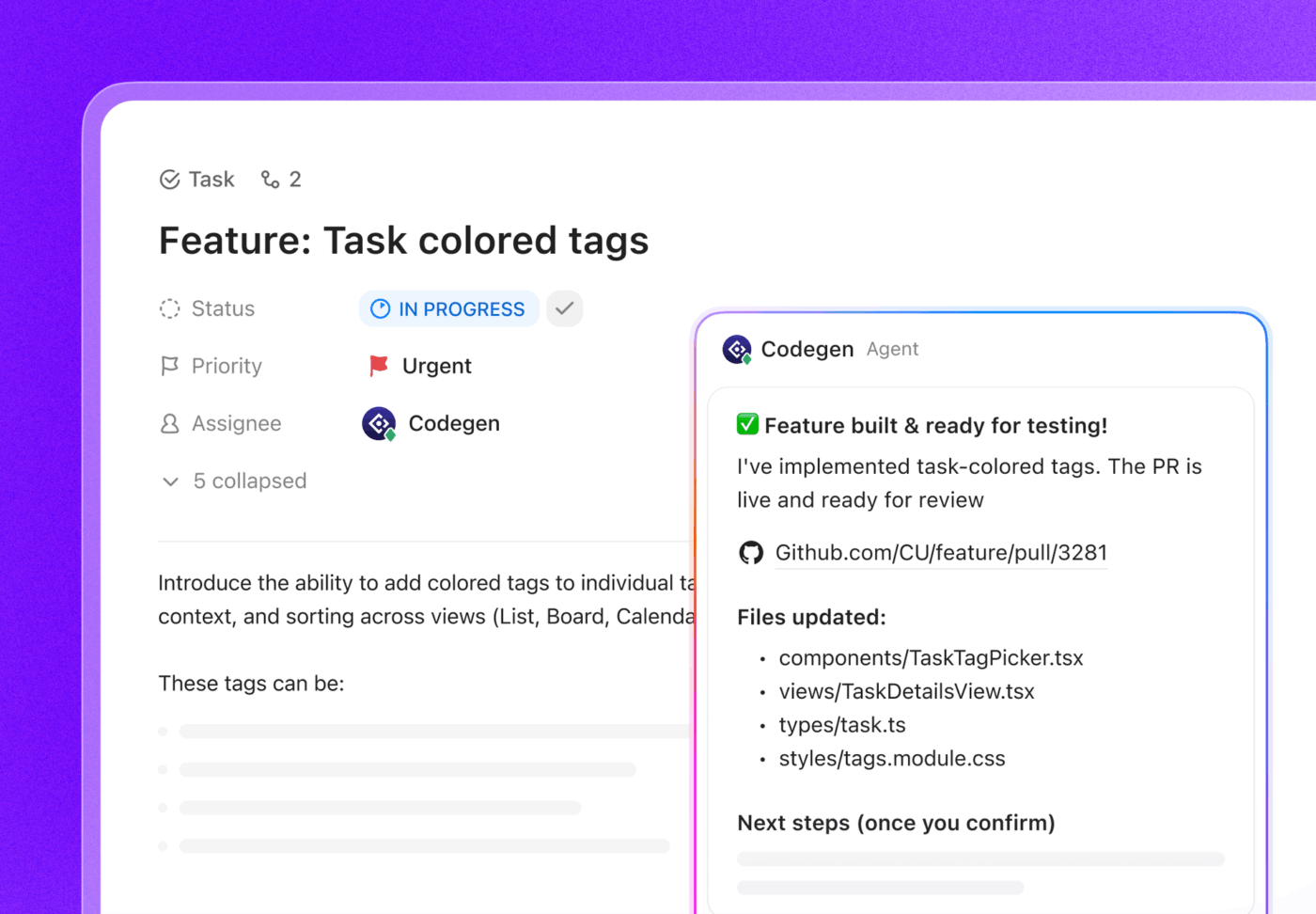
They don’t replace people; they stabilize the workflow around them so adoption becomes easier, not harder.
For most organizations, that shift alone is what finally moves AI from experimentation to execution.
Every successful transformation I’ve seen had one thing in common.
This is also how ClickUp itself grew pre-AI:
Quick wins → visible success → organic expansion.
With AI, the stakes are even higher. It’s not just switching tools—it’s shifting mindsets.
You’re not just replacing manual steps; you’re reimagining how work gets done. With ClickUp, it’s typically convincing someone who used to use another comparable project management tool why ClickUp is better.
With AI, it’s about changing the way they think about how they do work: a BETTER way.
That’s a scary leap for many. It can feel like a threat.
We have to frame the transformation as an opportunity to improve, vs. eliminating a job or questioning someone’s worth.
I frame it as super-powering the human worker, and teams and leadership have to create that vision and culture from the top, to drive a fully AI-mature organization that’s constantly doing continuous improvement and evolution of how they do work, especially with AI advancements happening so quickly.
Let’s be honest: culture is the hardest part.
That’s the real bottleneck for most companies.
Remember those guys I mentioned at the Sales Summit? The ones set in their ways?
I told them:
Don’t judge it until you see how it’ll help you and your day-to-day work easier. Let our teams train you on how to best deploy, give us your workflow and let us show you how you can transform it.
And then:
You don’t want to be the last team still on Lotus Notes. Or a flip phone. Or still printing out calendar invites.
Technology is evolving, and you will want to be part of that change; otherwise, you or your organization will become irrelevant.
If you’re a leader who’s hesitant about facing the uncomfortable diagnostics of your AI progress, here’s what I’d tell you.
You don’t have to do it alone.
Let us—your partners, experts, and agents—help show you the art of the possible. We can help jump-start your organization with our certified agents and expert resources, so you hit the ground running quickly.
Three critical actions:
The gap between AI maturity and AI investment is only growing wider. Only 13% of companies today are fully ready to capture AI’s potential, down from 14% a year ago, according to Cisco research. Meanwhile, 98% report that the urgency to deploy AI has increased. That’s not sustainable.
The companies that will win aren’t the ones with the biggest AI budgets.
They’re the ones willing to:
The technology is ready. The question is whether your organization is ready to face the truth about where you actually stand and do the hard work to close the gap.
Here’s the final, uncomfortable truth: your competitors are making that assessment right now.
And the ones who act decisively today will be the ones capturing market share tomorrow.

© 2026 ClickUp

There’s an easier way. Try a free AI Agent in ClickUp that actually does the work for you—set up in minutes, save hours every week.