






Still downloading templates?
There’s an easier way. Try a free AI Agent in ClickUp that actually does the work for you—set up in minutes, save hours every week.
Sorry, there were no results found for “”
Sorry, there were no results found for “”
Sorry, there were no results found for “”
I have a strong interest in how information moves inside teams since my sociology PhD days. It was academic back then – when a sharp team grows from 5 to 50 to 500, something starts to break:
People drift into silos. Decision makers get blindsided. Obvious signals only show up in hindsight.
That curiosity followed me into the operator seat. After scaling teams from scrappy startups to Fortune 500 environments, I have seen the same pattern again and again. To put it bluntly: why do smart teams make worse decisions as they scale?
To answer that, let’s start with two foundational studies on organizational behavior.
Thirty years ago, sociologist Ronald Burt mapped how information flows within organizations. What he found was not one network, but clusters. Tight, busy pockets of people who talk constantly within their own group, while the connections between groups thin out fast.
Those gaps are structural holes. In simple terms, a structural hole is just a gap between groups that should be sharing information but aren’t.
They don’t show up on an org chart. They live in the social network.
A few people naturally bridge those gaps. Burt called them brokers. They’re the ones who hear both sides, catch inconsistencies, and connect dots others miss. When brokers are missing, overloaded, or not looped in, the insight dies inside the local cluster.

As a CFO, structural holes are one of the biggest operating risks I watch for. The brokers who bridge them are critical. I constantly urge leaders to identify these people as Key People of Information (yes, not that kind of KPI) and keep them close to the decision table. I’m sure a few names already come to mind as you read the examples below:
Finance was wrestling with a sudden drop in pipeline conversion rate. Endless deep dive meetings, lots of theories, no answers. Then an ops manager casually mentioned to a financial analyst over lunch that a small CRM workflow had changed. That single detail explained everything.
A product engineer once mentioned a user pain point at a company party to a Product Marketing manager who had never heard it phrased that way. That one comment could have reshaped the key part of the launch narrative.
Sales reps often carry priceless customer context, but it rarely reaches the pricing team at HQ. During a quick coffee chat with the Growth director who happened to visit the local office, an AE explained recent packaging confusion that perfectly matched a drop in win rates…
These moments look small, but they are structural holes in action.
And structural holes in the employee network turn into data holes in the workflow.
Context gets scattered across communication tools, side chats, and meetings. The dots do exist. Humans naturally struggle to connect them without brokers accidentally filling in the blanks.
In the 1980s, researchers Garold Stasser and William Titus ran a deceptively simple experiment.
They put people in 4 person groups and asked them to make a decision.
They ran two setups:
When everyone had the same facts, the group outperformed individuals.
When people held different facts, the group often chose a worse answer than individuals would have chosen alone.
Why?
When the researchers reviewed the recordings, they found the pattern.
Groups kept repeating what everyone already knew.
The unique facts on which the decision hinged received little airtime or were ignored entirely.
If you’ve ever sat through a meeting where the team rehashes the widely known facts for 30 minutes and never touches the edge case that actually matters, you have lived this experiment.

I’ve seen this play out firsthand.
We once struggled for weeks with forecast accuracy in our sales capacity model.
In every meeting, the same theories surfaced. Maybe it was a hiring issue. Maybe enablement. Maybe marketing pipeline quality. Maybe leadership. The conversation kept circling the same shared assumptions, and the tone slowly drifted toward a finger-pointing exercise.
Then one day, a quiet data analyst stopped me in the hallway. She mentioned she had been tracking the historical numbers and noticed something small but meaningful. Our seasonality assumption, a tiny input everyone took for granted, had been drifting further away from the baseline each quarter.
It turned out that a single overlooked detail, buried in her private analysis and never mentioned in the group discussion, was the real driver skewing the entire sales capacity model.
It was the perfect real-world example of this research. The group kept repeating what everyone already knew. The unique insight that actually solved the problem was sitting in one person’s head, because “everyone else looks like they have known the right answer.”
Now scale that across thousands of personalities, hundreds of meetings, dozens of work tools.
It becomes nearly impossible to surface unique insights when the meeting keeps getting bigger.
Because of these two organizational dynamics, as smart teams scale, decision quality drops fast. Not because people get dumber. Because information gets harder to extract and the decision-making process gets exponentially muddier.
When the dots are so scattered, and the flow is untraceable, humans can’t connect them.
Neither can AI.
From the 2 studies above, it is clear that what’s missing is a shared memory for the organization. A system that captures work, decisions, and interactions as they happen, instead of just storing the “final record”.
A system that effectively films the decision-making process live: logging the inputs, debates, assumptions, trade-offs, and outcomes in real time.
That’s what I mean by a Company Brain.
This is not a static knowledge base, but a living layer of intelligence that observes how the company operates, records how decisions are made, and helps everyone immediately access the full context as the business scales.
With AI, this is no longer business sci-fi.
We have been experimenting with it at ClickUp. Our lesson is that it takes a 3-step strategy to build a Company Brain. (Warning: skip one step and the whole thing collapses into AI slop!!)
Shine light into the structural holes: create an intentional system that pulls unique insights out of individuals and siloed teams, then broadcasts them as widely as possible.
NVIDIA CEO Jensen Huang has said he avoids 1:1 meetings for important context. He prefers sharing in large groups so everyone hears the same thing at the same time.
He is reducing structural holes by default. Private context is fragile and slow. Public context becomes searchable, reusable, and feedable into AI.
At ClickUp, an open context culture is reflected everywhere: people send meeting notetakers to as many meetings as possible, we encourage people to post questions/share thoughts in group chats, not DMs, we run a rigorous weekly update ritual: from IC to the C-suite, everyone submits a weekly reflection in ClickUp with just 3 bullets:
It seemed almost too simple, but the compounding effect was strong. Hidden signals surfaced. Blockers showed up in real time instead of months later. Leaders stopped relying on secondhand generic reports and started going straight to the signals.
We use AI to digest the signals. Humans focus on asking the question, “What are we missing?” AI scans the entire organizational surface and synthesizes the common theme. Human works remain essential for judgment and anticipation. AI takes over the mechanical reporting and summaries.
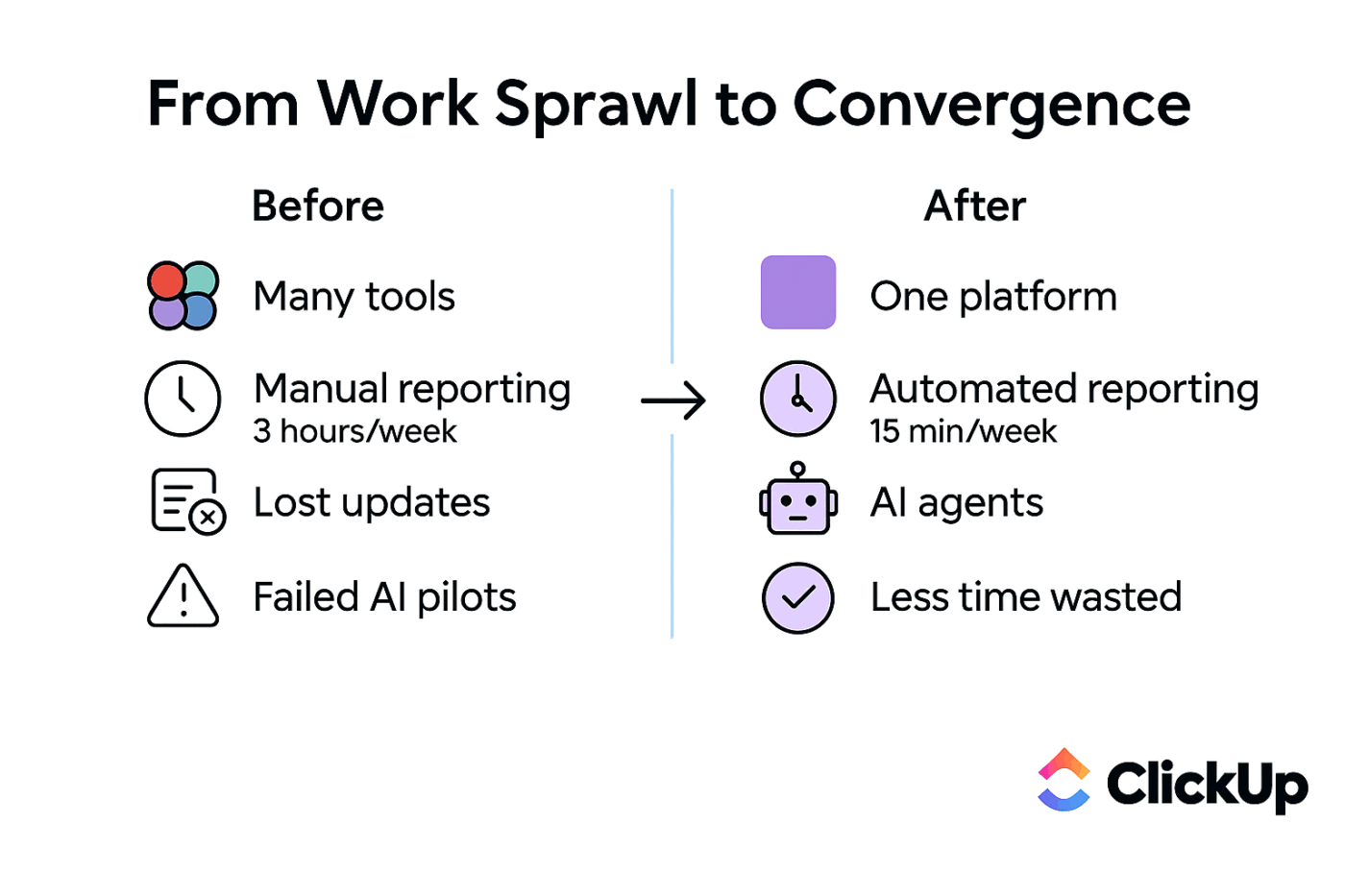
Put all the raw artifacts of work in one place, and pick a single work platform to converge everything there. Everything: the weekly updates, team chats, project threads, memos, and handoff plans.
Start a log on how key decisions are made.
This is a muscle most teams never build. When something goes wrong, it is often impossible to determine how the decision was made. The post-mortem turns into a painful forensic hunt. That’s the telltale sign of not having a real decision audit log.
But forcing teams to stop and document every step isn’t the answer. That’s not how humans work! It kills flow and slows execution.
The right approach is to capture decisions as they happen, like filming the work instead of asking people to recreate it later. Each key step, assumption, and tradeoff gets recorded in the background. When the team moves on, the trail is already there.
This is where AI changes the game.
At ClickUp, our Company Brain logs key decisions directly in the converged work platform and continuously feeds those decision trails back into the system.
As a finance leader, when I join a new company, my first question is almost always the same: “How do you build your budget?”
Eisenhower said it best: “Plans are worthless, but planning is everything.” I’m not judging the final number. I’m gathering the context of how a business operates: How decisions get made.
The budget process has always been my X-ray for the health and maturity of a company’s decision-making.
Now, enter AI agents.
I often get pitched “budget agents” that promise to help CFOs build budgets. Without context, that’s a dead end. At best, you get textbook answers. Seriously, how much prompting do I need to do to teach the agents how we make decisions?
But give an agent a real decision audit log and everything changes. The agent now understands how this company thinks. The decision log becomes its treasure map. Companies that have this capability can unlock agentic power an order of magnitude faster than those that don’t.
Our Company Brain faithfully records how we build the Engineering budget for next year:

M&A decision is another example that’s high-stakes, multi-dimensional, and requires lots of inputs, both qualitative and quantitative. Here is a decision log of us evaluating an acquisition target. We just work, Company Brain filmed it. In the future, if a new human or agent needs to evaluate another target, they’ll know where to start.

Imagine, once all these decisions live in one place, they become searchable, linkable assets. AI can finally do what it’s good at: connecting the decision to the workflow behind it, and the outcomes that came after. The agents we deployed to mimic what humans can do can finally have eyes and stay on track.
Once your work lives in one place, and your Company Brain is activated, this is where everything starts to click and compound. Your team is ready to deploy an AI execution layer that works in two modes:
This is the AI that works quietly in the background. It watches patterns, surfaces risks, and answers questions without being prompted. It catches the risk signals that humans overlook because of our blind spot.
For example, my weekly reflection AI helps me scan for my blind spots (“signals you may have ignored”):

With the firm foundation of the company, team, and individual work context, you can summon agents on demand. Each agent understands a specific workflow but shares the same foundational company context. You can pull them into a chat, a task, or a doc – anywhere work is happening.
Our team has a group of finance agents that takes on a huge amount of daily heavy lifting. These Super Agents aren’t generic. They know our workflows, our definitions, our cadence, and our decision-making process.

Do these 3 steps right, and you get what business leaders have wanted from GenAI all along.
AI becomes an integrated part of how the company thinks, learns, and decides.
And the good news: Step 2 and Step 3 have a powerful solution: Build your Company Brain on ClickUp.
If you made it this far, you’ve earned my first shameless plug. 😊
The human behaviors that strip context from large organizations have been around for centuries. Structural holes bury information. Group conversations drown out the unique signals.
For a long time, there was no real fix. Businesses learned to live with it, treating lost context as a tax on growth.
AI is not the answer to everything. On its own, it solves very little. A Company Brain doesn’t magically appear. It takes intentional work to change the culture, redesign the operating system, and centralize context.
But once that groundwork is in place, AI becomes the key ingredient that brings it all together.
You already have a smart team. This is how you prepare your organization to build a Company Brain, mine the wisdom of your own crowd, and keep smart teams from making dumb decisions as you scale.

© 2026 ClickUp

There’s an easier way. Try a free AI Agent in ClickUp that actually does the work for you—set up in minutes, save hours every week.