






Still downloading templates?
There’s an easier way. Try a free AI Agent in ClickUp that actually does the work for you—set up in minutes, save hours every week.
Sorry, there were no results found for “”
Sorry, there were no results found for “”
Sorry, there were no results found for “”
Most organizations today are stuck in a frustrating pattern. They’ve adopted AI tools. They’ve built automations. They’ve launched impressive proofs of concept inside individual teams. Yet somehow, the transformative productivity gains they expected remain elusive.
The problem isn’t the technology.
It’s that most companies are still operating in the first phase of AI maturity: siloed automation.
And the gap between siloed automation and the next phase, where AI becomes truly ambient, proactive, and contextually aware, represents one of the most significant competitive inflection points in business today.
How do you know when your organization is ready to move beyond siloed automation? There’s a specific pattern I’ve observed that indicates readiness.`
When workflow maturity and consolidation occur together, your organization is ready to evolve beyond siloed automation toward unified, ambient AI.
This convergence moment matters.
It’s when teams stop asking “What can this tool do?” and start asking, “How do we create an environment where AI understands our entire operation?”
Even with clear readiness, most organizations hit the same bottlenecks:
This is where the AI Transformation Matrix becomes essential.

Organizations need high maturity on both axes: AI maturity and context maturity. You can have the most sophisticated AI capabilities in the world, but if your context is fragmented across dozens of disconnected tools, your AI will remain blind to the patterns that matter most.
Before teams can advance, they need to rethink what AI actually is.
Generative AI vs. Agentic AI:
Ambient AI doesn’t “just happen.”
It requires intentional design for context sharing, orchestration, and clear rules of engagement.
Think about it this way: having a ChatGPT-like interface doesn’t make something an agent any more than having a steering wheel makes something a self-driving car.
True agentic AI operates within defined parameters, executes multi-step workflows, and makes decisions based on accumulated context. Ambient AI goes even further, operating invisibly in the background across your entire operation.
Let me give you a concrete example of what changes when you move from siloed automation to connected, agentic workflows.
This isn’t just about efficiency.
It’s about creating institutional memory that actually persists and becomes more valuable over time. In the old model, the sales context gets trapped in email threads, chat messages, and meeting notes scattered across different systems. In the ambient AI model, that context flows automatically to where it’s needed, when it’s needed.
Context is the real accelerator
Once AI can access your organizational context, your tasks, timelines, conversations, and decisions, it stops behaving like a writing tool and starts acting like an analyst. ClickUp BrainGPT leverages this by drawing from your entire Workspace, surfacing patterns that people often miss, and making connections that you didn’t manually provide.
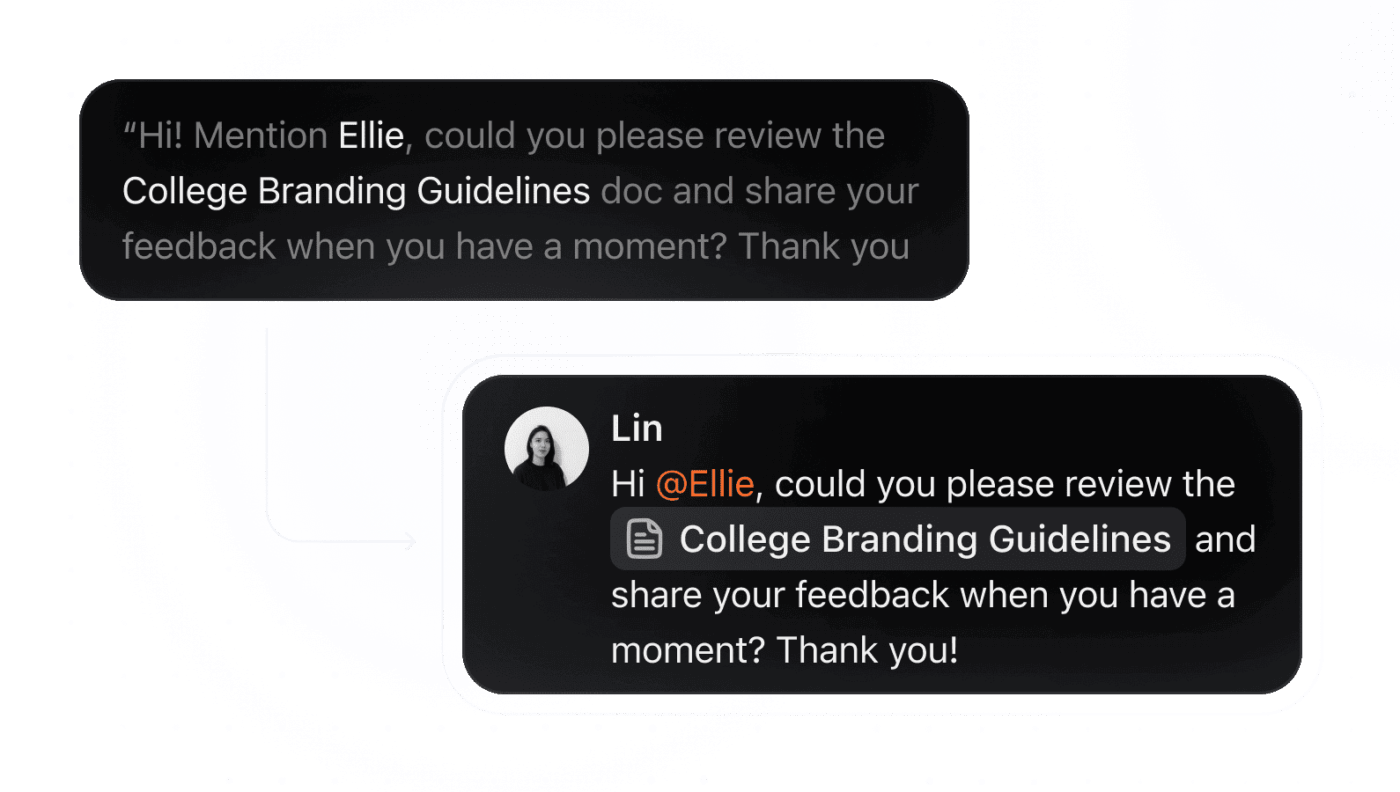
You think out loud, it listens with Talk-to-Text, it correlates, and the insights reflect how work actually moves across your company.
As organizations progress from basic automation to truly ambient AI, the role of leadership undergoes a fundamental change.
This is not about technical expertise. It’s about creating the organizational conditions that enable ambient AI to thrive. That means committing to convergence even when individual teams resist giving up their preferred tools. It means investing in the infrastructure and governance that enable safe, cross-functional AI operations. Most importantly, it means treating AI transformation as a strategic priority, not a series of tactical experiments.
Devin Stoker, Director of our AI Center of Excellence at ClickUp, has worked extensively with organizations navigating this transition. He sees two distinct approaches that can lead to company-wide ambient AI.
1. Aggregation of marginal gains
Essentially, it’s similar to the approach of the British Cycling team, led by Sir Dave Brailsford, which focused on the aggregation of marginal gains,” Devin explains. “I view each new high-quality agent or AI workflow as contributing a 1% marginal gain for your company. As you continue investing in these enhancements, it culminates in the significant outcome of having Ambient AI seamlessly integrated across all your processes.
In this model:
2. Ambient AI operating in the background
The second approach Devin describes focuses on AI automatically working in the background to perform tasks on your behalf. These ambient agents don’t require direct commands to provide support.
ClickUp includes multiple types of these ambient agents that can answer questions in chat, take actions as a part of your workflows, adapt to user feedback over time, and even update your company knowledge in the background.
Both approaches share a critical requirement: they need a converged environment where AI can access complete context across all work, communication, and collaboration.
The quiet power of ambient agents
The most underrated advantage of ambient agents is that they operate autonomously, eliminating the need for manual instructions. They collect context in the background, route information where it belongs, capture knowledge before it’s lost, and maintain the connective tissue teams never have time to document.
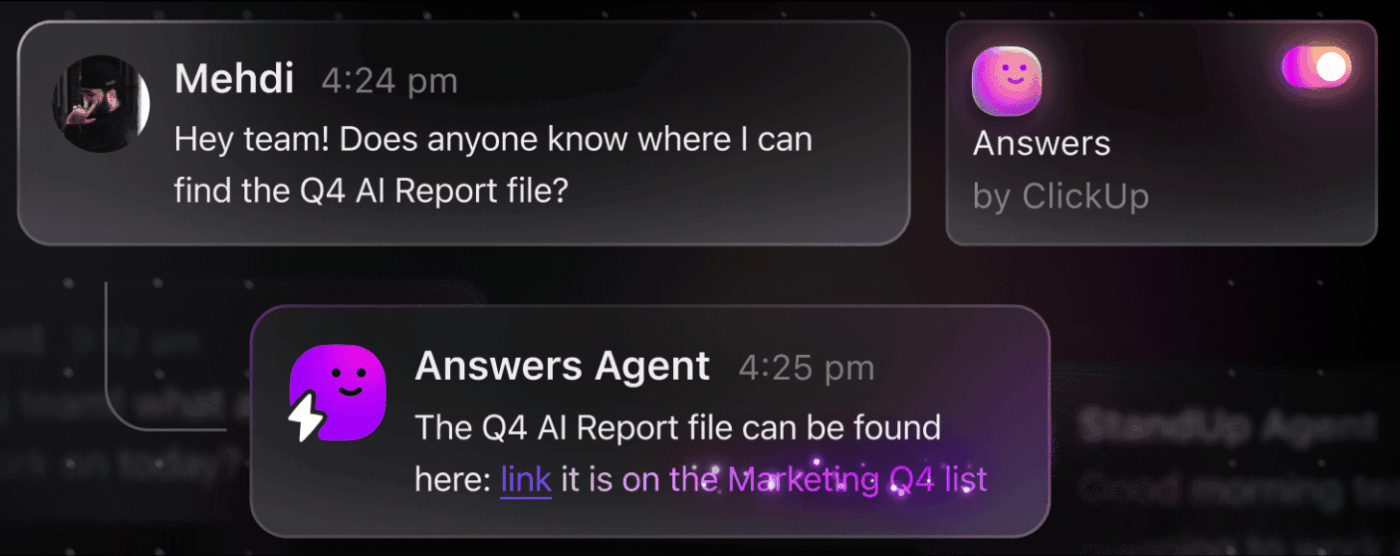
When these agents operate inside a converged environment, they become the backbone of a system that learns continuously and improves without prompting.
The journey from siloed automation to ambient AI isn’t just about adopting better technology. It’s about creating conditions where AI can operate with clarity, context, and continuity.
Here’s what the most successful organizations commit to:
Organizations that make this transition don’t just get better productivity. They unlock a compounding effect where each improvement makes the next one easier and more valuable.
Their AI gets smarter because it has more context. Their teams get faster because they spend less time searching and more time creating. Their competitive advantage grows because they can execute at a pace their competitors can’t match.
The question isn’t whether to make this transition; it’s how to do it effectively. It’s a matter of whether you’ll lead or watch your competitors pull ahead.

© 2026 ClickUp

There’s an easier way. Try a free AI Agent in ClickUp that actually does the work for you—set up in minutes, save hours every week.