






Still downloading templates?
There’s an easier way. Try a free AI Agent in ClickUp that actually does the work for you—set up in minutes, save hours every week.
Sorry, there were no results found for “”
Sorry, there were no results found for “”
Sorry, there were no results found for “”
Business leaders are caught in an investment paradox. AI spending has increased 130%, yet 80% of organizations report no tangible enterprise-wide EBIT impact from their generative AI investments (Source: Wharton, McKinsey).
This gap between investment and impact doesn’t stem from the technology itself. It comes from a reactive, fear-driven strategy that fuels agent sprawl and tool overload.
The fear of being left behind is driving a rushed obsession with onboarding new disconnected AI tools, inadvertently building an “AI Sprawl“—a disconnected ecosystem where individual tools are powerful but lack the shared context of a team’s core work areas.
This internal chaos is now spilling into public view, with software giants like Salesforce and Atlassian beginning to throttle or block third-party tools’ access to sensitive data and contextual work information.
It is this exact kind of chaos and fragmentation that challenges the assumption that the next AI tool will solve the sprawl problem. To move beyond speculation and uncover the reality of day-to-day AI use, we surveyed over 1,000 knowledge workers from around the globe.
Our goal was to answer critical questions: many AI tools are do workers use today and how effective are they?
Key findings from our survey:
The solution? Our research shows that contextual, integrated AI delivers dramatically higher adoption rates and user satisfaction.
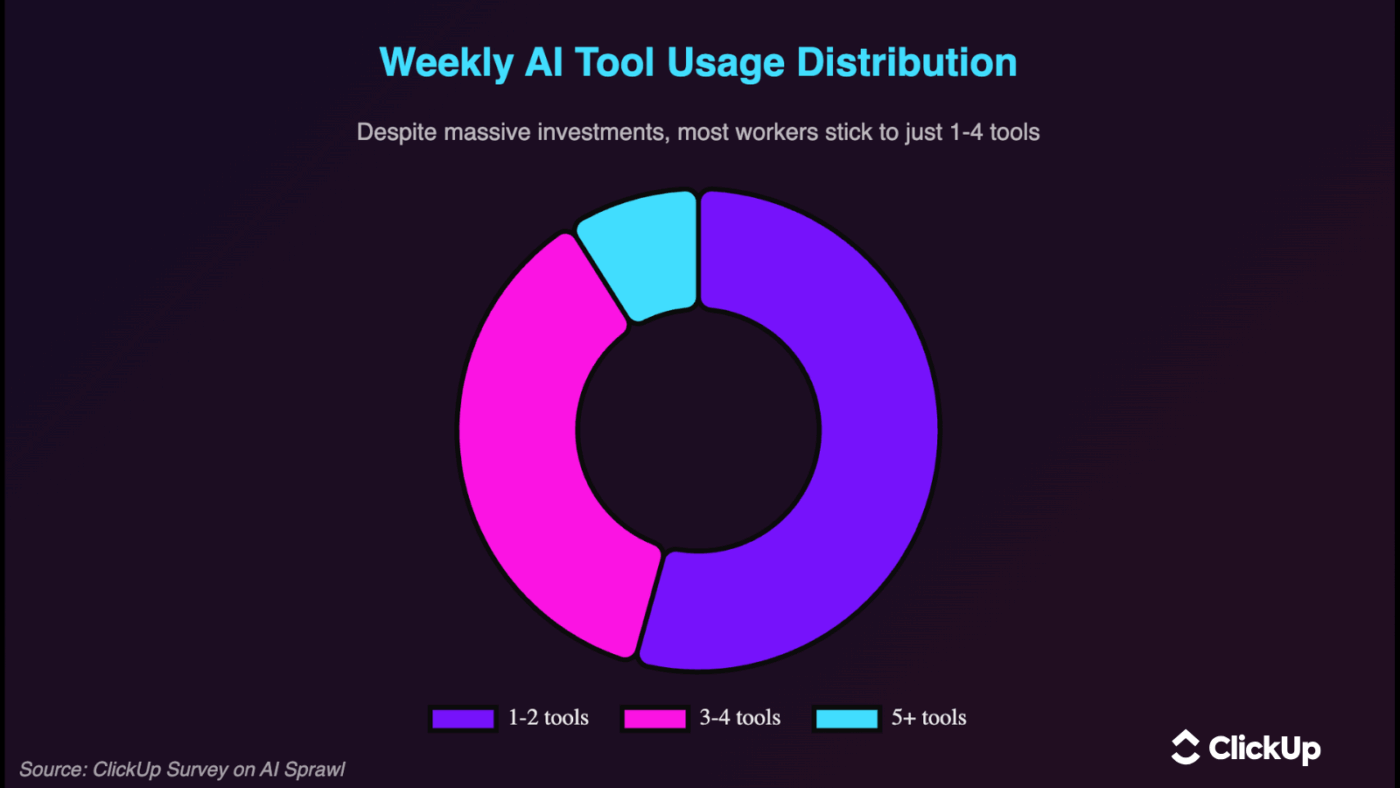
While IT departments continue their buying sprees, employees have already voted with their workflows. Despite organizational investments in dozens of AI tools, 91% of workers only use 1-4 tools weekly:
More alarming still, 44.8% of teams have already abandoned AI tools adopted within the past year:
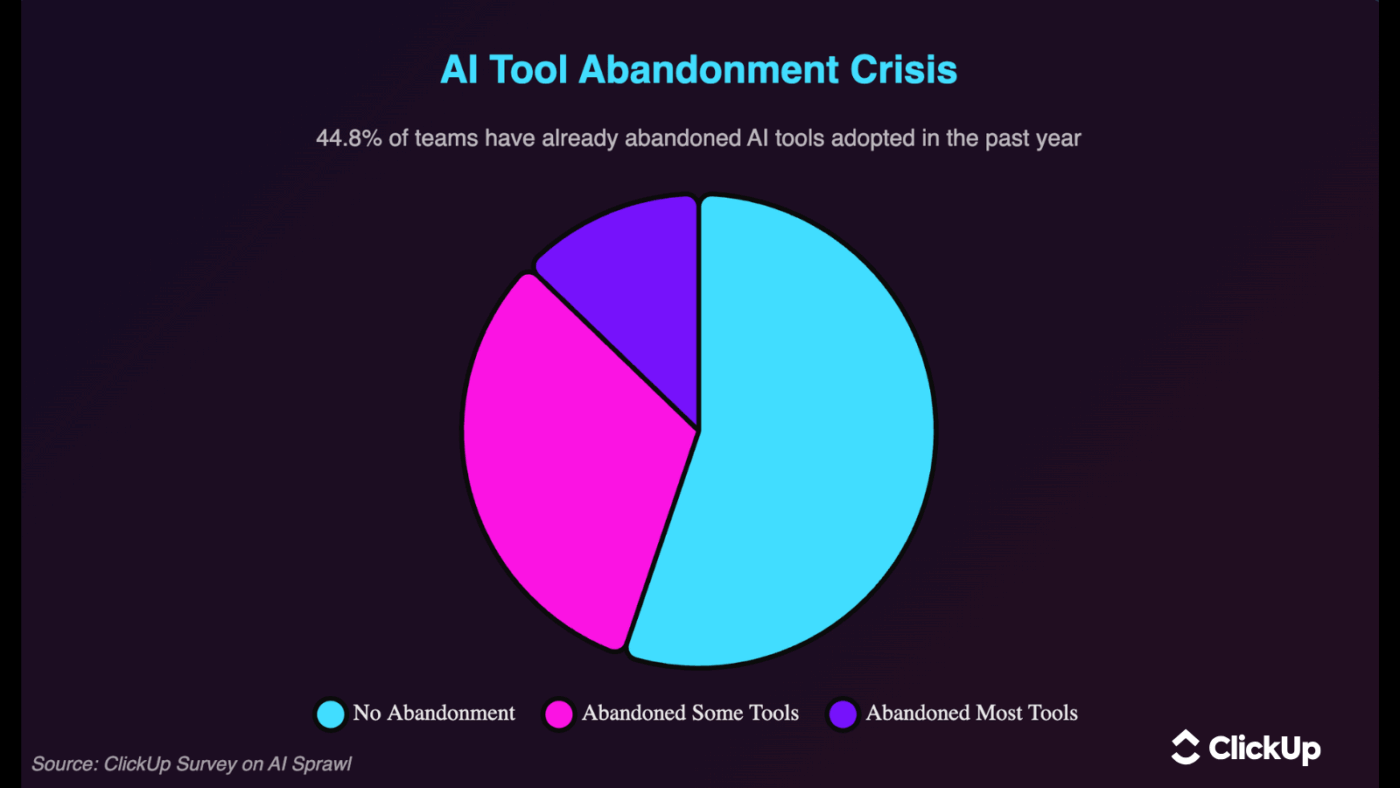
This isn’t just wasted licensing costs—it’s lost implementation time, training resources, and eroding employee trust in future AI initiatives.
The message is clear: Your AI portfolio likely contains significant dead weight. Every new tool added without retiring others increases the likelihood of further abandonment.
Nearly half of all workers (46.5%) are forced to bounce between two or more AI tools to complete a single task.
This productivity-killing pattern—starting in one tool, copying results to another, reformulating prompts, reconciling outputs—creates compliance risks and confusion. It isn’t automation. It’s complication.
The impact shows in user satisfaction:
Each tool switch requires:
The cognitive load accumulates until using AI becomes harder than doing the work manually.
Bottom line: You’re not just losing productivity to switching—you’re training your teams to avoid AI altogether.
Over a third of workers (34.4%) use AI tools with zero integration to their core work areas—projects, documents, and chats.
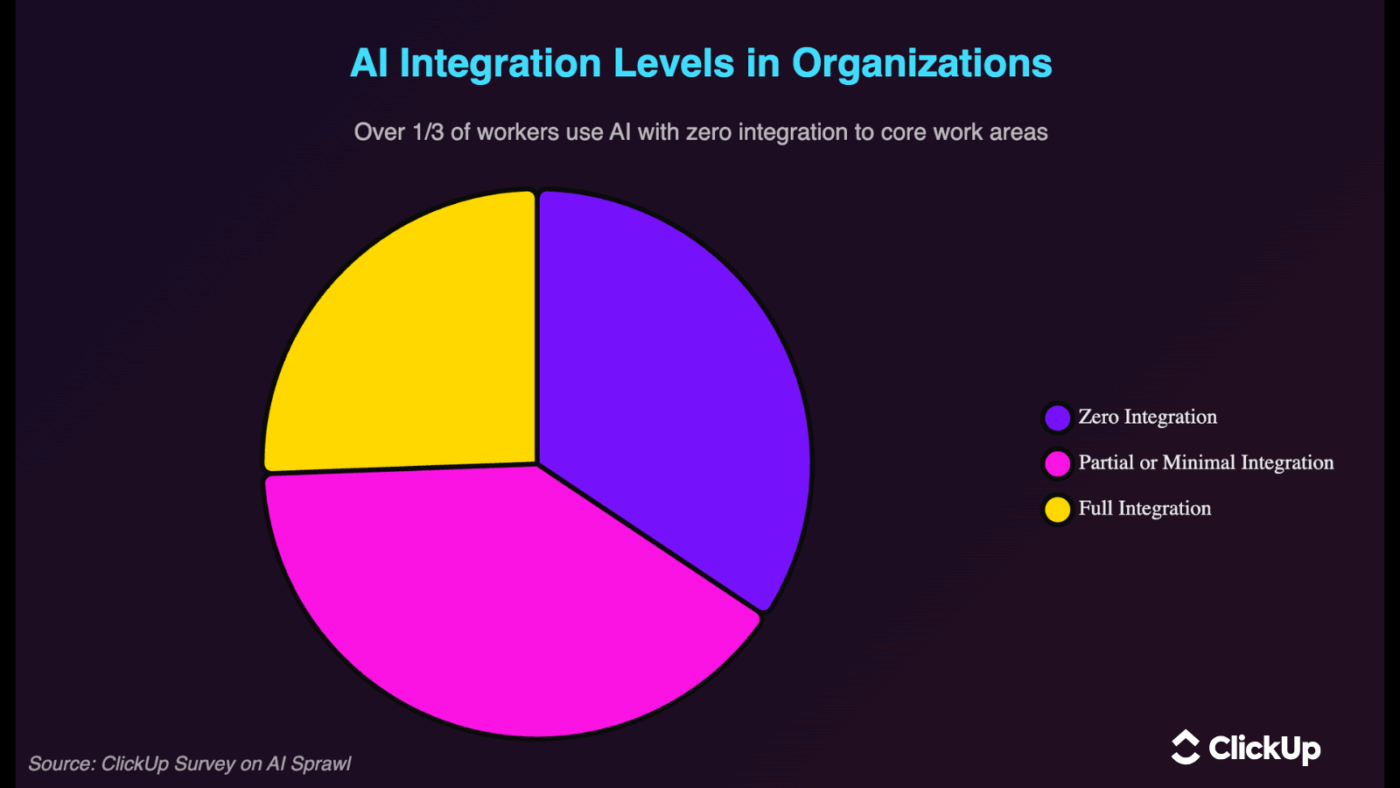
That means AI systems don’t know their projects, cannot access their documents, and cannot understand their conversations. It’s like hiring an assistant and blindfolding them.
The integration statistics reveal the full scope of the problem:
| Integration Level | Percentage of Users |
| Full Integration (all 3 work areas) | 25.6% |
| Partial Integration (2 areas) | 22.8% |
| Minimal Integration (1 area) | 17.3% |
| Zero Integration | 34.4% |
When AI can’t access the context where work happens, every interaction starts from zero—fueling the rise of shadow AI tools adopted without oversight or proper integration. Users must manually provide background, explain terminology, and reconstruct context that already exists in their work systems.
The reality: Without integration, AI tools become expensive calculators, adding security risks rather than functioning as intelligent assistants.
Here’s a finding that should stop every AI strategy meeting in its tracks: 77.5% of workers would feel indifferent or relieved if half their AI tools were removed.
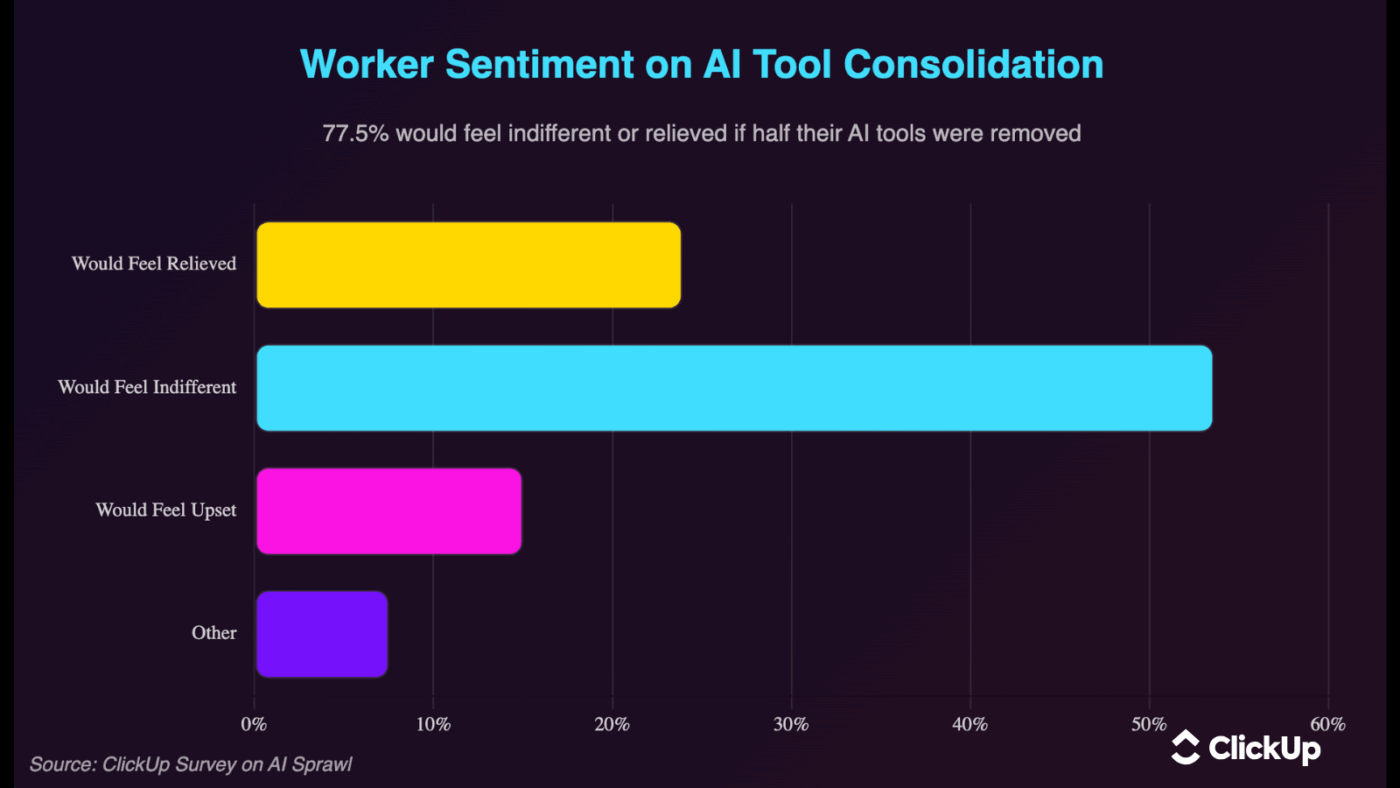
The breakdown reveals the depth of tool fatigue:
These aren’t technology resistors—they’re knowledge workers drowning in tool complexity who see consolidation as liberation. They understand what many leaders don’t—more tools mean more context switching, more passwords, more interfaces to learn, and ultimately, less productivity.
The path forward is clear: AI success runs through consolidation, not proliferation. Your teams aren’t asking for more options—they need simplification.
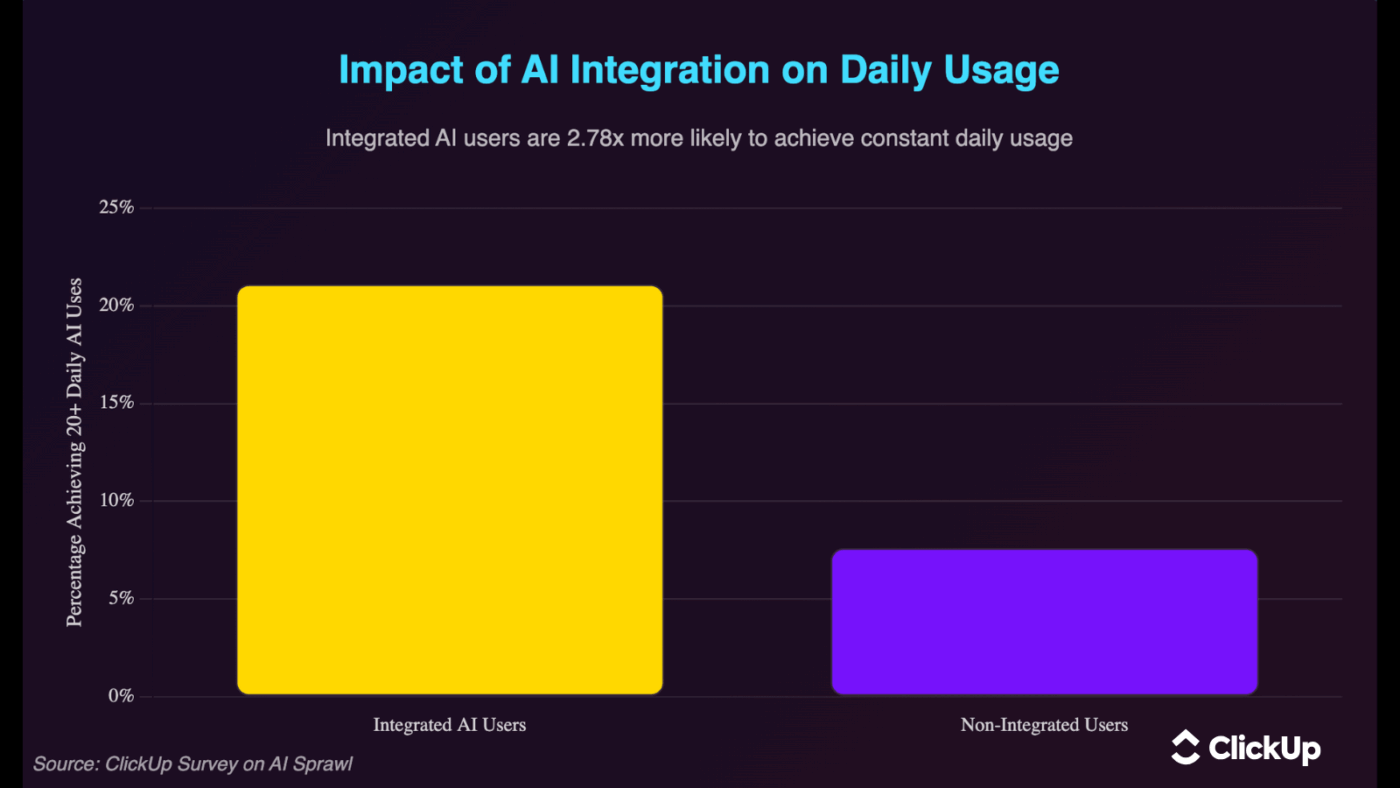
The data crystallizes around a single truth: integration is the difference between AI success and failure.
Workers with fully integrated AI are 2.78x more likely to use AI constantly throughout their day:
Less than 1 in 10 teams achieve meaningful AI returns:
📊 Key ROI Metrics:
This isn’t disappointment; it’s wholesale failure. The scramble for external expertise reveals widespread recognition that current approaches have failed—often due to deep governance gaps in how AI strategies are designed and deployed.
Worker behavior tells the real story. They intuitively understand what many strategies miss: tool proliferation is the enemy of productivity.
The harsh truth: Your AI strategy likely isn’t working, and your teams know it.
The research points to clear actions for leaders ready to move beyond AI Sprawl:
This is why we built ClickUp Brain—not as another tool to add to your sprawl, but as a solution.
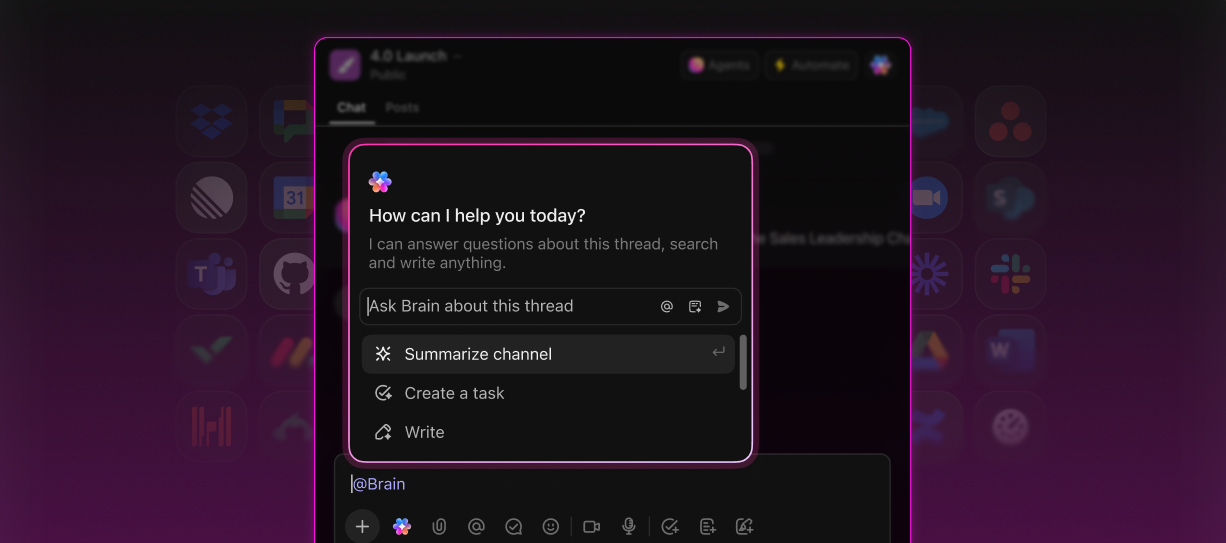
Unlike generic AI assistants, ClickUp Brain:
ClickUp Brain users report:
These users have experienced what works and naturally gravitate toward simplification around effective tools.
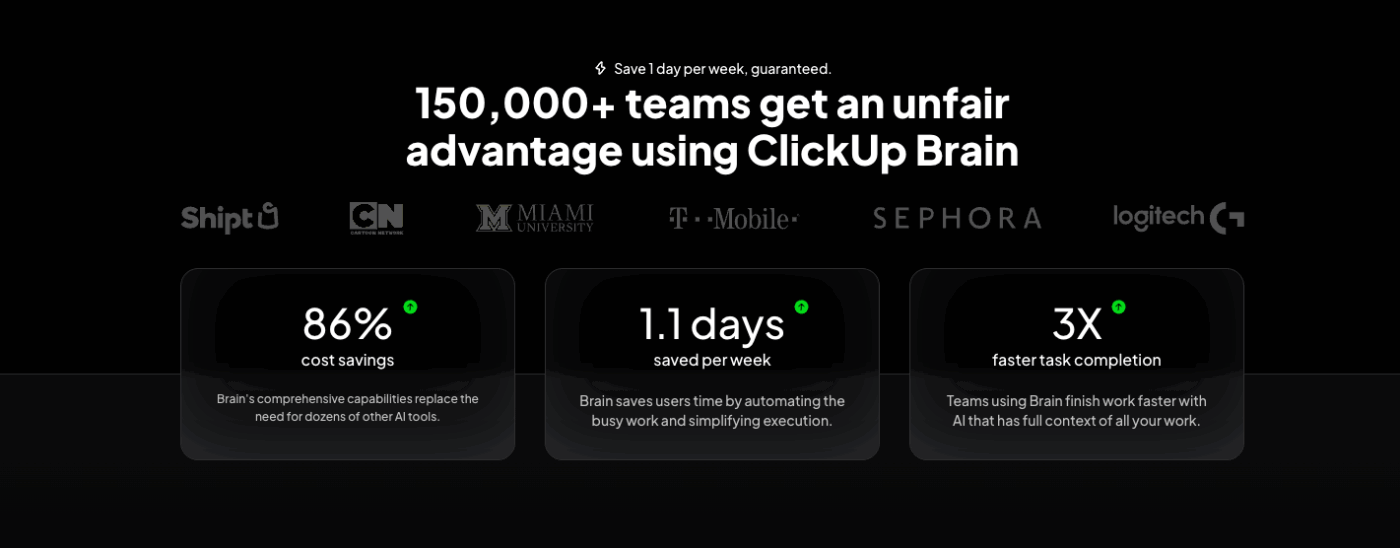
The verdict: Deep, native integration doesn’t just improve AI—it transforms how teams work.
Our research proves that AI Sprawl is killing the promise of AI—to eliminate busywork, not create more of it. Frustrated by fragmentation, workers are rejecting tools, abandoning investments, and yearning for consolidation.
The small minority achieving success share one characteristic: deeply integrated, contextual AI.
The future belongs to organizations that understand this truth: AI value comes not from having many tools, but from having the right tool—one that understands your work context, integrates with your workflows, and grows more valuable over time.
The question for every leader:
Will you continue adding to the sprawl, watching abandonment rates rise, and ROI disappoint?
Or will you choose the proven path of contextual AI?
Learn more about ClickUp Brain
The only AI that connects across all of your work.
📺 Access the on-demand webinar and playbook
See how leading teams are eliminating AI Sprawl and achieving real ROI.
💬Schedule a personal consultation
Discuss your organization’s AI consolidation opportunity with our experts.
Research methodology: The data for this report was collected over a two-week period in mid-to-late June 2025. The survey, consisting of 10 multiple-choice questions, was administered anonymously to over 1000 participants. Respondents represented a balanced mix of professional roles, from executive leadership and managers to individual knowledge workers and entrepreneurs. For complete methodology and detailed findings, contact research@clickup.com

© 2026 ClickUp

There’s an easier way. Try a free AI Agent in ClickUp that actually does the work for you—set up in minutes, save hours every week.