I’ve sat through a lot of these conversations. A leadership team gathers in a conference room. They have ChatGPT accounts. Someone’s running a pilot. There’s buzz about “AI strategy.” And they’re convinced they’re ahead of the curve.
Then we start looking at the details. The wins are real, but they’re small. One team automated a workflow. Another is getting decent outputs from prompting. Good stuff.
But the rest of the business? Still operating the same way it did five years ago, with the same fragmented tools, disconnected workflows, and growing context sprawl. Most of what changed is localized, not systemic.
I’m not knocking the effort. The pressure is real. Boards want to see progress. Customers expect innovation. Everyone’s asking what’s next. But here’s what I’ve learned after running dozens of these assessments: urgency doesn’t equal readiness. You can throw resources at AI and still end up with nothing that scales.
Why Most Companies Get AI Maturity Wrong (And What Actually Works)
Summarize this article with AI
ClickUp Brain not only saves you precious time by instantly summarizing articles, it also leverages AI to connect your tasks, docs, people, and more, streamlining your workflow like never before.
Summarize this article for me please
What AI Maturity Looks Like (and What It Doesn’t)
Let’s start with the patterns that show up again and again.
Pattern 1: Prompting ≠ maturity
The first pattern I see constantly is leaders assuming that because people are prompting an LLM, the organization has reached some higher level of AI maturity. Those gains are small. They’re isolated, classic symptoms of AI pilots vs. scale failure. And they still need constant human oversight. That’s useful experimentation. It’s also fragile.
Pattern 2: One-use-case depth, zero breadth
The second pattern is companies that go very deep on one single use case. It feels impressive when you’ve fully automated one workflow. But it’s still a tiny fraction of the business. You optimized one corner. The rest of the operation still runs on legacy habits.
Pattern 3: Confusing investment with readiness
The third pattern is confusing urgency or investment with readiness. Many companies feel intense pressure to adopt AI. Very few are actually positioned to operationalize it. Pilots create surface-level activity, but the underlying capability stays shallow.
What’s the lesson? Early wins create a false sense of momentum.
Real maturity requires:
Connected workflows
Governance structures
Training programs
Trust in the technology
Mechanisms to measure quality
Without that foundation, organizations stall. They struggle to move from scattered pilots to enterprise impact.
Summarize this article with AI
ClickUp Brain not only saves you precious time by instantly summarizing articles, it also leverages AI to connect your tasks, docs, people, and more, streamlining your workflow like never before.
Summarize this article for me please
What Moves Organizations from Pilots to Scale AI Maturity
The strongest move I’ve seen? Creating a real community of practice.
You bring together people across functions who are naturally curious about AI. You give them shared space, shared language, and shared problems to solve. This is where collaboration becomes a multiplier.
What makes communities of practice work:
Friendly competitions that surface creative ideas
Workflow catalogs that help teams validate each other’s thinking
Pattern sharing that spreads quickly instead of staying trapped in pockets
From there, leaders invest in process mapping, one of the most practical tools available. Mapping workflows shows how work actually moves, where it stalls, where people still copy and paste between tools, and where agents can add real value.
For example, a product team might discover they’re manually compiling customer feedback across three platforms, when a lightweight agent could centralize it in real time.
This is also where context-aware AI starts to matter. Tools like ClickUp Brain work because they’re embedded directly inside workflows, not bolted on after the fact. Instead of asking teams to explain context to an AI tool, the AI already understands tasks, dependencies, conversations, and documents as part of the system.
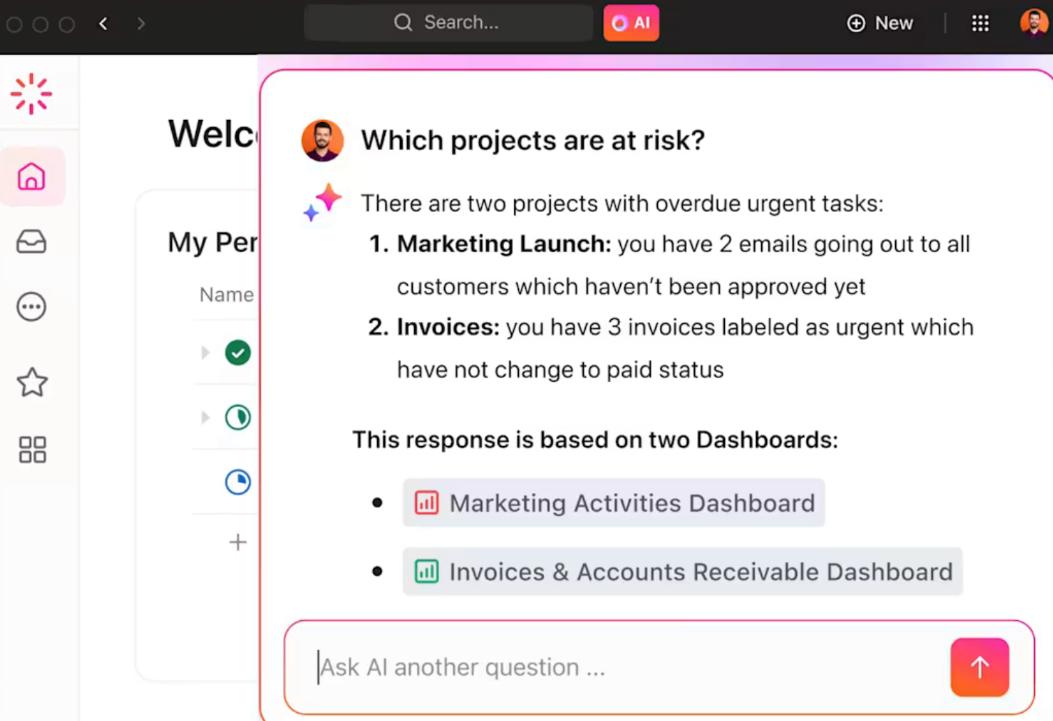
AI-powered project risk insights: Instantly identify overdue urgent tasks and take action, all from your dashboard
With ClickUp BrainGPT on desktop, teams can ask operational questions in plain language and get answers grounded in live work, not static documents. That shift removes friction and helps AI support day-to-day execution instead of creating yet another surface-level pilot.
Once these foundations are in place, AI becomes a visible operational directive. Teams understand that AI is now part of how the business runs, not as a side tool, but embedded into daily workflows inside a converged AI workspace. Managers and executives share responsibility for identifying workflows that should be automated or augmented.
The trap most companies fall into
These foundations work. What consistently fails is expecting organic adoption.
Giving teams access to tools without direction, training, or quality standards leads to fragmentation. Pilots multiply. Value doesn’t.
Summarize this article with AI
ClickUp Brain not only saves you precious time by instantly summarizing articles, it also leverages AI to connect your tasks, docs, people, and more, streamlining your workflow like never before.
Summarize this article for me please
The Watermelon Effect: When Projects Look Green But Are Actually Red
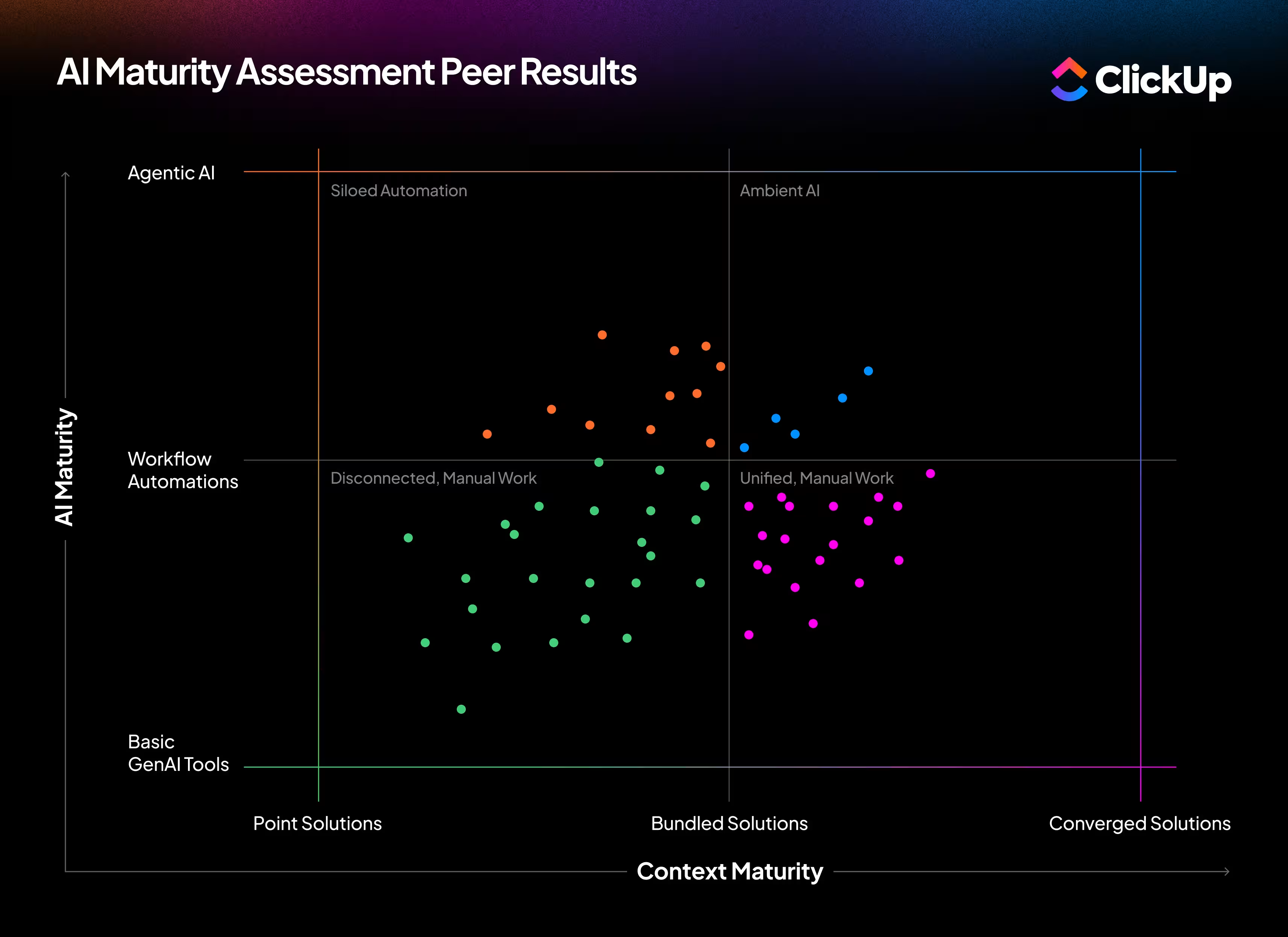
Some organizations begin with maturity assessments. These provide an objective baseline and help leaders understand where they actually stand.
Often, the results are surprising. At the same time, strategy and tooling may look solid, but capability and readiness score the lowest.
The most mature companies also build transparency into daily operations:
KPIs
Rollout metrics
Evaluation frameworks
These metrics keep progress visible. They make it harder for projects to look “green” on status reports while running “red” underneath.
I call this the Watermelon Effect. A project looks green on the outside, but is red on the inside.
Status reports look positive, yet real enterprise AI adoption is weak once you dig deeper. Calling that pattern out directly helps leaders understand why surface-level reporting can’t guide AI strategy.
When organizations combine external benchmarking with open internal visibility, honest assessment becomes normal. That honesty is what prevents stagnation and keeps the organization moving toward real maturity.
Summarize this article with AI
ClickUp Brain not only saves you precious time by instantly summarizing articles, it also leverages AI to connect your tasks, docs, people, and more, streamlining your workflow like never before.
Summarize this article for me please
The Turning Point Most Companies Miss
A major turning point happens when leaders see that the real constraint isn’t technical.
Maturity assessments often reveal the same gap: the tooling and governance look solid, but the people side hasn’t caught up.
That realization changes the strategy. Instead of buying more tools or building more architecture, they start investing in the people who will scale AI inside the business.
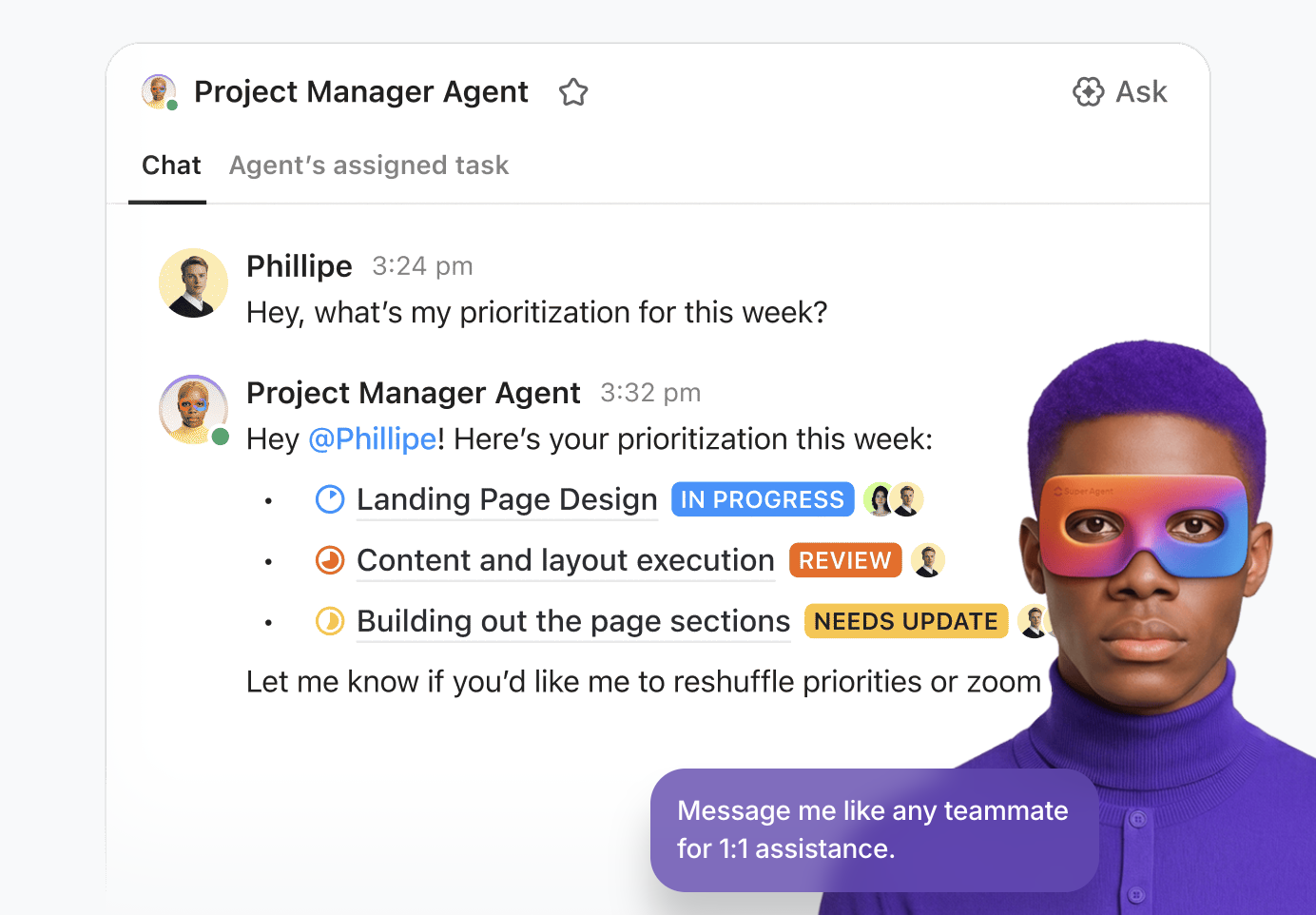
This is often the point where AI stops being treated as a tool and starts functioning as part of the system. Super Agents are built for exactly that transition.
Speed up workflows with Super Agents in ClickUp
Super Agents function as AI teammates inside the workspace. They monitor work as it unfolds, act on defined triggers, and handle routine execution like follow-ups, reporting, or surfacing risks. Instead of relying on people to remember what needs attention, the system itself helps maintain momentum.
That shift matters because scale breaks manual oversight. When AI can observe, act, and escalate within guardrails, leaders stop depending on heroics and start building resilience into operations.
And when people have the tools and freedom to automate their own work? Results can be surprising. Teams create solutions that leadership never would have scoped. Small wins become reusable patterns. Trust in AI grows organically.
This shift from tech-first to people-first is usually the moment when organizations start to see real transformation.
A quick diagnostic table:
Signal
You are in pilot mode
You are scaling
Where AI lives
In a few tools and a few people
Embedded in daily workflows
How success is measured
Anecdotes and demos
Adoption, quality, time saved, output impact
Who owns it
Innovation team or one champion
Leaders and managers across functions
How patterns spread
Random and informal
Community of practice and a workflow catalog
Risk and governance
Unclear or reactive
Defined standards and review paths
What breaks
Fragmentation and trust
Continuous improvement loops
If your organization is mostly in the left column, you are not behind. You are normal. But you need to stop pretending pilots equal maturity.
Summarize this article with AI
ClickUp Brain not only saves you precious time by instantly summarizing articles, it also leverages AI to connect your tasks, docs, people, and more, streamlining your workflow like never before.
Summarize this article for me please
What This Means for Leaders
If you’re leading this work, here’s what actually moves the needle:
Let your experts show you what’s possible. The best ideas often come from the people closest to the work
Invest in training. Not just tool training. Real capability building
Make it safe to experiment and fail. Innovation requires permission to try things that might not work
Build a culture where innovation is expected, not just tolerated
And don’t wait for perfect. The companies that move now, with honesty and focus, are the ones that will pull ahead.
If you’re still measuring progress by the number of pilots you have running, you’re missing the point. Real maturity shows up in how work gets done every day. You see it in the way teams talk. The way they solve problems. The way they share what they learn. That’s the stuff that lasts.
Summarize this article with AI
ClickUp Brain not only saves you precious time by instantly summarizing articles, it also leverages AI to connect your tasks, docs, people, and more, streamlining your workflow like never before.
Summarize this article for me please
Get Your AI Maturity Report
Ask the uncomfortable questions. Be ready to act on the answers. That’s how you move from pilots to progress.
Summarize this article with AI
ClickUp Brain not only saves you precious time by instantly summarizing articles, it also leverages AI to connect your tasks, docs, people, and more, streamlining your workflow like never before.
Summarize this article for me please
Frequently Asked Questions
What is an AI maturity assessment, really?
It is a structured way to measure how ready your organization is to scale AI beyond pilots. Not just tools, but workflows, governance, training, measurement, and adoption.
We already have AI pilots. Does that mean we are mature?
Not necessarily. Pilots prove the possibility. Maturity shows up when AI changes day-to-day work across teams, with standards, measurement, and repeatable patterns.
What is the biggest reason AI initiatives stall?
Fragmentation. Work is scattered across tools, teams, and handoffs, so AI outputs do not connect to execution. The other reason is the lack of quality and governance standards.
Do we need more tools to scale AI?
Usually no. Most teams need better workflow mapping, clearer governance, and training that helps people change how work runs. Tools matter, but they are rarely the constraint.
What should we measure to know if AI is scaling?
Adoption in real workflows, quality of outputs, time saved, cycle time improvements, error reduction, and business impact. If you cannot measure it, you cannot scale it.
What is a “community of practice” and why does it matter?
It is a cross-functional group that shares patterns and builds reusable solutions. It stops AI progress from staying trapped in pockets and turns individual wins into organizational capability.
Everything you need to stay organized and get work done.