






Still downloading templates?
There’s an easier way. Try a free AI Agent in ClickUp that actually does the work for you—set up in minutes, save hours every week.
Sorry, there were no results found for “”
Sorry, there were no results found for “”
Sorry, there were no results found for “”
For the last year, the word “Agent” has been everywhere. But for many, the experience has been a mix of curiosity and healthy skepticism about ROI, ease-of-use, and actual time-saving benefits.
We’ve seen chatbots that can write a poem but can’t move a task forward, and “agentic” tools that are basically interfaces that require more hand-holding than a new intern.
We wanted to see where our blog readers were at when it came to AI Agents. So we ran an opt-in survey across hundreds of professionals to find out where AI agents are winning, where they are failing, and what it will take for them to become a permanent part of the team.
We were stunned by the results.
That shows how fast the idea of agents is spreading, but also how abstract the category still feels in practice. Many tools claim to be agentic in theory, but cannot really participate in day-to-day work.
Super Agents in ClickUp live within the workspace and can operate autonomously within the rules and approvals you define. The best part? It looks less like “AI” and more like a virtual teammate that’s quietly keeping the work on track.
Most agents work in isolation. They respond to a single prompt without knowing how you like to do things, how you work, or your preferred processes.
ClickUp’s Super Agents work differently. They operate with 100% context pulled directly from your tasks, docs, chats, meetings, and updates in real time. And they retain recent, preference-based, and even episodic memory over time.
And that’s what turns an agent from a confident guesser into a proactive coworker who can keep up as work evolves.
🎥 As ClickUp CEO Zeb Evans shared, Super Agents are the first digital teammates that don’t just live in a chat box, they live where your work happens. They have the memory, the context, and the permissions to actually take work off your plate.
The expectation here is relief from low-value work, and that’s fair. If an agent needs ongoing setup, supervision, or prompting, it stops feeling helpful and starts feeling like more work.
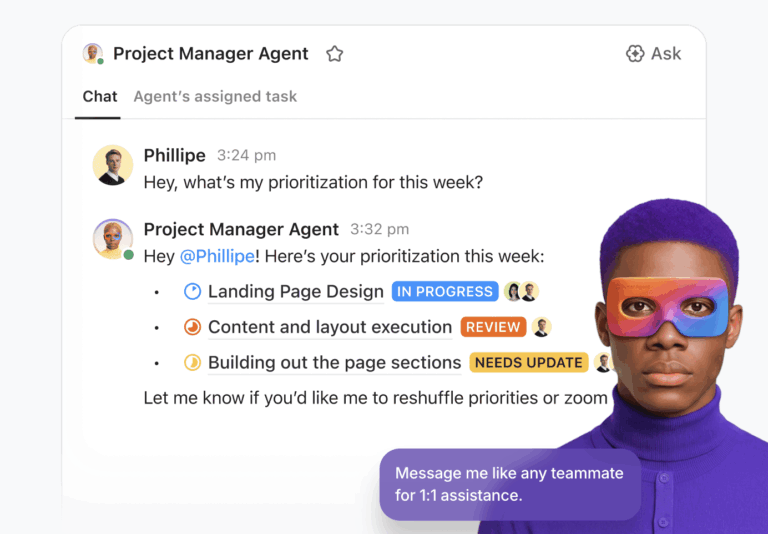
In ClickUp, Super Agents operate continuously in the background, updating tasks, drafting docs, and moving work forward with the same tools your team already uses. You can DM them for one‑off help, and even @mention them in a Doc to turn a brainstorm into a clear plan!
🌏 Leader Speak: According to a PwC survey, 88% of business leaders say their team or business function plans to increase AI-related budgets in the next 12 months due to agentic AI.
When agents feel too “early-stage” or even create more work than they remove, that frustration often shows up in the handoff. An agent summarizes a meeting, suggests next steps, or flags an issue, and then stops. You still have to create tasks from the action items, assign owners, update statuses, and follow up manually.
Super Agents are designed to take care of all those steps. They can use chain actions to turn meeting notes into tasks, update project statuses, route work to the right owners, and keep workflows moving inside the same system where execution happens.
When an AI agent can take work from “here’s what should happen” to “it’s already in motion,” the value becomes real.
Most of the time, a user doesn’t know where an agent lives, what it can access, or how its actions are governed once it’s running.
Super Agents are built as first-class users inside a governed workspace. They inherit the same user-level permissions as your team, ensuring explicit, controlled access from day one.
Every action they take is logged in real time, and for high-impact decisions, a human stays in the loop for approval.
Intelligence can move faster, operating firmly within the lines teams rely on for security and accountability.
📚 Also Read: Introducing ClickUp Super Agents
This makes sense because most AI agents fail when they don’t understand why decisions were made or how you want your work to flow.
Since Super Agents retain context, remember past decisions, and operate continuously, they’re able to act with far more reliability than prompt-based agents. They work from a living workspace history, stay active as work evolves, and operate within clear permission boundaries and audit trails.
When intelligence understands the work and carries it through safely, you’ll finally feel like you’re working with a virtual coworker you can rely on.
Clearly, the future of work isn’t just about AI that thinks; it’s about AI that does.
But a project management workflow isn’t exactly a checklist. It’s a moving system of tradeoffs, handoffs, and shifting priorities, where yesterday’s plan rarely reflects today’s reality.
ClickUp’s Super Agents are built to respond to the state of your work, not just instructions. They execute work on schedules you define and listen for triggers like questions being asked, new tasks being created, or forms being submitted, and can proactively flag issues!
🎥 Curious about how much tech knowledge it takes to build an AI Agent? Zero! Simply ask for what you need.
That confusion is understandable. “Agent” is often used for tools that suggest ideas or generate text, but don’t actually contribute meaningfully to the work itself.
A more practical definition is this: an agent observes what’s happening, understands context, and acts on your behalf to keep work moving. Super Agents are built to do exactly that inside the workspace, where your tasks, updates, and workflows already live.
Their value becomes evident through clearly defined actions, as they handle follow-through like summarizing activity, updating tasks, and supporting workflows without needing to be prompted every time.
🎥 AI agents shouldn’t be another AI tool that adds to your AI Sprawl. They only make sense if they can handle anything you throw at them. Check out how Super Agent tools work in ClickUp. 👇🏼
That kind of time rarely comes from speeding up a single step. Instead, it comes from collapsing multi-step workflows: the handoffs, follow-ups, and coordination work that quietly fill your day.
Super Agents in ClickUp can chain actions to move work forward from intake to follow-through in one flow, without needing each step to be triggered manually.
Because time can only be reclaimed via dozens of small transitions that no longer need constant human overview!
And they’re right. AI agents can help you stay organized by moving tasks forward, assigning ownership, setting deadlines, and handling routine follow-through that would otherwise get delayed.
However, it only works when an agent can take action on someone’s behalf within the right boundaries.
Operating inside a unified workspace where tasks, files, and conversations are already connected, Super Agents inherit the same user-level permissions as the people they support.
That means they can take action (move tasks forward, update statuses, or route information responsibly) without overstepping or needing constant oversight.
Data has to be piped in manually, permissions have to be redefined, and every workflow depends on a chain of integrations that can break or drift over time.
Good news? You don’t need to “connect” ClickUp’s Super Agents to your tasks, Docs, chats, or meetings. They are natively embedded in your Workspace, using the same objects, permissions, and workflows as any other human coworker.
Because integrations, access controls, and context are inherited from the workspace by default, agents can act immediately across tools without custom wiring. Forget configuring agents from scratch!
The data is clear: the era of generic AI is over. High-performing teams are looking for AI agents that:
ClickUp Super Agents was built to give your team this exact unfair advantage. You can make an agent for virtually every use case: marketing, project management, financial analysis, bug resolution, campaign management, and more. @mention, assign tasks, and message them directly. Plus, they’re always improving with infinite knowledge and memory, so they’ll grow alongside you.
Build your first AI Agent today!

© 2026 ClickUp

There’s an easier way. Try a free AI Agent in ClickUp that actually does the work for you—set up in minutes, save hours every week.