





Still downloading templates?
There’s an easier way. Try a free AI Agent in ClickUp that actually does the work for you—set up in minutes, save hours every week.
Sorry, there were no results found for “”
Sorry, there were no results found for “”
Sorry, there were no results found for “”
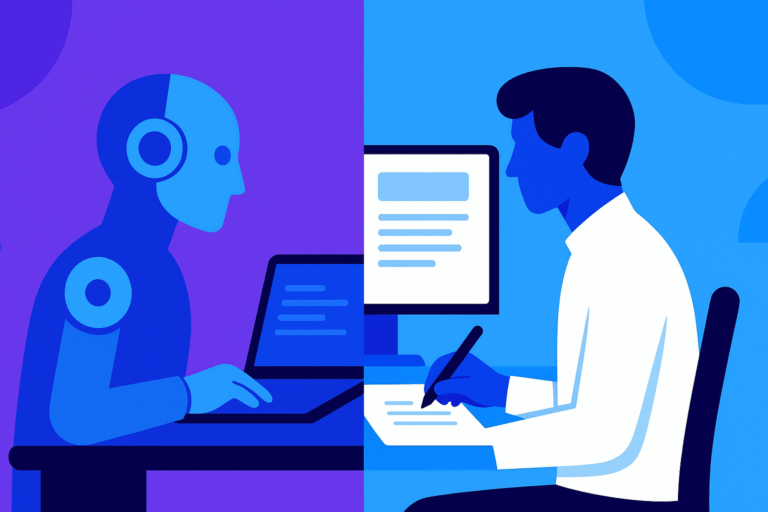
Summary: Will AI replace digital marketers or just reshape the job? Learn which tasks automate, which skills matter more, and how to plan your next moves.
AI won’t wipe out digital marketers, but it will reduce and merge roles that are purely executional, repetitive, or junior.
Positions centered on strategy, commercial outcomes, and integrated planning are far more resilient, while narrow channel-operator roles face the most pressure.
Across the stack, AI is taking on routine production and optimization work, from generating basic assets to tuning campaigns and surfacing simple insights. Your contribution shifts toward setting direction, making trade-offs, and ensuring quality and integrity.
Overall, the role’s moving up in complexity, even as some lower rungs on the ladder may shrink.
Before today’s AI tools, digital marketers spent much of their week producing assets, configuring campaigns, and pulling performance numbers. That work often limited how many ideas they could test and how deeply they could think about strategy.
Now, common tools generate first drafts, streamline setup, and provide quick-read views of results. In many teams, that’s shortened production cycles and reduced routine busywork.
Marketers who use these capabilities well spend more time on direction, refinement, and learning from experiments, while expecting that a meaningful share of their previous workload can be automated over time.
AI is becoming the default layer in ad buying, content systems, and analytics, not a side tool. Knowing the main trends helps digital marketers decide where to invest effort and which workflows will keep changing.
Platforms like Google and Meta run campaign types that auto-handle bidding, placements, and creative rotation if you feed clear goals and assets.
In practice, you move from micromanaging settings to defining objectives, tracking quality, and designing better inputs. Clients and leadership now expect marketers to set strategy while the system executes.
Many teams use AI to produce continuous streams of copy and creative variants for blogs, ads, and lifecycle campaigns. This changes expectations: you’re judged more on editorial judgment, testing plans, and brand coherence than raw writing speed. Some marketers describe their week as “less typing, more editing and thinking.”
Analytics tools and copilots answer natural-language questions about campaign performance and spot anomalies. Teams need stronger critical thinking about causality, experiment quality, and which insights are worth acting on. The copilot suggests; the marketer interprets.
Regulators and platforms are tightening rules on tracking, personalization, and synthetic media. Digital marketers must understand data privacy basics, consent, disclosure of AI-generated content, and brand risk before launching campaigns. Governance is now part of campaign planning, not an afterthought.
These trends all push digital marketers toward being orchestrators, not button-pushers. The next section spells out which capabilities now matter more and which can be safely offloaded.
As AI handles more routine execution and surface analysis, competitive advantage shifts to judgment, strategy, and collaboration. Digital marketers should treat AI as a multiplier on strong skills, not as a substitute for them.
Customer insight, positioning, experimentation, brand judgment, and cross-functional communication become more valuable because AI can’t fully own them.
Many marketers report spending more time editing, planning tests, and aligning with sales or product teams.
Make these skills visible through weekly habits: a recurring experiment review, regular customer calls, or scheduled time to refine prompts and compare AI versus human outputs. Use campaign results and case studies to demonstrate growth in these areas.
Routine content production, manual keyword and list building, basic reporting, and narrow single-channel tweaking are less differentiating as tools take them on. Understanding these tasks is still important for QA, but not as a primary value proposition.
Gradually hand these tasks to tools while keeping a light-review habit to check quality. For example, compare AI-optimized campaigns against manual baselines each week and document learnings. This turns offloaded work into a learning loop.
Marketing roles are growing faster than average, with advertising, promotions, and marketing managers projected to grow around 6–8% over a decade.
The Future of Jobs Report estimates AI will displace 9 million jobs but create 11 million by 2030. Demand for strategic marketing work is rising overall, even as some execution-heavy roles get squeezed.
Continued digital channel growth, stricter privacy regulation, and higher expectations for personalization and measurable ROI all increase the need for capable digital marketers. Automation trims low-value volume while amplifying expectations around complex, cross-channel work.
Pay tends to stay strongest where digital marketers sit close to revenue—performance, growth, lifecycle—and in complex or regulated sectors. Moving between sectors (for example, ecommerce to B2B SaaS) or into marketing ops or analytics can improve both stability and compensation.
Resilient paths include growth marketing, lifecycle and retention, performance roles with P&L responsibility, marketing roles in regulated industries, and hybrid marketing ops or AI oversight positions.
Choosing a niche and building toward it is a key lever marketers still control.
Uncertainty is best handled with small, deliberate experiments rather than big career bets. These steps fit alongside a full-time role and build compounding advantage.
Map where AI already exists in your stack—ad platforms, content tools, CRM—and volunteer to help document or improve those workflows.
Align with your manager on how AI will change campaign setup, reporting, and output expectations, so you’re seen as part of the solution.
Choose one focus area (for example, lifecycle, performance, content strategy) and design 1–2 AI-augmented experiments per quarter there. Use side projects or low-risk campaigns to practice and then package outcomes into case studies.
Add adjacent strengths over time, such as marketing analytics, marketing ops, or AI governance, to open paths into more resilient and senior roles.
Your long-term value lies in owning outcomes and systems that include AI, not just knowing a tool list.
AI is absorbing routine digital marketing work and raising expectations, not wiping out the need for humans who understand customers and revenue.
Digital marketers willing to learn AI, sharpen judgment, and collaborate across teams are likely to see richer roles, not just risk. Treat AI as infrastructure you learn to drive, not a verdict on your career.
Focus on learning strategy, measurement, and being the person who can QA and improve AI outputs on real campaigns. Volunteer to document workflows, spot errors, and suggest experiments. Your value shifts from execution speed to decision quality.
Lean into hypothesis design, creative testing, and cross-functional coordination around offers and audiences. AI handles mechanics; you handle the questions that guide it. Show you can frame problems, interpret ambiguous results, and align stakeholders.
Agencies may face more pressure on production volume and billable hours. In-house roles often tie closer to business strategy and revenue. Either way, owning outcomes and AI fluency help. Consider which environment lets you learn faster.
Specializations remain useful, but lean into cross-channel thinking, experimentation, and understanding how AI-driven platforms work. A channel specialist who can design tests and interpret system decisions is more valuable than one who only adjusts knobs.
Growth marketing, product marketing, customer success operations, or marketing ops use similar skills and benefit from AI familiarity. These roles reward campaign thinking, data fluency, and stakeholder management—all transferable from digital marketing.

© 2026 ClickUp

There’s an easier way. Try a free AI Agent in ClickUp that actually does the work for you—set up in minutes, save hours every week.