

Sorry, there were no results found for “”
Sorry, there were no results found for “”
Sorry, there were no results found for “”
A change can look like a great decision right up until people have to live with it.
Sonos learned that the hard way. In May 2024, it replaced its familiar mobile app with a major redesign. The update stripped out popular features, broke existing speaker setups, and triggered an immediate customer backlash.
Sonos later delayed two hardware launches and spent millions on app repairs. Its CEO publicly apologized, admitting “too many” customers had hit problems and that Sonos should have warned them about missing features.
That’s the gap change management software is designed to close. The right platform gives your work a visible structure, so you can clearly assess risk, line up stakeholders, manage approvals, schedule rollouts, gather feedback, and track adoption long after launch day.
We reviewed the leading options to identify the 10 best change management tools for a range of change management initiatives, from IT releases and digital adoption to company-wide transformation.
Change management software is a tool that helps organizations plan, approve, execute, and track changes to their processes, technology, or people, while limiting disruption.
In practice, products sold or used for change management generally fall into four broad groups:
For example, Microsoft used Prosci’s change management platform and methodology to help customers adopt new Microsoft technologies. Teams used a shared framework to assess readiness, train employees, manage resistance, and measure adoption. Microsoft reports that the approach increased customer adoption rates by 450%.
Here’s a quick side-by-side view of the top change management tools, grouped by what each one handles best, whether that’s IT change control, software adoption, cross-functional execution, or people-side transformation.
| Tool | Best for | Standout feature | Pricing* | Where it taps out |
|---|---|---|---|---|
| Freshservice | Integrated ITSM change control | ITIL-based change requests with risk scoring, approval paths, CMDB links, and Freddy AI | Paid from $19/agent/mo | Not as strong on employee sentiment, adoption tracking, training, and people-side change |
| Jira Service Management | DevOps and engineering changes | Automated change risk assessment, CI/CD gating, change calendar, and Jira-native approvals | Free; paid from $20/agent/month | Needs Atlassian setup skills to manage workflows, permissions, services, and automation |
| Prosci Proxima | Methodology-led organizational change | ADKAR-based guidance, PCT assessments, Kaiya AI, and access to Prosci research | Paid from $149/year (Proxima access plan starts at $499/year) | Guides change strategy, but does not manage task ownership or implementation work |
| ClickUp | Cross-functional change programs | Change templates, Forms, Docs, Dashboards, Automations, AI Notetaker, and ClickUp Brain | Free; paid from $7/user/mo | Does not provide a prescribed methodology or dedicated ITIL change control system |
| Whatfix | In-app software adoption | Walkthroughs, Smart Tips, Self Help, Product Analytics, and Whatfix Mirror | Custom pricing | Guides adoption across connected apps, but isn’t the system of record for approvals or delivery |
| WalkMe | Enterprise-wide digital adoption | Cross-app guidance, automation, surveys, WalkMe Discovery, and enterprise adoption analytics | Custom pricing | Requires specialist setup and another system for the wider transformation plan |
| ServiceNow ITSM | Large-enterprise IT change governance | CMDB-based impact analysis, change approval policies, conflict detection, and Now Assist | Custom pricing | Heavy, expensive, and often needs months of setup plus dedicated experts |
| monday service | Visual, no-code change tracking | WorkForms, custom boards, automations, dashboards, and multiple planning views | 14-day trial; paid from $31/seat/mo | Lacks deep CMDB impact analysis, formal risk engines, and audit-grade IT controls |
| ManageEngine ServiceDesk Plus | Visual ITIL change design | Drag-and-drop change workflows, CAB routing, rollout plans, calendars, and asset links | Custom pricing | Dense setup once roles, rules, assets, and multiple workflows enter the picture |
| Howspace | Participatory organizational change | Guided journeys, discussions, polls, segmentation, translation, and AI theme clustering | Custom pricing | Good for dialogue and buy-in, not IT governance, ticketing, or delivery tracking |
Our editorial team follows a transparent, research-backed, and vendor-neutral process, so you can trust that our recommendations are based on real product value.
Here’s a detailed rundown of how we review software at ClickUp.
When picking the right tool for change management, start by naming your change type, because it dictates everything else. An IT team gating a production release needs risk scoring and a CAB; an HR leader running a reorg needs stakeholder mapping and sentiment tracking. Buying across those lines is how teams end up with shelfware, i.e., software that sits idle but costs you money.
Beyond fit, these are the capabilities that separate a real system from a glorified checklist:
Here’s a breakdown of the 10 best change management tools available today:
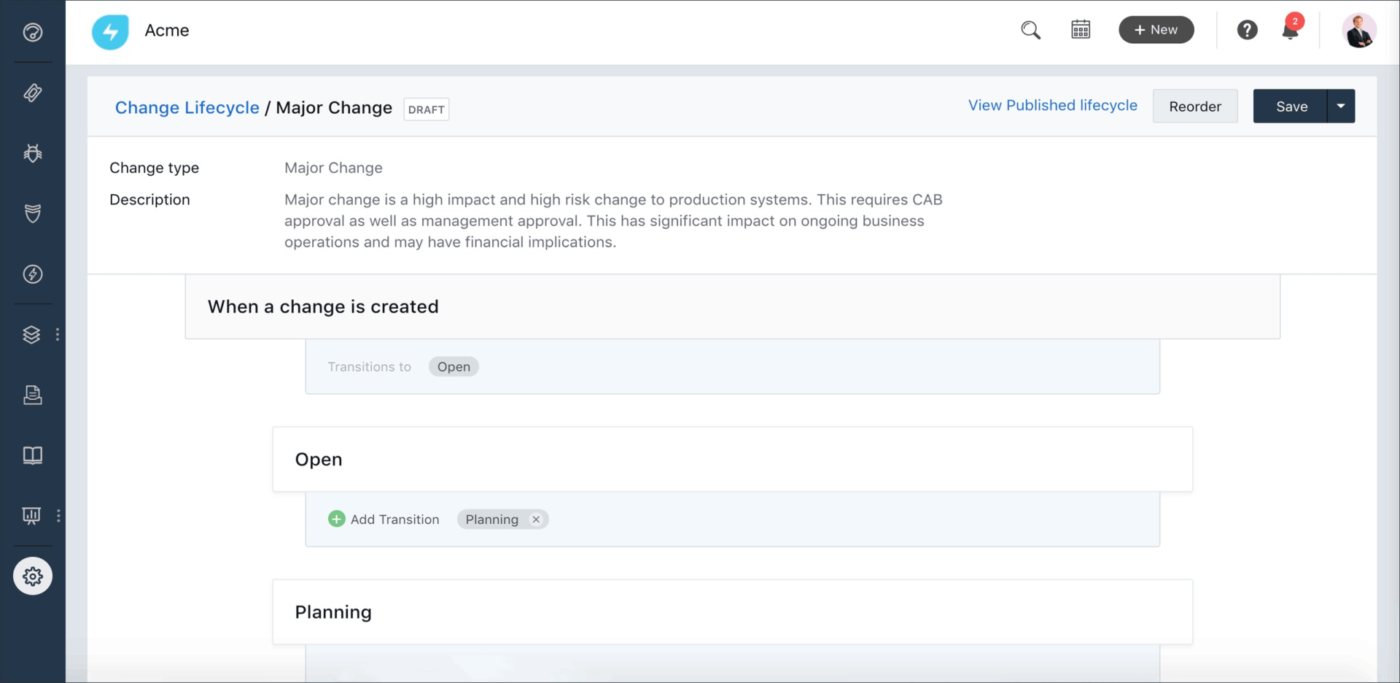
Freshservice is a cloud-based IT service desk from Freshworks, built on ITIL best practices. Change is one of the areas it handles best. Instead of a rushed edit, each change becomes a request that gets planned, scored, approved, and reviewed on the record.
And that structure is how Freshservice earns its spot on this list. Every change opens as a form that captures the rollout plan, backout plan, and implementation schedule in one place. From there, it follows the approval path you configure for its type. Routine, low-risk work clears on a pre-approved template with no board involved. Meanwhile, higher-impact changes route to the CAB and wait for sign-off. A risk survey automatically scores each one and flags any request scheduled during a code freeze.
Freddy AI also helps with the surrounding admin work. It can summarize records, classify tickets, assist agents, and reduce the manual triage that builds up during busy release periods.
A G2 user says:
What stood out to me with Freshservice is how it pulls multiple moving parts into one place. Before this, we were juggling different tools for service requests, asset tracking, and internal workflows, which created gaps in visibility. Freshservice made it easier to centralize everything, especially with incident and change management. The interface is fairly clean and doesn’t feel overwhelming once you get used to it.
Where it taps out: Freshservice handles technical change control well, but it does little for the human side of organizational change. Communication planning, employee sentiment, training, resistance, and adoption tracking need another system or process.
Best for: Teams that live in a service desk and want change control that follows ITIL without a consultant to run it.
Skip it if: Your change challenge is organizational or cultural rather than technical.
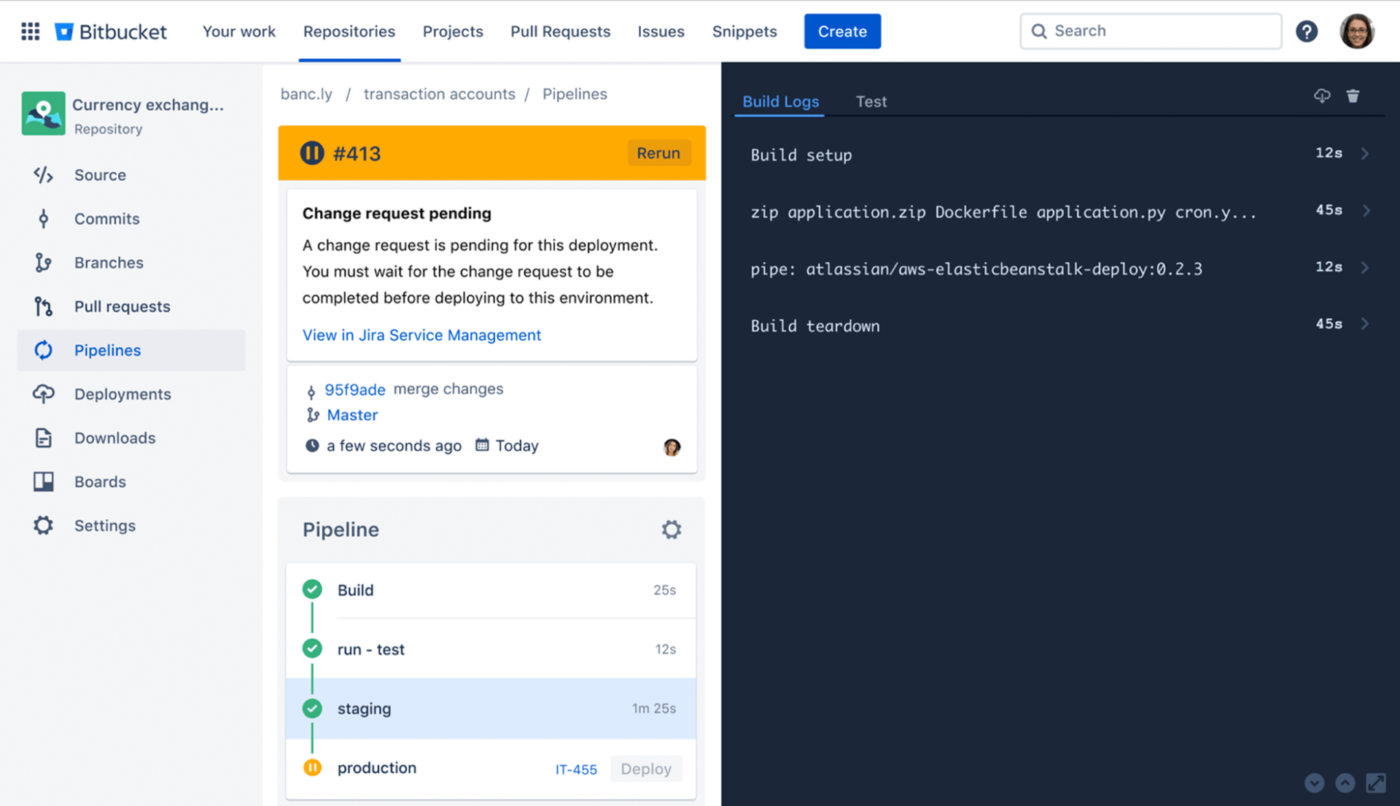
Jira Service Management (JSM) brings change control into the tools that development and IT ops teams already use. A deployment can create or update a change request on its own. It pulls in details from Jira and connected CI/CD tools. That saves engineers from re-keying the same information into a separate service desk.
Its biggest strength is automated pipeline gating. When a dev pushes code, the pipeline pauses. Jira checks the change right away. If the system finds a low risk, the pipeline proceeds to deploy. If there is a major risk, Jira freezes the pipeline. It then creates a ticket with full git commit data and alerts your review board.
Plus, Atlassian’s new AI helper, Rovo, makes reviews easy. It reads past incidents, trends, and files. Then, it explains why a change is risky and tells you how to fix it before you launch.
JSM offers users progressive pricing*:
*JSM is sold as part of Atlassian’s Service Collection; progressive pricing means per-agent cost shifts with team size.
A G2 user shares:
I think Jira Service Management’s powerful automation and its seamless integration with other tools like Jira Software and Confluence make it really valuable. I also appreciate its proactive problem management, streamlined change management, and accelerated incident resolution. It’s a very powerful tool that we need on a daily basis.
Where it taps out: Jira Service Management takes time to configure well. Workflows, permissions, services, automation rules, and deployment integrations get hard to manage without someone who knows the Atlassian setup.
Best for: DevOps and IT ops teams that want change requests, approvals, and deployment controls tied to engineering work.
Skip it if: Your team doesn’t use Jira and wants a simple change tool with little configuration.
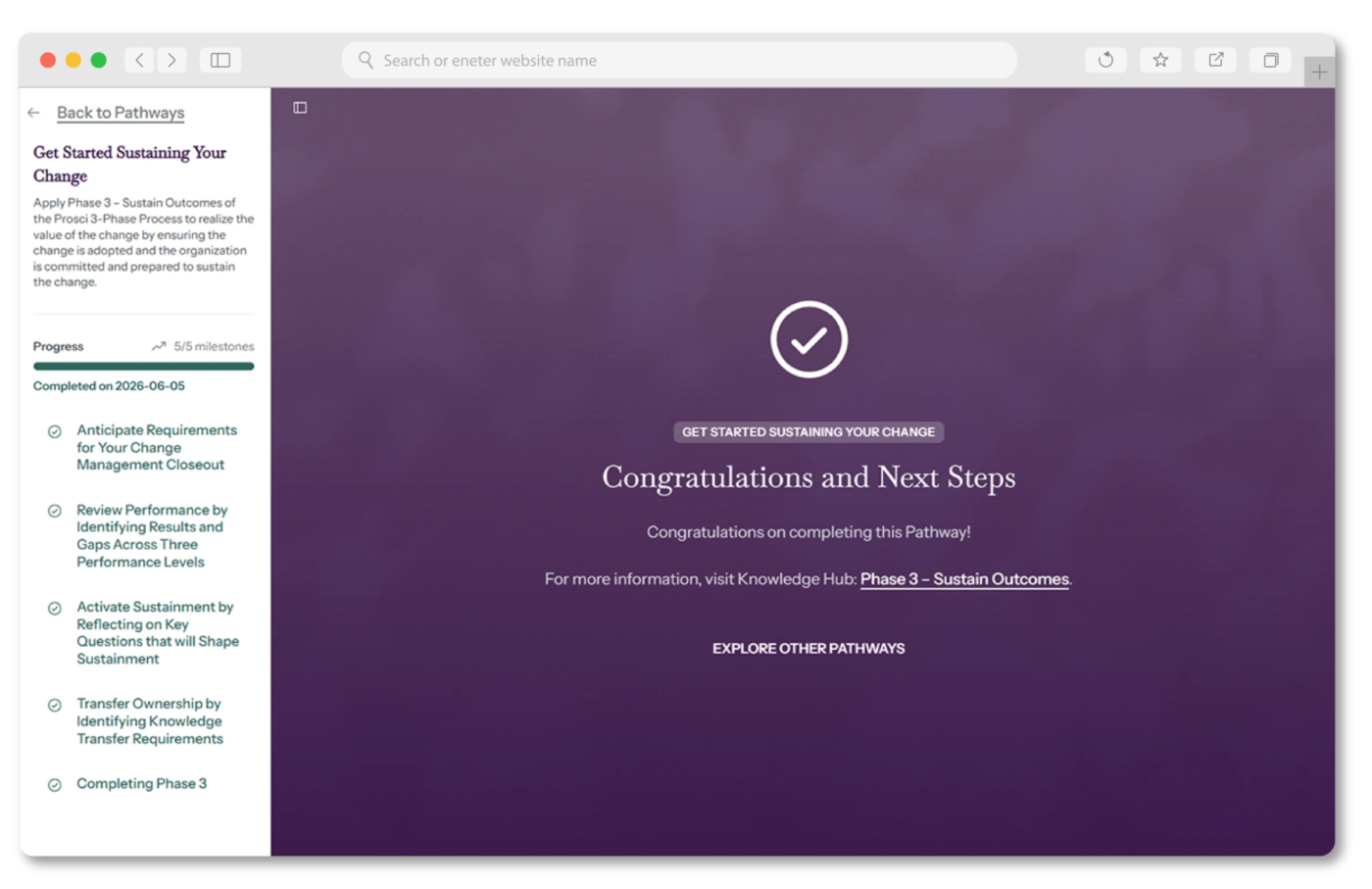
Prosci Proxima is a digital change coach for the human side of a rollout. It takes the Prosci Methodology, one of the most widely taught approaches to organizational change, and turns it into a guided workspace that covers the full arc, from early planning through adoption and reinforcement.
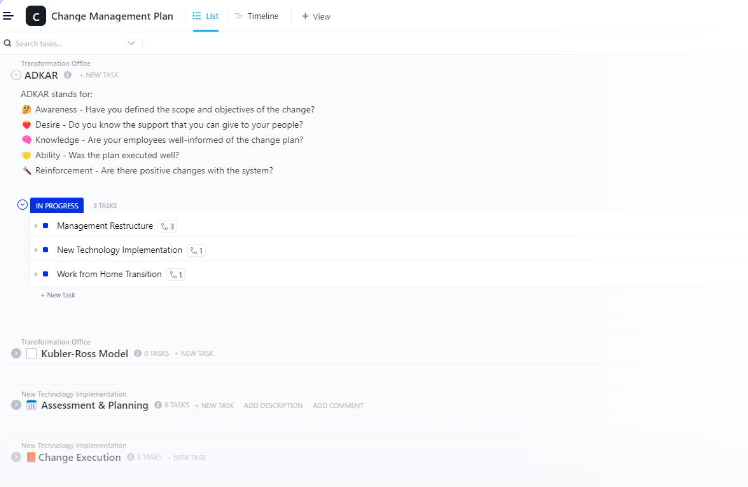
The ADKAR Model anchors it. ADKAR tracks the five outcomes a person has to achieve for a change to stick: Awareness, Desire, Knowledge, Ability, and Reinforcement. Around that, Proxima walks practitioners through Prosci’s 3-Phase Process with plain-language prompts. What should this change achieve? Who has to work differently? And what will they need to get there?
This pays off when a rollout crosses several teams or is under close executive watch. Sponsors and practitioners share one method for reading whether people are ready.
Where it taps out: Proxima guides the people side of change but doesn’t run the delivery plan. Teams still need a project management platform for task ownership, dependencies, deadlines, and day-to-day implementation.
Best for: Change management offices and transformation teams that want a proven method applied consistently across major organizational initiatives, with a focus on the people side of change.
Skip it if: You need one platform to manage both the change strategy and the operational work behind it.
ClickUp gives change teams one place to plan a rollout, run the work, and track what happens after approval. A request arrives through a ClickUp Form that captures its owner, risk level, and target date up front. From there, it follows a workflow you configure yourself. Review leads to approval, approval to implementation, and implementation to a documented closure.
Its real strength is in how tightly it connects the plan to the work beneath it. Stakeholder maps, communication plans, and training material all live in ClickUp Docs. Each one links directly to the tasks that carry it out, while dependencies ensure testing, briefings, and launches follow the right sequence.
ClickUp Brain runs underneath all of it without taking over the story. Ask it a question, and it reads across your workspace and connected apps to answer. It can trace why a decision was made, or surface work that has gone off track. ClickUp Super Agents can act as effective change managers, creating communication plans, ushering users through tasks, sending updates and reminders, tracking progress, and more.
A G2 user writes:
I really like the ease of use of ClickUp; it has made adoption in my company really simple, without obstruction. The graphics are also a great strength, as it makes it pleasant to use all day at work. The customization is fantastic, as it allows me to adapt each digital project to its unique scheme and replicate it easily. The ability to centralize everything is crucial for me. Additionally, I often use ClickUp’s tasks, documents, automations, and emails.
Where it taps out: The one thing ClickUp won’t hand you is a methodology. You set the stages, write the approval rules, and decide how you report. It’s also not an ITIL-certified change control system, so heavily regulated IT change governance may still want a dedicated ITSM tool alongside it.
Best for: Cross-functional teams that need change requests, stakeholder communication, training, approvals, and rollout work all connected in one place.
Skip it if: You need a prescribed methodology or a dedicated ITSM change control system.
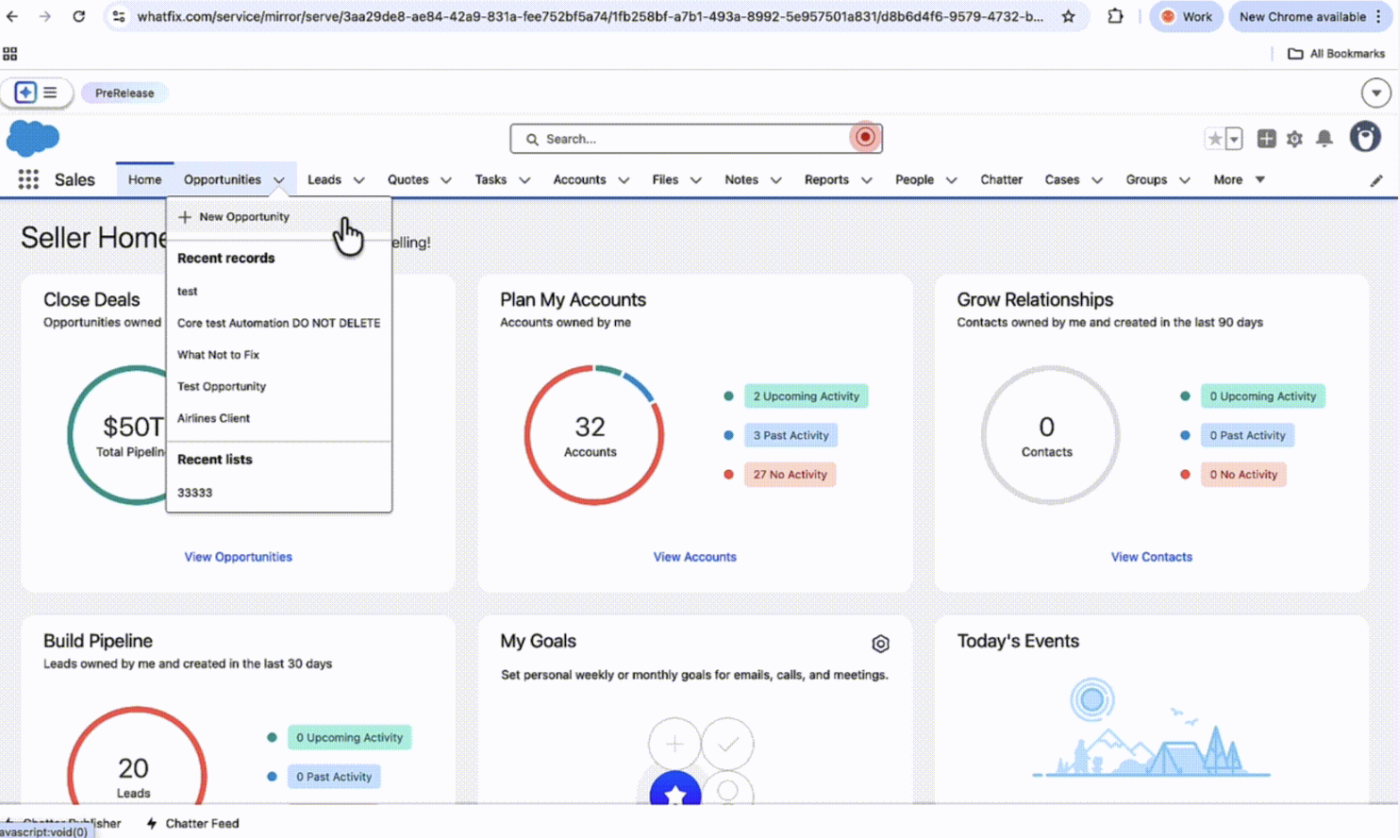
Whatfix’s core differentiator is that it is a DAP, a digital adoption platform. This is what makes it valuable during software-led change. A change team drops interactive walkthroughs, tooltips, and a self-help menu into the live application. Help then shows up exactly where someone gets stuck.
As the process evolves, the team updates the guidance without modifying the underlying software. Whatfix Product Analytics reveals which features people use, where they abandon a task, and which workflows cause the most friction.
Whatfix Mirror handles the rehearsal stage. It spins up a safe replica of the application where employees can practice a task without ever touching real data. That safety net earns its place in ERP, CRM, and HRIS rollouts, where one wrong click in production can snowball into a real problem.
A G2 user says:
What I like best about Whatfix is its smart in-app guidance that turns complex enterprise software into something that feels effortless and intuitive for every user. Instead of forcing people to hunt through manuals or watch long training videos, it delivers real-time, step-by-step walkthroughs, tooltips, and interactive prompts right inside the application itself. This means faster onboarding, fewer support tickets, and happier teams who can actually focus on their work rather than struggling with the tools.
Where it taps out: Whatfix handles adoption inside the software beautifully, but it won’t run the change program around it. Ownership, dependencies, approvals, and rollout milestones all live somewhere else.
Best for: Enterprises rolling out new CRM, ERP, HRIS, or other business software that need guidance inside the application.
Skip it if: The change doesn’t center on software use, or you need one tool to run the full transformation program.
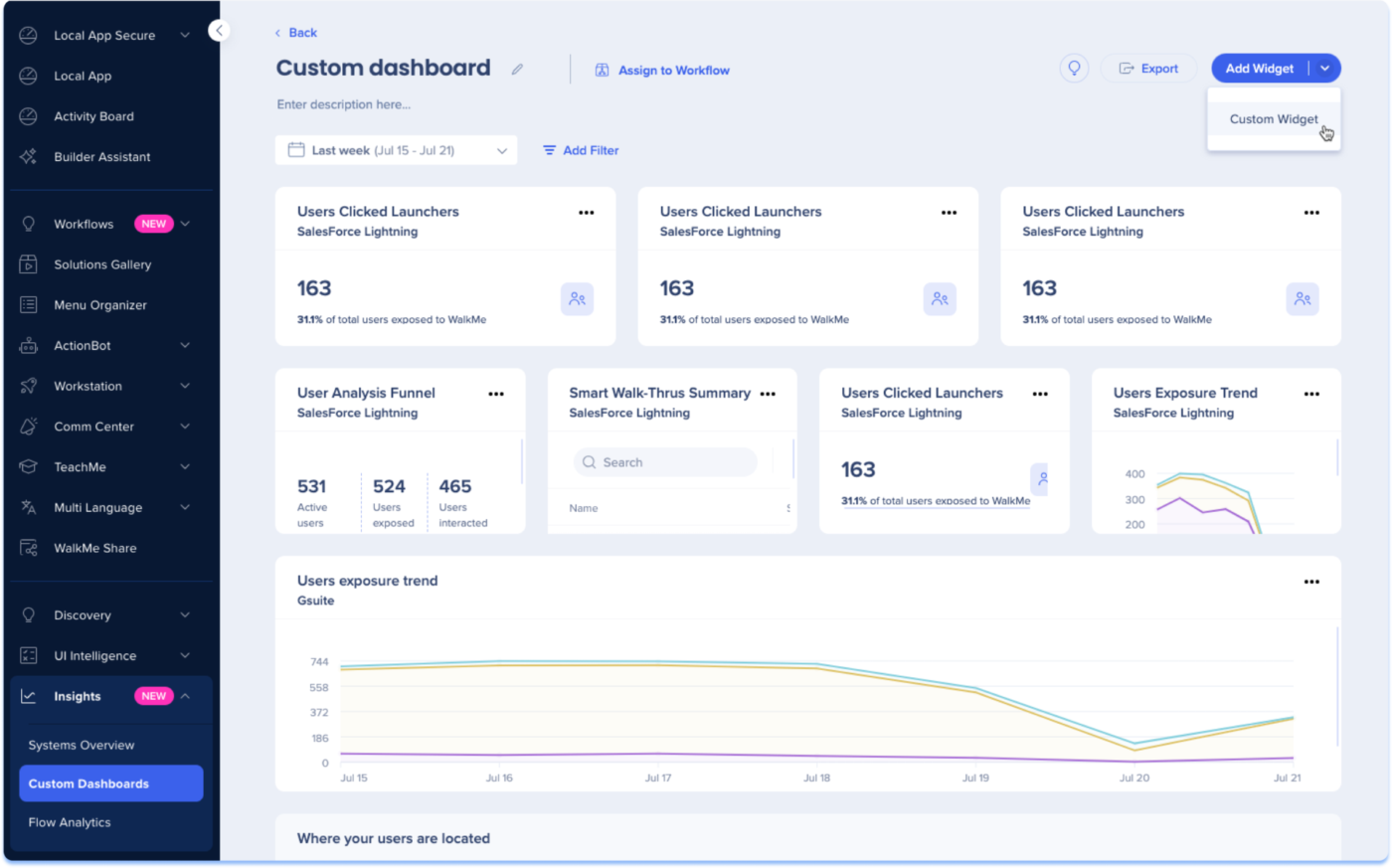
WalkMe is an enterprise digital adoption platform, now owned by SAP, that guides employees through software as they work. It layers in-app prompts, walkthroughs, self-help content, and automation over the business applications a company already runs.
Where it pulls ahead is the cross-system process. Say an employee kicks off a request in Workday, jumps to Salesforce, then finishes in some internal portal. WalkMe carries the guidance across all three rather than treating each as a separate training job. For a change program spanning a dozen tools, that continuity is the whole reason to get it.
WalkMe shows which apps people rely on most, where they bail out of a workflow, and which steps trip them up. WalkMe Discovery widens that lens to the whole software estate, mapping usage by app, department, and user, which surfaces low adoption, duplicate tools, and licenses nobody touches.
A G2 user writes:
WalkMe stands out for its robust digital adoption capabilities and overall flexibility. Being able to build highly customizable in-app guidance, paired with strong analytics and segmentation, helps us proactively support users and tackle adoption challenges at scale. It also integrates smoothly into complex enterprise environments, making it easier to standardize processes and reduce user errors.
Where it taps out: WalkMe takes time and specialist skill to build, test, and maintain across a large software estate. It supports adoption inside digital workflows, but teams still need another system for sponsors, budgets, dependencies, and the wider transformation plan.
Best for: Large organizations rolling out complex processes across several enterprise applications.
Skip it if: You need a lightweight adoption tool for a single application, or don’t have the resources to run an enterprise DAP.
Also Read: How to Drive Feature Adoption
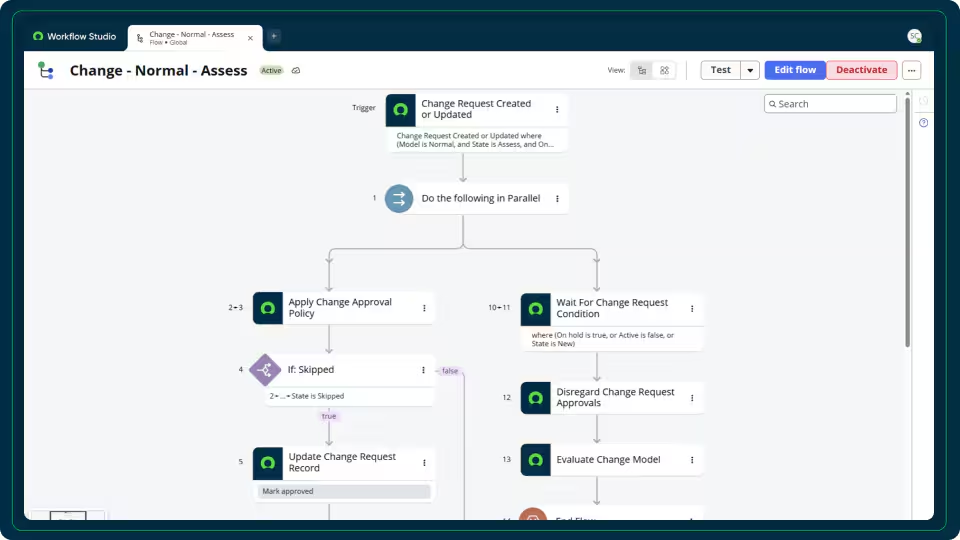
ServiceNow is one of the most widely used enterprise ITSM platforms. Big organizations run it when a single change can ripple across dozens of services, teams, and business units. Every change request stays wired to the incidents, configuration items, services, approvals, and work behind it. A reviewer sees the full blast radius before signing off on a high-risk update.
Standard, normal, and emergency changes each get their own workflow. Risk scoring routes every request to the right approvers. The change calendar lays out planned work, maintenance windows, and blackout periods on one timeline. Are two teams about to touch the same service at once? The conflict surfaces to the right person before either one ships.
The CMDB is the real anchor. Every change links to the configuration items and services it affects, which lets a reviewer trace what else depends on them before approving anything. Now Assist further summarizes a sprawling change request and explains in plain terms why it scored low, medium, or high risk.
A G2 user shares:
ServiceNow ITSM is built around standardized IT processes. It helps track and resolve IT incidents (for example, outages and bugs), handle employee service requests (such as laptop access or software installs), and manage changes to IT systems in a safe, controlled way. It also supports maintaining a configuration database (CMDB) of assets and their dependencies.
Where it taps out: ServiceNow is a massive tool. The setup curve is very long, often taking six months to a year. Making custom edits requires dedicated experts who know the system inside and out. For small teams, the high price and heavy maintenance needs are hard to justify.
Best for: Large enterprises and public-sector IT teams managing frequent, high-impact changes across complex services.
Skip it if: You need lightweight change control and don’t have the team or budget to run a large ITSM platform.
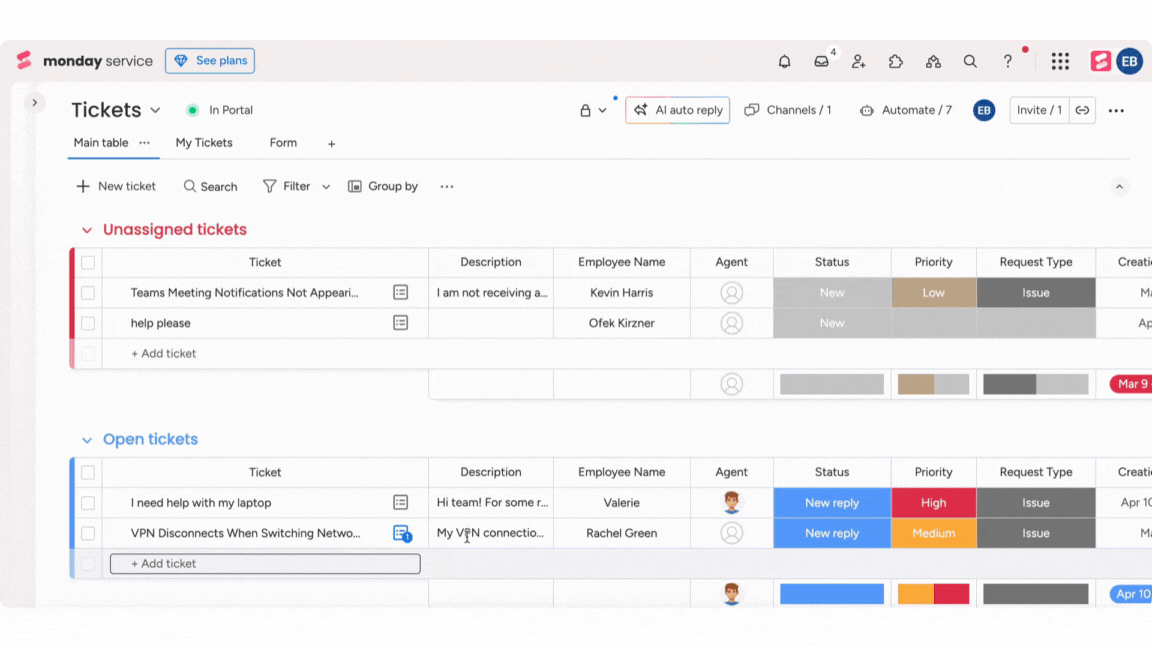
monday service is the service desk built on monday.com’s colorful, drag-and-drop boards. It’s aimed at teams that want to track change without standing up a full ITIL process first. A request lands through a form or a shared inbox and becomes a row on a board. Its owner, priority, affected service, risk level, target date, and approval status all sit right there in view.
The draw is that you bend the board to your process. Keep it as short as Submitted, Approved, Complete, or build a longer path with impact review, testing, rollout, and post-change verification. Automations then assign reviewers, nudge late approvals, flip statuses, and open follow-up tasks as a request reaches each stage.
Reporting is where the visual foundation pays off. A change lead can monitor open requests, work sorted by risk, overdue approvals, and team workload across boards on a single dashboard.
Note: There’s no permanent free plan for monday service. However, you do get access to a 14-day trial.
A G2 user writes:
The intuitive, customer-facing self-service catalog and portal builder has completely transformed how our captain and crew networks interact with our support desk. We can launch a clean, modern intake interface where yacht crews can instantly log mechanical requests, upload telemetry logs, or request dockside assistance.
Where it taps out: monday service can model a clear approval and tracking process, but it lacks the deeper CMDB-based impact analysis, formal change-risk engines, and conflict detection found in mature ITSM suites.
Best for: Teams that want an approachable, visual system for collecting and tracking change requests.
Skip it if: You manage highly regulated or high-risk IT changes that need formal service mapping and audit controls.
Also Read: How to Create a Change Management Checklist
ManageEngine ServiceDesk Plus is an ITSM platform from ManageEngine, the enterprise IT division of Zoho Corporation, and change enablement is one of its core practices. It moves an IT change from request to production without breaking a service along the way. Every change is logged, assessed for risk, presented to the appropriate approvers, and tracked through to a post-implementation review.
What sets its approach apart is how you shape that governance. Rather than settling for a single rigid process, you map each change type to its own path in a visual builder. A low-risk standard change can be cleared with a light review. A major change runs the full ITIL sequence, from planning and CAB approval to implementation, testing, and release.
Every request carries its rollout, backout, and test plans. It links to the incidents and assets it affects. And it’s recorded on a change calendar that already knows your maintenance windows and freeze periods. A reviewer sees the whole picture before authorizing anything, and no release collides with a code freeze.
A G2 user mentions:
I like best about ManageEngine ServiceDesk Plus is its easy-to-use interface, strong ITIL-aligned workflows, and powerful ticket automation. It helps streamline incident, problem, and change management, improves SLA adherence, and enhances overall service delivery and end-user satisfaction.
Where it taps out: ServiceDesk Plus offers a lot of control, but the wider setup gets dense once you add custom roles, business rules, assets, and several workflows. It’s also built for IT change enablement, not employee adoption or cultural change.
Best for: IT teams that want to map detailed, ITIL-aligned change workflows without writing code.
Skip it if: You need to manage the people side of a transformation rather than technical change requests.
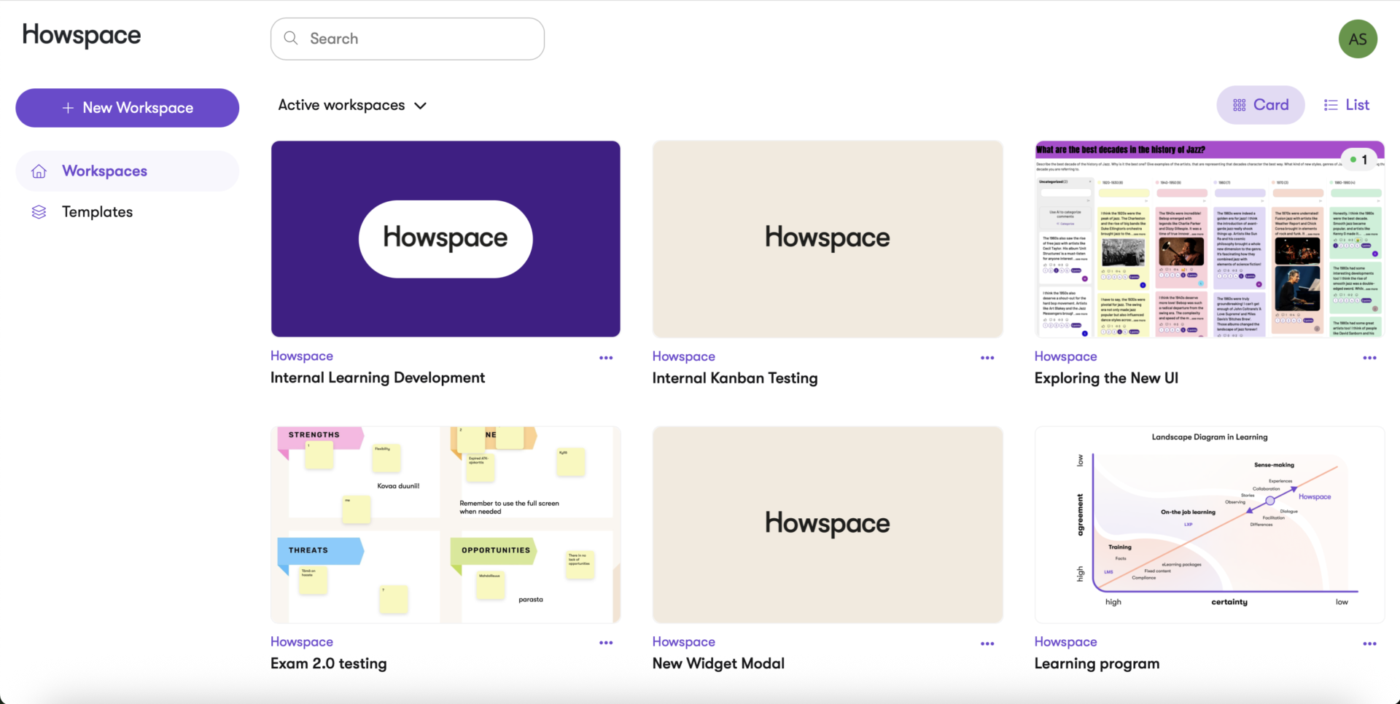
Howspace is a digital facilitation platform for change that people help shape rather than simply receive. Most tools in this listicle push a change down and measure who complied. Howspace works in the opposite direction. It opens a shared space where employees discuss, question, and co-create the change. Polls, workshops, reflections, and open dialogue carry the work before, during, and after a rollout.
That participatory bent fits the softer, slower change-management work: culture shifts, strategy resets, leadership programs, and big transformations where people need time to absorb a new direction. A facilitator guides everyone through a live or self-paced journey. They break a large group into smaller ones, gather anonymous input, and keep the thread alive between sessions. The content can be customized for different roles, too, which matters when a single change hits people in very different ways.
Howspace’s AI shows its worth once responses number in the hundreds. It summarizes long discussions, clusters similar ideas into themes, and flags what needs attention. A change leader can read the room, see where support is real and where resistance is building, without combing through every comment.
A G2 user says:
A flexible tool for every educator who wants to create a unique space for recipients to learn, share, and interact with others. Howspace works great as a platform for conducting interactive meetings and seminars, self-paced courses, and cohort courses.
Where it taps out: Howspace helps people discuss, understand, and shape a change, but it doesn’t manage technical approvals, risk scoring, service dependencies, or CAB workflows. Teams usually need a separate project tool to assign and track the implementation work that comes out of those sessions.
Best for: Change leaders running participatory transformations, culture programs, and large-group workshops.
Skip it if: You need IT change governance, ticketing, or detailed delivery tracking.
The right pick comes down to one question you need to ask yourself: what kind of change are you managing? The ten tools here answer four different versions of that question, and a tool built for one rarely does the others well.
If your change is technical, an IT update that has to reach production without breaking a service, you want ITSM.
If your change is about people, adoption, culture, and getting buy-in, the lane is different.
If your change is software-led, teaching people a new system, you want a digital adoption platform.
And if your change is all of the above, a rollout that needs strategy, approvals, and the delivery work in one place, then go for ClickUp. It connects the plan to the work like nothing else on this list, though it won’t hand you a certified methodology.
One last filter: Be honest about your team. A tool that needs dedicated admins and a six-month setup is a liability for a five-person team, and a lightweight board is ineffective for a regulated enterprise. Match the tool’s weight to the weight of your change, not to the length of its feature list.
Target hit Canada at a sprint, opening 124 stores in roughly ten months in 2013. Under the hood, teams were doing far more than opening doors. They swapped familiar systems for a new SAP stack, stood up brand-new distribution operations, loaded thousands of product records, and trained a mostly new workforce, all at once.
But the cracks showed up almost immediately. Product data was unreliable. Inventory counts didn’t match what sat on the shelves. Distribution centers filled up with goods that never made it to stores. To keep things moving, employees started working around the system, which only made the data worse. And still the rollout pushed on, because the store-opening calendar wouldn’t budge.
The result was almost surreal: empty shelves out front while warehouses sat packed in the back. Target pulled out of Canada in 2015, less than two years in, after losses ran into the billions. The software took some of the blame, but the real failure was a lack of readiness. Too many dependent changes went live together, on shaky data, with no room to pause, learn, and fix.
What it teaches us about change management: A green project plan doesn’t mean the organization is ready. Before you roll out, pressure-test the data, the frontline workflows, the training, the supply chain, and your rollback conditions together. And give your team real authority to hit pause when those conditions aren’t met.
Target Canada shows what happens when implementation outruns readiness. Rutgers University Foundation took the opposite approach, treating adoption as part of the rollout from day one.
In this ClickUp customer story, the team explains how it supported employees through the change and reached a reported 100% AI adoption rate:
Launch day only tells you the change shipped. It doesn’t tell you whether people adopted it, if the new process actually works, or whether the business got the result it hoped for.
Track a small set of measures after launch, grouped into three areas: adoption, performance, and business impact.
Compare each metric with a pre-change baseline. A 70% adoption rate means little on its own if usage is shallow, errors are climbing, or people still lean on the old process.
The strongest scorecard pairs one adoption metric, one performance metric, and one business outcome. That keeps the team focused on three questions: is the change being used, does it work, and was it worth doing?
Often, the subscription cost you see on a tool’s pricing page is rarely the full bill. A tool that looks affordable per user can become expensive once implementation, training, integrations, and ongoing administration enter the picture.
Watch for costs such as:
Ask vendors for the total first-year cost, not just the license price. Include setup, training, support, migration, integrations, and the internal hours needed to keep the system running.
Failed change usually comes down to a coordination gap: the system that shipped before people were ready, the approval nobody logged, the rollout no one could see end-to-end. Every tool on this list exists to close one version of that gap, which is exactly why buying the wrong type costs you twice.
So, again, start from the change, not the feature list. Name what you’re managing—a technical release, a culture shift, a software rollout, or all three at once—and the shortlist picks itself. The teams that get this right are the ones whose tool matches the weight of the change in front of them.
If yours keeps stalling in the space between the plan and the work getting done, that’s the layer ClickUp is built for.
Start managing change in ClickUp for free.
Change management is the broad discipline of guiding people and processes through a transition; change control is the narrower, IT-owned process of documenting, approving, and deploying a specific technical change. Change control is usually one step inside a wider change management effort. Tools like ServiceNow and Jira Service Management handle the control side, while a platform like Prosci Proxima handles the people side.
Change management software ranges from free to tens of thousands per year, depending on the category. ITSM tools price per agent, from Freshservice at $19/agent/mo up to enterprise platforms like ServiceNow, which is custom-quoted. Work platforms price per user (ClickUp from $7/user/mo, with a free tier). Most organizational-change and digital-adoption platforms (WalkMe, Whatfix, Howspace) are custom-quoted too, often in the tens of thousands annually. Always confirm current pricing on the vendor’s site before budgeting.
Treat the platform rollout like any other change. Start with a small group, build the workflow around work people already do, and remove duplicate reporting wherever possible. Keep forms short, automate routine updates, and show each team what value the platform brings. Managers should use it in meetings and decisions too. Track active use, incomplete tasks, repeated support questions, and work that still happens outside the system. Low adoption often points to a poor workflow or unclear value, not employee resistance. Finally, set reasonable but non-negotiable deadlines for adoption
An ITSM tool governs technical change: risk scoring, approvals, and a CAB before code reaches production. A digital adoption platform (DAP) sits inside an application and teaches employees to use it with in-app walkthroughs and tooltips. Put simply, ITSM controls whether a change ships; a DAP drives whether people actually adopt it once it does.
Not really. No single tool specializes in both, which is why most teams pair two. ITSM and organizational-change platforms are built for opposite problems, so companies typically run one of each alongside a work management platform that ties the plan to the delivery work. Match each tool to the layer it’s built for, rather than forcing one to cover everything.
Not always. A five-person team rolling out one tool rarely needs a full ITSM suite or a six-month implementation; a lightweight board or a work platform’s free tier is usually enough. Dedicated change software earns its cost when change is frequent, high-risk, or spread across multiple departments and systems. Match the tool’s weight to the weight of your change.
AI is shifting these tools from record-keeping to decision support. Vendors now use it to summarize sprawling change requests, score risk, predict which changes are likely to fail, and cluster employee feedback into themes. Examples include ClickUp’s Brain, ServiceNow’s Now Assist, Atlassian’s Rovo, Freshworks’ Freddy AI, and Prosci’s Kaiya. The value is triage and pattern-spotting, not replacing the human judgment behind an approval.

Arya P Dinesh
Max 18min read
Arya P Dinesh
Max 20min read

Praburam Srinivasan
Max 45min read

© 2026 ClickUp





