






Still downloading templates?
There’s an easier way. Try a free AI Agent in ClickUp that actually does the work for you—set up in minutes, save hours every week.
Sorry, there were no results found for “”
Sorry, there were no results found for “”
Sorry, there were no results found for “”
Here’s something that keeps me up at night: I watch companies rush to deploy AI agents, implement the latest models, and hire AI specialists. All while their fundamental work infrastructure is still scattered across a dozen disconnected tools.
They’re trying to build the penthouse before they’ve poured the foundation.
I’ve seen this movie before. In my years in sales, marketing, and business intelligence, I watched companies layer new technology on top of broken processes and expect transformation. It never works.
And with AI, the stakes are even higher because AI doesn’t just execute workflows. It learns from them, amplifies them, and compounds them.
Which means if your foundation is fractured, AI will just help you fail faster.
In physics, a flywheel is a mechanical device that stores rotational energy. Once you get it spinning, it builds its own momentum. Each rotation makes the next rotation easier. The energy compounds.
In business, a flywheel represents a self-reinforcing cycle where each component strengthens the others, creating exponential returns rather than linear gains.
Amazon’s classic flywheel? Lower prices attract more customers, which attracts more sellers, which creates more selection, which attracts more customers.
Each component feeds the next, and the whole system accelerates.
Most companies right now? They’re not spinning flywheels. They’re dragging triangle wheels. Clunky, disconnected systems that jerk forward and stall every few inches.
This is what happens when your tools are disconnected: it creates Work Sprawl.
| Triangle Wheel | AI Acceleration Flywheel |
|---|---|
| Scattered tools and shadow systems | Unified tools in one workspace |
| Siloed data, surface-level AI | Centralized context, deep intelligence |
| Manual workarounds | Native automation and agent support |
| Frustrated teams | Compounding engagement |
| Slow, expensive transformation | Accelerating momentum |
You can’t spin a triangle. You can only push it. Over and over.
⚠️ AI investment without maturity is just expensive experimentation
Before you add another agent, model, or AI initiative, you need to know whether your infrastructure can actually support it.
The ClickUp AI Maturity Assessment benchmarks your readiness for real AI transformation across unified tools, context, and operations.
It shows why AI feels underwhelming today and what to fix first to unlock compounding returns.
👉 Take the AI Maturity Assessment and see what stage your flywheel is really in.
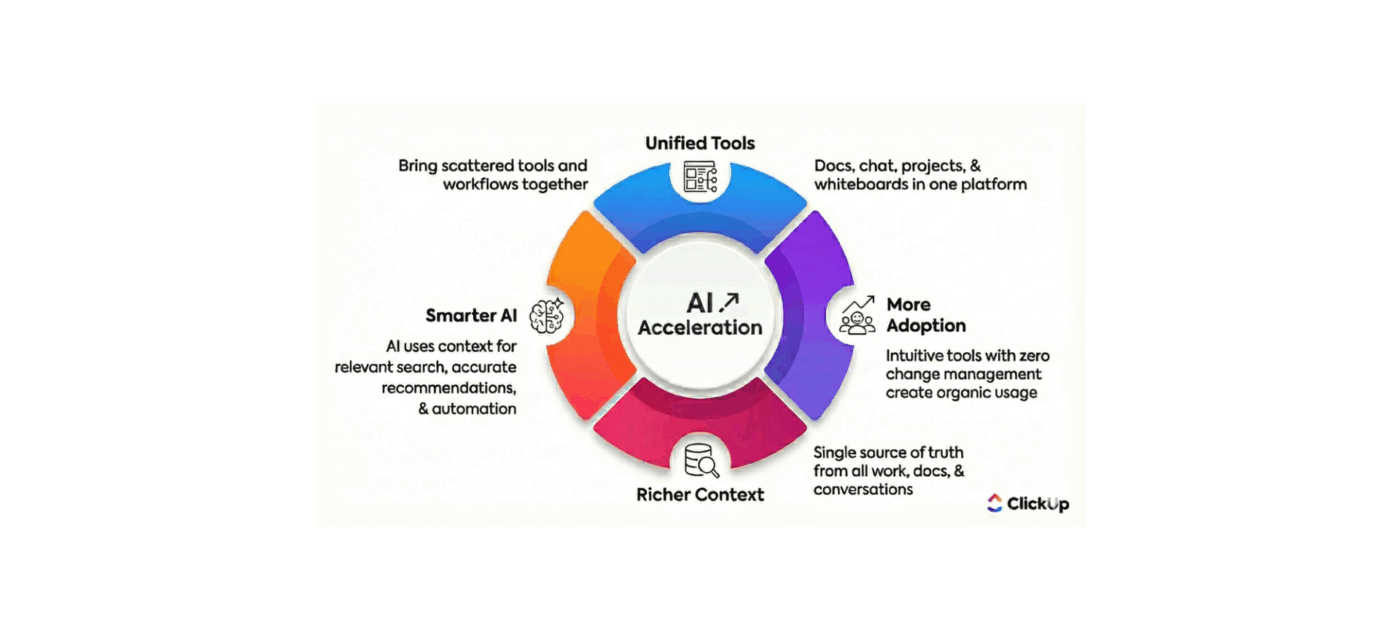
The AI Acceleration Flywheel is a self-reinforcing system where unified tools, centralized context, and intelligent automation continuously amplify each other. This creates compounding value from your AI investments over time.
Unlike fragmented tech stacks that slow down adoption and dilute AI’s impact, this model builds momentum:
Better tools → More adoption → Richer context → Smarter AI → Better tools.
Here’s what I’ve observed:
After working with hundreds of companies at different stages of AI maturity, one pattern stands out:
The companies making real, sustainable progress aren’t the ones chasing the latest models or hiring the biggest AI teams.

They’re the ones who’ve built an AI Acceleration Flywheel, whether they call it that or not.
Here’s how it works in practice:
All the surfaces people actually work on: Docs, Chat, Projects, Dashboards, Whiteboards, Time Tracking, and AI Agents. Not loosely integrated. Not “connected” workflows that break every other week. Truly unified in one Converged AI Workspace.
This is critical. If adopting your unified platform requires six months of training and process overhaul, people won’t use it consistently.
The tools have to be intuitive because they’re connected. The value has to be obvious. When tools naturally work together, adoption happens organically.
This is where it gets interesting. When people are actually working in one place, you build a comprehensive context base.
All your knowledge, all your docs, all your projects, all your conversations, and all your meeting notes. Everything in one space, creating a single source of truth.
Here’s the flywheel effect: the unified context doesn’t just sit there. It feeds back into your tools, making them smarter.
Your AI capabilities now have comprehensive knowledge to leverage. Your search becomes more relevant. Your recommendations become more accurate. Your automation becomes more intelligent.
And here’s the key: this makes people want to use the tools more, which creates more context, which makes the tools more valuable. The flywheel accelerates.
🎥 If your organization has “AI everywhere but impact nowhere,” this video breaks down the real reasons most AI initiatives fail and how scattered chatbots, notetakers, and extensions quietly undermine productivity.

I talk to a lot of execs who are frustrated. They’ve invested in AI. Bought the latest platforms. Hired the specialists. Launched pilot after pilot.
But nothing feels transformational.
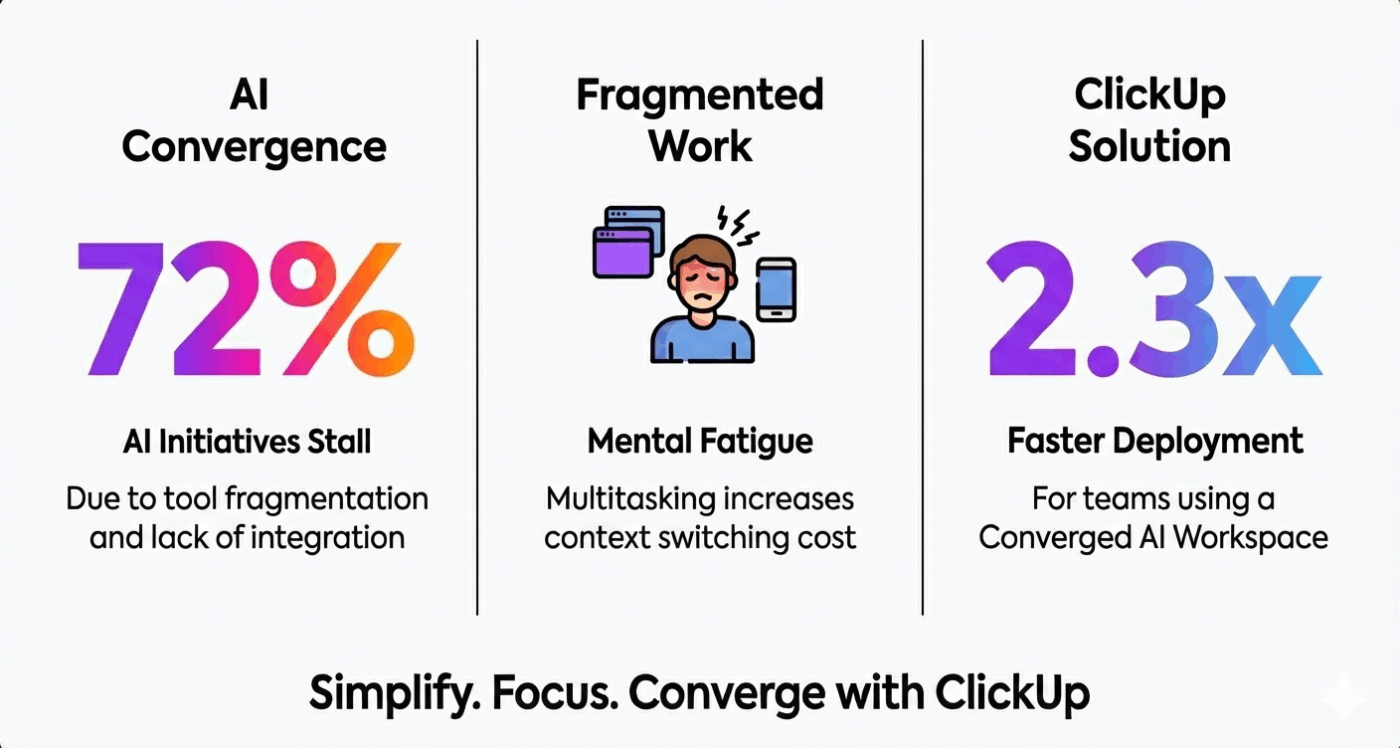
BCG research shows that 74% of companies still struggle to achieve and scale real value from their AI investments. Not because the models are weak, but because their data, tools, and workflows remain fragmented.
The reason is usually the same: They’re trying to deploy sophisticated AI on top of a fragmented infrastructure.
Sophisticated AI needs more than data. It needs context.
It needs to understand your work, your people, your processes, and your knowledge base. It needs to know what happened yesterday, what’s happening today, and what’s planned for tomorrow.
However, when your work is scattered across various tools for communication, writing, project management, knowledge management, meetings, and more, your AI lacks a comprehensive view. It’s like asking someone to manage your household finances when your bank statements are scattered across ten different drawers in different rooms.
Sure, you can train AI on parts of your stack. But you lose the connections.
The relationships between different types of work reveal the real patterns and opportunities.
Here’s what really excites me about this flywheel model: it creates the conditions for genuine human-AI symbiosis.
Humans create value when tools feel intuitive. AI creates value when it understands human context. Real transformation happens only when both work in sync. When people can act naturally, and AI has the context to act intelligently.
In a disconnected environment, you never get this symbiosis. Humans get frustrated and work around the tools. AI can’t learn, so it provides surface-level insights instead of transformational intelligence. Everyone loses.
But when the flywheel is spinning, something powerful happens:
The system improves continuously. And the relationship between humans and AI becomes symbiotic—not artificial.
If you’re a leader trying to figure out AI Transformation, here’s my advice: before you invest another dollar in AI capabilities, audit your infrastructure.
Ask yourself these questions:
If the answers to these questions reveal fragmentation, you don’t have an AI problem. You have an infrastructure problem. And no amount of sophisticated AI will solve it until the foundation is connected.
The companies actually succeeding with AI Transformation aren’t the ones with the flashiest models or the biggest data teams. They’re the ones who realized a simple truth: convergence has to come before intelligence.
They unified their tools.
They drove adoption.
They created context.
Then the flywheel started spinning. And once it started, it accelerated.
That’s the difference between AI theater and AI Transformation. Between trying something new and fundamentally changing how work gets done.
The question isn’t if transformation is coming. It’s whether you’ll lead it, or be stuck searching six tools for last quarter’s strategy doc while your competitors pull ahead.
The flywheel’s ready to spin.
You just have to build it.
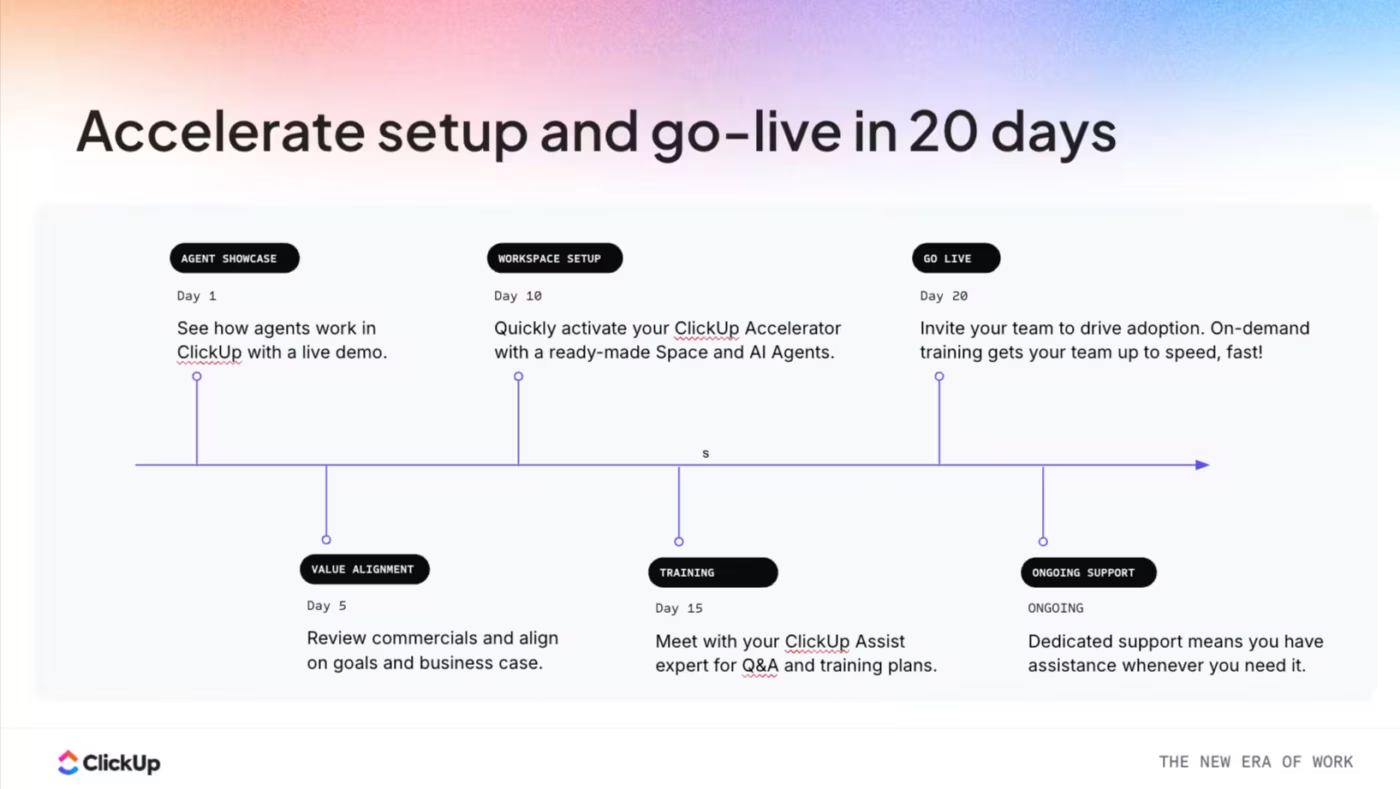
📘 Want the full AI playbook?
Discover how small businesses are building real AI workflows without the chaos.
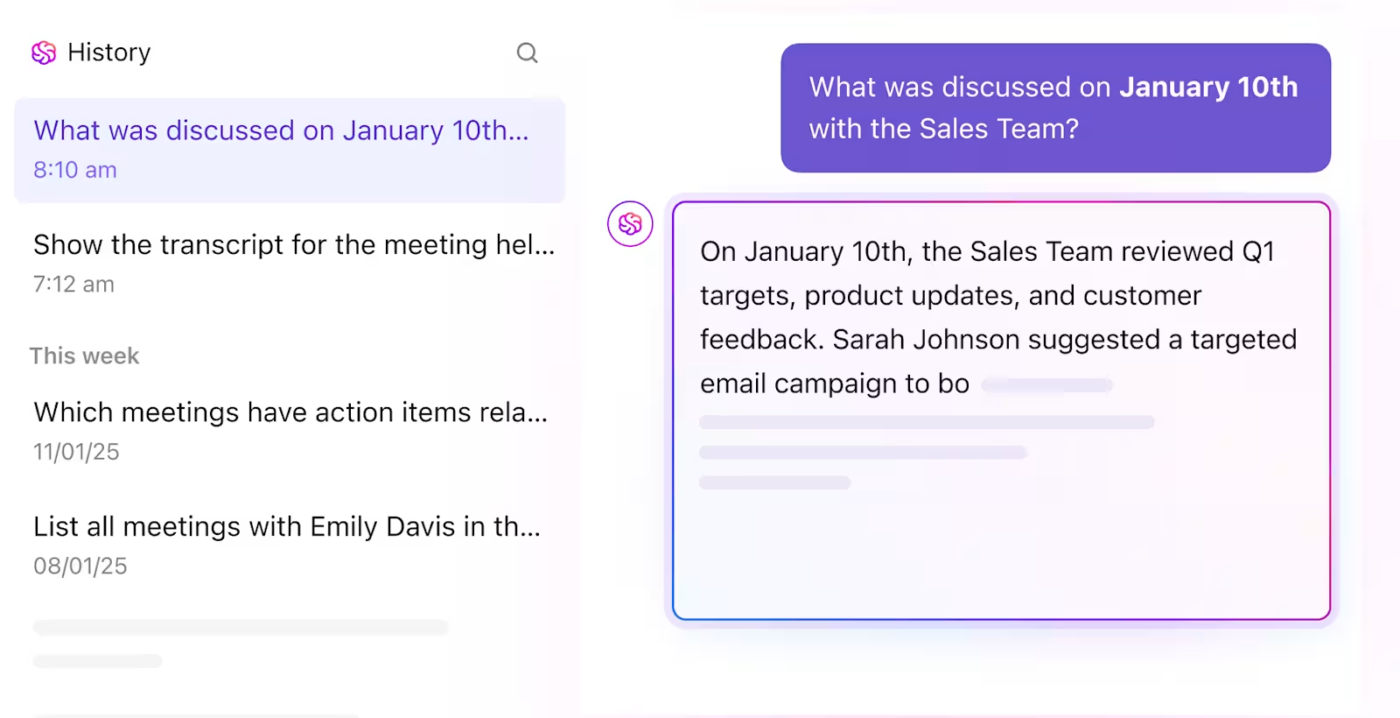
Once companies unify their work, something important happens: AI finally has the environment it needs to operate with depth, not just surface-level cleverness. This is where ClickUp Brain shows its real value. Because it sits inside the same workspace where your teams plan, write, discuss, execute, and measure work, Brain connects the dots others miss. It can summarize a project’s history instantly, highlight blockers before they escalate, and surface insights grounded in real context—not guesswork.
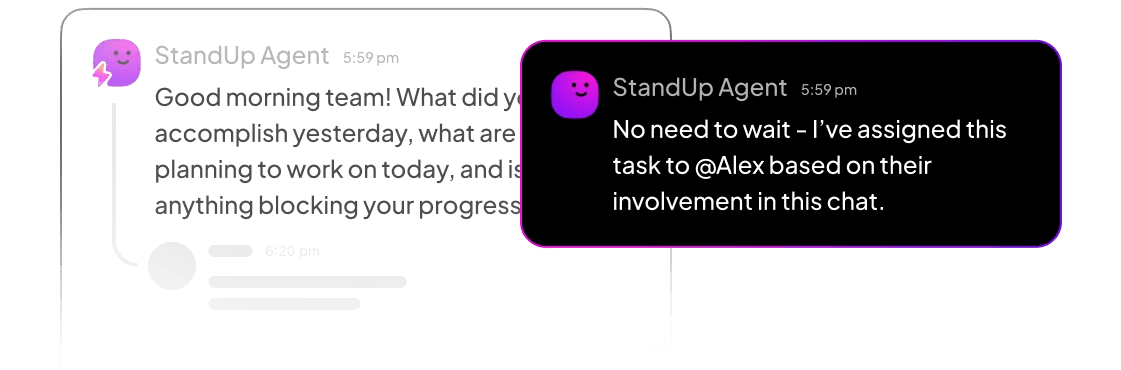
And when that context is stable, ClickUp Agents take over the operational layer. They keep projects updated, maintain knowledge, move work forward, and automate multi-step workflows without constant human supervision. Not because they’re “advanced,” but because they finally have the unified data and structure required to act reliably.
This is the practical outcome of the AI Acceleration Flywheel:
an intelligence layer (ClickUp Brain) and an execution layer (ClickUp Agents) working inside the same connected system, amplifying each other with every cycle.
Once the foundation is unified, AI stops being a pilot experiment and becomes part of how work actually gets done.
ClickUp gives you a unified platform to start. One place for work, context, and AI that actually delivers. Sign up for free right away.
Next Steps
Ready to build your AI Acceleration Flywheel?
Take the AI Maturity Assessment →
See how ClickUp creates the unified foundation for real AI Transformation—where tools, context, and intelligence compound to accelerate your business.
Kyle Coleman is Global VP of Marketing at ClickUp, where he leads go-to-market strategy and helps organizations understand how to achieve real AI Transformation. With deep experience in sales, marketing, and business intelligence, Kyle specializes in helping companies build the foundational infrastructure that enables AI to deliver transformational results.

© 2026 ClickUp

There’s an easier way. Try a free AI Agent in ClickUp that actually does the work for you—set up in minutes, save hours every week.