
Sorry, there were no results found for “”
Sorry, there were no results found for “”
Sorry, there were no results found for “”
Google Keep and Evernote both capture a note in seconds. What sets them apart is the follow-up.
Google Keep keeps things light on purpose. You open it, jot a thought, build a checklist, set a reminder, or save an image, then get back to your day. Evernote adds structure after capture, with notebooks, tags, richer formatting, document search, and filters for building a reference library over time.
That gap widens as your notes pile up. A shopping list or a quick reminder doesn’t need a filing system. Meeting notes, research, receipts, project references, and documents you’ll need months from now often do.
Before you choose, ask yourself three questions. How long will you need these notes? How much structure are you willing to maintain? And when you come back months later, how quickly do you need to find one specific detail?
Short answer: Pick Google Keep if you mainly capture quick notes, lists, reminders, and ideas, already work in Google’s ecosystem, and want a free tool with almost no setup. Pick Evernote if your notes are turning into a searchable reference library and you need stronger organization, formatting, and search. Plan to pay as that library grows, since Evernote Free caps you at 50 notes, one notebook, and one synced device.
If you end up using one app for quick capture and another for long-term reference, a bigger question follows: how do those notes connect back to the work they’re meant to support?
| Category | Google Keep | Evernote |
|---|---|---|
| Best for | Quick notes, checklists, reminders, and everyday organization | Research, document archives, and long-term knowledge management |
| Note capture | Fast, card-based capture with text, lists, images, drawings, and voice notes | Richer notes with tables, attachments, PDF annotations, and Web Clipper |
| Organization | Labels, colors, pins, and archives; no notebooks or folders | Notebooks, stacks, and tags for structured collections |
| Search and OCR | Keyword search, filters, and text recognition in photos | Search across PDFs, Office files, scans, and transcripts, plus Semantic Search |
| AI capabilities | No built-in AI suite; once you connect Google Workspace, Gemini can create and find Keep notes and lists, and add items to existing lists | AI Assistant, Semantic Search, AI Transcribe, AI Edit, and AI Meeting Notes |
| Offline access | Offline access on mobile; desktop browser requires internet | Offline access through dedicated Windows and Mac apps, plus mobile |
| Collaboration | Shared notes and checklists with edit access for all collaborators | Shared notes and notebooks with view, edit, and full-access permissions |
| Pricing* | Free with a Google account | Free; Starter $14.99/month or $99/year; Advanced $24.99/month or $249.99/year; team plans available |
| Free-plan limits | No stated note-count or connected-device cap | 50 notes, one notebook, and one connected device |
| Ratings | G2: 4.6/5 (Google Workspace listing); Capterra: 4.7/5 | G2: 4.3/5; Capterra: 4.4/5 |
Our editorial team follows a transparent, research-backed, and vendor-neutral process, so you can trust that our recommendations are based on real product value.
Here’s a detailed rundown of how we review software at ClickUp.
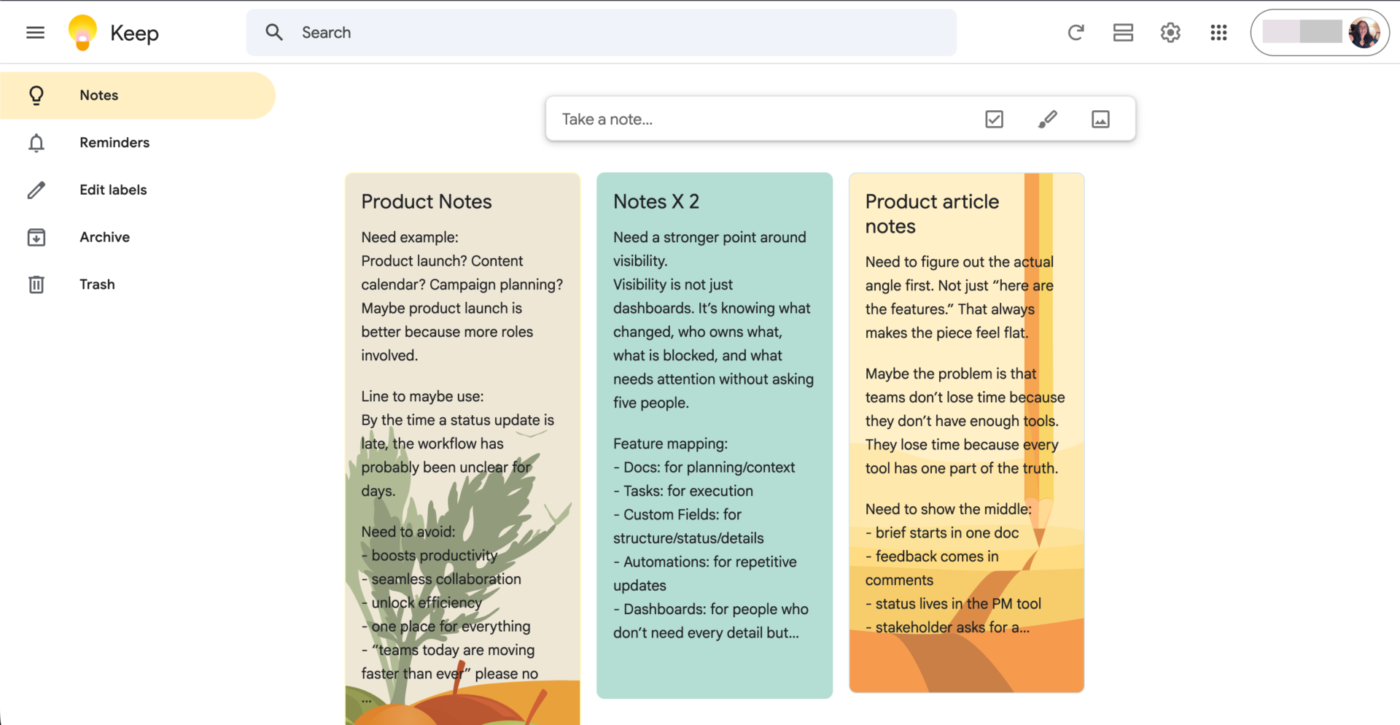
Google Keep is Google’s free note-taking app for the web, Android, and iOS. It stores text notes, checklists, images, drawings, and voice notes as cards that sync across devices through your Google account. It skips the setup steps other note apps ask for, like choosing a notebook, picking a template, or hitting save for every single edit.
Google Keep is for people who need a fast, free tool that holds short-term notes. It fits Google Workspace users best, since their workday already runs through Gmail, Google Calendar, and Google Docs. For those teams, Keep comes included with the subscription, and notes stay close to the email and files they relate to.
It also works for anyone managing everyday lists with others. Think of a grocery list you share with your partner, a packing checklist for a family trip, or a running list of gift ideas. Mobile-first users benefit too, since Keep is designed to capture a note on your phone and act on it later.
A Capterra user said:
Google Keep offers the best experience for keeping notes and checklists. Integrates with other Google products seamlessly and is easy to use. It integrates very nicely with Gmail and Google Calendar. Adding contributors to notes and checklists is very important as it offers a better workflow for the whole team. Also, the labeling system works very well for me, helping in organizing everything.
Google Keep has no folders or notebooks, and checklists support only one level of indentation. Labels, colors, and pins help organize quick notes but offer little structure for larger archives.
Sharing is limited to editable notes, with no view-only or comment-only permissions. Google also removed location-based reminders in 2025. And while Keep can search text in photos, it doesn’t offer a documented full-text PDF search capability.
Best for: Quick notes, checklists, voice capture, and timed reminders across Google apps.
Skip it if: You need hierarchical organization, granular sharing permissions, location-based reminders, or searchable document archives.
Also Read: Note-taking Apps for Android
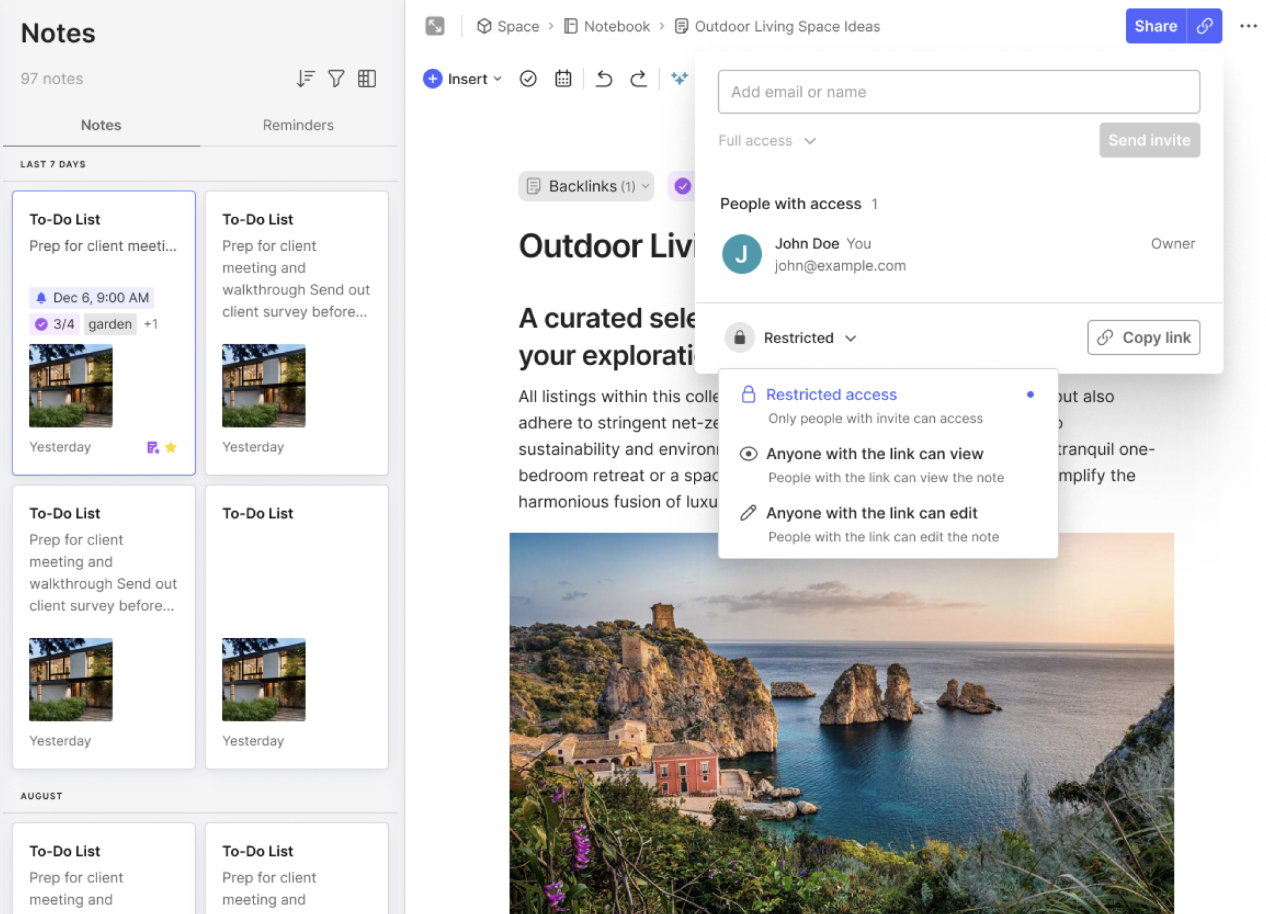
Evernote is a note-taking and personal knowledge app for the web, Windows, Mac, iOS, and Android. It’s built for notes you’ll need to find and use long after you save them. Web clips, PDFs, scanned documents, and meeting notes all live in one searchable archive, organized by notebooks and tags. That depth makes Evernote a strong fit for anyone building a reference library over months or years.
Evernote is for people who collect information they expect to come back to. Researchers, consultants, writers, and students fit that description well because their work depends on saving sources and finding them later. A consultant might keep a notebook per client. A student might clip journal articles and attach lecture slides to the same note. Small teams can also use shared notebooks and Spaces to keep a common knowledge base.
A G2 user said:
What I like most about Evernote is its seamless cross-device synchronization and powerful note organization. It allows me to capture ideas instantly across my phone and laptop without losing any progress. The ability to structure notes into dedicated notebooks, apply custom tags, and use the advanced search functionality makes finding specific information incredibly fast and effortless. Additionally, the web clipper tool is a game-changer for saving research articles, images, and formatting directly into my notes for future reference.
Evernote’s biggest trade-off is cost. The Free plan caps you at 50 notes and one connected device, which works for a trial and little else. Starter raises those limits to 1,000 notes and three devices. Once your archive outgrows that, Advanced costs $249.99 a year, a real commitment for a tool you’ll likely use for years.
Search also has a size limit. Evernote indexes PDFs up to 52 MB per file, so text inside larger files won’t appear in results. Built-in tasks handle personal follow-ups well. Teams that need project dependencies, workload planning, or broader execution controls will likely need a dedicated work management platform.
If the subscription cost or project management limits outweigh what Evernote offers, these Evernote alternatives are worth comparing.
Best for: Research-heavy work, long-term reference libraries, web clipping, searchable documents, and AI-assisted retrieval.
Skip it if: You need free multi-device sync, have a growing archive on a tight budget, or want full project management alongside your notes.
Both apps handle everyday note-taking well. The differences show up in five areas: search, organization, offline work, sharing, and cost.
Google Keep searches typed notes and text inside photos in plain language. It can also pull text out of an image and turn it into an editable note, which saves retyping a whiteboard or printed handout. But while Search covers your note text and images, Keep can’t search inside documents because its notes can’t hold PDFs or Office files.
Evernote searches almost everything you save. It indexes PDFs, Office documents, scans, and handwriting, plus audio and video transcripts. Its advanced search lets you combine Boolean operators with filters for dates, tags, and notebooks, and Semantic Search can surface related notes when you don’t remember the exact words. That depth comes with a few quirks. Partial matches only work from the start of a word, so a search for “ball” finds “ballpark” but misses “softball.”
Winner: Evernote
Document search, OCR, and semantic search provide far more ways to extract information from a large archive. Google Keep is enough if your searches stay fairly simple.
Keep lets you quickly capture different kinds of notes, including text, checklists, drawings, photos, and voice recordings. Evernote handles text, checklists, images, audio, and files, and adds tables, collapsible sections, and PDF annotations. That makes it better suited to long, structured notes.
The bigger difference is how each app sorts what you save. Keep’s labels work like flat tags, so a single note can have several, though your account is capped at 50 labels total. Evernote places each note in one notebook and lets you add tags, too. Evernote caps tags by plan, at 20 on Free and 100 on Starter. Free also allows only one notebook, so free users end up relying almost entirely on tags.
Keep’s card layout suits short notes you’ll glance at and act on, but longer meeting records or research write-ups can quickly feel cramped. Evernote’s notebooks keep those longer notes in order, but only if you keep filing into them.
Winner: Depends on your workflow
Keep is simpler for quick capture and everyday lists, especially notes you’ll act on within days. Evernote pulls ahead for long-form notes, meeting records, and research you’ll need to organize and revisit over months.
Google Keep reaches more devices at no cost. It runs on Android, iOS, the web, and Wear OS smartwatches. And it doesn’t cap how many devices you can connect. Its mobile apps also work offline and sync your changes once you reconnect. On a computer, things are different. Google retired the Keep Chrome app in 2021. On a laptop, you have to use Keep in the browser, which needs an internet connection.
Evernote is stronger on the desktop, with native Windows and Mac apps that store your notes locally for offline work. But the Free plan allows one connected device, and Starter allows three. Evernote counts its web app as one of them. On Free, using a phone and a browser already puts you over the limit, and on Starter, a phone, a laptop, and the web app fill every slot.
Winner: Google Keep for free cross-device access; Evernote for offline desktop work.
Keep is the better pick if you move between your phone and browser and want everything free. Evernote makes more sense if you often work offline on a laptop, like while traveling or in places with unreliable Wi-Fi, and you’re already on a paid plan.
Google Keep’s sharing is designed for people who already use Google. You invite collaborators by email or Google Group, they open the note with their Google account, and changes sync to everyone’s devices. Every collaborator gets full edit access, which means anyone can rewrite or delete items. That works for a grocery list, but it becomes risky for a note you’re relying on as a reference.
Evernote gives you finer control over who can do what. You can give each collaborator view, edit, or full access, and you can set shared links to be view-only or editable.
On security, the two are closer. Neither app offers end-to-end encryption for full notes. Evernote adds one extra layer by letting you encrypt selected text in a note with a passphrase in its Mac, Windows, and web apps. For passwords and sensitive records, a dedicated encrypted vault is still the safer choice with either app.
Winner: Evernote
Granular permissions matter when you share client documents or maintain a team knowledge base. Google Keep still works well for low-stakes sharing, like a trip checklist, where you want everyone to edit freely.
Google Keep is free with a Google account. Note capture, shared checklists, reminders, and cross-device sync all come at no cost.
Evernote Free is far more limited, with a cap of 50 notes, one notebook, and one connected device. Paid plans raise those caps, and Advanced removes most of them for larger archives. If your collection keeps growing, Evernote becomes a recurring cost.
Winner: Google Keep
Free sync and no note limits make it the better value for everyday note-taking. Evernote’s paid plans earn their cost once your notes grow into a reference library and its search, editing, and organization tools start saving you real time.
Start with the types of notes you save, where you need to access them, and the limits you’re willing to accept.
Pick Google Keep if:
Pick Evernote if:
Pick neither if: Your notes often turn into work shared across a team, with owners, dependencies, approvals, and progress reports. Google Keep’s reminders and Evernote’s tasks can handle individual follow-ups, but neither provides the full project management controls needed to coordinate complex work.
If you’re still exploring your options, our guide to second brain apps covers a wider range of tools. See it in action:
Both apps let you export your notes, so your data never gets locked in. Moving that data into another app is harder, because layout, formatting, links, and organization don’t always carry over cleanly.
From Google Keep to Evernote: Google Takeout lets you export your Keep notes, but Evernote does not offer a direct Keep import. Evernote’s migration guide says Keep labels don’t transfer directly, and reminders must be recreated manually after import. Export a small batch first, then rebuild labels as tags and set up important reminders again before moving your full archive.
From Evernote to Google Keep: Evernote exports notes as ENEX or HTML files, with attachments and optional details like tags and creation dates. You can export up to 100 selected notes at a time or an entire notebook, and the feature works on the Free plan. Exporting requires the Mac or Windows app, though, since Evernote Web doesn’t support it.
Before you switch: An export protects your data, but the new app may display it differently. First, test a small mix of lists, images, attachments, and reminders. Check how each item looks in the new app before moving your full archive.
We took the comparison to Reddit to see how people feel about these apps after years of use. The discussions raise a few concerns that feature lists can miss: how much time an app takes to maintain, whether it still meets your needs, and when the subscription stops making sense.
For starters, one Google Keep user had tried Evernote, Notion, and Obsidian before settling on Keep. The extra options in those apps had started to feel like more work:
I love Keep as it’s free and simple. It’s part of Google, so I don’t have to download extra apps on PC, and other phones. I tried Evernote a while ago and could not get used to it, and I can’t even remember why… Tried Notion, Obsidian, and some other similar stuff but had way too many options. So instead of using the apps to simplify/optimize my life I ended dealing with how to simplify/optimize the apps.
The user had also built a custom system of labels and visual cues in Keep. Their experience shows that a simpler app can still support an organized workflow, even if it takes some effort to set up.
Evernote users stay for their own reasons. In an August 2026 discussion, a lawyer who manages thousands of notes and PDF attachments explained how Evernote helps with their work:
I always wanted to use Evernote and was willing to pay for it from the beginning. My workflow depends heavily on having OCR, since I have thousands of notes with PDF attachments. I am constantly capturing news every day, so I use Web Clipper a lot. I keep a personal journal using an Evernote template and its Daily Note feature. I use reminders to track the progress of bills and relevant news. I use tasks for things in the context of a note, to give my notes momentum, since I use TickTick as my main task app. I use email-to-note to forward emails from clients to each client’s respective notebook. I plan my projects in Evernote and use the dashboard to get an overview of my productive world.
But do you know what I love most? Evernote’s AI. It may not be perfect, but it has completely changed my workflow. I need to find precise information under pressure, and semantic search combined with OCR makes that possible.
The user also relies on Web Clipper, AI Assistant, and audio transcription for legal research, client meetings, and document reviews. They consider the subscription worthwhile because those features are part of their daily work.
Then there’s the cost. Another Reddit user described why they were leaving after a decade:
This honestly breaks my heart a little bit. I’ve been using Evernote for a decade. It‘s hard to be forced to say goodbye to something so useful and familiar that has been with me for so long, but the new situation is unaffordable.
These experiences show why choosing a note app involves more than checking its features. People also weigh the time they’ve spent building their system, how well it holds up, and whether the cost still makes sense. A tool that works well today may deserve another look as those needs change.
Picking between Keep and Evernote decides where your notes live. For teams, the harder question comes after that: what happens to the work inside those notes once the meeting ends?
Take a project sync that produces a decision, three follow-ups, and a launch date. Each follow-up needs an owner and a deadline, and the decision has to reach the people it affects. In Keep or Evernote, that usually means copying action items into a separate project tool, where they lose the context of the discussion behind them.
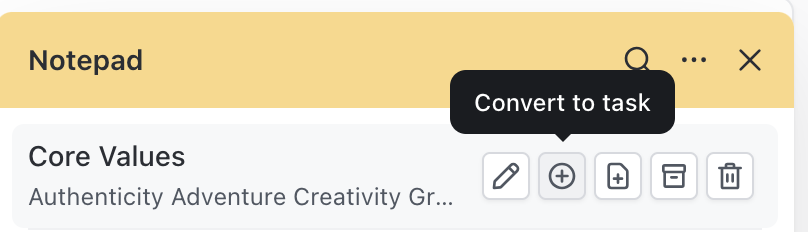
ClickUp keeps notes and the work they create in one Workspace. You can capture ideas privately, turn them into tasks or shared Docs, and track each follow-up alongside its project. Evernote’s built-in tasks do cover personal follow-ups. But ClickUp adds dependencies, team communication, and reporting on top.
Having our team’s process documentation and task management in one place helps us save time searching for things. It also provides us with one single source of truth for information.
Seequent brought its customer experience team’s processes, reference materials, and project work into ClickUp. The team further used Docs to share processes, Tasks to manage work, and Workload view to plan around capacity. Seequent reported a 50% increase in resource management efficiency and a twofold increase in work efficiency.
ClickUp takes more setup than Google Keep, and it’s built around projects rather than a document archive like Evernote’s. Offline Mode lets you create tasks and view notes without an internet connection, but you can’t edit existing tasks or notes until you’re back online.
If you only need quick personal lists, Keep is easier to maintain. For a large collection of PDFs, scans, and research notes, Evernote offers more specialized search and retrieval. ClickUp makes the most sense when those notes need to feed ongoing projects and team decisions.
The choice comes down to how long your notes need to last. If what you write tends to get acted on and cleared out within days, Keep covers it for free. If your notes keep their value for months and you often need to find one specific detail inside them, Evernote’s cost is easier to justify.
The real test is whether the tool saves you more time than it costs.
Before committing to either, try it with the notes you already have. Save a few new ones, look for something you filed weeks ago, and run a test export. Those three tasks will tell you more about long-term fit than any feature list.
If your notes regularly turn into work for other people, a note app alone will start to fall short. ClickUp brings Notepad, Docs, Tasks, Chat, and Dashboards into the same Workspace. Choose the note app that fits how you think and work.
Your notes stay in your account. You can still view, edit, share, and export them after a downgrade. But you can’t create new notes or notebooks until you’re back under the limits. Delete notes and empty Trash, or consolidate notebooks. Exporting only makes a copy, so it won’t lower your count. Evernote explains this in its downgrade FAQ.
Keep sits outside the usual 15 GB storage picture. Google’s storage policy names Gmail, Drive, and Photos as the services that share your quota, and Keep is exempt from its over-quota rules. The more practical limit is note length. According to Google’s community experts, a single note holds about 20,000 characters, so longer writing belongs in Google Docs.
Yes, though each app connects differently. Keep works with the Gemini app, which can create notes and lists in Keep, find them, and add items to existing lists once you connect Google Workspace. Evernote’s plan comparison lists an MCP connection that brings your notes into Claude, ChatGPT, and other MCP-compatible tools. Evernote’s MCP server is available on paid plans, so check yours before you build a workflow around it.
No. Google lists Keep as an active product. The rumor recurs because Google has retired other note and messaging apps over the years. Keep remains available on Android, iOS, and the web.
Yes. Bending Spoons acquired Evernote in early 2023, and the app has changed considerably since then. Recent additions include AI Assistant, Semantic Search, and AI Transcribe. In 2026, Evernote also replaced its Personal and Professional plans with Starter and Advanced, and long-time subscribers were moved to the new pricing. If you’re returning after a few years away, compare the current plans before assuming your old setup still applies.
Yes. Many people use Keep for quick capture and lists, and Evernote to archive material they want to organize and revisit. Set a clear rule for when a note moves from Keep to Evernote, so you don’t end up maintaining two archives that compete with each other.

Manasi Nair
Max 26min read

Arya P Dinesh
Max 18min read
Arya P Dinesh
Max 20min read
© 2026 ClickUp