Sorry, there were no results found for “”
Sorry, there were no results found for “”
Sorry, there were no results found for “”
The Kanban Method’s creator, David J. Anderson, built the whole system around one rule: a column should only exist where work actually waits. A spreadsheet can respect that rule, right up until it can’t.
Most people reach for Google Sheets because it’s free and already open in another tab, then slowly start spending more time cutting, pasting, and re-fixing broken formatting than moving work forward.
For a solo content calendar or a 20-card project, that trade is worth it. Past that, it isn’t.
This guide shows you how to build a Google Sheets Kanban board in about 20 minutes, and the exact point where it starts costing you more than it saves.
Google Sheets can handle a simple Kanban board if you need a lightweight workflow without extra software.
For small teams or temporary workflows, Sheets works fine. For anything more complex, dedicated Kanban tools save time fast.
Before building one, it helps to know where spreadsheet Kanban fits best.
| If your workflow looks like this… | Typical board size | Team size | Automation needs | Best fit |
|---|---|---|---|---|
| Personal task tracking or a solo content calendar | Under 20 active cards | 1 person | None | Google Sheets |
| Small internal project tracking with occasional updates | 20–40 cards | 2–5 people | Low | Google Sheets (short-term) |
| Cross-functional workflows with recurring handoffs | 40+ cards | 5–10 people | Moderate | Dedicated Kanban tool |
| Workflows requiring status-based triggers, reporting, or dependencies | Any size | Multiple teams | High | Dedicated Kanban tool |
| High-volume operational pipelines | 50+ cards | 10+ people | High | Dedicated Kanban tool |
The whole setup is pretty quick: you create status columns like To Do, In Progress, and Done, format the sheet to resemble a board, and then add reusable task cards to move between stages. Let’s walk through the fastest way here:
Your column headings define the workflow stages every task card passes through. Getting these right upfront saves you from restructuring the Kanban board later:
Three columns is the minimum for a useful board. More than six creates horizontal scrolling problems on most screens, which defeats the purpose of a visual overview.
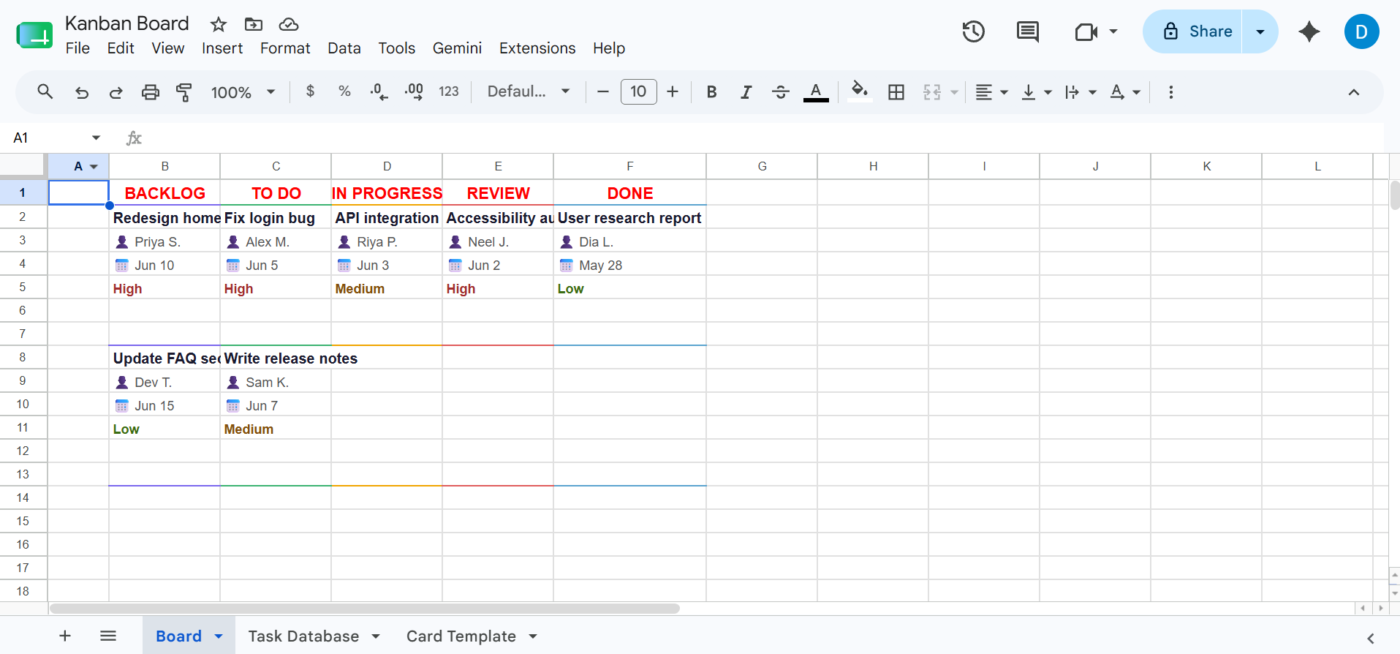
Fill your Google Sheet with meaningful data
Formatting turns a plain spreadsheet into something that reads like a board. Every choice here serves scannability, which means that you want to spot a card’s location in under two seconds.
Add thin light-gray borders around each card slot to reinforce the visual separation. This way, it’ll look like a physical Kanban board with sticky-note-sized spaces arranged under each column heading.
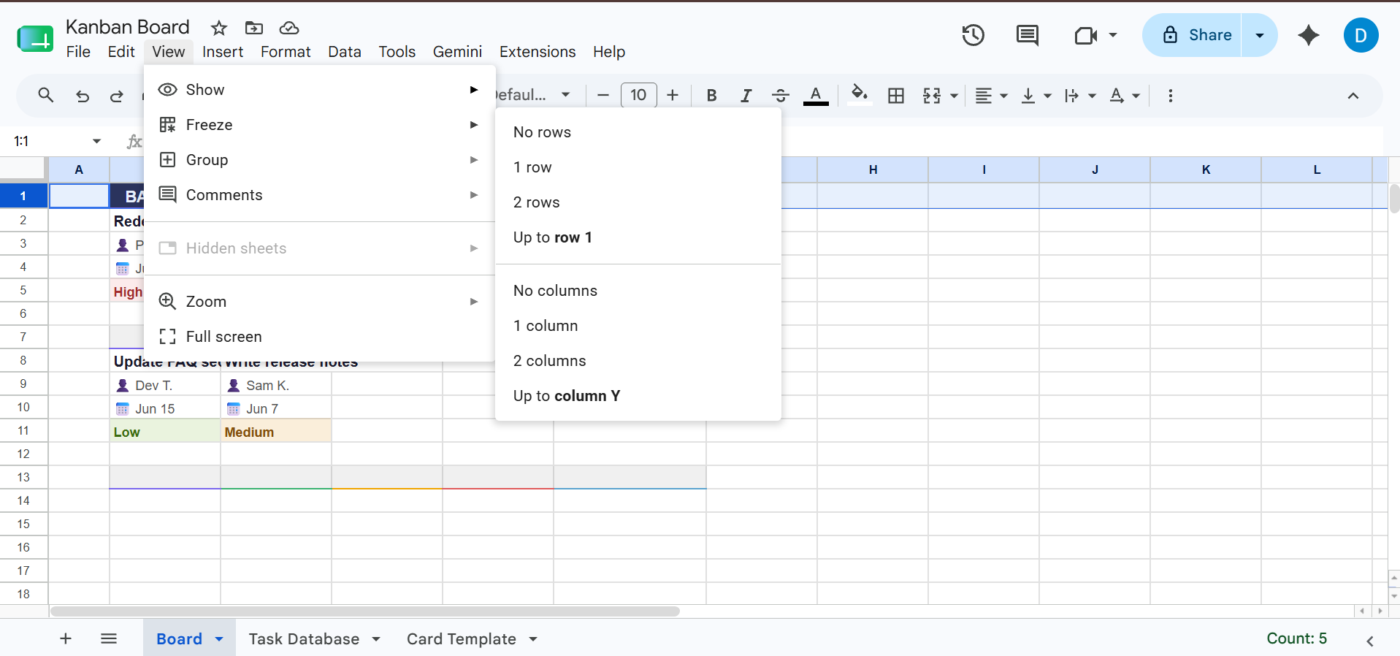
Format the Google Sheet to make it visually appealing
Quick hacks:
| Action | Windows Shortcut | Mac Shortcut |
|---|---|---|
| Bold text for headings | Ctrl + B | Cmd + B |
| Open format menu | Alt + O | Ctrl + Option + O |
| Insert new row | Alt + I, then R | Ctrl + Option + I, then R |
| Copy cell formatting | Ctrl + Alt + C | Cmd + Option + C |
| Paste formatting only | Ctrl + Alt + V | Cmd + Option + V |
| Freeze top row quickly | Alt + W, then F, then R | View → Freeze → 1 row |
| Resize columns faster | Double-click column border | Double-click column border |
| Duplicate sheet tab | Right-click tab → Duplicate | Right-click tab → Duplicat |
Creating a card template on a separate sheet saves you from formatting every new task from scratch:
Every new card requires this copy-paste action. There’s no drag-and-drop creation keyboard shortcut to spawn a card in a column.
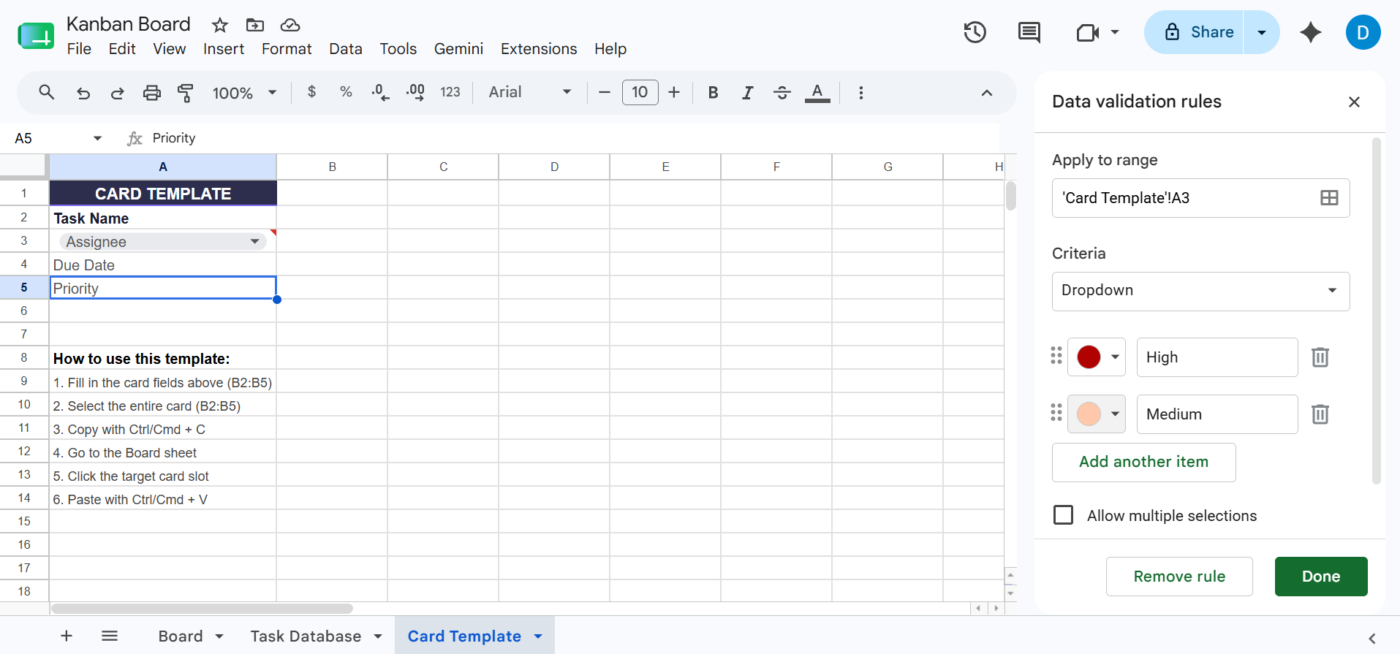
Customize the Priority dropdown in your Google Sheet
Pro Tip: If you’re building your first board, start here:
| Team size | Suggested In Progress limit |
|---|---|
| Solo | 2–3 tasks |
| 2–4 people | 4–6 tasks |
| 5–8 people | 8–12 tasks |
Rule of thumb: If a column consistently exceeds its limit, your bottleneck is process design, not team speed.
Moving a card means changing its status. In Google Sheets, you have two approaches, each with trade-offs.
1. Manual cut-and-paste method
2. FILTER formula method
=FILTER(Tasks!A:A, Tasks!C:C=’In Progress’)
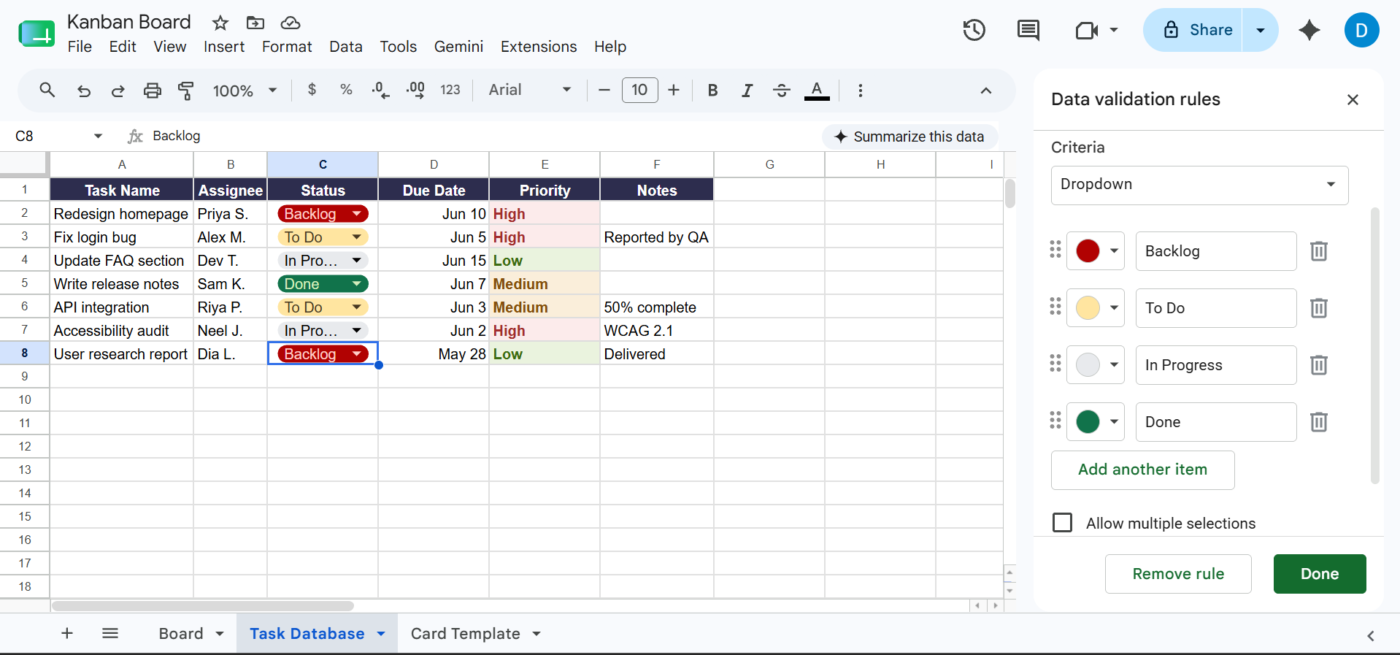
Add Data Validation to the Status dropdown in your Google Sheet
| Criteria | Manual method | Formula method |
|---|---|---|
| How it works | Cut and paste card cells between columns | Change a dropdown on a database sheet |
| Pros | Cards keep visual formatting | Cards move automatically |
| Cons | Every move is manual; formatting can break | Output is plain text rows, not visual cards |
Most spreadsheet Kanban problems come from setup shortcuts that seem harmless early on. Here are the common ones.
| Problem | What causes it | How to fix it |
|---|---|---|
| Cards lose formatting when moved | Cut-and-paste breaks merged cell styling | Use template blocks or paste values separately |
| The board becomes hard to scan | Too many columns or inconsistent row heights | Keep workflows to 3–6 columns and standardize spacing |
| FILTER formulas stop working | Someone edits the database structure | Lock formula ranges or protect the database sheet |
| Horizontal scrolling kills visibility | Overbuilt workflows with too many stages | Merge low-value stages into broader statuses |
| Cards feel cluttered | Too much detail inside one cell | Keep cards lightweight and move supporting details to a database tab |
If building from scratch feels like overkill, start with a template. The three below cover the most common use cases: a fully automated personal task tracker, a simple team workflow, and an agile sprint board. Each opens in Google Sheets and is ready to copy.
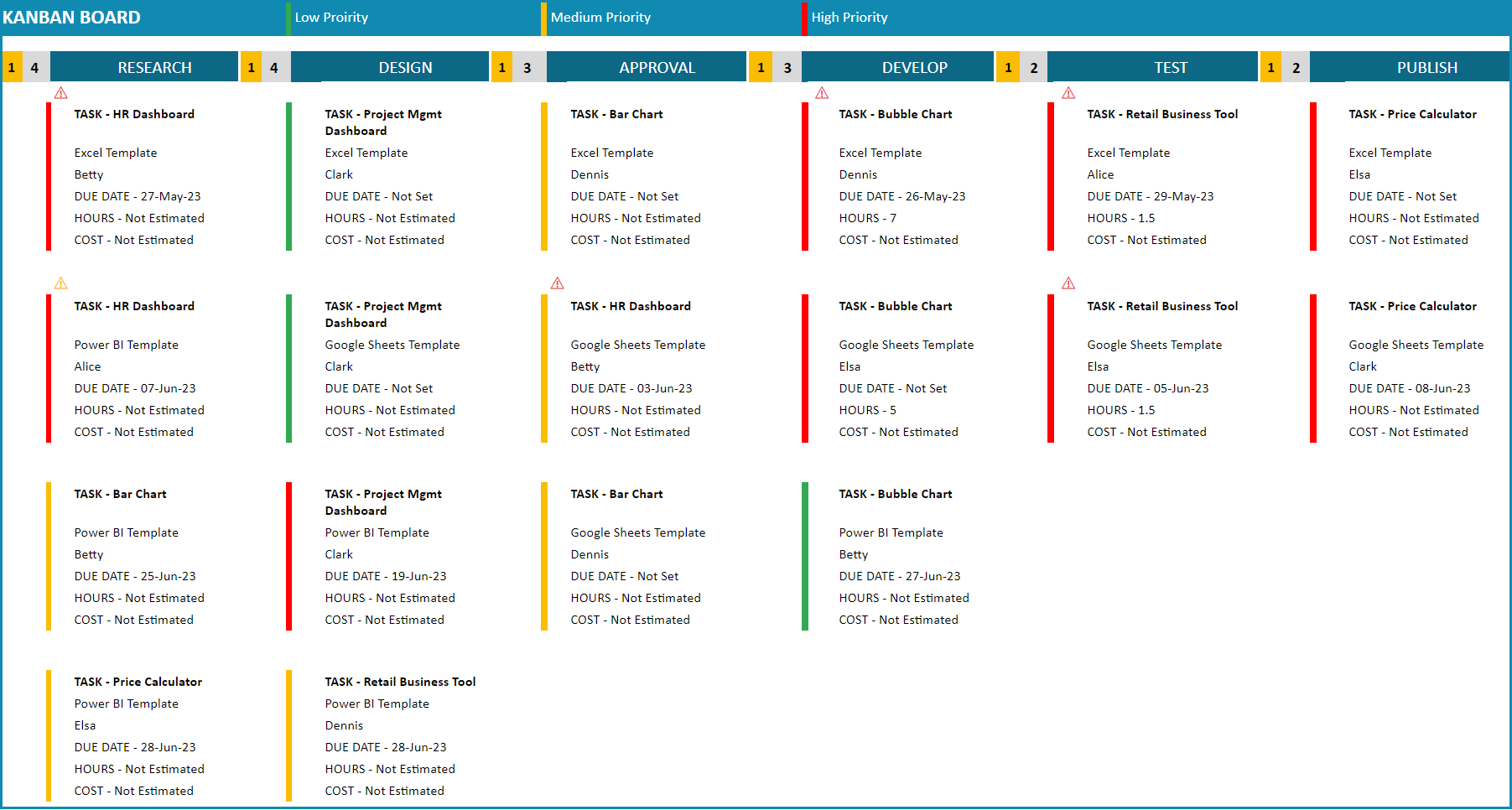
The Kanban template from Indzara is the most automated of the three. You enter tasks on a settings sheet (assignee, priority, due date, up to six stages) and the board builds itself, with color-coded priority cards and warning flags that turn orange as a due date nears and red once it’s passed.
It’s best for individuals or small teams who want a polished, low-maintenance board without wiring up formulas themselves.
Something to note: The automation runs on a fixed structure. You customize through the settings sheet, not by dragging cards, so if you want to move work by hand, this isn’t that kind of board.
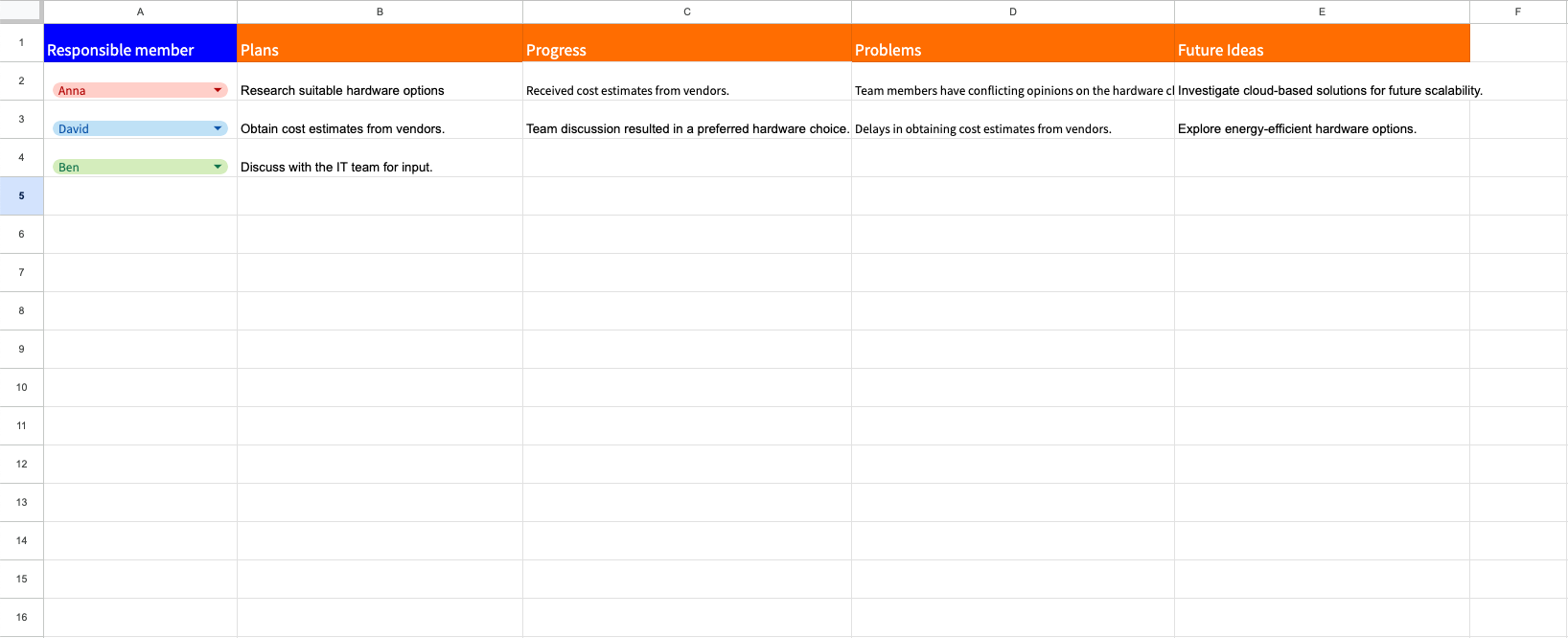
Weekdone’s Kanban board template keeps things deliberately simple, with four columns: Plans, Progress, Problems, and Future Ideas. It comes pre-filled with an example scenario you can clear and replace. It’s best for small teams that want a lightweight status snapshot rather than a detailed task system, like a weekly check-in board.
Something to note: There are no assignee, priority, or due-date fields built in, and the four-column setup doesn’t map to a typical To Do / In Progress / Done flow. You’ll adapt it manually if you need stage-based tracking.
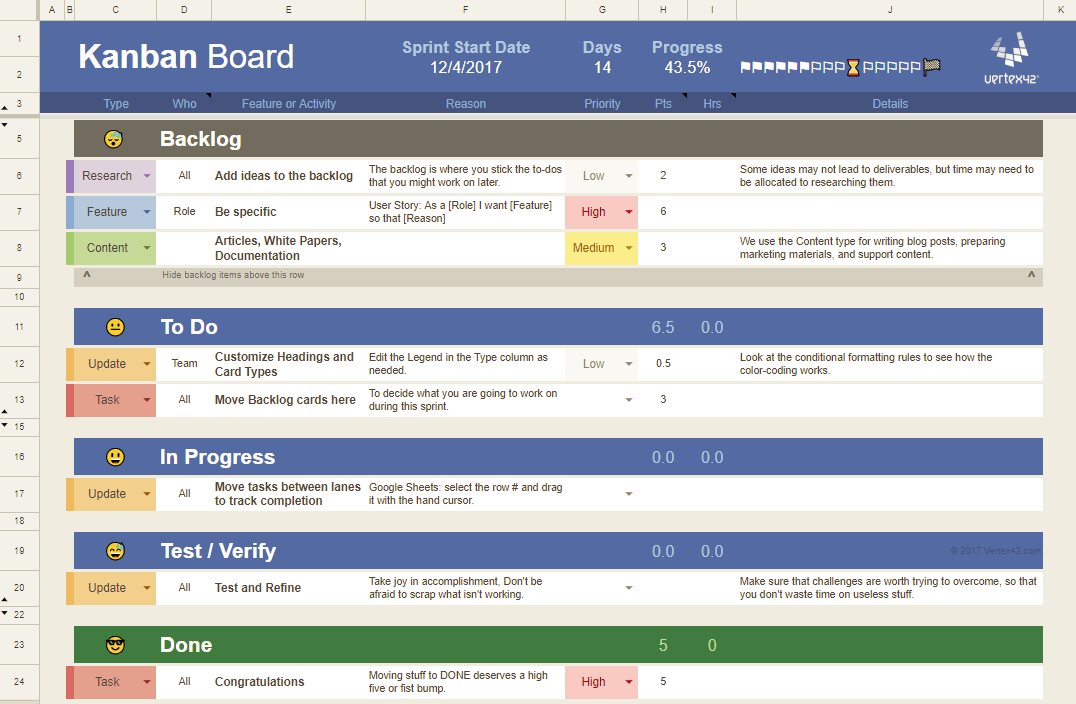
Vertex42’s Kanban template is built for sprint-based work and runs in both Google Sheets and Excel. It uses horizontal lanes (each row is a card you drag between To Do, In Progress, and Done), plus a backlog you can hide between sprints and a sprint progress chart that tracks completion against time. It’s best for small dev teams or solo developers running one or two-week sprints.
Something to note: The row-based layout reads less like a visual board than column-style templates, and the sprint chart relies on manual hour estimates per task. If you skip the estimating step, you lose the progress tracking that’s the template’s main draw.
Google Sheets Kanban boards are free, familiar, and require zero onboarding. But the trade-offs compound as your team or project grows. Let’s compare them:
| Pros | Cons |
|---|---|
| Included with any Google account; no add-ons needed for basic boards. | Moving cards requires cut‑paste or formula updates; core kanban interaction is missing. |
| Anyone who’s used a spreadsheet can start immediately with no tool‑specific training. | Adding cards, updating statuses, and fixing formatting require hands-on work. |
| Up to 100 people can edit simultaneously with Google Sheets’ native sharing. | No built‑in rules for auto‑assigning, notifications, or trigger‑based moves (Apps Script requires coding). |
| Control every cell, formula, and formatting rule with no feature gates or plan restrictions. | Boards over ~20–30 cards become hard to scan; horizontal scrolling and long columns degrade usability. |
| Lives alongside Docs, Slides, and Drive without switching ecosystems. | No built‑in tracking for cycle time, throughput, or WIP limits. |
A Google Sheets Kanban board is a workaround, rather than a workflow tool. That distinction matters once you hit specific thresholds, regardless of which tool you pick. Here are some signs that you need an upgrade:
Some Kanban tool recommendations for you:
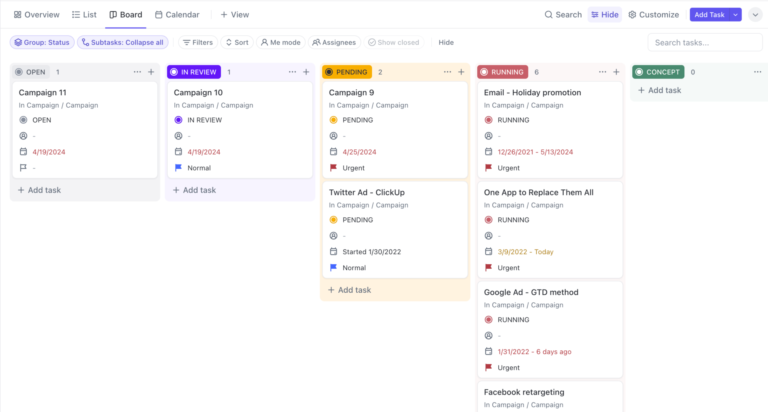
If you are already using ClickUp, you can simply use the ClickUp Board View to see tasks in Kanban style.
This video shares more information about the top kanban board software:
ClickUp brings boards, tasks, and automation into one workspace for teams that want Kanban to manage work, not just display it.
Here’s how our marketing team runs it.
Every workflow starts with a ClickUp List built around the process it tracks. Our editorial pipeline lives in one List, campaign production in another, and each uses its own set of ClickUp Custom Statuses to reflect how work moves.
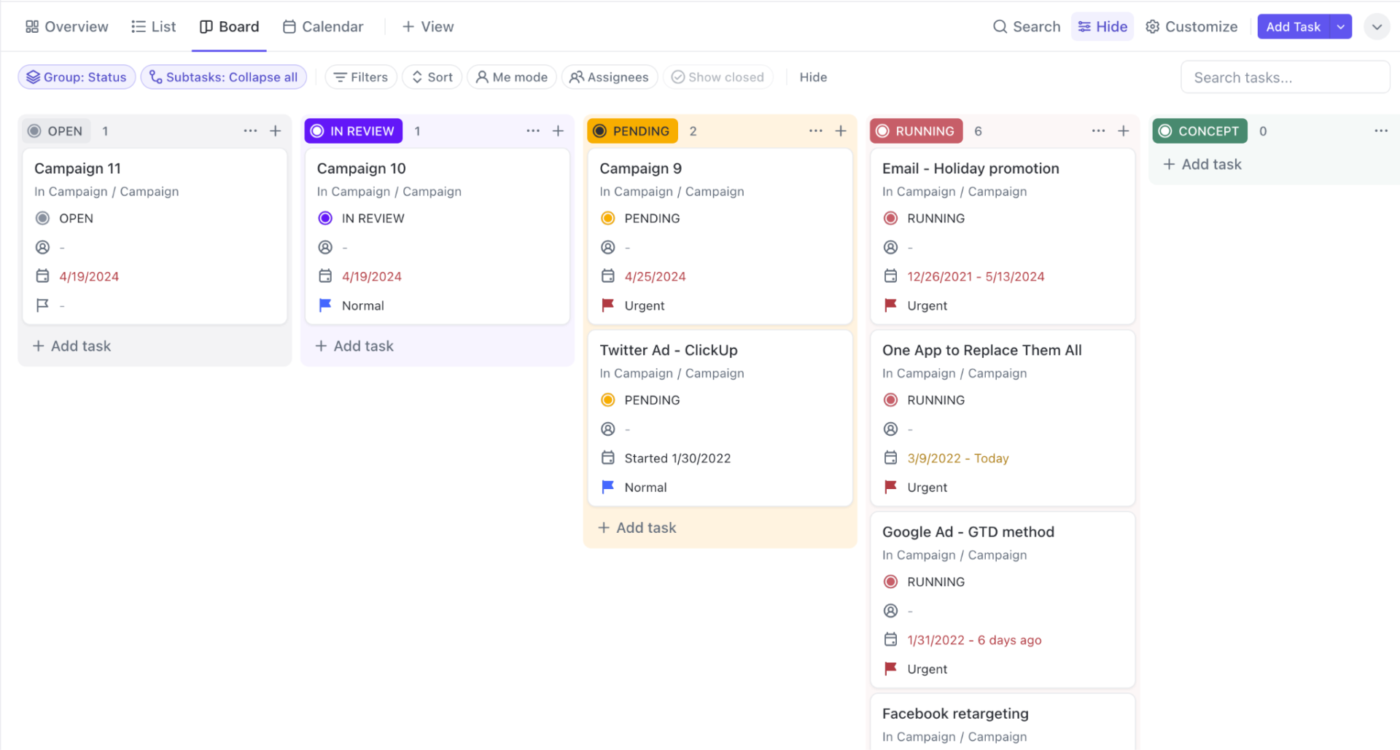
The ClickUp Board View mirrors the workflow instead of forcing it to fit a spreadsheet structure. Columns come straight from your task statuses, so moving a card actually changes its status. No cut-paste, no broken formatting, no FILTER formula to babysit. Each card also carries its full context: the brief, subtasks, due dates, attachments, and comments all travel with it, so an editor opening a card for review has everything in one place.
Drag and drop your team’s tasks in a Kanban format with the ClickUp Board View
ClickUp Automations handle repetitive handoffs. When a task moves into Review, it automatically assigns the right editor and posts a handoff comment with next-step instructions. When it reaches Approved, it updates priority and pushes the task into the publishing queue.
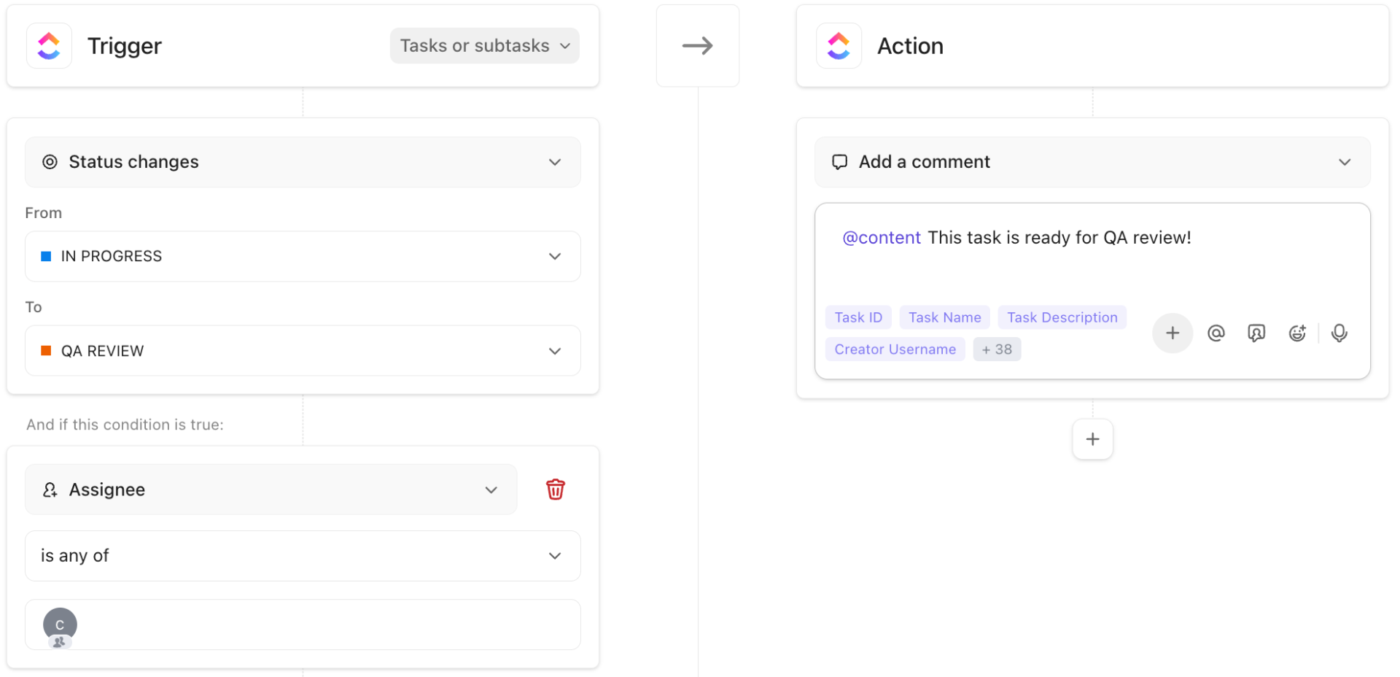
Automate repetitive tasks like status changes with ClickUp Automations
We also use work-in-progress limits to keep columns from turning into parking lots. If Review starts stacking up, the board shows it immediately. Some of our teams also use ClickUp Brain or dedicated Super Agents to flag overdue tasks to the relevant owners.
Reporting happens in the same place using ClickUp Dashboards. They pull status distribution and throughput from live board activity, so you see where work is slowing down without rebuilding formulas or refreshing charts.
The workflow we described above works because the board, the task, and the workflow rules all live in one workspace. Moving a card updates its status, triggers the right automation, and keeps reporting current without anyone touching a second tool.
If your team already tracks work in ClickUp, Board View becomes the natural operating layer. If not, moving from Sheets usually means shifting the workflow itself.
ClickUp also comes with a setup curve that spreadsheets don’t. Teams used to the flexibility of dragging rows around a sheet need a little time to adjust to Lists, statuses, automations, and task structure.
ClickUp fits best when: Your Kanban board manages active work across multiple people, you need task ownership and automation, and your workflow has enough moving parts that manual spreadsheet updates are starting to break down.
Skip it if: The board is lightweight (a few cards across basic stages), the workflow rarely changes, or your team only needs a simple visual tracker. In those cases, a Google Sheets Kanban board will usually be faster to build and easier to maintain.
A Google Sheets Kanban board works well when the workflow is simple, the task volume is manageable, and the goal is quick visibility without adding another tool.
Use only the columns where work actually waits and set realistic work-in-progress limits. We’d suggest archiving completed work before your Done column turns into clutter. And if maintaining the board starts taking more effort than completing the tasks on it, that’s your signal to rethink the system.
If your workflow includes recurring handoffs, multiple contributors, status-based automation, or reporting needs, a dedicated board becomes worth it. ClickUp is a good option if your team needs drag-and-drop boards, built-in automations, live reporting, and tasks that carry their full context with them.
Sign up to ClickUp for free today!
A to-do list tracks what to do; a Kanban board tracks where work is across stages and caps how much runs at once (via WIP limits). The board surfaces bottlenecks a flat list hides.
Yes, up to 100 people can edit a Sheet simultaneously. But concurrent edits on a Kanban layout cause overwrites and broken merged cells fast, so it’s reliable only for 2-3 light collaborators.
Poorly. The Sheets mobile app doesn’t support drag-and-drop, and cut-paste across columns is painful on a small screen, so a Sheets board is effectively desktop-only.
A Kanban board is a methodology that visualizes work in progress and enforces flow limits. Trello is a specific software product that implements kanban principles with drag-and-drop cards, attachments, and automation.
Yes, the same build pattern works in Excel: column headings as status stages, formatted cells as card slots, and cut-paste to move cards between columns. Excel adds two capabilities Sheets lacks: VBA macros for limited automation, and PivotTables for basic throughput tracking. Excel still has no drag-and-drop card movement, so the core Kanban interaction is missing in both spreadsheet tools.
Three columns is the functional minimum (To Do, In Progress, Done), and six is the practical maximum for most teams. The Kanban Method’s creator, David J. Anderson, recommends mapping columns to actual workflow stages, not arbitrary categories, and adding a column only when work genuinely waits there for a meaningful amount of time. More than six columns creates horizontal scrolling problems on most screens and dilutes the visual signal the board is supposed to provide.
Sheets has no native WIP enforcement. Use a COUNTA formula on each column with conditional formatting that flags the cell red when the count exceeds your limit. It warns you; it won’t block new cards.

Manasi Nair
Max 22min read

Arya P Dinesh
Max 20min read
Manasi Nair
Max 15min read

© 2026 ClickUp