Two tools can both claim a critical path and do very different jobs. One calculates float for every task and holds up in a contract review. The other shades the longest bar red and stops. Most buyers find out which one they bought after a date slips and the finish date won’t budge.
That gap gets expensive. In July 2026, the US Government Accountability Office said schedule delays persist across the Pentagon’s costliest programs; the average wait for a new capability has passed 12 years.
Critical path software finds the chain of linked tasks that controls your finish date and calculates how much scheduling flexibility each activity has. This guide covers ten of them. Primavera P6, Microsoft Project, Planera, and Asta Powerproject serve planners whose schedules face outside review. ClickUp, Smartsheet, and Wrike keep the path attached to daily work. GanttPRO and TeamGantt fit small teams and client-facing plans. Lucidchart is where you draw the network first.
We compared them on scheduling depth, float and dependency controls, baselines, collaboration, resource planning, and ease of use.
Best Critical Path Software: 10 Tools Compared for 2026
Summarize this article with AI ClickUp Brain not only saves you precious time by instantly summarizing articles, it also leverages AI to connect your tasks, docs, people, and more, streamlining your workflow like never before.
Summarize this article for me please
Critical Path Software Compared at a Glance
Tool
Best for
Standout feature
Starting price*
Where it taps out
Oracle Primavera P6
Enterprise teams managing capital projects and EPC programs
Configurable critical path rules, total and free float, subcritical paths, retained logic, and progress override
Custom pricing
Requires specialist scheduling skill and significant setup for logic, baselines, calendars, and progress rules
Microsoft Project
Project management teams in Microsoft-centric organizations
Total and free slack, eight constraint types, Task Inspector, 11 baselines, and resource controls
$679.99 one-time
Windows-only desktop scheduler, with browser-based Planner handled separately
Teams of all sizes linking the critical path to live project work
Gantt critical path, Slack Time, dependency rescheduling, baselines, Workload, Dashboards, and Brain
Free; paid from $7/user/mo
Tuned to live work rather than contract-grade CPM review, so retained logic and progress override stay with specialist engines
Planera
Construction schedulers that want modern CPM
Four dependency types, lead and lag, multiple float paths, DCMA checks, Monte Carlo simulation, and Manny AI
Custom pricing
Depth is tuned to contractor workflows, so general project teams carry terms they won’t use
Asta Powerproject
Construction project planners working in 4D and BIM
Links schedules to IFC models, Critical Path Drag, unlimited baselines, Line of Balance, and schedule-quality checks
Trial; paid from £1,530/year (approx $2,066/year)
Full application is Windows-based, while SaaS and 4D-related add-ons increase the total cost
Smartsheet
Mid-sized spreadsheet-native program teams
Grid-based scheduling with critical path, Driving Path, lead and lag, automations, forms, and portfolio controls
Paid from $9/user/mo
Baselines and workload tracking require Business, and float is not surfaced as a numeric CPM field
Wrike
Professional services teams
Four dependency types, lead and lag, AI risk prediction, workload planning, approvals, and budgeting
Free; paid from $10/user/mo
Handles dependency-driven critical paths but not formal CPM validation or multiple float-path analysis
GanttPRO
Small teams that need a critical path fast
Four link types, float calculation, auto-scheduling, AI Gantt generation, workload, and change history
Paid from $7/user/mo
No permanent free plan once the 14-day trial ends
TeamGantt
Teams managing client-facing schedules
Critical path, baselines, live view-only sharing, Project Health, portfolio views, and cost-loaded scheduling
Free; Paid from $24/mo
Project and task limits can become restrictive for busy teams managing many schedules
Lucidchart
Individuals and small teams drawing the dependency network before scheduling
PERT and network diagrams, formulas, data linking, conditional formatting, AI diagram generation, and co-editing
Free; paid from $9/mo
Has no scheduling engine, so downstream dates do not recalculate when the network changes
*Pricing and features reflect what was available at the time of writing and can change. Always verify the current details on the tool’s official website before making a decision.
How we review software at ClickUp
Our editorial team follows a transparent, research-backed, and vendor-neutral process, so you can trust that our recommendations are based on real product value.
Summarize this article with AI ClickUp Brain not only saves you precious time by instantly summarizing articles, it also leverages AI to connect your tasks, docs, people, and more, streamlining your workflow like never before.
Summarize this article for me please
What Is Critical Path Software?
Critical path software applies the critical path method (CPM) to a network of dependent tasks. It returns the longest path through the schedule, the earliest possible finish date, and the float available on every other task.
The critical path is the longest path through the network. Yet it’s also the shortest possible project duration. That contradiction trips up almost everyone the first time.
Three capabilities show how much scheduling depth a critical path tool provides:
Float calculation on every task, not just a flag on the critical ones
Support for finish-to-start, start-to-start, finish-to-finish, and start-to-finish links, with positive and negative lags
Automatic recalculation when durations, actuals, or constraints change, so the path moves as reality moves
Summarize this article with AI ClickUp Brain not only saves you precious time by instantly summarizing articles, it also leverages AI to connect your tasks, docs, people, and more, streamlining your workflow like never before.
Summarize this article for me please
What to Look For in Critical Path Software
When evaluating critical path software, focus on how accurately it calculates dependencies, handles calendars and constraints, tracks float and baselines, and stays aligned with live project updates.
Float reporting
Look for total float on tasks outside the critical path. It shows how long an activity can slip before it delays the project. Also watch near-critical tasks with only a few days of float. They can become critical as the schedule changes.
Logic integrity
Critical path calculations are only as reliable as the dependency logic behind them. Missing links or hard constraints can produce a path that looks correct while giving you the wrong finish date.
During the trial, add a large amount of time, commonly 600 working days, to the remaining duration of an unfinished critical path activity. After recalculation, the project finish should move by roughly the same amount. If it doesn’t, inspect the logic, constraints, and calendars.
The Defense Contract Management Agency (DCMA) has a 14-point schedule assessment, documented by the Department of Defense, that teams can use for this.
Constraint and calendar handling
Real schedules include holidays, shift patterns, weather windows, and fixed dates. Check whether the tool supports multiple calendars, task- or resource-level calendar assignments, and different constraint types. These controls matter when parts of the project follow different working rules.
Baselines and variance
A baseline shows how far the current schedule has moved from the original plan. Look for saved baselines and a variance view that compares planned and current dates. Multiple baselines are helpful when you need to track major schedule revisions over time.
Connection to the work itself
A critical path loses value when the underlying schedule falls out of date. Tools tied to live tasks can recalculate as work changes. Dedicated scheduling tools may rely more on manual updates. Either model can work, but it should match how your team actually maintains project data.
Before exploring the tools in detail, here’s a quick look at how modern Gantt software handles timelines, dependencies, and project scheduling.
Summarize this article with AI ClickUp Brain not only saves you precious time by instantly summarizing articles, it also leverages AI to connect your tasks, docs, people, and more, streamlining your workflow like never before.
Summarize this article for me please
The 10 Best Critical Path Software Tools
The best critical path software calculates float on every activity, supports all four dependency types with lead and lag, and recalculates the finish date when durations or actuals change. Primavera P6, Planera, and Asta Powerproject go deepest on that math. ClickUp, Smartsheet, and Wrike keep the path attached to live work.
1. Oracle Primavera P6 (Best for capital projects and EPC programs)
Primavera P6 is Oracle’s enterprise scheduling platform for CPM programs, the kind where the schedule is a contract deliverable. It works best for construction, infrastructure, energy, and EPC teams with a full-time planner on staff.
Where most tools hand you one critical path and call it done, P6 asks you to define the rule first. In “Schedule Options,” you mark every activity at or below a total float number you set. Or you choose Longest Path, which traces driving relationships back from the latest early finish. Run both on a job with night shifts and a shutdown calendar, and you get two different lists.
The rest of the calculation is just as explicit. Every activity carries total and free float. You can also generate subcritical float paths to see the chains sitting a few days behind the leader. Progress that lands out of sequence follows a rule you choose: Retained Logic, Progress Override, or Actual Dates.
Standout features
Resource leveling priorities: Rank projects and activities 1 to 100 so P6 picks who gets the shared crane
Risk register with scoring matrix: Score threats on a company-wide matrix and attach response plans to the activities they hit
Visualizer reports: Print time-scaled logic diagrams for a claim packet or an owner review
Reflection projects: Copy the live schedule, try a recovery sequence, then merge back only the changes you approve
Note: P6 has no built-in AI assistant. Oracle keeps that work in Primavera Cloud, so analysis in P6 stays manual.
It is a very powerful scheduling tool that you can use for high-level projects. You can attach not just time and activities but also resources and other things that are attached to the critical path for the success of a project.
Where it taps out: P6 needs more scheduling skill than most project tools. Setting up logic, baselines, calendars, and progress rules takes time. Smaller teams may also find the admin work hard to justify.
Best for: Contractors and owners who submit CPM schedules for review and need the math to hold up.
Skip it if: Your plan shifts daily next to task work, or nobody on the team is a scheduler by trade.
2. Microsoft Project (Best for CPM in Microsoft-centric organizations)
Microsoft Project runs CPM scheduling in a Windows desktop app, and many PMOs end up with it by default. If your company already uses Microsoft 365, onboarding a Project license is quicker than learning a new ecosystem.
Raise the slack threshold, and tasks carrying a day or two of float get flagged critical alongside the zero-float ones, which is how near-critical chains stay visible. Total and free slack sit on every task as fields you can sort and filter, and eight constraint types let you pin dates the way a contract requires.
When a date shifts for no obvious reason, Task Inspector names the culprit: the predecessor, constraint, calendar, or resource assignment. And the broader Microsoft planning stack brings AI into the mix through Copilot.
Standout features
Team planner: Drag work between people and watch overallocation clear in the same screen
Task modes: Switch tasks between manual and auto-scheduling so early placeholders don’t get shoved around by the engine
Compare Projects report: See every changed date, duration, and link between two versions of the same file
11 baselines: Store the original plus 10 more and track schedule, work, and cost drift against any of them
Note: Microsoft is retiring Project Online on September 30, 2026. Project Desktop, Project Server, and Planner all continue.
Pricing
Project Standard 2024: $679.99, one-time purchase
Project Professional 2024: $1,129.99, one-time purchase
Project Server Subscription Edition: Custom pricing
Ratings
G2: 4.0/5 (1,600+ reviews)
Capterra: No clean current rating for standalone Project Desktop. Capterra lists Microsoft Planner and Project Server separately, so combining those scores would mislead
I like the scheduling power of Microsoft Project & Portfolio Management, including its ability to automate project logic and calculate duration, start, and finish dates. The dependencies feature is helpful because it clearly identifies what tasks must happen before others. I also appreciate the baseline feature as it helps us track variance efficiently. The initial setup was simple for us.
Where it taps out: The Microsoft Project desktop scheduler is Windows-only, which matters if your team uses Macs or needs cross-platform access. Microsoft offers browser-based Planner, but it’s separate from Project Desktop.
Best for: PMOs in Microsoft shops that need baselines, slack analysis, and resource controls in one file.
Skip it if: Your schedule has to be built collaboratively in the browser, or you want the critical path sitting inside daily work management.
3. ClickUp (Best for linking the critical path to the work that moves it)
Use ClickUp Gantt View’s critical path and slack time calculations for your project
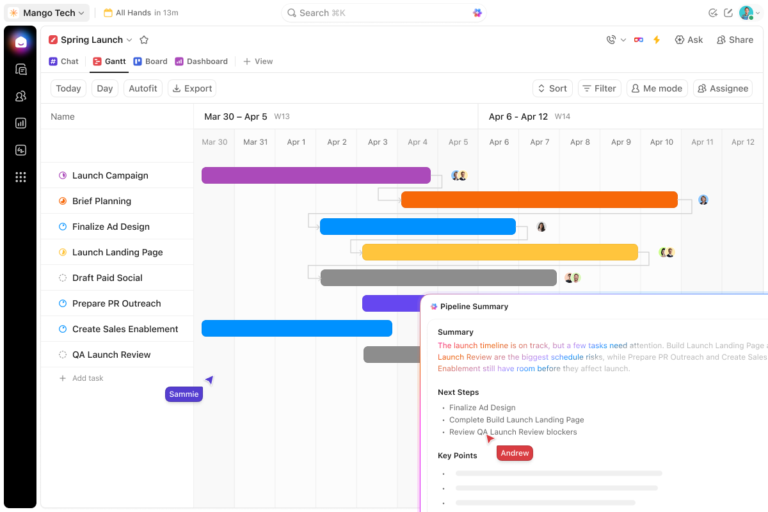
ClickUp is a converged work AI platform. What earns it a place here is that ClickUp Gantt View runs on the same tasks people update every day. Turn on Critical Path, and the chain controlling your deadline lights up. Turn on Slack Time, and each flexible task gets a dashed bar showing how far it can move before the deadline feels it.
Because those bars are live tasks, the path recalculates when an assignee drags a date or clears a blocker. Dependency rescheduling pushes the connected work along with it, so nobody rebuilds a file after a bad week.
ClickUp Brain sits on the same data and answers questions about what slipped and why, pulling from all across your workspace and connected apps. For delivery teams, that closeness is the point. The schedule and the work share one home, so the critical path always reflects reality.
Standout features
ClickUpMilestones: Mark launches, approvals, and handoffs on the timeline, then see which chain of work feeds each one
Gantt baselines: Snapshot task dates at the project or portfolio level and measure later drift against it
ClickUp Workload View: Check assigned work against real capacity to catch the overload that delays scheduled tasks
ClickUp Dashboards: Push status, time tracked, and milestone progress into stakeholder reports so nobody has to read the Gantt chart every time
I appreciate ClickUp for solving the problem of seeing multiple clients in one view and providing better organization for bigger projects. I really like the task dependencies, automations, and dashboards. The Gantt view, Mind map, calendar, docs, and AI notes add significant value to my workflow. It’s great that we can have a master template to replicate, saving a lot of time and ensuring nothing gets forgotten when starting new projects.
Where it taps out: ClickUp’s Gantt is built to keep the critical path tied to work in motion, so it reads task dates and dependency chains. Teams submitting schedules for owner or claims review will want a specialist CPM engine for retained logic and progress override, and plenty run both.
Best for: Cross-functional delivery teams that want the critical path sitting next to the tasks, workload, and reporting they already run.
Skip it if: You only want a scheduling file, and the rest of your team has no plan to move their daily work into the same tool.
Planera builds CPM schedules for construction on a shared canvas. A superintendent and a scheduler can sketch the sequence together while the engine keeps the logic honest underneath. Contractors are the whole audience here.
The draw for critical path work is how much control sits under that simple surface. You get all four link types, lag and lead, multiple float paths, retained logic, and progress override.
It also checks its own work. Run the DCMA 14-point test inside the tool, and it flags weak logic, hard constraints, and negative float before an owner’s consultant finds them. And Manny, the built-in AI helper, answers questions about what drives the path and spins up what-if versions to weigh recovery options.
Standout features
Version comparison: Keep several schedule versions and compare them side-by-side to see which dates and drivers moved
Connected field schedules: Build short-term look-ahead plans that stay tied to the master schedule, so operations get detail without a second file
Resource and cost loading: Put crews and dollars on activities to see where the money sits along the path
Monte Carlo risk simulation: Model uncertainty across the schedule and estimate the probability of meeting key dates
Pricing
Custom pricing
Ratings
G2: Not available
Capterra: Not available
Note: Planera doesn’t yet have enough published third-party reviews for us to judge it the same way as the more established tools on this list. For this entry, we’re relying on our own understanding and Planera’s published documentation.
Where it taps out: Planera is built mainly for construction scheduling. Its CPM model, field schedules, resource tools, DCMA checks, and integrations all fit contractor workflows. Teams outside construction may find it too detailed and may not need all the terms or features.
Best for: General contractors and project controls teams who want full CPM depth without installing a Windows client.
Skip it if: Nobody at your company reads a schedule for a living, and simple dependencies would carry the plan.
5. Asta Powerproject (Best for planners working in 4D and BIM)
Asta Powerproject is Elecosoft’s planning tool for construction programs, and it’s the one here that ties the schedule to the model. Link tasks to objects in an IFC file through the 4D module, and you can play the build sequence back as a video. A logic argument becomes something a subcontractor can watch.
The Critical Path Drag measures how much time each critical task adds to the total duration. Sort by it, and the worst offender rises to the top. That’s the number you want when a client asks where four weeks might come from. The tool also runs schedule quality checks against configurable standards, with metrics drawn from DCMA and CIOB guidance.
Site data flows back through Asta SiteProgress, where crews update quantities, attach photos, and raise new tasks from a phone. The program then reflects what actually happened on site.
Standout features
Unlimited baselines: Create as many as the job needs and compare progress, resources, and costs against any earlier version
Resource heat maps: Read planned against actual effort or cost by period, with color flagging under-, fully-, and over-allocated resources
Cost and earned value: Track budget, planned, and actual cost with earned value reporting and full change history in the project file
Line of Balance graphs: Chart repeating work across locations to see where two trades will collide on the same plot before either crew shows up
Pricing
Trial available
Asta Powerproject: £1,530/year for a single user via Elecosoft’s store (approx $2,066/year)
Note: Concurrent licenses, SaaS access, and add-ons like Vision and SiteProgress are priced separately.
What I like best about Asta Powerproject is its ability to create, manage and analyse complex construction programs efficiently. The software offers powerful planning functionality, including logic-linked scheduling, resource management, progress tracking and delay analysis, while remaining intuitive for day-to-day use.
Where it taps out: The main application is Windows software. Mac teams go through PowerProject SaaS, which is licensed separately. So the full BIM setup costs meaningfully more than the headline price.
Best for: Planners who need the schedule and the 3D model arguing with each other in one file.
Skip it if: Nobody on your project touches an IFC model, since the 4D work is what justifies the price here.
6. Smartsheet (Best for spreadsheet-native program teams)
Smartsheet turns a spreadsheet into a real schedule. Switch on dependencies and type predecessors and durations into the columns you already use. The Gantt view then calculates and shades the critical path across those rows. Teams that plan in a grid get CPM logic without needing to learn a planning tool.
You can further set lead and lag time, choose which days count as working days, and let dependent dates move on their own. Driving Path answers a narrower question. Pick one task, and Smartsheet highlights only the predecessors pushing its start date, so you can chase a single milestone without reading the whole project.
Those same rows feed forms, reports, dashboards, and automations. That’s why program teams keep the schedule and the intake process together. Its base price tier, Pro, now bundles conversational AI through Smart Assist and Smart Columns.
Standout features
Cell linking: Feed a subproject’s finish date straight into a master sheet row, so a slip on one plan moves the program schedule
Workload tracking: See assigned work across the team so you can tell whether a capacity problem is really a schedule problem
Control Center: Standardize how new projects get created, push changes into existing plans, and roll reporting up across a portfolio
Forms: Route intake through a form so the new scope arrives as rows in the plan and gets sequenced
It functions like an advanced spreadsheet, but with the added ability to attach files, add comments, and set up automated alerts for each action or line item. In the Gantt chart view, I can track timelines, show dependencies between tasks, and identify my project’s critical path. It also supports cross-sheet reporting across projects, which gives me a single, consolidated view. I like that it uses familiar formulas, and the predefined column types make setup and organization straightforward.
Where it taps out: Baselines and workload tracking both start on the Business plan, so a team on the Pro plan can build a dependency-driven critical path and still have no way to measure drift against the original plan.
Best for: Program and operations teams who want dependency logic without moving anyone off a grid.
Skip it if: Your schedule needs float reported as a number rather than a highlighted chain of rows.
7. Wrike (Best for enterprise and professional services teams)
Wrike suits services teams juggling a dozen client schedules at once. Switch on its Gantt view, wire up dependencies, and it marks the tasks with the most pull on the delivery date. All four link types work here, including start-to-finish, and you can add lead or lag on any of them.
AI Project Risk Prediction reads project data for signs that a deadline is slipping. It tags each project as low, medium, or high risk and shows that rating in views, dashboards, and reports. A delivery lead gets a warning before the critical path visibly moves.
When a date does change, Wrike shifts the dependent active tasks down the chain.
Standout features
Request forms: Turn client requests into structured, routed work so new scope enters the plan already sequenced
Proofing and approvals: Keep creative review cycles attached to the task, which stops approval delays from hiding in email
Resource and workload planning: See how work spreads across people and teams when three client schedules want the same employee
Budgeting: Track planned against actual cost with hourly rates, so a slipping schedule shows up as a margin problem
I like the ability to add a critical path and the general usability as it relates to assigning task owners. I also like the dashboards and all of the integrations to other programs.
Where it taps out: Wrike can highlight a project’s critical path and model four dependency types. However, its scheduling tools are built mainly for work management. Teams that need formal CPM validation, multiple float-path analysis, or contract-grade schedule testing will need a more specialized scheduling tool.
Best for: Companies sharing a single bench of specialists across multiple client timelines.
Skip it if: You need specialist CPM analysis beyond dependency-driven scheduling.
8. GanttPRO (Best for small teams that need a critical path fast)
GanttPRO is the pick when you need a working critical path this afternoon. It’s a browser-based Gantt tool aimed at small teams and consultants, and the setup is genuinely short. Add tasks, drag in dependencies, then switch on critical path. GanttPRO shades the driving chain and works out float on everything else.
Under the surface, the rules are complete enough to trust. All four link types are supported, along with lead and lag, project calendars, and auto-scheduling. Move one date, and the connected tasks follow. The chart keeps behaving like a schedule instead of a picture of one.
An AI Gantt chart maker handles the blank page problem. Describe the project in a few lines, and it drafts phases, tasks, dependencies, milestones, and role assignments. You then correct it by hand.
Standout features
Change history: Review every edit made to the plan and roll back the one that broke the sequence
Private sharing links: Send clients a view-only chart, with control over which details show, so nobody needs a seat
Time and cost tracking: Log time against tasks and pair durations with resource costs to watch schedule and budget together
Workload and portfolios: Spot resource pressure across several projects at once (Business plan)
What stood out to me most was how intuitive the dependency management and overall interface are. Setting up task dependencies is super simple and gives a visual idea of where I’m at in the project. And when you shift one task’s timeline, everything downstream automatically recalculates and shifts with it. On past projects using other tools, I’ve had to manually re-check and re-adjust every linked task whenever a deadline moved – GanttPRO just handles that cascade for you, which saved me a surprising amount of time and prevented scheduling errors that would’ve otherwise slipped through.
Where it taps out: GanttPRO doesn’t offer a permanent free plan. Once the 14-day trial ends, you need a paid subscription to keep working in the product, which matters for solo users or teams that only build an occasional schedule.
Best for: Consultants and small teams who need a defensible schedule without a week of configuration.
Skip it if: You only need critical path planning occasionally and can’t justify an ongoing paid subscription after the trial.
TeamGantt is a web-based scheduling tool built so that the Gantt chart stays at the center of the work. Tasks, dependencies, progress, and workload all feed the same timeline, which suits teams who run their projects through the schedule.
While critical path and baselines cover the planning basics, TeamGantt gets more interesting once the schedule leaves the project team. Filter the chart down to the dates or tasks a client cares about, then share a live view-only link.
For client-facing work, the same chart does two jobs. It’s the plan the team updates daily and the timeline you walk a stakeholder through.
Standout features
Project Health report: Compare how much should be done today against actual progress, then open the tasks behind each status
Portfolio view: Group projects by client, team, owner, or quarter and scan health across the whole portfolio
Builder Edition controls: Add material lead times, lookahead scheduling, Procore sync, and RACI assignments for construction work
Cost-loaded scheduling: Assign costs to tasks and watch projected spend change as dates move
I really like that TeamGantt offers an intuitive drag-and-drop Gantt chart interface, making project scheduling and timeline adjustments super easy. It also enables seamless team collaboration with task assignments, file sharing, and real-time progress tracking. The initial setup was very easy, not painful at all.
Where it taps out: Everything is metered by project and task count. The Basic plan includes two projects and lets you add up to five with additional per-project charges, each capped at 150 tasks. The Business plan limits you to 20 projects and 500 tasks, so a busy agency can hit the ceiling mid-year and pay per project to keep going.
Best for: Consultants, agencies, and project teams that need a critical path schedule that they can also present clearly to clients and other stakeholders.
Skip it if: You regularly manage schedules that exceed the project or task limits in its standard plans.
10. Lucidchart (Best for drawing the network diagram first)
Lucidchart is a web-based diagramming platform, which makes it the outlier in this list. It doesn’t run a schedule. But it draws the network you build the schedule from. PERT and project network templates give you nodes that hold a task, a duration, and links to whatever comes next.
Sketching first has a real payoff. The forward and backward pass is easier to reason about as boxes and arrows than as rows in a table. Shapes can also carry custom data and formulas, so early dates, late dates, and float will calculate on the canvas as your inputs change. That still needs you to design the underlying model, but it gives technical teams much more control over how the network calculation is represented.
Lucid AI turns a text prompt into an editable diagram and revises it when you ask again. Handy in a planning workshop when the goal is getting the structure on screen while everyone’s still in the room.
Standout features
Conditional formatting: Set rules on shape data so activities that hit a condition, like zero float, change color on their own
Data linking: Pull project data from a connected source so nobody retypes values into individual boxes
Real-time co-editing: Let several planners work the same network at once during a sequencing workshop
Presentation mode: Walk stakeholders through the finished network without rebuilding it in slide software
Pricing
Free
Individual: $9/month
Team: $10/user/month
Enterprise: Custom pricing (includes Lucidchart and Lucidspark)
Note: Lucid markets Lucidspark and Lucidchart through the broader Lucid Visual Collaboration Suite, so the exact price can depend on the product package and billing term selected. Confirm the final cost at checkout.
I like how intuitive and collaborative Lucid Visual Collaboration Suite is. It makes it easy to quickly turn ideas, workflows, complex processes, and structures into clear, visual diagrams that my team can understand at a single glance. I find the wide variety of templates for workflows really effective, saving time with detailed templates for process maps, workflows, and diagrams, which help me do my job much faster. The initial setup is also very easy.
Where it taps out: You get the building blocks and assemble the logic. There’s no scheduling engine, so nothing reschedules downstream work when a duration changes. Move a date in Lucidchart, and you update the diagram, not a plan.
Best for: Teams working out the dependency logic on a wall before it becomes anyone’s schedule.
Skip it if: You want the tool to maintain the dates once the network is drawn.
Summarize this article with AI ClickUp Brain not only saves you precious time by instantly summarizing articles, it also leverages AI to connect your tasks, docs, people, and more, streamlining your workflow like never before.
Summarize this article for me please
How to Choose the Best Critical Path Software
Start with the constraint that broke your last schedule. If it was outside scrutiny, you need a dedicated CPM engine: Primavera P6, Planera, or Asta Powerproject. If it was a plan nobody updated, you need the path sitting next to the work: ClickUp, Smartsheet, or Wrike. If it was setup time or a stakeholder who won’t log in, GanttPRO, TeamGantt, and Lucidchart get you there faster than any of them.
Your constraint
Go with
Schedule gets submitted for owner or claims review
Oracle Primavera P6
Must stay inside the Microsoft ecosystem
Microsoft Project
Plan drifts because it lives somewhere the team doesn’t
ClickUp
Need contract-grade CPM without installing Windows software
Planera
The 3D model drives the build sequence
Asta Powerproject
Team already thinks in spreadsheet rows
Smartsheet
One specialist bench serves many client timelines
Wrike
Need a defensible schedule by end of day
GanttPRO
The schedule doubles as a client presentation
TeamGantt
Dependency logic itself is the deliverable
Lucidchart
Your critical path can be correct and still miss the delay
Critical path software tells you which sequence controls the finish date under the schedule you have today. That doesn’t mean every dangerous delay starts there.
Researchers studied 323 schedules from 77 real construction projects worth more than $10 billion and found that delays propagated through the wider dependency network, not only along the critical path. In larger schedules, the critical path also represented a shrinking share of the total activity network.
That changes what “good” critical path software looks like. The red chain matters, but so do low-float activities, branching dependencies, resource conflicts, and paths sitting just behind it. A tool that shows only one highlighted route can give you a clean answer to a messier problem.
Summarize this article with AI ClickUp Brain not only saves you precious time by instantly summarizing articles, it also leverages AI to connect your tasks, docs, people, and more, streamlining your workflow like never before.
Summarize this article for me please
CPM Software vs. Gantt Chart Tool: What’s the Difference?
CPM scheduling software calculates the schedule from activities, durations, and dependency logic, then draws the Gantt chart as the output. A Gantt chart tool starts with bars on a timeline and adds dependencies afterward. Both show you a colored chain. Only one of them can tell you what that chain costs you.
The difference shows up the moment something changes. A CPM engine reschedules the whole network, reports total and free float on every activity, and moves the finish date. A chart-first tool may shift the bars you linked and leave the finish date sitting where it was.
Capability
CPM scheduling software
Gantt chart tool
Starting point
Activities, durations, and logic
Bars placed on a timeline
Float
Reported as a number on every activity
Often just a highlight on the critical chain
Dependency types
All four, with positive and negative lag
Usually finish-to-start, sometimes more
When a duration changes
Whole network recalculates, finish date moves
Linked bars shift, finish date may not
Calendars
Multiple, assignable per task or resource
One project calendar
Typical output
Float tables, baselines, variance reports
A picture of the plan
Examples
Primavera P6, Microsoft Project, Planera, Asta Powerproject
Most work management platforms with a Gantt view
Summarize this article with AI ClickUp Brain not only saves you precious time by instantly summarizing articles, it also leverages AI to connect your tasks, docs, people, and more, streamlining your workflow like never before.
Summarize this article for me please
The Critical Path Only Helps If Someone Updates It
Every tool here can draw a critical path. The question is which one still reflects reality on a Thursday, after two tasks slip, and nobody has opened the file.
If your schedule has to survive a contract review or a delay claim, that means a dedicated CPM engine, and the depth is worth the setup. If your plan drifts because it lives somewhere your team doesn’t, the fix is proximity, not more features.
Want to watch a critical path recalculate against real tasks instead of a maintained file? Try ClickUp for free.
Summarize this article with AI ClickUp Brain not only saves you precious time by instantly summarizing articles, it also leverages AI to connect your tasks, docs, people, and more, streamlining your workflow like never before.
Summarize this article for me please
Frequently Asked Questions About Critical Path Software
Can you calculate the critical path in Excel?
Yes, but Excel has no scheduling engine, so you build the math yourself. Set up columns for predecessors, duration, early start and finish, late start and finish, and float, then run the forward and backward pass with MIN, MAX, and IF formulas.
Is Primavera P6 better than Microsoft Project?
For schedules that get reviewed by someone outside your company, yes. P6 Professional handles projects up to 100,000 activities, with multi-project resource leveling and a choice between Longest Path and a total-float threshold for defining critical. Microsoft Project is cheaper and easier to staff, with 11 baselines, eight constraint types, and Task Inspector.
What is a near-critical path?
A near-critical path is a sequence with relatively little total float. The exact threshold varies by project. It matters because small delays can consume that float and turn the sequence into the new critical path.
How do you show the critical path in Microsoft Project?
Open the Gantt Chart view, go to the Format tab, and select the Critical Tasks checkbox. Critical activities turn red. Add Total Slack and Free Slack as columns, and you get the float numbers behind that formatting. Task Inspector then explains which predecessor or constraint drives any given date, which is the fastest way to diagnose a path that looks wrong.
How do you analyze critical path delays?
Start by comparing the current schedule against a saved baseline to see which activities on the path moved and by how much. Two formal methods dominate. Time impact analysis inserts a delay event and measures the effect on the completion date. Windows analysis examines the critical path over discrete periods. Both need a baseline and clean logic, which is why it’s best to perform schedule integrity checks before a dispute arises.
Can a project have more than one critical path?
Yes. Any path with the same total duration as the longest path is also critical, and schedule compression often creates a second one. Microsoft Project can display multiple critical paths by calculating one for each independent network. Primavera P6 goes further with multiple float paths, showing subcritical chains sitting behind the leader. More parallel critical paths means less room for error.
How do you shorten the critical path?
Two techniques: crashing and fast-tracking. Crashing adds resources or overtime to critical activities and raises cost. Fast-tracking runs sequential critical activities in parallel and raises rework risk. Both only work on critical path activities, so adding people to a task with float changes nothing. Recalculate after every change: compressing one path usually promotes another to critical.
Is there free critical path software?
TeamGantt and Lucidchart both offer free plans, and ClickUp’s Free Forever plan includes the Gantt view (limited uses). Free tiers usually cap projects, tasks, or seats rather than the calculation itself, so check the current limits before you commit a real schedule.
What is the difference between PERT and CPM?
CPM uses one fixed duration per task and returns a single schedule with one critical path. PERT uses three estimates, optimistic, most likely, and pessimistic, to model how uncertain each duration is. Teams often sketch the network with PERT thinking, then run CPM to manage the live schedule.
Everything you need to stay organized and get work done.