

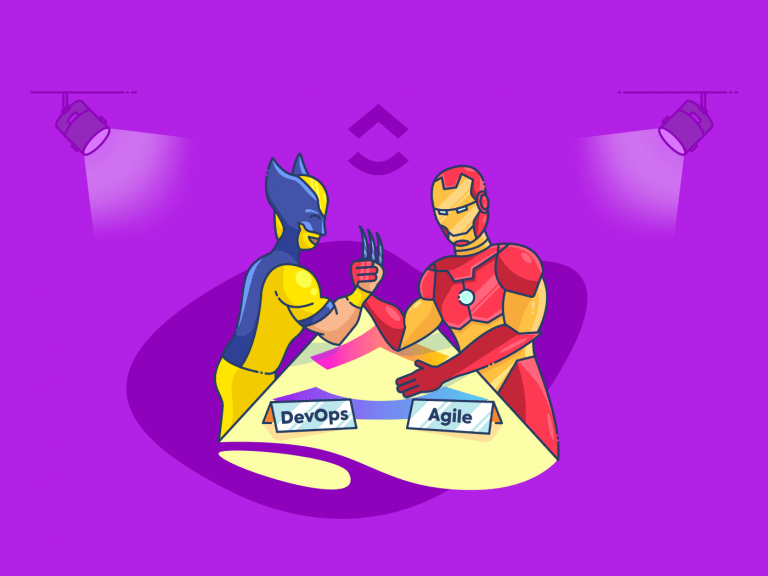
Curious about the differences between DevOps vs Agile?
Agile and DevOps are superheroes in the world of software development.
However, just like the X-men and the Avengers, they have their own different worlds.

While Agile takes care of the developer-stakeholder world, DevOps focuses on the developer-operation world.
In this article, we’ll look at each of them in detail and how they differ in approach, people, benefits, and more. We’ll also highlight a project management tool that can handle both methods.
This Article Contains:
Let’s get started!

 Summarize this article for me please
What Is DevOps?
DevOps is a software development methodology that focuses on bridging the gap between the software development team and the operation team.
The DevOps method bridges the gap between both teams with…
- Collaboration: development and operation teams collaborate with each other
- Process automation: automate as many processes as possible
- Continuous testing: both teams continuously test each small increment
- Continuous integration: software is developed as smaller chunks for faster integration
- Continuous deployment: codes that pass the testing phase are automatically deployed
- Continuous monitoring: the operation team monitors each increment as it is deployed
- Continuous software delivery: code changes are continuously built and tested to release anytime
But you don’t just want to know how cool the Avengers are, right?
You want to see them in action!
So let’s check out how DevOps works…
Traditionally, you’ll have your software development team working weeks or months on the development process, and when it’s done, the product is passed over to the operation team.
Now the operational team has a long job: managing, monitoring, and deploying these huge chunks of codes.
While this could potentially overwhelm the operation team, the software deployment can also take a long time. Your users won’t like waiting, and you don’t want to make them mad: especially if there’s someone like Bruce Banner!

Instead, the DevOps culture focuses on continuous integration.
The development team would write new codes in smaller chunks, test them and pass it over to the operation team. The operation team would then further test, integrate, and deploy the codes.
However, it requires strong collaboration between your development and operation teams.
For tackling all these, DevOps uses specific tools and infrastructure to facilitate seamless collaboration and automation.
Impressive, right?
Now let’s check out what Agile is!
Summarize this article for me pleaseWhat Is Agile?
Agile is a software development methodology where you break down an entire project into shorter development cycles (known as sprints) that last 2-4 weeks.
What’s the benefit?
The Agile method is a significant improvement over traditional project management methods, like the Waterfall model.
In the Waterfall methodology, you involve the customers only after months of developing the product. And if they aren’t okay with the product, you’ll have to restart the development process all over again!
Agile focuses on continuous improvement.
With Agile, you present a version of the working software to your customer after each sprint. Now that you’ve got their feedback, you can incorporate it in your upcoming cycle.
Here’s an example to understand the Agile process better:
Let’s say your software engineering team is building an iOS app.
If you use the traditional waterfall approach, your in-office or remote team could take a year for developing and testing the app.
However, after finally launching it into the market, the customers may not like a feature that your team spent four months perfecting.
But with the Agile methodology, things would be different.
At the end of each sprint (which lasts only 2-4 weeks), you get feedback from your customer on your latest increment. This way, you can scrap a bad idea without wasting any time and money on developing it.
But the best part is, you can build software that fits your customers’ needs perfectly!
Sounds like Agile is a pretty powerful methodology, right?
But how does it compare to the DevOps method?
Summarize this article for me pleaseDevOps vs Agile: How Do They Differ?
The X-men and the Avengers both have a common goal: to save the world.
However, they have their own unique style of doing it.

Similarly, DevOps and Agile have the same goal: to increase business efficiency.
However, just like the X-men and Avengers, their worlds are a bit different.
Let’s dive into these differences:
1. Differences in the approach
Agile and DevOps use different software development approaches:
A. Agile approach
The Agile approach focuses on bridging the gap between the customers and the Agile development team using an iterative feedback process. In short, the Agile process takes a constant change approach to keep the customers happy.
B. DevOps approach
The DevOps approach bridges the gap between the software development team and operation team by making the process automated and continuous. For example, it incorporates multiple methods like test automation, continuous deployment, continuous integration, and continuous testing.
Bonus: Check out the top 10 Continuous Deployment Tools for Software Teams in 2023
Note: Unlike the DevOps methodology, Agile has a guiding document called the Agile Manifesto. It outlines the values and principles of the Agile software development method.
2. Differences in the team
Both the X-men and Avengers have teams consisting of members with different skill sets.

Similarly, DevOps and Agile both have team members with different skill sets and sizes.
A. Agile team
In the Agile methodology, teams are always small and cross-functional. As such, Agile teams generally prefer full-stack developers who can understand every part of the software development lifecycle.
And while you have a project manager, product owner, or Scrum master to guide the team, each team member is expected to be self-sufficient.
B. DevOps team
The DevOps process will often have many development and operations teams working together with excellent collaboration. As a result, they’re much larger and involve team members with varying experience levels.
In the DevOps culture, the roles are clearly defined instead of focusing on cross-functionality.
3. Differences in documentation
When it comes to documentation, Agile is more like Wolverine, and DevOps is more like Nick Fury.
A. Agile documentation
Agile is more focused on the working process than on the documentation.
Kinda like how Wolverine wants to directly jump into the action!
However, this doesn’t mean that Agile fully ignores documentation; it just takes a backseat.
B. DevOps documentation
In the DevOps methodology, documentation is as serious as Nick Fury’s demeanor.

Since the operational team doesn’t create the increment, they need proper documentation to understand the increment clearly.
4. Differences in timeframe
Wolverine or Hulk might not care about time, but timeframes are crucial for your software company.
A. Agile timeframe
Agile works in short, predetermined periods called sprints. These sprints typically last 2-4 weeks.
B. DevOps timeframe
The DevOps process has no such specific timeframes, but it focuses on a long term schedule for better reliability.
5. Differences in tools
Thor’s hammer won’t work well if Wolverine tries to use it, right?
He’s already awesome with his adamantium claws.

Similarly, both Agile and DevOps have their own set of tools that work for them.
A. Agile tool
An Agile tool focuses on team collaboration and project tracking.
Most Agile teams use project management software that helps them plan, manage, and track projects, as well as collaborate with team members in real-time.
Sorta like an all-in-one software, like JARVIS!
B. DevOps tool
DevOps needs automation software and good tech infrastructure. For example, cloud computing technology like AWS can provide the required infrastructure to implement DevOps.
Besides team collaboration, a DevOps tool will also offer tons of automation to help them with deployment pipelines.
6. Differences in the pros and cons
No one is perfect, right? Even a god, like Thor, makes his share of mistakes.
Likewise, both Agile and DevOps have their strengths and weaknesses.
A. Pros and cons of Agile
Here’s a quick look at some advantages of the Agile development approach:
- Promotes collaboration between the developers and the stakeholders
- Offers faster software delivery
- Members spend less time on documentation
Now, let’s go over the downsides of the Agile development process:
- Limited documentation
- Scope creep can always be a problem in Agile projects
B. Pros and cons of DevOps
Here’s why DevOps is an effective software development methodology:
- Promotes collaboration between the developers and the operation team
- Long term approach keeps software quality and reliability in check
- There’s full clarity on software development which reduces chances of scope creep
Let’s glance at some shortcomings of the DevOps software engineering methodology:
- Members have to spend additional time and energy on documentation
- Keeping up with new DevOps processes like continuous testing and continuous deployment can be a constant challenge for companies
Here’s a chart summarizing all the DevOps vs Agile differences:
| Parameter | Agile | DevOps |
|---|---|---|
| Principle | Agile principle is to manage projects rapidly by involving stakeholders | DevOps principle deals with managing end-to-end engineering processes |
| Approach | Agile approach is iterative and focuses on the customer and rapid releases | DevOps approach is a collaborative approach between the Dev and Ops teams |
| Team size | An Agile team is small, between 3-8 people | A DevOps team doesn’t have a limit as it brings two large teams to collaborate with each other |
| Practice | Agile practice promotes adaptability and collaboration between small teams | DevOps practice promotes fully automated continuous integration for frequent software delivery |
| Tool | An Agile tool focuses on team collaboration and progress tracking | A DevOps tool focuses on automation and team collaboration |
| Timeframes | Agile method focuses on short sprints lasting from 2-4 weeks | DevOps method focuses on long-term reliability |
| Culture | Agile culture is about self-organized and cross-functional teams for faster development | DevOps culture is all about shared understanding and responsibility between the Devs and Ops teams |
Clear about their differences?
Now let’s clarify a common misconception about DevOps and Agile:
Summarize this article for me pleaseCan DevOps and Agile Work Together?
DevOps and Agile both offer a framework that can speed up the software delivery process.
While the Agile method works in the developer and customer world, the DevOps process works in the developer and operation world.
But imagine how cool it’d be if you could choose both of them,
Well, you can do that with Agile and DevOps!
While you can use Agile methods, like Scrum and Kanban, to incorporate customer feedback, you can use the DevOps methodology for increasing the efficiency between your developer and operational team.
However, the main challenge is: how do you implement both of these effectively?
Summarize this article for me pleaseHow to Manage both Agile and DevOps Projects?
Of course, you’ll need powerful software that can help you with everything.
Sorta like the software in Tony’s Suit!
But what exactly should you look for in that tool?

Agile and DevOps both require separate functionalities from their tools.
The Agile process requires your software to keep track of tasks, the current progress, and help you communicate with stakeholders.
DevOps would need things like cloud computing and automation solutions. But above all, the DevOps toolchain would need to facilitate smooth collaboration between large operation and development teams.
Ideally, the software that you need must:
- Let team members collaborate seamlessly
- Manage processes
- Automate processes
- Integrate well with your other workspace tools
Luckily, a tool like ClickUp aces all of this!
What’s ClickUp?
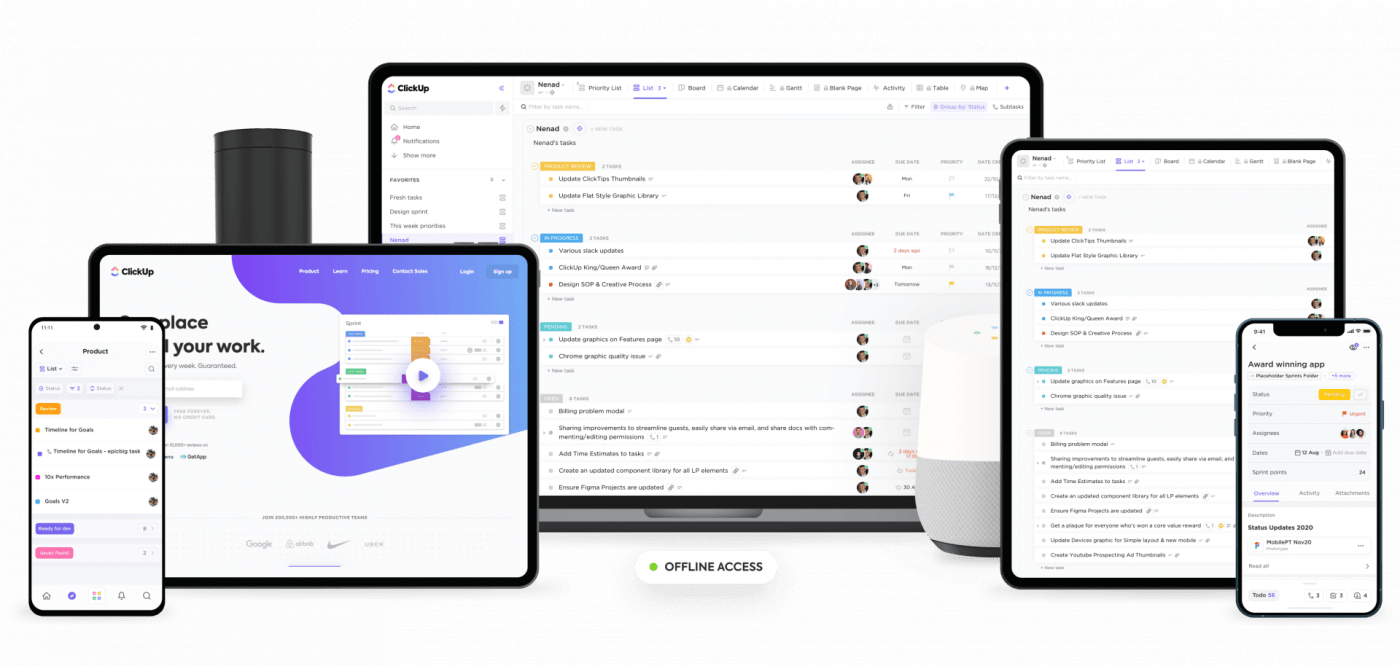
ClickUp is the world’s highest-rated Agile project management software.
Whether you need help to:
- Manage an Agile team or an entire DevOps team
- Track all your Agile software development projects
- Implement Scrum, Kanban, or even, the Waterfall approach
ClickUp can take care of it all!
Let’s see how ClickUp can help you adapt the DevOps or Agile methodology:
A. Goals
Goals are essential for every business process.
Don’t worry; your goal won’t be like “stopping Thanos”.
Better let the Avengers handle that.
Here are some examples of Agile goals:
- Incorporate a timer feature in the landing page
- Increase the website loading speed by 10%
On the other hand, DevOps goals look like:
- Deploy the new version of the app in 48 hours
- Monitor the resource usage for the latest live version
Usually, a project can have multiple goals, and keeping track of all of them might be challenging.
Unless you’re Charles Xavier, of course.

So, how do you keep track of your goals?
With ClickUp’s Goals feature!
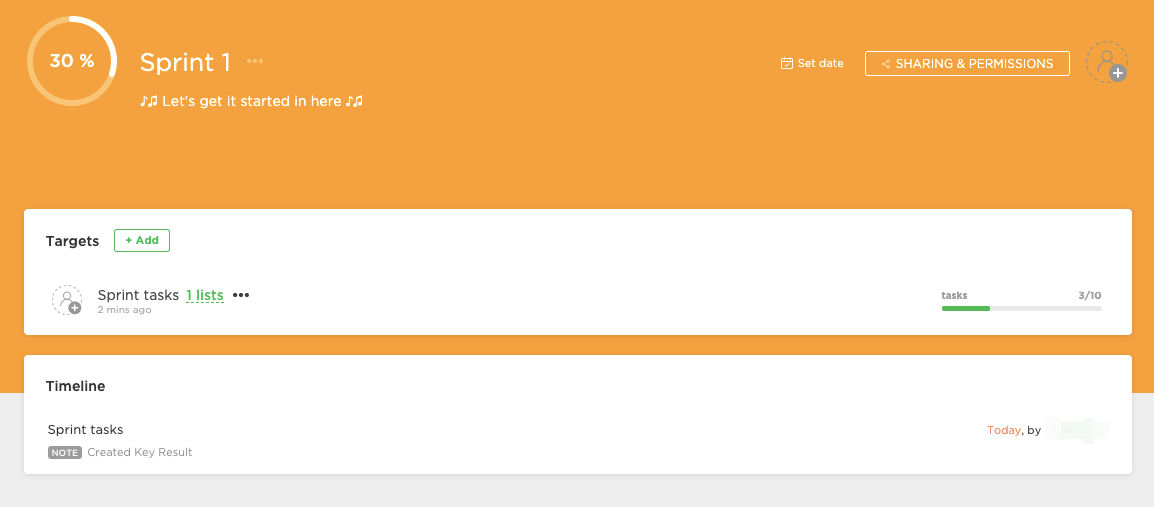
Goals are high-level containers that can be broken down into smaller Targets that can be easily achieved. While this keeps things organized, it also motivates your DevOps or Scrum team members by giving them a feeling of accomplishment.
But that’s not all!
With every completed Target, ClickUp automatically updates your progress percentage in real-time. This way, you’ll have a clear picture of how close you’re to achieving your goal.
Using ClickUp Goals, you can also:
- Quantify your Agile/ DevOps Goals with OKRs (Objectives and Key Results)
- Create weekly scorecards for performance appraisal
- Track Scrum sprints or projects in real-time
B. Workflow Automation
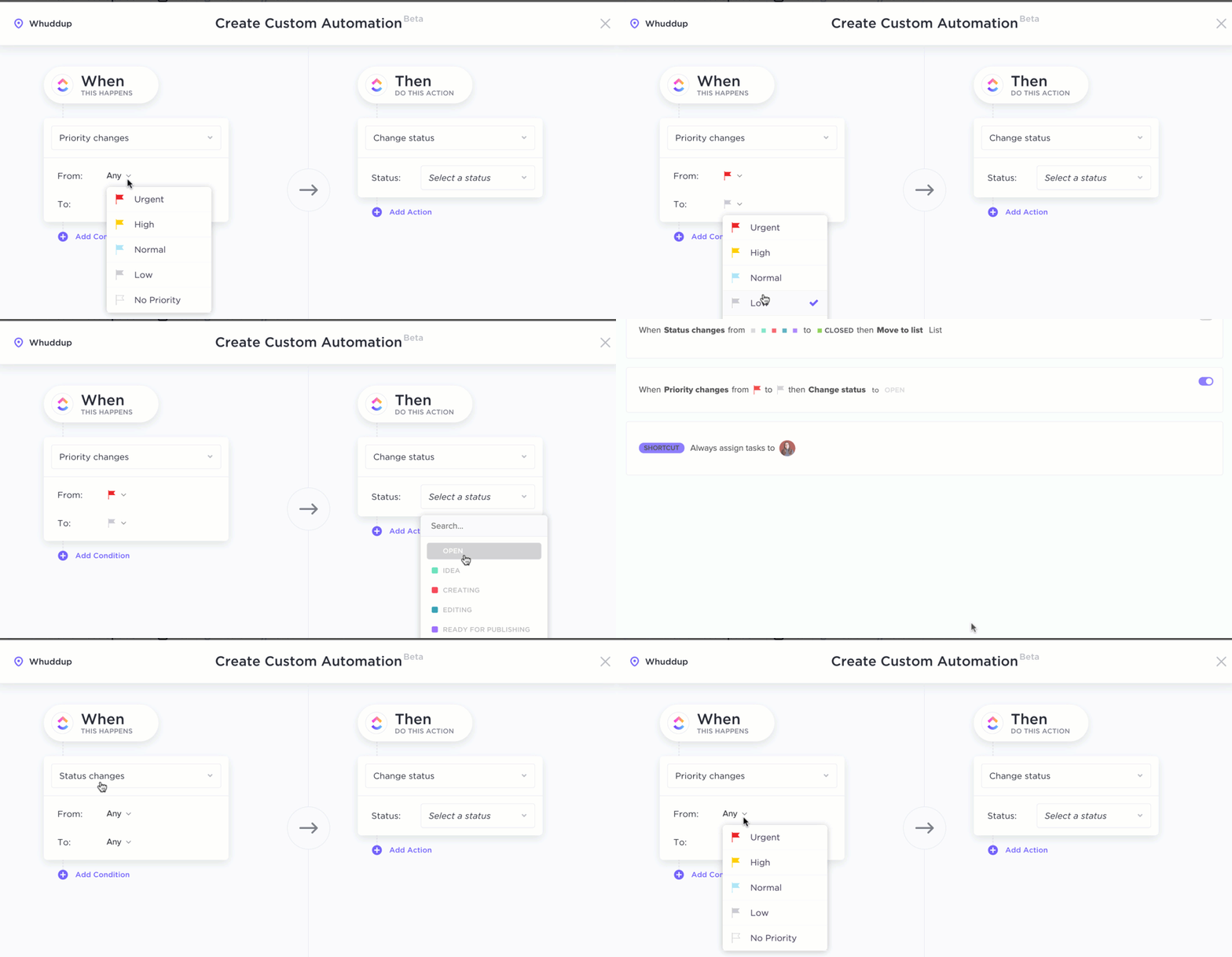
ClickUp’s Automation feature lets you automate repetitive tasks by offering tons of task automations. This not only saves you time but frees up your resources for tasks that actually need them.
Here’s how workflow automation works:
If a trigger happens and a condition is true, a specific action is executed automatically.
Hulk already has inbuilt workflow automation.
If bad guys are nearby and Hulk gets mad, he smashes them automatically.
Similarly, you can also create a custom automated process for your project workflows.
(There’s no “smashing” involved, of course).
However, ClickUp offers 50+ prebuilt Automations to help you get started quickly.
Some of these include:
- When a task’s status changes it automatically changes the assignee
- Apply a template while creating a task
- Update task priority when its checklist is cleared
- Change tags when a task’s deadline arrives
- Archive a task when its priority changes
(Click here to check out more preset Automations.)
C. Custom Task Statuses
Imagine asking the Black Widow for mission updates every now and then.
Not only is this time-consuming, but she’s also going to get super annoyed.

Similarly, you don’t want to call your team members 24/7 to get updates!
Luckily with ClickUp, you won’t need to.
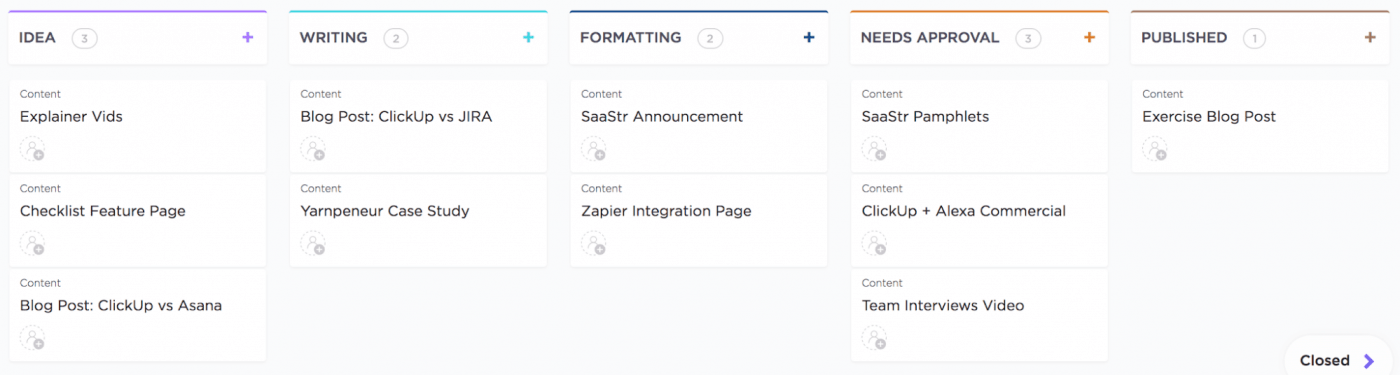
With ClickUp’s Custom Statuses, you can quickly see the status of any task at any time you want.
But the best part is that you can customize these according to your project needs.
For example, in your DevOps software development project, you can create an “undergoing beta testing” or “bug testing” stage instead of a generic term like “in progress”.
D. Comment sections
Good communication is essential for any team.
Imagine miscommunicating with the Hulk!

Whether it’s DevOps or Agile, managers often need to discuss complex technical details with their team members.
However, it’s hard for team members to get the right context when all they get are long emails.
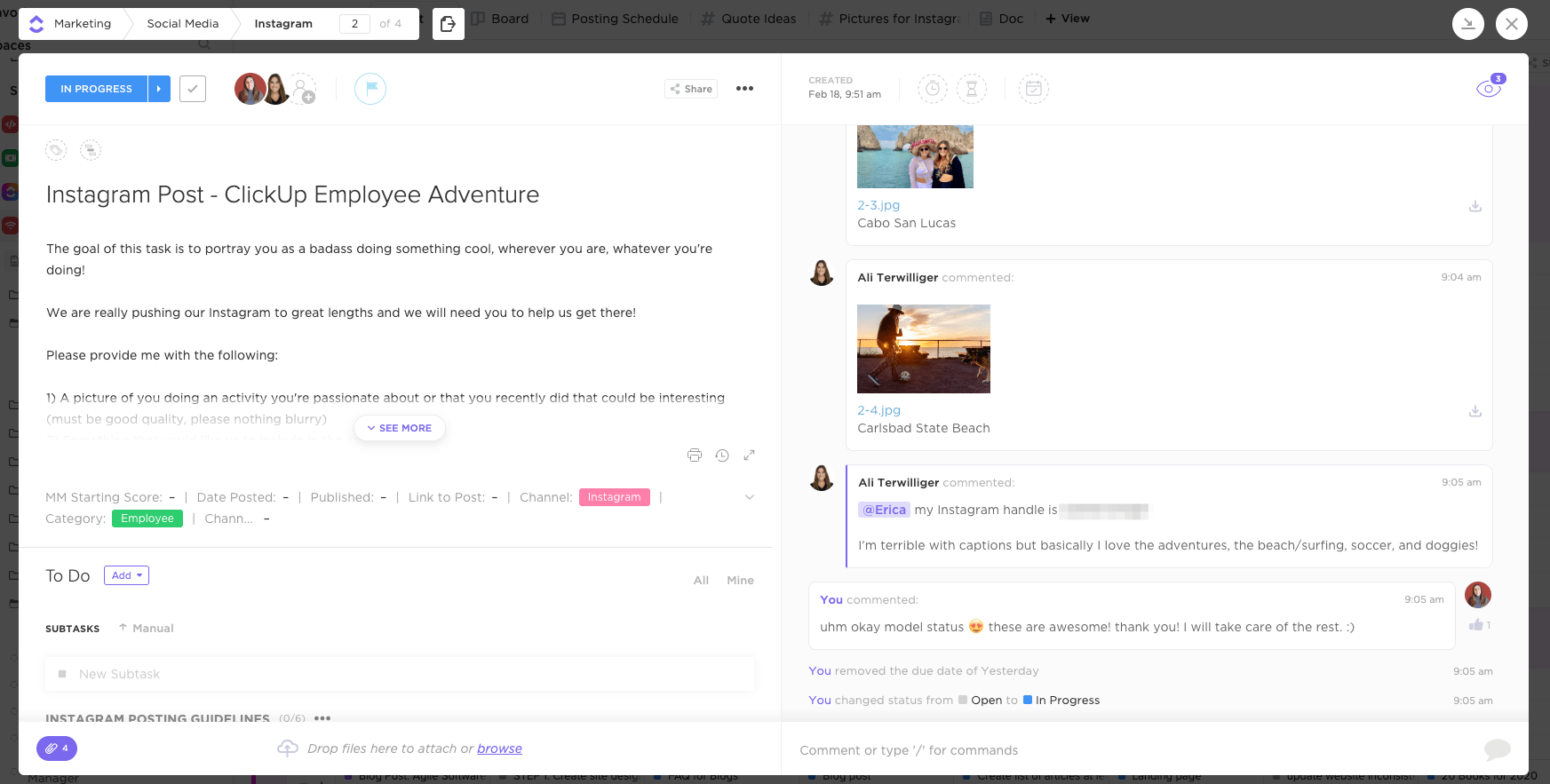
Luckily, ClickUp has an easy solution for it: Comments.
Each task in ClickUp comes with an inbuilt Comment section, which lets every team member have task-specific discussions.
Here’s how the Comment feature can help you:
- Tag members to highlight important comments
- Clarify what needs to be done exactly in a task
- Handle any problem with the right context
- Assign Comments to any team member to ensure that it doesn’t go unnoticed
- Share relevant files within any task section
For that extra collaboration, you can also use the Chat view to have discussions unrelated to any tasks. A great alternative to Slack channels!
E. Dashboards
Whether it’s Agile or DevOps, you need to keep track of your ongoing projects, right?
Unlike Tony Stark, you won’t need to spend millions of dollars on sophisticated technology to track your team’s progress effectively.

You can just use ClickUp’s Dashboard for free!
Dashboards give you quick summaries of any project. You can customize it to display exactly what you need, pretty much like your own project mission control.
Here are some graphs that you can use in your Dashboard:
- Velocity Charts: show you the completion rate of your tasks
- Burndown Charts: show the amount of work remaining for completing the project
- Burnup Charts: display the amount of work already completed in a project
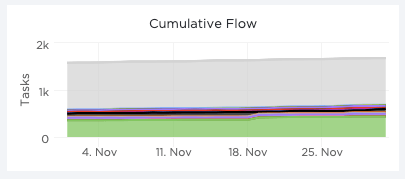
- Cumulative Flow Charts: give you a view of task progress over time, helping you identify any roadblocks
F. Integrations
What makes good teams like Avengers or X-men so strong?
They work well with each other.

Similarly, you need all your software to work well with each other all the time.
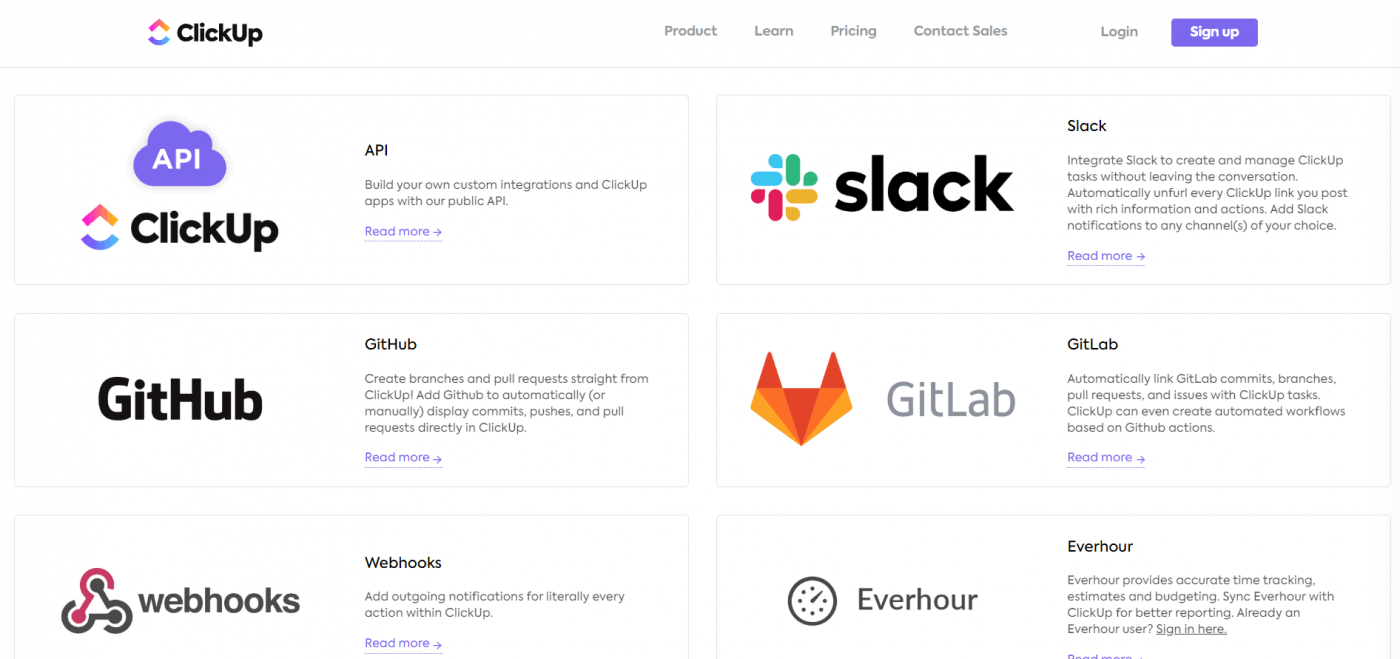
ClickUp has native Integrations with various popular workplace software to streamline the data flow between your tools. While this helps you manage projects easily, it also boosts your team’s efficiency.
Some of the popular software ClickUp seamlessly integrates with include:
- GitHub: automatically displays pushes, commits and pull requests directly within ClickUp
- GitLab: create automated workflows based on your GitHub actions
- Time Doctor: track project time and monitor the productivity of your employees
- Zoom: conduct high-quality video conferences with your virtual team members
But wait…
That’s not all ClickUp can do for you!
Here are some more amazing features it offers:
- Project Management Automation: automate repetitive 50+ tasks to save time
- Dependencies: tackle your tasks in the right order
- Pulse: view which tasks your team is most active in during a day
- Priorities: prioritize your tasks based on their urgency
- Docs: create detailed project documents and share them with your team conveniently
- Reporting: access various reports on your team’s performance
- Powerful Mobile Apps: keep track of your work on the go with ClickUp’s powerful Android and iOS apps
Summarize this article for me pleaseConclusion
So what’s the result between DevOps vs Agile?
DevOps and Agile both tackle different aspects of your software engineering projects.
And using both of them is like having both the Avengers and the X-men by your side.
But with great power comes great… management challenges.
Luckily, all you need is a project management tool like ClickUp!
If you need help with Agile or DevOps adoption, ClickUp can help you every step of the way with features like Goals, Automations, and Dashboards.
Like Captain America’s shield or Thor’s hammer, ClickUp is the perfect weapon to defeat any project obstacle.
Sign up today and experience this superpower!



Everything you need to stay organized and get work done.

Recent Articles

Enterprise Project Management: How to Run Every Project as One Portfolio 
Enterprise Project Management: How to Run Every Project as One Portfolio
How to Build a Task Dashboard Your Team Actually Trusts
How to Build a Task Dashboard Your Team Actually Trusts
