Sorry, there were no results found for “”
Sorry, there were no results found for “”
Sorry, there were no results found for “”
With marketing budgets having dropped by 15%, marketing teams now need to do even more with even less. Disciplined goal-setting has never mattered more.
This guide breaks down what marketing goals actually are and how to build them using the SMART framework. We also look at real-world marketing goals examples across brand awareness, revenue, retention, and more, and how to track them without drowning in spreadsheets.
Marketing goals are the specific, measurable outcomes your team commits to achieving within a set timeframe. They translate broad business ambitions into focused daily action for everyone from product marketing to demand generation.
Most teams confuse goals with objectives, which creates fuzzy accountability across the department. Let’s clarify that terminology right away:
| Term | What it is |
| Business goal | The company-level outcome that marketing supports |
| Marketing goal | The broad marketing outcome that ladders up to the business goal |
| Marketing objective | The specific, measurable target beneath a goal |
| Tactic | The activity or campaign that drives the objective forward |
When your goals, objectives, and campaign data live in one place, every team member sees the exact same picture. You can finally prove how daily marketing tasks actually move the needle for the business. 👀
👀 Did You Know: A CMI benchmark study found that 62% of B2B content marketers attribute their success to setting goals aligned with organizational objectives.
Setting goals that aren’t tied to company priorities leads to wasted effort and marketing initiatives that leadership simply doesn’t care about.
Eliminate this misalignment by mapping your marketing targets directly to company-level objectives. You can break high-level objectives down into smaller, measurable milestones tracked through ClickUp Tasks and ClickUp Custom Fields.
Before writing anything down, identify the exact business outcomes your team owns this quarter. Then, run them through a strict marketing lens to ensure they are actually viable. Here’s how you’d ensure you’re setting SMART goals.
💡 Pro Tip: Turn goals into execution plans automatically with ClickUp Brain.
Most teams stop at defining SMART goals. The gap is translating them into actual work.
Use ClickUp Brain to bridge that gap instantly:
Watch this video to learn how to create a structured marketing playbook that connects your goals to repeatable processes and campaign frameworks.
Taking on too many mismatched objectives spreads your budget too thin and guarantees you’ll underdeliver across the board. Focus your efforts by selecting just three to five goals that perfectly match your current business stage.
The examples below represent the most impactful targets across industries.
Brand awareness means the number of people in your target market who recognize your brand without prompting. This is notoriously hard to measure. Teams default to counting impressions, which tell you almost nothing about actual recognition.
SMART goal: Increase branded search volume by [target] within [timeframe] through a co-marketing campaign series targeting [audience segment].
Keep this in mind:
💡 Pro Tip: Stop digging through separate analytics tools by building ClickUp Dashboards to consolidate your branded search and direct traffic data in one central view.
Qualified leads are potential customers who match your ideal buyer profile and show genuine purchase intent. Lead volume’s a complete vanity metric if your sales team rejects most of the prospects you send over.
SMART goal: Generate [target] marketing-qualified leads per month from organic content by [timeframe], with a lead-to-opportunity conversion rate of [target].
How to do this:
💡 Pro Tip: Prevent hot leads from falling through the cracks by using ClickUp Automations to instantly route new prospects to the right team member based on their industry or lead score.
Aim to grow the number of relevant visitors to your site through organic, paid, referral, or direct channels. However, more traffic is only useful if you know those specific visitors actually convert into paying customers.
SMART goal: Increase organic traffic to product-led blog content by [target] within [timeframe] by publishing [target] new articles targeting mid-funnel keywords.
Steps you can take:
💡 Pro Tip: Keep your content engine running smoothly by planning your editorial calendar in ClickUp Docs and tracking each piece from brief to publish using ClickUp Custom Statuses. 📚
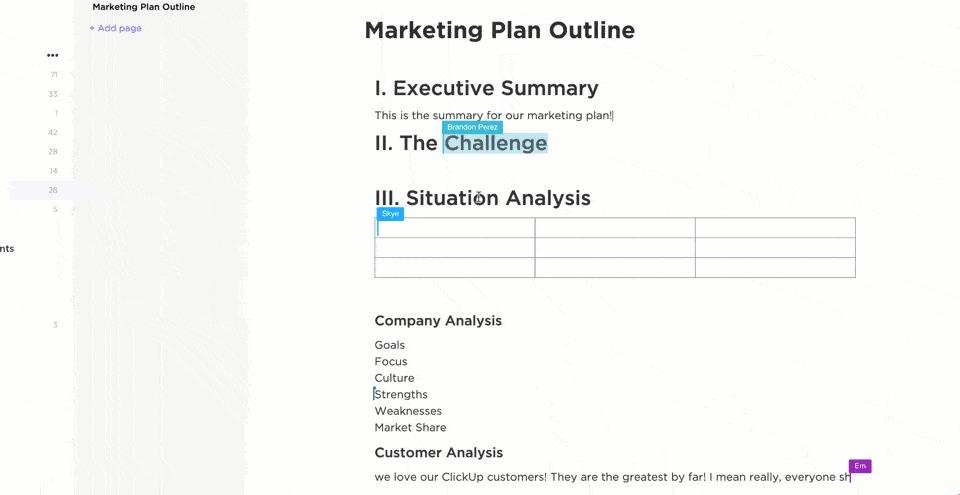
Brand engagement measures meaningful interactions like comments, shares, and saves between your audience and your company. A smaller, highly engaged audience converts significantly better than a massive but passive follower count.
SMART goal: Increase average engagement rate on LinkedIn company posts to [target] within [timeframe] by shifting to carousel and video formats.
Best practices to follow:
💡 Pro Tip: Turn messy brainstorming sessions into actionable work by using ClickUp Whiteboards to map out content themes and converting those sticky notes directly into assigned tasks.
Grow the income generated from marketing-influenced deals and campaigns. Tying your goals directly to revenue drives better campaign selection and eliminates activity for activity’s sake.
SMART goal: Increase marketing-attributed revenue by [target] in [timeframe] by improving demo-to-close conversion rates through a revamped nurture sequence.
A few points to note:
💡 Pro Tip: Prove your team’s financial impact instantly with ClickUp Real-Time Reporting that visualizes marketing-attributed pipeline right next to your campaign spend.
Customer lifetime value is the total revenue a single customer generates over their entire relationship with your company. Most marketing teams pour their entire budget into acquisition, even though retaining and expanding existing accounts costs significantly less.
SMART goal: Increase average customer lifetime value by [target] within [timeframe] by launching a post-purchase email nurture series.
Things to remember:
📚 Also Read: Expert-Approved Advertising Templates for Marketers
Brand authority positions your company as the trusted, go-to expert in your specific category. Authority isn’t built by publishing a high volume of generic content, but by publishing deep insights that other people cite.
SMART goal: Earn [target] backlinks from industry publications within [timeframe] through a proprietary original research program.
Here’s how to do this:
Customer retention focuses on reducing the rate at which your existing buyers cancel their subscriptions or stop purchasing. The onboarding emails and community content that marketing controls directly influence whether a new customer feels welcome and stays.
SMART goal: Reduce monthly churn rate to [target] within [timeframe] by redesigning the onboarding sequence and launching a customer community.
Tips to make this work:
💡 Pro Tip: Ensure no new client falls into a communication gap by using ClickUp Task Templates to automatically apply a standardized onboarding checklist the moment a deal closes.
Improving rankings means moving your most important web pages higher in search results for keywords your buyers actually use. Ranking for massive informational keywords feels great, but high-intent comparison keywords drive actual revenue.
SMART goal: Move [target] priority product pages into the top three positions of Google within [timeframe] through content optimization.
How to start:
💡 Pro Tip: Accelerate your optimization process by asking ClickUp Brain to summarize competitor content gaps and instantly generate detailed brief drafts. ✨
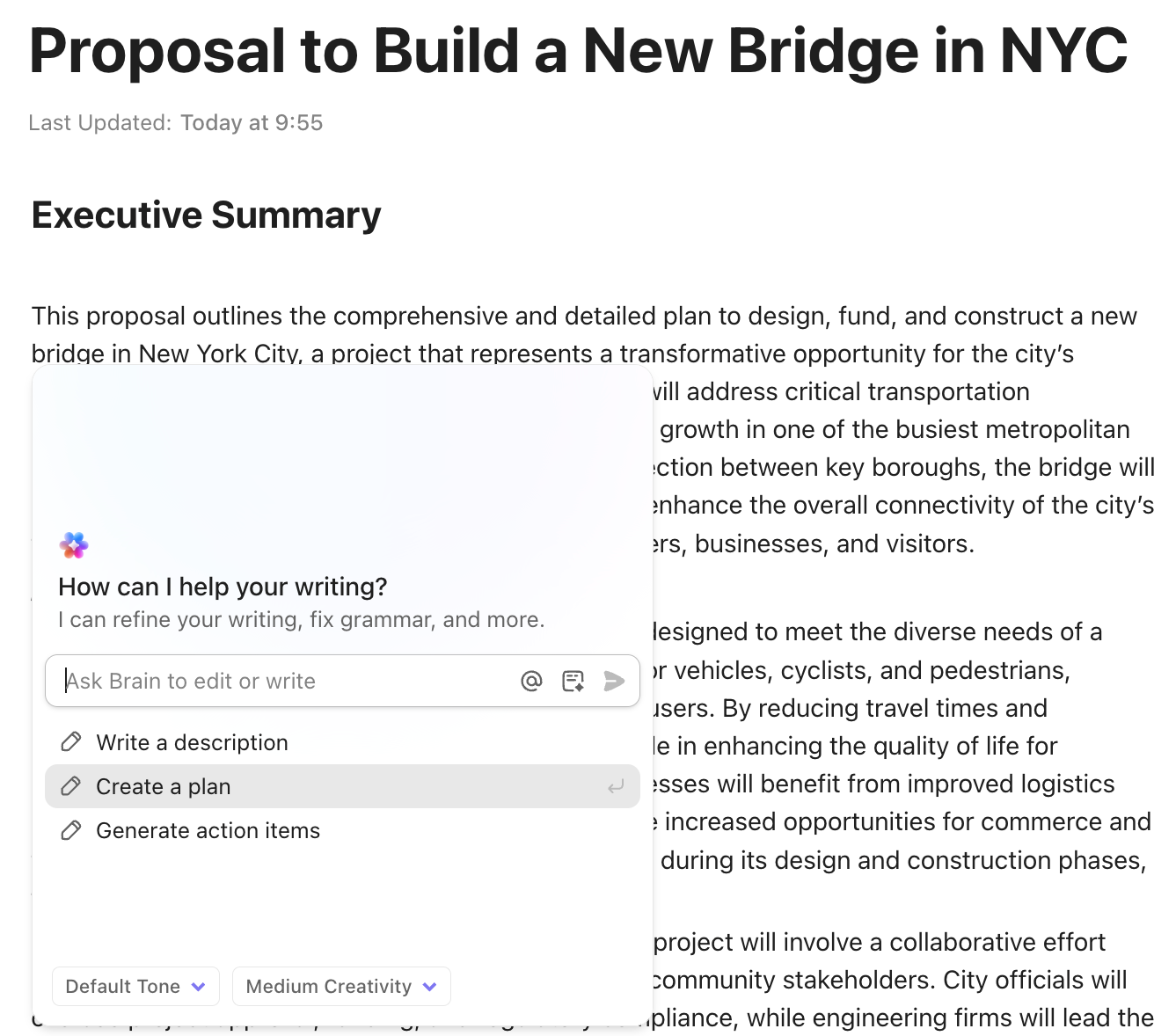
🦸🏻♀️ The Content Gap Analyzer compares your content against competitor content to find missing coverage.

Grow your brand’s reach and influence across the specific platforms where your buyers hang out. But trying to be on every single platform is a losing strategy that spreads your creative resources way too thin.
SMART goal: Grow LinkedIn follower count by [target] and increase average engagement to [target] within [timeframe] by publishing daily insights.
Begin like this:
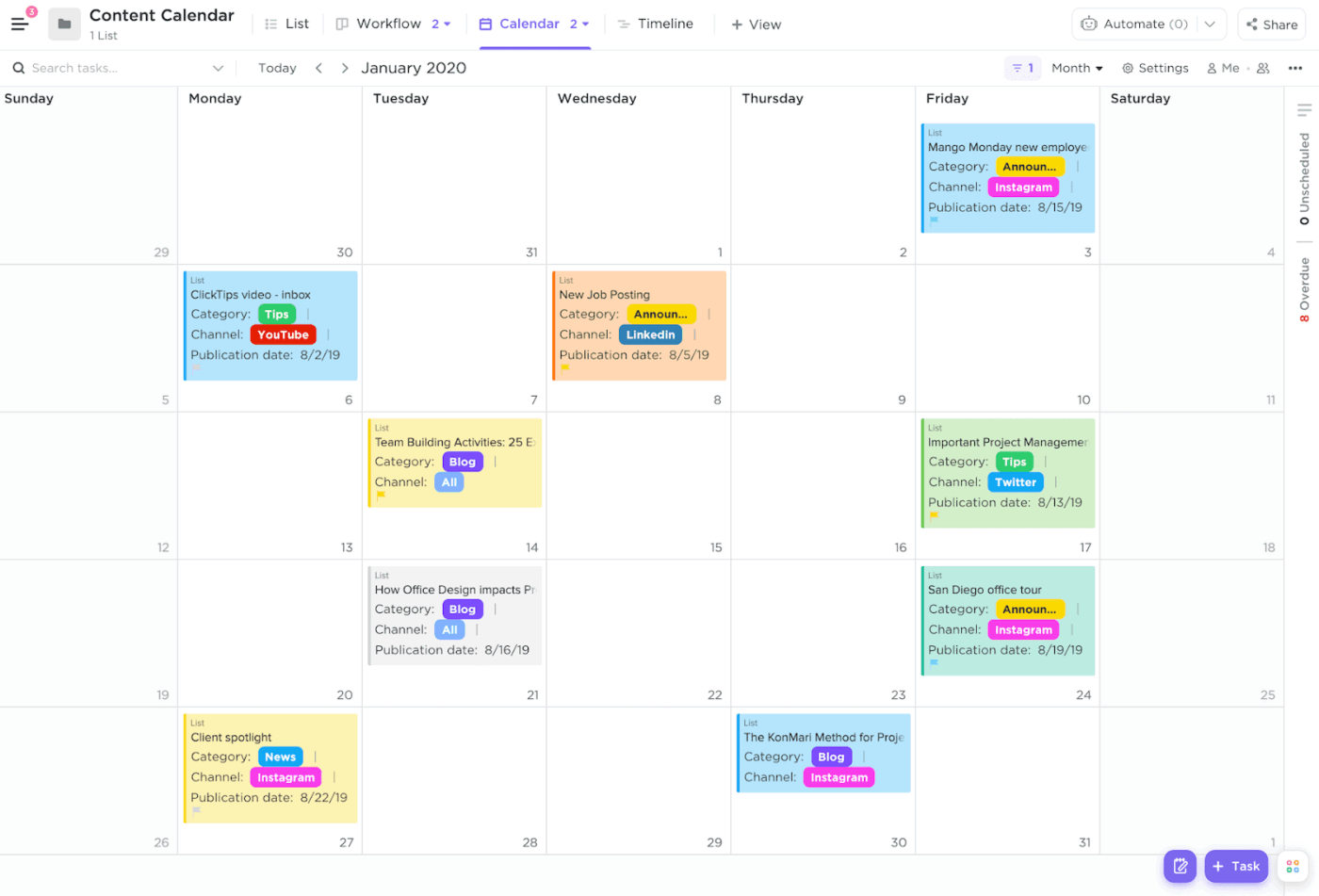
💡 Pro Tip: Eliminate the need for a separate social media tool by scheduling all your posts directly in ClickUp Calendar View and routing them through ClickUp Approval Workflows.
Most marketing teams don’t fail at setting goals—they fail at tracking them consistently. January plans turn into Q2 guesswork because the data lives everywhere: analytics tools, CRM reports, spreadsheets, slide decks. This kind of work sprawl turns something that should take 5 minutes into a weekly research project. The fix isn’t “more data”—it’s a tighter system for measurable marketing goals, progress tracking, and reporting.
Here’s how to build one that actually holds up.
If a goal has five metrics tied to it, it has no clear definition of success. Force prioritization by assigning a single primary KPI to each goal. This sharpens focus and makes dashboards useful instead of overwhelming.
| Goal | Primary KPI | Where to track |
| Brand awareness | Branded search volume | Search console + dashboard |
| Qualified leads | MQL-to-SQL conversion rate | CRM + dashboard |
| Website traffic | Organic sessions by intent | Analytics + dashboard |
| Revenue | Marketing-attributed pipeline | CRM + dashboard |
If you can’t pick one KPI, the goal isn’t specific enough to measure.
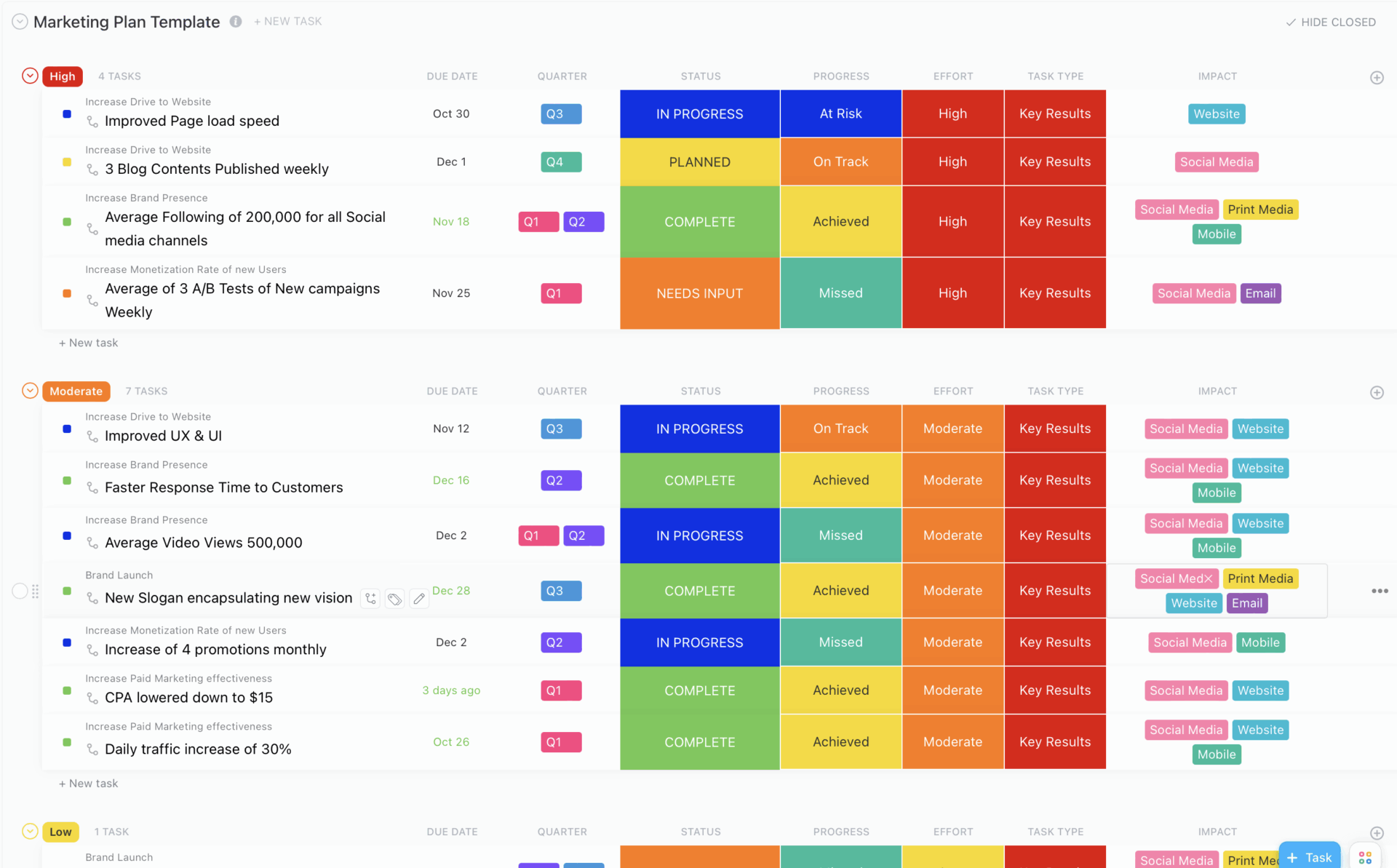
⭐️ Create, organize, and track your marketing project plan with ClickUp’s Marketing Plan Template.
With this template, you can easily:
Without a rhythm, tracking becomes reactive—and that’s when surprises show up.
Set a strict reporting cadence to keep your team accountable.
Instantly generate progress summaries on demand with ClickUp Brain. It pulls answers directly from live workspace data. 🙌
💡 Pro Tip: Use ClickUp Brain MAX as your weekly marketing analyst
This turns your reporting cadence into a decision-making loop—not just a status update.
When your KPIs live across five tools, you’re not tracking—you’re stitching together narratives after the fact.
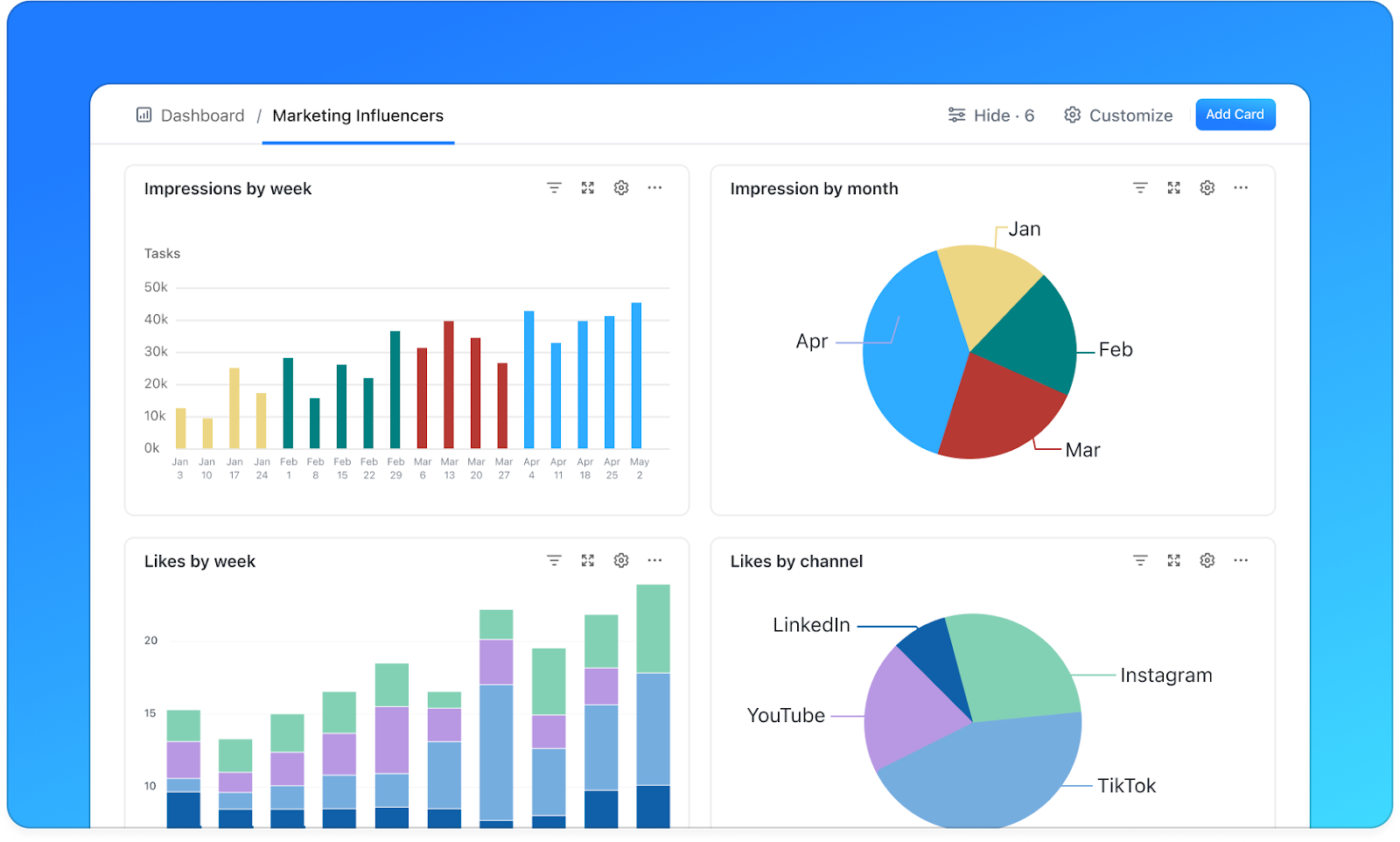
This is where a centralized dashboard matters. With ClickUp Dashboards, you can pull in:
The real advantage is visibility. Instead of manually compiling reports, you get a real-time view of progress tracking across campaigns and teams.
💡 Pro Tip: ClickUp Brain adds another layer: instead of digging through dashboards, you can ask, “What’s the status of our Q3 lead gen goal?” and get a synthesized answer based on live workspace data. That’s the difference between reporting and actual insight.
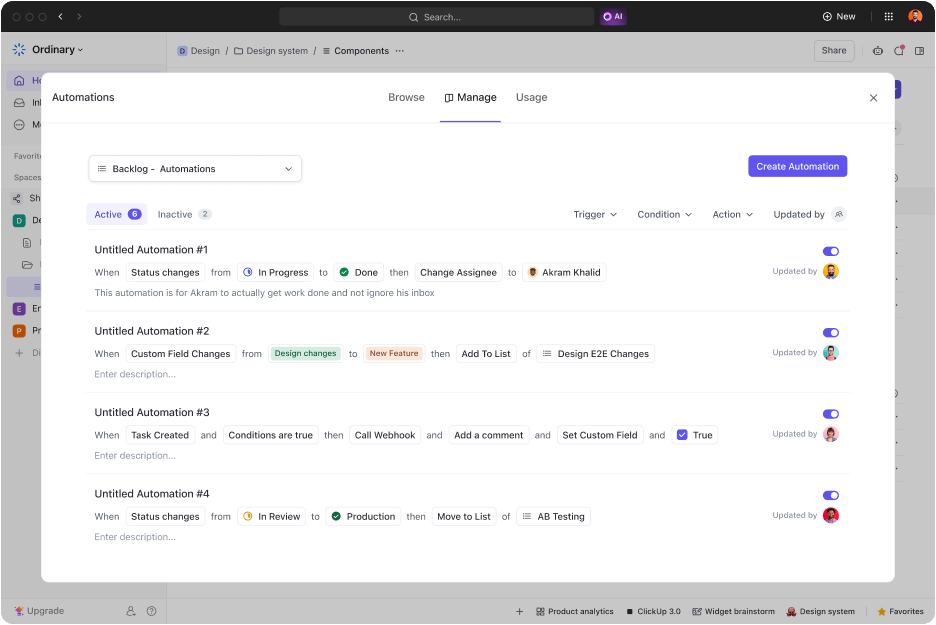
Manual tracking breaks down under pressure. When teams get busy, updates slip—and suddenly your dashboard is outdated. Automation fixes that.
With ClickUp Automations, you can:
This removes the friction that makes tracking feel like a second job. Your system updates itself as work happens.
Goals are hypotheses. If you’re not reviewing them, you’re just hoping they work.
Build in explicit checkpoints to ask:
ClickUp’s Timeline and Workload Views make this easier by showing whether progress is pacing correctly against your marketing strategy timeline. You don’t have to wait for a quarterly review to realize you’re behind.
💡 Pro Tip: Deploy ClickUp Super Agents to monitor goals continuously.
Tracking usually happens in bursts (weekly, monthly). Problems happen in between.
This is where super agents change the game:
Instead of waiting for your next review, your system actively protects your goals.
The best marketing goals are highly specific, easily measurable, and directly tied to your company’s bottom line. The exact framework you use matters far less than the discipline of picking a small number of targets and checking your progress regularly.
Goal-setting’s the easy part, but keeping those targets visible and connected to daily work is a massive systems problem. Teams that centralize their tasks and reporting in ClickUp’s converged AI workspace spend less time proving their value and more time actually creating it. Get started for free with ClickUp to bring your marketing goals, campaigns, and reporting into one place.
A marketing goal is the broad outcome you want to achieve, while a marketing objective is the specific, measurable milestone that proves you’re getting there. Goals set your overall direction, and objectives set the exact scoreboard you will use to measure success.
Most teams perform best when they focus on just three to five core goals per quarter. Taking on more than that splits your focus and makes it nearly impossible to resource any single initiative well enough to actually hit the target.
You should review your progress weekly against leading indicators and conduct a full evaluation at least once per quarter. Markets, budgets, and company priorities shift constantly, so your goals should shift right alongside them.

Praburam Srinivasan
Max 21min read

Sudarshan Somanathan
Max 15min read
Praburam Srinivasan
Max 17min read

© 2026 ClickUp