

Struggling with endless overthinking or second-guessing your choices? You’re not alone.
Learning how to be more decisive at work helps you take control, make clear decisions, and move forward with confidence. Decisiveness is about balancing logic and action, even when outcomes are uncertain.
Let’s explore actionable strategies to overcome hesitation, essential tools to streamline choices, and insights to strengthen your decision-making skills.
How to be More Decisive at Work?

 Summarize this article for me please
⏰ 60-Second Summary
By being more decisive at work, you stand to reap long-term benefits like confidence, growth, and reduced stress. Here’s how you can start:
- Understand how decision-making works and why it matters
- Recognize and address the roots and consequences of indecisiveness, including indecision and analysis paralysis
- Build workplace decision-making skills like risk assessment, emotional intelligence, and analytical thinking
- Use strategies like setting priorities, limiting options, and breaking decisions into steps
- Leverage tools like ClickUp’s templates, AI, and automations for seamless decision-making
Summarize this article for me pleaseUnderstanding Decision-Making
Decision-making is the structured process of evaluating options to achieve a specific goal. It involves identifying a decision, analyzing available choices, and selecting the best path forward. From small daily tasks to high-stakes decisions, the process involves:
- Identifying what needs to be decided
- Exploring options and gathering relevant facts
- Weighing the outcomes—both good and bad
- Making a choice with clarity and purpose
While logic plays a key role, intuition and timing also influence outcomes. The goal is to make informed decisions while minimizing analysis paralysis or hesitation.
Role of executive functions and discipline in decision-making
The brain’s prefrontal cortex governs critical functions that drive effective decision-making:
- Working memory: Juggling multiple options and scenarios
- Attentional control: Filtering distractions to maintain focus
- Cognitive processes: Analyzing data to predict potential outcomes
🧠 Fun Fact: The prefrontal cortex and hippocampus are the most critical parts of the human brain for making decisions. The neural wiring between these two parts helps you make a decision.
Discipline ensures these mental processes work efficiently, helping to manage conflicting thoughts and reduce decision fatigue. It supports navigating both irreversible and reversible decisions with clarity, ensuring timely and well-considered actions.
Summarize this article for me pleaseThe Importance of Being Decisive
Decisiveness is a cornerstone of success in both personal and professional life. It drives progress, fosters confidence, and minimizes delays caused by hesitation. Here’s why being decisive matters:
- Quick and confident decisions enhance personal productivity by keeping tasks moving forward and reducing wasted time, helping you make decisions in a timely manner
- Decisive individuals build trust by inspiring confidence in colleagues, teams, and leaders, while avoiding negative consequences caused by hesitation
- Making timely choices prevents analysis paralysis and decision fatigue, helping you avoid the dreaded trap of overthinking or making a wrong decision
- Resolving uncertainty reduces your stress by bringing clarity and focus to the next steps, even in moments where decisions involve uncertainty
- Each decision, whether right or wrong, encourages growth by serving as a learning opportunity, sharpening decision-making skills, and fostering personal development
Indecisiveness often leads to missed opportunities, delayed progress, and decision fatigue. Conversely, decisiveness empowers individuals to act with clarity, adapt to challenges, and achieve meaningful outcomes, even when facing high-stakes or irreversible and reversible decisions.
💡Pro Tip: Remember, mastering decisiveness isn’t about perfection—it’s about confidence, preparation, and the willingness to move forward.
Summarize this article for me pleaseCommon Barriers to Decisiveness
Even skilled decision-makers face challenges that hinder clarity and action. Among these, indecision and analysis paralysis are two of the most common barriers.
🚫 Indecision: The cost of hesitation
Indecision often arises when fear and overthinking take control. For example, you might hesitate to present a project proposal, worrying about making the wrong decision or facing negative consequences. This delay not only affects yourconfidence but also slows team progress, illustrating how decisions involve uncertainty.
On a personal level, indecision can manifest in everyday scenarios, like someone endlessly debating between two brands of cereal. This inability to commit creates mental fatigue and drains cognitive resources, making even less consequential decisions feel overwhelming.
Also Read: How to Deal with Decision Fatigue at Work?
🚫 Analysis paralysis: Overthinking at its worst
Analysis paralysis occurs when excessive evaluation leads to inaction. A real-life example is a company delaying a product launch because they’re stuck debating every detail of packaging design. This kind of overthinking not only wastes time but also allows competitors to gain an edge.
On an individual level, analysis paralysis might look like someone researching job opportunities endlessly but never applying. The weight of conflicting thoughts and too much information creates choice anxiety, leaving them unable to make decisions in a timely manner.
These barriers, while universal, can lead to costly delays, strained mental energy, and missed opportunities in both personal and professional contexts.
Summarize this article for me pleaseDecision-Making in the Workplace
In professional settings, decision-making shapes productivity, team dynamics, and overall organizational success. From strategic planning to day-to-day operations, every choice you make carries weight. Effective decision-making enables leaders to manage uncertainty, minimize risks, and capitalize on opportunities.
Essential skills for leadership and management
Leadership and management rely heavily on decision-making. The ability to weigh options and act decisively is crucial for steering teams toward success. Key skills include:
- 🧐 Analytical thinking: Leaders must process data quickly and draw meaningful conclusions to guide their teams
- 📈 Risk assessment: Evaluating potential downsides while identifying opportunities for growth
- 🧠 Emotional intelligence: Balancing logic with empathy to address both organizational goals and individual needs
Decisive leaders inspire confidence and clarity, providing direction during uncertainty and empowering their teams to align with organizational goals. Their ability to act swiftly fosters trust and ensures collaboration, keeping teams motivated and focused.
In the workplace, decision-making is more than a task—it’s a skill that defines leaders, shapes team performance, and determines success.
Summarize this article for me pleasePractical Tips and Strategies to Become More Decisive
Developing decisiveness takes practice and a mix of thoughtful strategies. Here are 10 actionable tips to help you make confident decisions in both personal and professional contexts.
1. Set clear priorities
Clarify what truly matters to you or your organization. Knowing your goals helps eliminate distractions and focus on decisions that align with your objectives. Priorities act as a guide, especially when choices feel overwhelming.
2. Embrace the 80/20 rule
Not every decision requires perfection. The 80/20 rule, also known as the Pareto Principle, encourages focusing on the 20% of efforts that drive 80% of results. This approach reduces wasted time on less consequential decisions.
3. Break decisions into smaller steps
Big decisions often feel intimidating. Simplify them by breaking them into smaller, manageable parts.
For example, if you want to change your career, then start with smaller actions like researching industries of interest, identifying transferable skills, and networking with professionals in the field.
This approach is rooted in the chunking technique, which organizes complex tasks into digestible pieces, reducing cognitive load. By focusing on one step at a time, you maintain momentum and prevent decision fatigue.
4. Set time limits for decisions
Avoid overthinking by setting deadlines. For minor decisions, give yourself minutes; for major ones, set realistic but firm deadlines to avoid decision fatigue. Deadlines create urgency and prevent analysis paralysis.
5. Use the two-way door method
Amazon’s Jeff Bezos popularized the idea of “one-way” and “two-way” decisions. One-way doors are irreversible, while two-way doors allow you to pivot if needed. Treat most decisions as reversible, which reduces fear and hesitation.
6. Limit your options
Too many choices can lead to choice anxiety. Narrow down your options to the most viable ones. Whether you’re picking a new tool for your team or deciding what to cook for dinner, fewer choices mean faster decisions.
👀Did You Know? Herbert Simon’s bounded rationality theory explains that individuals have cognitive limitations, making it essential to narrow focus and avoid excessive input
By limiting your options to relevant choices, you reduce cognitive overload, improve clarity, and make faster, more confident decisions.
7. Visualize the worst-case scenario
Imagining the worst-case outcome helps you put decisions in perspective. Ask yourself, “What’s the actual danger here?” Often, you’ll find the worst case is manageable and not as dire as it seems.
8. Practice mindfulness
Decisions made under stress are often less effective. Practicing mindfulness, even for a few minutes, calms your mind and improves attentional control. This helps you approach decisions with clarity and focus.
9. Seek constructive input selectively
Feedback is valuable, but too many opinions can lead to conflicting thoughts. Ask for advice from a few trusted individuals, especially those with expertise or insight related to the decision.
For example, if you’re deciding on a new business strategy, a finance expert might provide insights on budget constraints, while a marketing leader can guide audience engagement tactics.
10. Reflect on past decisions
Reviewing past choices, both good and bad, provides deeper wisdom. What worked? What didn’t?
Successes reveal strategies to replicate, while setbacks highlight areas for improvement. For instance, analyzing a delayed team project might show the need for stricter deadlines, while reflecting on a well-executed decision reinforces the value of preparation.
This reflection builds confidence and sharpens your decision-making skills for the future.
Becoming more decisive is a skill that evolves with practice and consistency. These strategies empower you to act confidently and move forward, even when faced with uncertainty.
Summarize this article for me pleaseTools and Resources for Better Decision-Making
Having the right tools and resources can streamline decision-making and eliminate unnecessary guesswork. From frameworks to automation, these solutions help individuals and teams make confident choices.
Decision models and frameworks
Decision-making frameworks provide a structured approach to evaluating options and outcomes. The ClickUp Decision-Making Framework Template is a powerful resource that simplifies complex decisions.

Here’s how it helps:
- Organizes all options, risks, and benefits in one place
- Improves clarity with customizable fields and collaborative inputs
- Speeds up decisions by reducing overanalysis
For tracking decisions over time, the ClickUp Decision and Change Log Template helps document choices and their impact, offering insights for future decision-making.
AI and automation tools
ClickUp’s AI and automation features are invaluable for simplifying decisions and enabling better organization. These tools work together to support seamless workflows and informed choices.
Transforming information into insights

With ClickUp Brain, you can transform complex information into actionable insights. It enhances brainstorming with AI-generated ideas and provides valuable support for strategic decision-making by analyzing data trends.
Streamlining workflows and consistency
ClickUp Automations streamline repetitive tasks, ensuring consistency and freeing up valuable time for critical decisions. They also send updates and notifications automatically, keeping teams aligned and workflows smooth.
Centralizing decision-related tasks
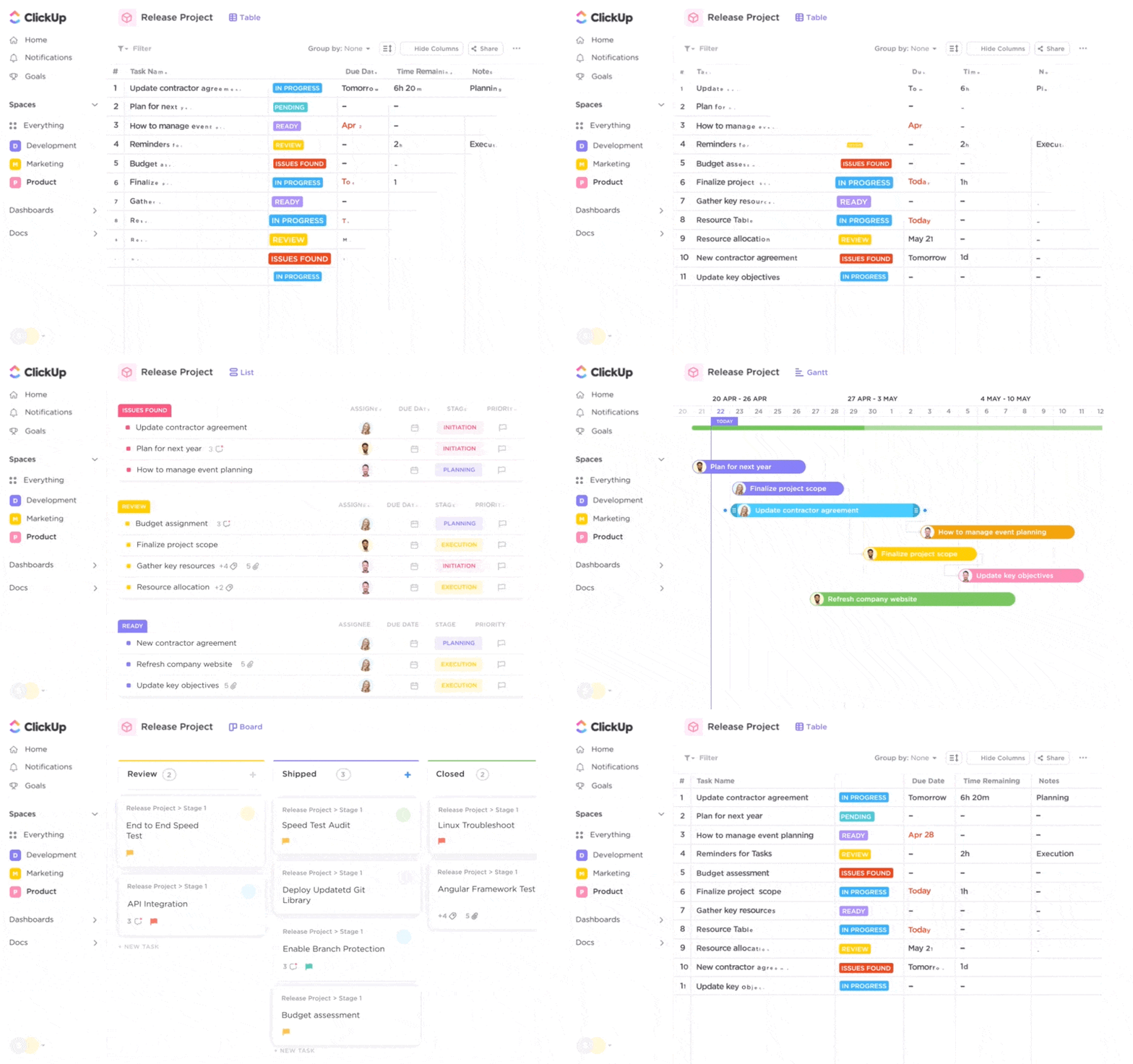
Organize decision-related actions in one centralized platform to streamline the process. With ClickUp Tasks, you can track progress effortlessly, prioritize tasks based on deadlines or dependencies, and link related tasks for a comprehensive overview. This approach ensures a more structured and efficient decision-making process.
Staying on track with timely reminders
ClickUp Reminders help prevent delays by alerting you to pending decisions and tracking important milestones. They support breaking down large tasks into manageable actions, reducing the mental load associated with complex decisions.
Integrating these tools into your workflow empowers you to reduce uncertainty, stay organized, and approach decision-making with confidence and clarity.
Summarize this article for me pleaseLong-term Outcomes of Being More Decisive
Becoming more decisive doesn’t just solve immediate challenges—it creates a ripple effect that transforms your personal and professional life over time. Here’s how:
- Stronger self-trust: Making timely decisions reduces self-doubt and strengthens cognitive processes, helping you act without hesitation
- Faster career growth: Decisive individuals thrive in decision-making under uncertainty, gaining recognition as problem-solvers and leaders
- Respect and loyalty from others: People value those who weigh options effectively and make informed decisions, even when decisions involve uncertainty
- Lower stress levels: Decisiveness cuts down on decision fatigue and conflicting thoughts, freeing up cognitive resources for bigger challenges
- Adaptability to setbacks: By mastering reversible and irreversible decisions, you recover quickly from setbacks and avoid common regret
- Continuous growth: Reflecting on outcomes sharpens your decision-making skills and builds deeper wisdom for personal development
- Better team dynamics: Clear, confident decisions reduce confusion and align team efforts, improving performance and morale
In the long term, decisiveness sets you apart as someone who can make confident, impactful decisions, fostering both personal and professional success.
Summarize this article for me pleaseEmbrace Decisiveness to Transform Your Career Path
Decisiveness is more than a skill—it’s a mindset that empowers action and fuels progress. By learning to trust your judgment, adapt to challenges, and streamline your decision-making processes, you reduce the risk of making a wrong choice or focusing on the wrong thing, and instead, move forward with confidence.
Whether it’s shaping your career, strengthening relationships, or driving team success, decisiveness helps you avoid painful consequences and positions you as a growth-oriented individual with clarity and purpose.
Ready to take your decision-making to the next level? Sign up for ClickUp today!


Everything you need to stay organized and get work done.

Recent Articles
8 Communication Strategies That Actually Fix Team Chaos 
8 Communication Strategies That Actually Fix Team Chaos
ADHD Task Management: How to Build a System You’ll Still Use in a Month 
ADHD Task Management: How to Build a System You’ll Still Use in a Month

