In healthcare, collaboration isn’t just about teamwork—it’s about saving time, reducing errors, and ultimately improving patient outcomes. But when care teams, administrators, and IT staff are juggling dozens of systems and communication channels, even simple coordination can feel like a maze.
That’s where healthcare collaboration software comes in.
These tools bring everyone—from clinical leaders to practice managers—onto a single platform to share updates, track patient information, and streamline workflows.
Whether you’re trying to reduce admin bottlenecks, boost team communication, or strengthen cross-department coordination, the right software can make it happen.
In this blog post, we review some of the best tools based on real clinical workflows to enhance patient care.
Let’s get started!
- Top Healthcare Collaboration Software at a Glance
- Why Healthcare Needs Collaboration Software
- What Should You Look for in Healthcare Collaboration Software?
- The Best Healthcare Collaboration Software
- How we review software at ClickUp
- 2. TigerConnect (Best for clinical communication and care coordination)
- 3. Sickbay (Best for patient monitoring data analysis and workflows)
- 4. OceanMD (Best for provider network connectivity and referral management)
- 5. CareCloud (Best for AI-powered clinical documentation and EHR integration)
- 6. Microsoft Teams (Best for healthcare team meetings and secure collaboration)
- 7. Slack (Best for HIPAA-compliant communication workflows)
- 8. Zoom (Best for telehealth consultations and virtual care team meetings)
- 9. Google Workspace (Best for document collaboration and familiar productivity tools)
- 10. Epic Systems (Best for comprehensive EHR management and clinical workflows)
- 11. Oracle Health (Best for integrated clinical and operational data management)
- How to Choose the Right Healthcare Collaboration Software
- Use Cases of Healthcare Collaboration Software
- Frequently Asked Questions (FAQ)
Top Healthcare Collaboration Software at a Glance
Here’s a quick snapshot of the top healthcare collaboration software solutions.
| Tool | Best for | Best features | Pricing* |
| ClickUp | Unified care and operations coordination for clinical, research, and administrative teams in HIPAA-compliant settings | HIPAA-compliant project management with Custom Roles, contextual messaging with ClickUp Chat, shared SOPs and documentation via ClickUp Docs, smart care coordination with ClickUp Brain, real-time scheduling via AI Calendar, task-level PHI tracking with Custom Fields, centralized views for patient and staff workflows, and AI-generated discharge checklists and CDC references | Free forever; customizations available for enterprises |
| TigerConnect | Clinical messaging and real-time coordination for hospitals, physicians, and emergency response teams | Role-based communication with Dynamic Teams, care workflow integration via EHR and monitoring systems, secure mobile messaging with auto-escalation, and high-urgency routing with priority alerts | Custom pricing |
| Sickbay | Real-time patient monitoring and risk tracking for research hospitals and multi-facility health systems | Vendor-neutral data platform for telemetry review, historical trend analysis, remote collaboration on clinical events, and multi-unit continuity dashboards | Custom pricing |
| OceanMD | Referral management and interoperability for multi-clinic provider networks | Cross-province eReferrals and eConsults, automated booking and check-in tools, analytics on wait times and patient feedback, and EMR integration across 30+ platforms | Custom pricing |
| CareCloud | AI-powered documentation, billing, and EHR workflows for outpatient and specialty clinics | cirrusAI support for automated clinical notes, appeals generation, EHR assistant chat, evidence-backed care guidance, and ONC-certified interoperability with external systems | Custom pricing |
| Microsoft Teams | Secure communication and video meetings for hospital systems and care teams | HIPAA-compliant team chats, video consults and shifts scheduling via Microsoft Cloud, structured channels for specialties, and seamless EHR launches with FHIR integration | Free; Paid plans start at $5.25/month per user |
| Slack | HIPAA-compliant internal communication for research, payer, and admin teams | Enterprise-grade access control, Workflow Builder for care process automation, Slack Connect for cross-org discussions, and DLP support for secure file and message use | Free; Paid plans start at $8.75/month per user |
| Zoom for Healthcare | Telehealth consultations and virtual rounds for clinics and distributed care teams | HIPAA-compliant video sessions with patient-friendly access, EHR integration with tools like MyChart, device streaming during virtual visits, and Zoom Rooms for smart clinics | Paid plans start at $16.99/month per user |
| Google Workspace | Document-based collaboration and productivity for health education and cross-team planning | HIPAA-compliant Google Docs and Meet, embedded training hubs via Google Sites, synced Forms and Sheets for intake, and secure mobile device access | Paid plans start at $8.40/month per user |
| Epic Systems | Comprehensive EHR management and clinical operations for hospitals and enterprise health systems | Role-specific Hyperspace UI, AI chart summarization with Comet, secure communication through In Basket, and mobile EHR access via Haiku and Canto | Custom pricing |
| Oracle Health (Cerner) | Integrated clinical, financial, and operational data management across large networks | Unified workflows through Cerner Millennium, patient engagement via HealtheLife, population health analytics with HealtheIntent, and open APIs for 3rd-party tools | Custom pricing |
Why Healthcare Needs Collaboration Software
Traditional healthcare project management often struggles to keep pace with the demands of modern medical practice. Healthcare collaboration software addresses these challenges by:
- Enhancing interprofessional communication: Facilitates real-time, secure, centralized communication among healthcare professionals, ensuring alignment and accurate information sharing
- Streamlining clinical workflows: Integrates with existing systems to automate tasks, reducing administrative burdens and allowing clinicians to focus more on patient care
- Supporting remote and hybrid models: Accommodates telehealth and mobile care teams, ensuring continuous communication regardless of location
- Ensuring compliance and security: Adheres to regulations like the Health Insurance Portability and Accountability Act (HIPAA) to safeguard patient data and maintain trust across the healthcare ecosystem
💡 Pro Tip: Document treatment decisions in a way that explains the ‘why,’ not just the ‘what.’ This makes it easier for other primary care physicians or new team members to quickly align on the reasoning without having to backtrack.
What are the benefits of using healthcare collaboration software?
Implementing collaboration software for healthcare offers numerous advantages. These include:
- Reduced medical errors: Clear documentation and streamlined communication pathways help minimize misunderstandings and mistakes
- Improved patient satisfaction: Faster response times and coordinated care lead to better patient experiences and outcomes
- Accelerated decision-making: Real-time communication tools enable faster consultations and approvals, reducing delays in patient care
- Active knowledge sharing: Collaboration tools allow healthcare professionals to share insights and best practices for continuous learning
- Improved resource allocation: They help track and manage resources efficiently, ensuring optimal utilization management and reducing wastage
🧠 Fun Fact: Collaboration can even improve recovery after cardiac procedures. Patients who had doctors and nurses working together in a structured ‘collaborative care model’ reported better sleep, stronger mental health, and a higher quality of life within three months.
What Should You Look for in Healthcare Collaboration Software?
Selecting the right healthcare collaboration software is essential for enhancing team coordination and patient care. Here are key factors to consider:
- User-friendly interface: Opt for platforms that are intuitive and easy to navigate, minimizing the learning curve for healthcare professionals
- Mobile accessibility: Ensure the software is accessible on various devices, allowing healthcare providers to stay connected and informed from anywhere
- Integration capabilities: Choose solutions that seamlessly integrate with existing Electronic Health Records (EHR) and other clinical systems to streamline workflows
- Customizable notifications: Look for features that allow personalized alerts and notifications, ensuring timely responses to critical patient needs
- Comprehensive reporting tools: Select healthcare software with robust analytics and reporting features to monitor performance and patient outcomes effectively
🔍 Did You Know? Collaboration helps with chronic disease, too. A meta-analysis found that interprofessional care (different health professionals working together) lowered systolic blood pressure, LDL cholesterol, and HbA1c in patients, while also reducing hospital days.
The Best Healthcare Collaboration Software
Here are our picks for the best healthcare collaboration software. 👇
How we review software at ClickUp
Our editorial team follows a transparent, research-backed, and vendor-neutral process, so you can trust that our recommendations are based on real product value.
Here’s a detailed rundown of how we review software at ClickUp.
1. ClickUp (Best for healthcare teams needing a secure collaboration platform to manage care and operations)
Our first pick is ClickUp, and for obvious reasons.
ClickUp’s Healthcare Project Management Software is a secure collaboration platform that brings together clinical and administrative teams in a unified workspace.
It’s designed to handle everything from patient workflows and documentation to staff scheduling and inventory management, all within a HIPAA-compliant environment.
Streamline real-time communication
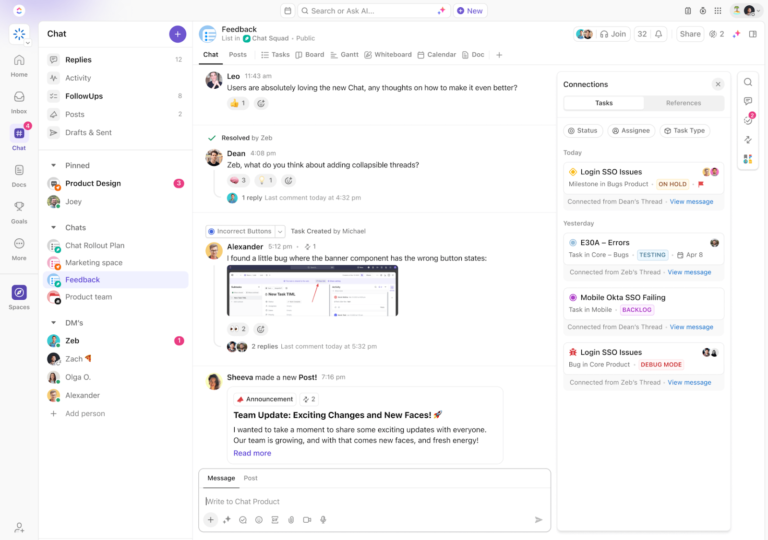
Communication is a critical piece of healthcare collaboration, and ClickUp Chat makes it seamless with features like Channel-Based Discussions and Threaded Replies.
For example, a care team managing cardiac patients can create a dedicated ‘Cardiology’ chat channel where nurses update vitals in real time, a pharmacist drops in medication adjustments, and the on-call cardiologist is instantly notified with an @Mention for rapid consultation.
Since conversations are linked directly to patient tasks and related docs, discharge instructions or medication changes remain visible and actionable for everyone involved.
Centralized knowledge and documentation
ClickUp Docs lets teams create and share materials like SOPs, patient education materials, or protocols, linking them directly to related tasks or patient cases. This ensures everyone has the latest information.

You can also embed PubMed or Scopus references to collaborate on publications or experimental data.
With real-time collaboration, multiple clinicians or researchers can edit, comment, and update documents simultaneously.
Manage patient cases with clarity
The AI-powered ClickUp Calendar centralizes appointments, shift schedules, and care team meetings in one secure, accessible place. With real-time updates, shared visibility, and seamless integration with tasks, it helps healthcare teams coordinate efficiently and reduce scheduling errors.
With ClickUp Tasks, care teams can assign and track patient follow-ups, schedule referrals, or manage administrative workflows such as insurance approvals.

ClickUp Custom Fields allow teams to capture essential details like PHI, patient IDs, or urgency levels, eliminating confusion during appointment scheduling and intake processes.
Use AI to connect clinical staff
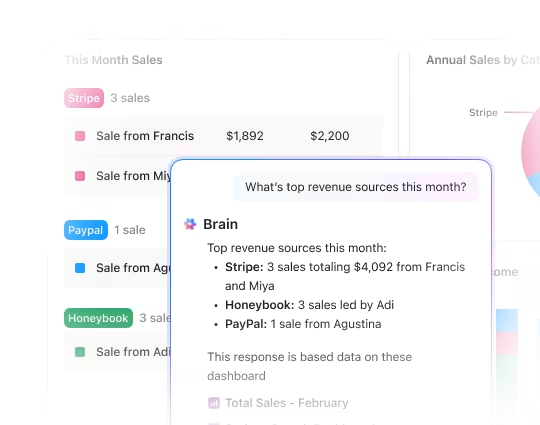
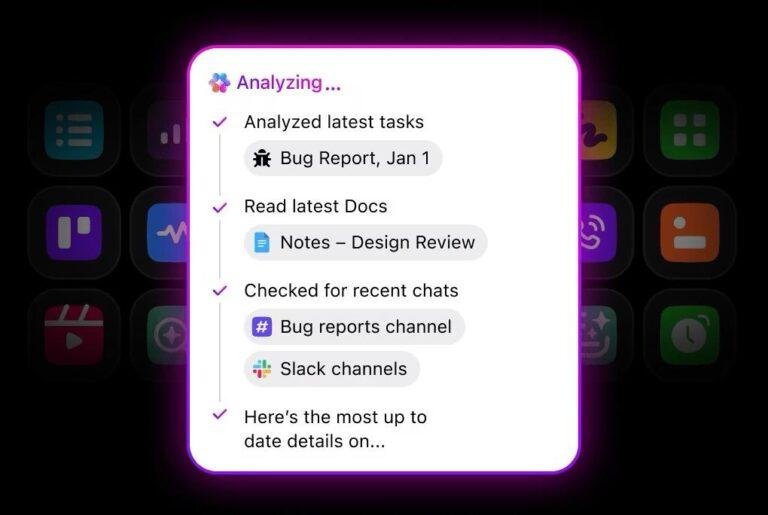
Finally, ClickUp Brain, the integrated AI assistant, ties everything together.
You can use ClickUp Brain to summarize meeting notes, extract action items from care discussions, or generate patient follow-up checklists without spending extra time on manual documentation.

For instance, a hospital infection control team can use ClickUp Brain to process daily incident reports and extract key trends (like recurring sources of infection).
You can even generate a prioritized action list for the team and provide instant access to the latest CDC protocols within the same workspace.
📌 Try these prompts:
- Summarize today’s multidisciplinary team meeting notes and list action items for the cardiology, nursing, and pharmacy teams separately
- Generate a follow-up checklist for post-op patients based on this discharge protocol and assign tasks to the recovery unit
- Highlight recurring issues from this week’s infection control incident reports and suggest three priority actions for the next review meeting
- Provide a quick reference of CDC guidelines for hand hygiene compliance and link it to our infection control doc
Explore more ways to use ClickUp Brain as a personal assistant:
ClickUp best features
- Protect sensitive data with confidence: Add Custom Roles to control access and permissions, so only the right people can view or edit critical information
- Organize inventory and resources visually: Track vaccine expiration dates, PPE levels, and medical equipment using ClickUp Views like Gantt charts and Kanban boards
- Automate routine processes: Set up ClickUp Automations to handle appointment reminders, intake form submissions, or supply restocks, giving staff more time to focus on patient care
- Monitor everything from one place: Build ClickUp Dashboards to get real-time visibility into patient workflows, staff schedules, and inventory status for quick decision-making
- Collect and organize information efficiently: Create ClickUp Forms to gather patient data, supply requests, or incident reports. Responses automatically populate as tasks, keeping information centralized and easy to track
- Stay connected on the go: Manage to-do lists, post updates, check notifications, and more, from ClickUp’s mobile app
ClickUp limitations
- Getting started with ClickUp’s wide range of features and customization can feel a bit overwhelming
ClickUp pricing
ClickUp ratings and reviews
- G2: 4.7/5 (10,500+ reviews)
- Capterra: 4.6/5 (4,500+ reviews)
What are real-life users saying about ClickUp?
A G2 review sums it up perfectly:
📮ClickUp Insight: 70% of respondents say they keep tabs open because they plan to “get back to them later.” We’ve heard that before. 🤭
Ironically, 30% say that they would feel relieved if they lost all those previous tabs in a browser crash, for instance.
That’s Zeigarnik effect at work. Our brains latch onto unfinished tasks, turning every tab into a cliffhanger. You feel busy, even when nothing’s actually moving forward.
As a Converged AI Workspace, ClickUp keeps your priorities front and center. Ask ClickUp Brain to surface your daily or weekly priorities, or run real-time web searches to find relevant information right when you need them. Now you can close tabs without closing loops. 🕊️
2. TigerConnect (Best for clinical communication and care coordination)

TigerConnect is a cloud-native Clinical Communication and Collaboration (CC&C) platform designed to bridge communication gaps across healthcare organizations.
It consolidates messaging, alerts, and clinical workflows into a single platform, ensuring that care teams, from physicians and nurses to EMS providers, have timely access to critical information.
The health project management software integrates deeply with existing hospital systems, including nurse call solutions, monitoring devices, and physician scheduling tools. This enables care teams to collaborate in real time, escalate urgent messages automatically, and maintain a continuous connection even during IT outages.
TigerConnect best features
- Enhance care coordination by sending context-rich alerts from EHRs, monitoring systems, and consult requests directly to the right team members
- Simplify communication with Role-Based Messaging, allowing clinicians to reach any provider by role instead of name
- Activate Custom Dynamic Teams instantly to align staff on urgent workflows and patient transfers
- Ensure urgent messages are addressed with Priority Messaging and Message Escalations for unattended alerts
TigerConnect limitations
- Limited live customer support, with numbers designed to avoid direct calls with representatives
- Occasional lag during sign-in, which can disrupt quick communication
- Users have reported an inability to tag specific people in messages, which reduces clarity in communication
- Archive permissions are too broad; some users who have archive access see all messages, even ones they ideally shouldn’t have access to
TigerConnect pricing
- Custom pricing
TigerConnect ratings and reviews
- G2: 4.5/5 (190+ reviews)
- Capterra: 4.6/5 (40+ reviews)
What are real-life users saying about TigerConnect?
Here’s what a user had to share:
🔍 Did You Know? In medical ICUs, daily rounds by multidisciplinary teams cut patient mortality. Hospitals with high-intensity physician staffing and full care teams had significantly lower death rates, even for serious cases like sepsis.
3. Sickbay (Best for patient monitoring data analysis and workflows)

Sickbay is a vendor-neutral healthcare collaboration software that makes patient monitoring data actionable across the care continuum.
Beyond monitoring, Sickbay transforms data into a tool for research, operational improvement, and proactive care. It allows executives, IT teams, and clinical staff to collaborate seamlessly, annotate events, and standardize care practices.
You can also optimize staffing and resource allocation using real-time patient monitoring dashboards and telemetry insights, so the right caregivers are always in the right place at the right time.
Sickbay best features
- Standardize clinical and research workflows using Analyze, delivering actionable insights with near-real-time and historical data
- Streamline multi-facility operations with Automate, digitizing workflows and reducing manual handoffs
- Enable population-level research and operational improvements with integrated analytics and collaborative tools
- Improve continuity of care by tracking patients across units and sharing risk-related information efficiently
Sickbay limitations
- It places the burden of setup, maintenance, and troubleshooting on the hospital’s internal IT staff
- Clinicians and researchers need extensive training to use its deep data analysis features
Sickbay pricing
- Custom pricing
Sickbay ratings and reviews
- G2: Not enough reviews
- Capterra: Not enough reviews
🧠 Fun Fact: Partnerships beyond hospitals matter too. When clinics, local governments, and social services work together, community health outcomes improve. However, success depends heavily on how well those collaborations are structured and sustained.
🌟 Bonus: Leverage ClickUp Brain MAX to instantly search across patient records, clinical documents, and care team communications—all from one AI-powered desktop companion.
It helps healthcare professionals find information, summarize updates, and streamline workflows, saving valuable time and supporting better patient care.
4. OceanMD (Best for provider network connectivity and referral management)

OceanMD is a clinic management platform built to connect patients, medical professionals, and health systems without friction.
Designed with interoperability at its core, OceanMD integrates with major EMRs and health information systems, enabling secure data exchange across clinics, hospitals, and provinces.
The platform is equally valuable for frontline staff and patients. With its Patient Engagement Suite, clinics can offer self-serve tools like online booking, reminders, and digital check-ins, while the Ocean Provider Network simplifies eReferrals, eConsults, and eOrders.
OceanMD best features
- Offer patients greater convenience with online booking, Patient Messages, Reminders, and Check-In Kiosks/Tablets
- Track outcomes using advanced reporting tools that provide usage data, wait time publications, and patient experience metrics
- Integrate with over 30 clinical information systems and repositories using open, standards-based APIs
- Create New Patient Registration templates that pre-populate chart fields automatically from patient responses
OceanMD limitations
- OceanMD is designed to facilitate data exchange and is not a long-term storage solution for patient information
- The online booking system requires an exact match between the patient’s entered information (name, birth date, health card number) and what is in their health record. Even minor discrepancies can cause errors
OceanMD pricing
- Custom pricing
OceanMD ratings and reviews
- G2: Not enough reviews
- Capterra: Not enough reviews
💡 Pro Tip: Capture learnings from cross-team cases in an internal knowledge base. If a care pathway for one patient uncovered a coordination trick or workflow improvement, document it so the whole organization benefits.
5. CareCloud (Best for AI-powered clinical documentation and EHR integration)

For most practices, the biggest obstacle is the daily grind of documentation, billing, and system silos. CareCloud addresses these pain points by blending EHR, practice management, revenue cycle optimization, and interoperability.
What sets CareCloud apart from other patient management software is its cirrusAI suite, built on generative AI for smarter clinical notes, appeals automation, and decision support.
Add to that ONC-certified interoperability tools like CareCloud Connector, and your practice will gain a secure and scalable way to exchange data across labs, immunization registries, and EHR systems.
CareCloud best features
- Automate clinical documentation with cirrusAI Notes, capturing patient-provider conversations for EHR-ready notes
- Support treatment accuracy with cirrusAI Guide’s evidence-based, AI-driven recommendations during healthcare consultations
- Expedite reimbursement with cirrusAI Appeals, generating tailored appeal letters from claim data and payer requirements
- Provide natural language support to staff with cirrusAI Chat, an in-EHR assistant for onboarding and workflow navigation
CareCloud limitations
- There’s no Android app available
- The software frequently crashes, and users have to struggle with slow performance and latency
- Users report severe customer service issues
- Billing and claims handling delays, with users reporting financial losses
CareCloud pricing
- Custom pricing
CareCloud ratings and reviews
- G2: 3.6/5 (30+ reviews)
- Capterra: 3.6/5 (100+ reviews)
What are real-life users saying about CareCloud?
Here’s how one user puts it:
💡 Pro Tip: Build feedback loops directly into collaborative tools. For example, allow nurses to flag if a discharge plan feels unrealistic or pharmacists to mark unclear prescriptions. Real-time input prevents errors later in the chain.
6. Microsoft Teams (Best for healthcare team meetings and secure collaboration)

In hospitals, quick decisions depend on smooth communication, but important updates often get buried in phone calls, emails, or missed messages. Microsoft Teams tackles this by giving healthcare providers a secure, HIPAA-compliant way to chat, meet, and share updates in real time.
Built into the Microsoft Cloud for Healthcare, Teams integrates directly with FHIR-enabled EHRs, making it easy to launch a patient consultation or update care plans from within existing systems.
Whether it’s a quick urgent message, a scheduled video consult, or a structured workflow with Lists and Approvals, Teams helps hospitals reduce delays and keep information flowing.
Microsoft Teams best features
- Launch video consults and team meetings using integrated audio/video conferencing
- Schedule patient visits with the Bookings app, automatically generating Teams sessions
- Apply healthcare-ready templates to set up channels and apps for medical teams quickly
- Coordinate frontline staff schedules with the Shifts app to simplify administrative workflows
Microsoft Teams limitations
- Limited admin capabilities, restricting certain IT tasks like credential entry or device management through Teams
- Complex notification settings make it harder for users to customize alerts effectively
- Inconsistent user experience across devices/platforms can hurt your workflow
Microsoft Teams pricing
- Free
- Enterprise: $5.25/month per user (Billed annually)
- Microsoft 365 F3: $8/month per user (Billed annually)
- Premium: $10/month per user (Billed annually)
Microsoft Teams ratings and reviews
- G2: 4.4/5 (16,000+ reviews)
- Capterra: 4.5/5 (10,000+ reviews)
What are real-life users saying about Microsoft Teams?
Here’s direct feedback from a G2 review:
📖 Also Read: Top Microsoft Teams Alternatives for Collaboration
7. Slack (Best for HIPAA-compliant communication workflows)

Slack is a secure collaboration tool that provides a flexible environment to connect, share updates, and coordinate care. Its Enterprise Grid plan is HIPAA-configurable, allowing providers, payers, and researchers to exchange electronic Protected Health Information (ePHI) while maintaining compliance.
With dedicated channels, secure integrations, and robust security controls, it helps reduce delays in patient care and ensures sensitive data remains protected.
Integrations with platforms like Salesforce Health Cloud and Service Cloud centralize patient and member data.
Slack best features
- Automate repetitive processes, from patient intake to incident reporting and approvals, with Workflow Builder
- Collaborate securely with external organizations through Slack Connect shared channels
- Use Data Loss Prevention tools to monitor your team’s use of Slack and enforce message and file restrictions
- Review patient updates asynchronously with Clips and hold quick team check-ins using Huddles
Slack limitations
- Search functionality is limited, making it harder to retrieve old messages or files in comparison to Slack alternatives
- No bulk option to clear direct messages, forcing users to manually delete old conversations
- Slack explicitly prohibits using its platform for patient-facing communication (patients, plan members, families, or employers) when PHI is involved. All PHI-bearing discussions must be internal only
Slack pricing
- Free
- Pro: $8.75/month per user
- Business+: $18/month per user
- Enterprise+: Custom pricing
Slack ratings and reviews
- G2: 4.5/5 (35,000+ reviews)
- Capterra: 4.7/5 (24,000+ reviews)
8. Zoom (Best for telehealth consultations and virtual care team meetings)

Zoom for Healthcare is built to simplify how providers connect with patients and colleagues.
Its healthcare-specific offering includes HIPAA compliance, dedicated BAAs, and integrations with major EHR systems. This ensures sensitive data stays protected while enabling providers to conduct telehealth visits, run virtual clinics, or collaborate with specialists across locations.
Zoom balances patient accessibility with clinical workflow efficiency. Patients can join virtual appointments from a single link, often through portals like MyChart, without needing to download or install any software.
Zoom best features
- Use waiting room chat and provider notifications to streamline patient flow
- Connect medical devices like TytoCare during virtual visits to stream live patient data and images directly to clinicians
- Set up telehealth carts in patient rooms with smart TVs using Zoom Rooms technology
- Collaborate visually with Zoom Whiteboard for tumor boards and treatment planning
Zoom limitations
- System-heavy updates and frequent patches can interrupt meetings at inconvenient times
- Security concerns from past vulnerabilities (e.g., Zoom bombing, encryption gaps) still create hesitation for sensitive use cases
- It lacks certain healthcare-specific built-in features like pre-visit intake forms, auto reminders, and integrated EHR workflows; these often have to be added via external tools
Zoom pricing
- Pro: $16.99/month per user
- Business, Business Plus, and Enterprise: Custom pricing
Zoom ratings and reviews
- G2: 4.6/5 (60,000+ reviews)
- Capterra: 4.6/5 (14,000+ reviews)
What are real-life users saying about Zoom?
According to a recent G2 review:
🧠 Fun Fact: Collaboration strengthens safety culture. In Japanese hospitals, when teamwork and organizational learning go up together, hospital safety improves—staff feel more at ease reporting errors, involving families, and working to prevent harm.
📖 Also Read: Best Zoom Alternatives
9. Google Workspace (Best for document collaboration and familiar productivity tools)

Google Workspace brings together everyday tools like Gmail, Docs, Sheets, and Meet into a HIPAA-compliant environment tailored for healthcare and life sciences.
Since most staff and clinicians are already familiar with these apps, adoption is quick and requires minimal training. The familiarity makes it easier to reduce silos between clinical teams.
Google Workspace’s dual focus supports healthcare providers and accelerates life sciences research. Combined with zero-trust security and built-in encryption, it allows organizations to collaborate at scale without the overhead of VPNs or constant patching.
Google Workspace best features
- Collect patient intake and feedback with Google Forms and sync responses instantly to Google Sheets
- Enable convenient scheduling with Google Calendar
- Conduct secure telehealth sessions, team meetings, or training events through Google Meet
- Build onboarding portals and training hubs with Google Sites and Google Vids
- Enable frontline staff with Chromebooks and Android Enterprise devices for safe, on-the-go access
Google Workspace limitations
- Some external apps don’t sync properly, causing scheduling or workflow challenges in comparison to Google Workspace alternatives
- Admins find the Google Workspace admin console overwhelming because of the sheer number of configuration options
- Google Contacts (which isn’t always covered under the BAA) may automatically store contact and subject line data, potentially exposing PHI
Google Workspace pricing
- Starter: $8.40/month per user
- Standard: $16.80/month per user
- Plus: $26.40/month per user
- Enterprise Plus: $42/month per user
Google Workspace ratings and reviews
- G2: 4.6/5 (46,000+ reviews)
- Capterra: 4.7/5 (17,000+ reviews)
What are real-life users saying about Google Workspace?
One user summed it up like this:
💡 Pro Tip: Embed ClickUp Task Checklists for recurring processes like discharge planning or pre-surgery prep. Standardization makes collaboration smoother by eliminating guesswork from high-stakes tasks.

10. Epic Systems (Best for comprehensive EHR management and clinical workflows)

Epic acts as a system of record, improving how clinicians, administrators, and even external providers coordinate around patient care. Its interface, Hyperspace, adapts to each user’s role, whether physician, nurse, or billing staff.
Comet provides predictive insights on risks, outcomes, and length of stay, while Epic’s generative AI features assist with charting, coding, and even drafting patient-friendly communications.
Healthcare providers can share information seamlessly when patients transition between different Epic-enabled facilities. The system handles both clinical work and administrative tasks, keeping care teams coordinated whether they’re in the same building or across different locations.
Epic Systems best features
- Manage secure communication and tasks through In Basket messaging and alerts
- Extend access to referring providers using EpicCare Link for web-based record sharing
- Reduce documentation time with AI Charting and generative AI features
- Review and place orders on the go with Haiku (mobile) and Canto (tablet) apps
Epic Systems limitations
- Limited historical data makes it harder to analyze trends over time
- Long implementation time, averaging around nine months, before full adoption
- Some external integrations are difficult
Epic Systems pricing
- Custom pricing
Epic Systems ratings and reviews
- G2: 4.2/5 (900+ reviews)
- Capterra: Not enough reviews
💡 Pro Tip: Create escalation pathways inside your collaboration system. If a lab result or patient note flags as critical, it should auto-notify the right senior staff instead of sitting unread in someone’s queue.
11. Oracle Health (Best for integrated clinical and operational data management)

Cerner, now part of Oracle Health, offers an EHR platform built to connect clinical, financial, and operational data.
Its core solution, Cerner Millennium, gives healthcare organizations a single environment where providers can document care, place orders, and access patient histories in real time.
What makes Cerner stand out is its emphasis on interoperability and patient engagement. Through tools like HealtheIntent for population health and HealtheLife for patient access, it extends collaboration beyond internal teams.
Oracle Health best features
- Manage orders, documentation, and care plans directly from PowerChart
- Exchange records seamlessly via CommonWell Health Alliance and Carequality networks
- Extend system functionality using Oracle Health Developer APIs and third-party integrations
- Involve patients directly in their care with HealtheLife, enabling secure messaging, lab result access, and appointment requests
Oracle Health limitations
- Lack of customization in service delivery for specific organizational needs
- Maintaining large datasets, especially with AI features, can be complex and costly
Oracle Health pricing
- Custom pricing
Oracle Health ratings and reviews
- G2: 4.1/5 (20+ reviews)
- Capterra: Not enough reviews
🧠 Fun Fact: Teamwork between nurses and doctors improves surgical outcomes. A large study of over 1.3 million patients in 665 acute hospitals showed that when these teams work well, the odds of dying within 30 days after surgery decrease.
How to Choose the Right Healthcare Collaboration Software
The stakes are high when selecting collaboration software for healthcare. Here’s where to get started.
Start with your current pain points
Before looking at any software, track your communication problems for one week. Note when messages get lost, when staff can’t find patient updates, or when important information arrives too late. These real examples will guide your choice better than any feature list.
Get input from actual users
Don’t pick software without asking the people who’ll use it daily.
Talk to nurses, doctors, and front desk staff about their biggest communication headaches. What slows them down? What information do they need quickly? Their answers matter more than vendor promises.
💡 Pro Tip: Users will love ClickUp’s Talk to Text feature that lets them quickly dictate clinical notes, patient updates, or care instructions—hands-free and on the go. This streamlines documentation, reduces manual typing, and helps healthcare professionals capture critical information in real time, improving both accuracy and efficiency.

Check how it works with your current systems
Your collaboration tool must connect easily with your existing EMR, scheduling, and billing software. If staff have to switch between multiple programs or enter data twice, they won’t use it.
Ask the vendor for specific details about how the software links with what you already have.
Needless to say, everything you use needs to be HIPAA compliant.
Test it with real situations
Test the software during actual busy periods with real patient cases. Try it during shift changes, emergencies, and typical daily workflows. See how it performs when your network is slow or when staff are rushed.
Think about future needs
Pick software that can grow with your practice. Can it handle twice as many users? Does the vendor regularly add new features? Choose a platform that will work for years, not just months.
Use Cases of Healthcare Collaboration Software
Healthcare collaboration software is transforming clinical workflows across various specialties. Here are some real-world applications:
- Remote surgical assistance: Certain platforms enable surgeons to guide procedures from anywhere using augmented reality and live video feeds. This tech has been instrumental in performing complex surgeries during the COVID-19 pandemic
- Emergency department coordination: In high-pressure environments like emergency rooms, collaboration software facilitates instant communication among multidisciplinary teams. This rapid information exchange is crucial for timely and informed decisions
- Medical education and peer learning: These platforms allow healthcare professionals to share real patient cases and discussions, fostering collaborative learning. This peer-to-peer knowledge exchange enhances diagnostic accuracy and clinical skills
- Fraud detection in healthcare claims: AI tools in healthcare help detect fraudulent activities, such as false claims and overbilling. This helps healthcare organizations minimize losses from fraud
💡 Pro Tip: ClickUp’s AI Agents can automate many of your repetitive tasks, such as patient follow-up and care coordination.
For example, you can configure a ClickUp Custom Agent to monitor when a patient’s status changes (such as discharge or a new test result), then automatically assign follow-up tasks to care team members, send reminders, and summarize key updates in a secure chat channel. This reduces manual effort, ensures timely patient care, and improves both efficiency and patient outcomes.
Learn how to set up your first no-code AI Agent:
🔍 Did You Know? Hospitals with better nurse-doctor collaboration report much lower mortality than expected. One study showed about 41% fewer deaths than predicted in hospitals with high collaboration, while those with weak collaboration exceeded predicted mortality by 58%.
Unite Your Care Teams in ClickUp
Missed calls, scattered notes, or outdated schedules can snowball into critical delays for patients. ClickUp fixes this work sprawl by giving healthcare teams one secure space to coordinate treatment, document updates, and manage workflows.
Care teams can assign responsibilities, document protocols, and track patient updates without switching tools. Conversations inside ClickUp Chat remain tied to the relevant patient task, so context never gets lost. ClickUp Docs allows real-time collaboration on treatment guidelines, research notes, or discharge instructions, while Custom Fields capture details like patient identifiers or urgency levels directly in the workflow.
ClickUp Brain adds another layer by surfacing risks, generating follow-up checklists, and answering critical questions on demand.
ClickUp is a secure platform that makes collaboration in healthcare actually work—so your teams can focus less on coordination and more on care.
Sign up to ClickUp for free today!
Frequently Asked Questions (FAQ)
Healthcare collaboration software connects clinicians, staff, and patients by centralizing communication, task management, and data sharing. These tools help reduce silos, improve care coordination, and streamline workflows across teams and departments.
ClickUp Enterprise supports HIPAA compliance when paired with a signed business associate agreement (BAA). Other platforms, such as Slack Enterprise Grid and Microsoft Teams (enterprise plans), can also be configured for HIPAA compliance, provided they are set up correctly and used under strict security policies.
For fast, secure communication, ClickUp and TigerConnect are popular. On the other hand, for secure clinical data exchange, Epic Systems and Oracle Health stand out.
If your priority is direct access to patient data and clinical records, EHR-integrated tools like Epic or Cerner are best. If you need broader project management, cross-department workflows, or integrations with multiple apps, general platforms like ClickUp provide more flexibility.
Healthcare collaboration software helps teams in the healthcare industry share information faster, reduce miscommunication, and coordinate treatment more effectively. This leads to fewer delays, more accurate decisions, and better overall patient care.
Pricing varies widely: healthcare project management platforms like ClickUp start with a free plan and offer various tiers including a HIPAA-relevant Enterprise plan, while healthcare-specific tools like Epic or Oracle Health may cost hospitals hundreds of thousands annually, depending on scale and customization.
No, collaboration tools complement but don’t replace EHRs. While they manage communication and workflows, EHRs remain the central system of record for clinical documentation and patient histories. The two work best when integrated.