

Sorry, there were no results found for “”
Sorry, there were no results found for “”
Sorry, there were no results found for “”
In the summer of 2025, WPP, the world’s biggest ad holding company, lost the Mars global media account, a deal worth $1.7 billion. A few months before that, Coca-Cola had walked too, taking its North American media business to a rival. WPP cut its revenue forecast twice that year, and by October, the stock dropped to its lowest point in 27 years. For anyone watching, it was a hard reminder that marketing agency leadership is first and foremost protecting margin, beyond winning pitches.
Across the industry, clients are leaving and taking their budgets with them, even when the creative work is arguably just as strong as it always was.
You feel this pressure long before it ever shows up on a stock ticker. Maybe a client asks for “leaner” execution without saying what to cut. Maybe you’re just watching your fees shrink while your team stays the same size.
To be fair, clients haven’t stopped caring about marketing. They just refuse to pay for hours that AI can now handle in minutes—the drafting and formatting—that used to fill up a timesheet. That work isn’t human-dependent anymore, so nobody wants to pay agency rates for it.
That’s why marketing agency leaders must move to a different operating model, one that charges for judgment, taste, and real results instead of time spent.
Marketing agency leadership today means shifting away from the operating model you used in the past decades. Before, the path to growth was simply landing bigger accounts that demanded greater headcount. More staff on a project meant a bigger invoice.
Then the AI revolution hit, and agencies tried to cope by cutting costs, trimming headcount, renegotiating vendor rates, and pushing for ‘AI efficiency’ without a clear idea of what that meant.
But that’s a road that goes nowhere. Using AI is table stakes. And there will always be someone who is cheaper and leaner. The real fix is two-fold: Using AI better than your competitors and pricing your work differently. Both are human-driven. Charge for outcomes and judgment instead of hours logged or seats filled. Your customers, like you, are under greater pressure than ever to show results. So tie your pricing to it.
Marketing agency leadership is the work of setting an agency’s direction: choosing which clients to serve, what capabilities to build in the current market, and where to spend valuable expert judgment so it pays off most.
That is a different job from agency management.
Agency management keeps the current work moving through briefs, staffing, approvals, budgets, and status updates. Leadership decides what the agency should be aiming for in the first place. The same people often do both, but the two demand different instincts.
Revenue grows without margin because complexity climbs with headcount. It’s great to have more clients, but a larger staff servicing those clients means more briefs, handoffs, approvals, dashboards, trackers, and reporting. That work keeps accounts running, but clients rarely pay for it directly.
The leak hides in small but essential tasks that never make it to an invoice: chasing whether a designer saw an update, reconciling a resource plan, rebuilding a status report from three tools. On a larger scale, these consume a senior’s time that could have been spent on selling or creative work.
When AI is bolted on as a standalone tool, it only adds to that drag (and your tech stack). For AI to actually improve agency margins, it needs to be wired into the workflow.
When Publicis Sapient mapped 700+ marketing tasks, it found AI could speed up 80% of them, but the real unlock was redesigning roles and cutting handoffs, not automating the old process.
The call underneath it all: split the work by where human judgment adds value, and design strong systems that can handle the rest.
We studied the agencies that kept 25 cents on the dollar while the industry averaged 13. The result is a report with five operating shifts, real case studies, and a two-minute calculator that shows where your hours are leaking.
To begin reframing how you lead your agency, start with the org chart. In many new marketing agencies, leadership is usually a founder wearing six hats, working weekends. That’s not a long-term strategy.
Filled by four executives or shared across a smaller team, every scaling marketing agency needs these four functions:
| Leadership seat | Core ownership | Key metrics |
|---|---|---|
| CEO/Managing Director/Founder | Vision, market position, capital allocation, enterprise business development | Net profit margin, agency valuation, revenue growth |
| VP/Head of Operations/COO | System design, capacity planning, the software and AI stack, resourcing | Billable utilization, effective hourly rate, operating margin |
| VP/Head of Client Success/Account Lead | Account health, retention, scope containment, relationship growth | Net revenue retention, account margin, client lifetime value |
| Executive Strategy/Creative Director | Capability design, quality standards, methodology, senior counsel | Deliverable impact, pitch win rate, renewal rate |
Expansion happens in stages. So once you are no longer a marketing agency of one, don’t jump to copying a big-company org chart while running a 15-person shop. Your leadership footprint has to match how you work.
Under 10 people: Flat and founder-led. The founder owns vision, sales, and senior client counsel. A project or ops lead runs day-to-day scheduling. The risk here is the founder bottleneck. Strategy, approvals, and sales all run through one person. That caps growth and burns the founder out.
The fix: Write down only the decisions you make today, then hand two or three to a named owner with the context needed to make them well.
10 to 50 people: Leadership splits by craft. You add leads for operations, client services, and creative or strategy. They step out of daily production to focus on the team and the process. The risk shifts to coordination drag. Managers start holding meetings to manage other managers, and billable hours leak away.
The fix: Give each lead a clear decision they own outright, so a meeting turns into a call one person makes.
50+ people: The agency runs on business units or client pods backed by a central ops engine. The C-suite focuses on company performance, new services, and major accounts. Pod leads run their teams like mini-agencies. The risk becomes siloed P&Ls. Teams guard their own headcount instead of sharing it, and utilization slips across the firm.
The fix: Measure pods on firm-wide utilization, not just their own P&L, so lending an idle designer to another team helps their number instead of hurting it.
In any modern organization, effective leadership today runs on AI fluency, data-driven decisions, and strategic thinking (which includes people management). This pairing of technical skills, like directing AI tools and proving ROI, with softer ones, like cross-functional communication and managing change in an AI-first world is how marketing agency leaders can find their edge.
In sum, these are the requirements to lead a marketing agency in 2026:
A marketing agency leader owns seven things: positioning, service mix, the client base, the team, the money, quality, and the system the work runs on.
Leadership decides where the agency will compete and what it wants to be known for. That covers which industries to serve, what problems to solve, and which work to chase first. A sharp position gives sales, hiring, and pricing a shared aim. A vague one leaves the agency chasing any brief in the inbox.
In 2024, Patrick Leonard rebranded his generalist SEO agency Brighter Digital into Wellspring, a firm built exclusively for therapists, psychologists, and mental health professionals. Instead of competing across a dozen verticals, he bet on one audience with a universal problem: clinicians who are exceptional at their work but never trained to market it. That focus sharpened his messaging, simplified hiring, and made referrals automatic. As he put it, trying to be everything to everyone was “a strategy for being nothing to nobody.”
While position determines the lane, service mix defines what the agency offers within it. Leaders choose which services to offer, grow, repackage, or drop. This matters because a new service adds a new way to sell, deliver, hire, report, and rate quality.
But a service can look great on paper and still hurt the agency if it makes the work too messy to run.
Strong leaders regularly ask:
After fifteen years, UK agency Sherpa had accumulated thirty-one separate services. Founder Tom Perry describes the moment he realized the breadth was hurting: “It was hard for the team to know what we stood for. Each project was a new start, and sometimes harder for clients to see the value clearly.”
Sherpa cut from thirty-one services to three. The team initially resisted, having built a culture of “yes.” But within the first year, growth hit 20% because the sharper offer made sales easier, delivery more repeatable, and expertise deeper.
Agency leaders own the shape of the client base, beyond the revenue it generates.
A big account can look great while it eats senior time and spawns endless scope exceptions. It can also leave the agency leaning on one logo too heavily. A smaller account can be more profitable, easier to serve, and a better fit for where the agency is headed.
Leadership decides which clients to chase, keep, grow, renegotiate, or drop. That call looks past account size. It weighs margin, fit, payment habits, team strain, room to grow, and how much niche know-how the work needs.
In 2025, independent agency Tilt Brand Solutions published a formal pitch policy that ruled out several standard industry practices. It would compete against only two other agencies at most in a single presentation round, with scope and fees agreed before the pitch. Tilt also required the real decision-makers to deliver the brief.
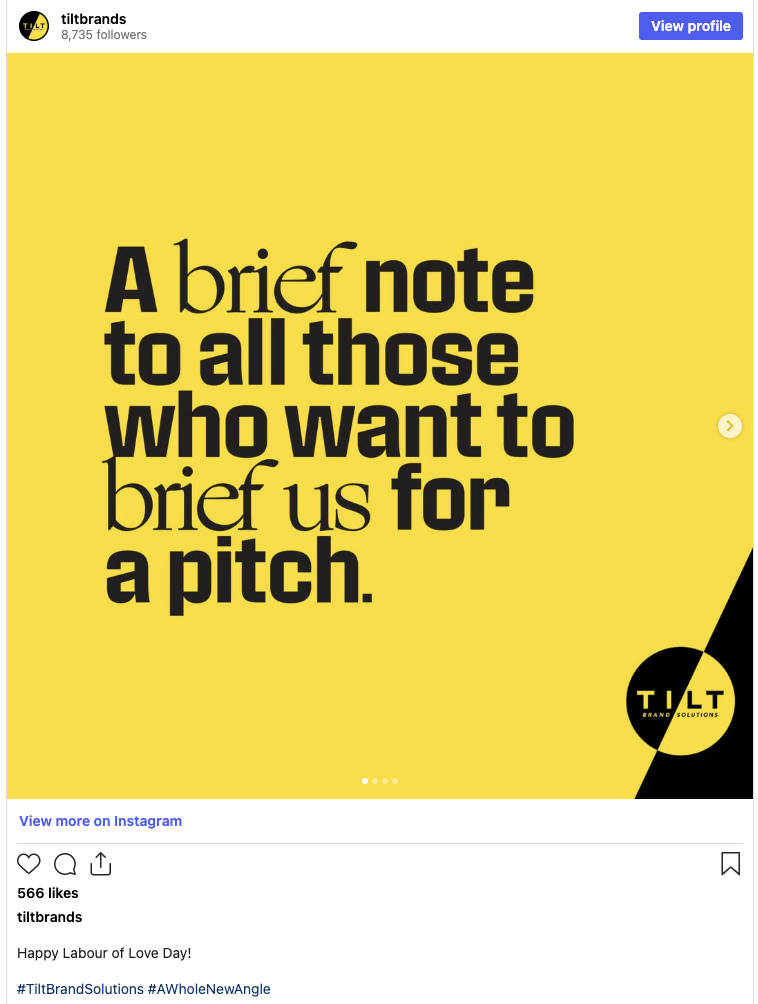
That is a bold stance in an industry where agencies routinely burn weeks on unpaid strategy and creative for a slim shot at winning. Tilt wasn’t refusing new business. It was refusing a process where the agency carried the cost and the client kept every option.
Lesson: Leadership isn’t measured by how many pitches an agency enters. It’s measured by whether leaders protect the team’s time, ideas, and margin before revenue pressure makes every brief look worth chasing.
Leaders set the money rules the agency runs on. They decide how work is priced and what margin is fair. They set the point where extra scope needs a change order. And they pick which numbers managers can trust. In the age of AI, this becomes a complex and critical decision that affects pricing, tool spend, and salaries.
They don’t need to read every timesheet. But they should know whether the agency can answer basic questions:
Revenue tells leaders whether the agency is selling. Margin, used hours, and cash flow tell them whether the model works.
AI has made this harder to see clearly. One European agency owner described watching his €40K monthly book of business shrink from 38% net margin to 12% over three years, without losing a single client or adding new deliverables. AI tools had compressed the labor cost of every project, but pricing never adjusted. A campaign brief that took six hours in 2022 took ninety minutes in 2026.
The work got faster, but the revenue stayed flat while costs around it (tools, overhead, growth investment) did not. The model only worked again once leadership re-priced retainers against outcomes rather than assumed hours.
Hiring sharp specialists is only part of the job. Leaders also need a team that can decide things without sending every issue back to the founder.
That means naming who owns client calls, quality reviews, staffing, and pricing exceptions. It also means coaching your best people to manage others before you promote them.
A common trap shows up when you hand over the work but keep the authority. The team owns the deadline, but the founder still signs off on the brief, estimate, concept, and client reply. Work moves outward while decisions keep moving up. Put simply, a team grows when people know which calls are theirs and when to escalate.
TNT Growth hit this wall at 25 people. Founder Adam Treboutat was buried in every decision, and the agency had no operating system beneath him. In twelve months, he hired a four-person executive layer, defined which decisions belonged at each level, and stepped out of daily delivery.
The result: the team doubled to 50, revenue grew 80%, and TNT landed at #442 on the Inc. 5000 list. The growth didn’t come from new clients. It came from removing the founder as the bottleneck.
Agency leaders set the level of quality clients should expect and the process that protects it.
This doesn’t mean reviewing every deliverable yourself. It means clear standards for briefs, strategy, creative review, approvals, and handoff. Plus, it also means deciding where senior judgment is a must and where a checklist is enough.
Without shared standards, quality rides on who happens to be assigned. Senior management then burn their hours rescuing work, fixing errors, and carrying know-how from one job to the next.
Digitalli, a luxury brand communications agency serving international fashion and lifestyle clients for over a decade, had its project management scattered across Trello, emails, and calls. Quality was inconsistent because it depended entirely on who happened to be managing a project that week.
Senior staff spent evenings rescuing work rather than reviewing it. After centralizing workflows and standards in one system, the agency increased order capacity by 30% and unlocked 43% more capacity, without adding headcount. The late-night rescue work dropped because the process now carried the quality standard, not individual memory.
The operating model is how strategy turns into daily work. It shapes how requests come in and how projects get scoped. It sets how people get assigned, where decisions live, how risks surface, and how you measure results.
Leaders own the design of that system even when an ops director runs it day-to-day.
A weak model forces good people to cope through memory, meetings, and overtime. A strong one makes the right next step obvious without someone stepping in. This is where leadership and management meet. Leadership chooses what the agency wants to protect, while management turns that into workflows, roles, meetings, and controls.
Martin City Marketing runs seven departments out of one Kansas City studio: account, design, paid, SEO, social, print/install, and ecom. As the agency grew, client approvals lived in email threads, status updates required chasing people down, and no two departments followed the same process.
Leadership restructured into a pod-based delivery model where each client set gets one specialist per department, all working from the same ClickUp workflow. Approvals now happen inside the task, not a forwarded email. Each department runs its own Super Agent to handle recurring coordination. The result: a system where the next step is visible without someone stepping in to direct traffic.
Agency leaders also decide where AI belongs in the business. The question isn’t just which tools the team may use. Leadership needs to define:
Ignite Social Media learned this when a major food brand’s RFP demanded answers to nine specific questions about how the agency uses AI: what tools, what safeguards, what data enters the system, and who is accountable.
The agency had been using AI informally for years but had never written it down. That RFP forced them to articulate their policy. They now recommend every agency write one before a client demands it, because articulating boundaries after the fact is harder than setting them proactively.
Also Read: Agency Capacity Planning
Below, we break down the five shifts one by one: consolidating onto a single system, pricing scope as soon as it’s requested, making your time data trustworthy, planning capacity from live numbers, and handing repetitive work to AI. We cover them in this order because each one builds on the last, starting with consolidation:
No agency sets out to run on a dozen tools. The stack builds up one defensible purchase at a time, and each one solves a real problem the month it lands:
Every one of those calls was rational on its own. The cost is structural, and it surfaces later because none of the tools were built to share a source of truth.
That is when coordination becomes the work itself. A project manager copies a client request out of email into the tracker, checks Slack to confirm a designer saw the latest comp, then reconciles three timelines to rebuild a status report the client reads for ninety seconds. The subscriptions cost a few hundred dollars a head. The senior hours spent reconciling the tools cost far more, and none of them are billable.
A sharper diagnostic is the newest-hire test. Meaning you give someone who started Monday a single client name and ask what’s going on with the account. If they can answer from one login, the work is genuinely consolidated. If it takes four tabs, a shared drive, and two colleagues to piece together, the tools are torn at the seams.
Guardrail: Don’t remove a specialist platform simply to reduce the tool count. Consolidation should lower coordination costs without weakening work quality.
Scope creep often gets blamed on demanding clients, but the bigger failure is delayed intervention. Ignition surveyed 273 U.S. agency leaders and found that 57% lose $1,000 to $5,000 a month on work they deliver but never bill for, and 78% rarely or only sometimes charge for work outside the agreed scope.
A client asks for one more small thing, the team agrees, and three weeks later the retainer is over-delivered with no change order. Raise it at invoicing, and the conversation feels adversarial, because the work is done and the agency has little room left to negotiate. Raise it the day the request arrives and the same conversation becomes a trade-off: expand the scope, swap a deliverable, extend the timeline, or hold the line.
Catching the drift early is the whole game. Deliverable counts mislead, because a project can look on track by output while running far over on effort, so the better tripwire is hours consumed:
| Hours consumed | What it means |
|---|---|
| 70% of scope | Still time to adjust the plan |
| 100% of scope | Only a record of margin already spent |
Two things make the tripwire fire:
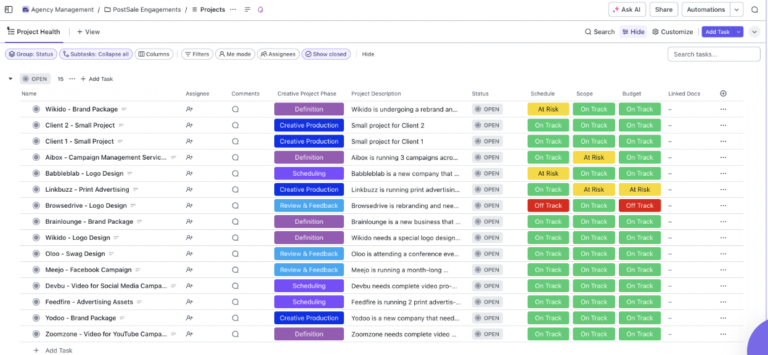
Pro Tip: Whatever tool you use, make sure change requests have a place to live outside of email and Slack threads. The ClickUp Agency Management Template has a built-in structure for this, so a client’s extra request gets logged and priced against your rate card the day it’s asked.
Project margin, client profitability, and capacity all rely on accurate time data. The real question isn’t whether agencies track time. It’s whether that data is current, logged to the right project, and tied to the work it describes. When time capture lives in a separate process, the reporting lags behind the work, and every scope, staffing, and pricing call gets shakier.
The fix is to capture time alongside the work, then feed a single clean dataset into reporting, capacity planning, and client profitability.
A better check is the effective hourly rate:
Client revenue ÷ Actual hours consumed
It tells you more than project margin, because it shows what you truly earned for the time that account ate up.
At minimum, leaders should be able to trust:
SPI Research’s benchmark found that average billable utilization across professional services firms had fallen to 68.9%, alongside the lowest average EBITDA margin in more than a decade. It shows how fast paid capacity turns into a margin problem when too few available hours reach billable work.
The fix is a rolling capacity plan that looks as far ahead as the agency sells. If clients are booking work eight weeks out, leaders need an eight-week view of:
Review that view every week. Move work before specialists become overloaded, reserve tentative capacity for likely deals, and bring approved work forward when someone has room.
Then compare planned hours with actual hours each month. A repeated gap usually points to one of three problems: weak estimates, scope drift, or work assigned at the wrong level.
Track fit alongside availability. While ten free hours from a junior designer are helpful, they don’t quite solve a strategy bottleneck. Likewise, a senior strategist shouldn’t be seen as fully utilized just because their week is mostly filled with routine tasks.
The best place to use AI in an agency is often the work nobody notices until it fails. A brief sits unassigned, a blocker surfaces too late, or a status update takes half an hour to rebuild.
These tasks tend to follow a clear pattern, which is what makes them good candidates for automation. Start with internal workflows where the inputs and the next step are easy to define:
Now, can you describe the workflow as “when this happens, do this, unless this exception applies”? If you can, the process is ready to map.
Take a client brief. Once it’s approved, the system can create the delivery tasks, assign the right team, apply the timeline, and flag any missing inputs. The account lead still steps in on exceptions, but nobody rebuilds the same project by hand.
Human approval stays on client-facing messages, budget changes, publishing, campaign launches, and anything where a small error carries a high cost. Then check whether the automation is helping. Track time saved, corrections needed, and errors introduced. A workflow that creates more review work than it removes isn’t finished.
Did you know? BCG’s survey of 300 global CMOs found that 42% still use generative AI only for isolated tasks. That can lift individual output, but it leaves the wider workflow unchanged.
The billable hour views “hours” as the limited resource. With AI making those hours more affordable, agencies now face a challenge: the quicker they complete a job, the lower the invoice becomes. And that can feel unfair sometimes.
No single model fixes this across the board. The task is matching the right pricing model to the right type of work, then moving clients onto it without turning the conversation into a price fight.
The five models agencies are using:
| Model | How it works | Best for | Watch out for |
|---|---|---|---|
| Hourly | Bill logged time at a rate | Ad hoc requests, unscoped discovery work | Punishes speed; AI gains shrink your invoice |
| Retainer | Fixed monthly fee for a defined scope of work | Ongoing accounts with predictable volume | Scope creep erodes margin if hours aren’t capped per phase |
| Project-based | Fixed fee for a defined deliverable | Campaigns, launches, one-off builds | Underestimating effort at the quote stage eats the whole margin |
| Value-based | Fee tied to the client’s estimated value of the outcome | High-impact strategic work, rebrands, market entry | Hard to price without trust and a track record; requires real data to defend the number |
| Hybrid outcome | Lower base fee plus a bonus tied to a measurable result (leads, revenue, conversion lift) | Performance marketing, media buying, growth work | Needs airtight measurement and attribution the client agrees to upfront |
Most agencies don’t run on one model. They run a blend: retainers for the always-on work, project fees for defined builds, and a value or outcome layer for the strategic engagements that justify it.
Both models decouple what the client pays from how many hours it took. That matters because the two things clients care about (the quality of the strategic thinking and the result it produces) aren’t things AI has made cheap. Meaning drafting and formatting have become cheap. But judgment hasn’t and never will.
The mistake most agencies make is trying to flip a client’s entire contract at once. That reads as a price increase dressed up in new language, and it usually gets pushed back hard.
A better sequence:
Guardrail: Don’t quote value-based or outcome pricing on work you haven’t already run under a project or retainer model with that client. Pricing on trust you haven’t earned yet is how agencies end up underpriced and locked into a bad number for a year.
The seven ownership areas above share a dependency: positioning, service mix, clients, money, talent, quality, and operations all break down when the information behind them is scattered. A leader can’t price scope accurately if hours live in one tool and deliverables in another. They can’t defend a capacity call if workloads are invisible until someone burns out.
ClickUp for Agencies solves that by putting the work, the time behind it, and the conversation about it in one workspace. Briefs sit beside tasks. Approvals happen inside the project, not a forwarded email. Time logs feed dashboards that show which clients are profitable and where scope is drifting. Use Workload view lays each person’s committed hours across the week, so staffing decisions come from data, not gut feel.
For instance, Admiral Digital lived the before-and-after:
Before ClickUp, our team was juggling Asana for tasks, Google Docs for project briefs, Miro for whiteboarding, and Slack for communications. Information was scattered, and ‘finding the latest version’ was a constant struggle. ClickUp has consolidated all of that into a single, unified workspace. We’ve created a single source of truth that has dramatically improved team efficiency and reduced our monthly software subscription costs.
The AI layer handles the coordination work that otherwise falls on the leader by default. ClickUp Brain reads across the workspace to answer live project questions, draft updates, or surface work that’s gone off track. Super Agents run multi-step jobs autonomously, like routing intake, sending client reminders, or compiling weekly reports, so coordination runs whether the founder is in the room or not.
Start with the Marketing Agency Template to skip the blank-canvas setup and get client delivery, campaigns, and statuses structured from day one.
Best for: Agencies ready to run the whole operation from one system, where scope, time, capacity, and AI draw on the same data.
Skip it if: Your team relies on specialist tools it won’t consolidate, or you can’t spare two to four weeks to migrate.
| Mistake | Why it causes problems | Fix |
|---|---|---|
| Cutting headcount before redesigning the workflow | The smaller team still has the same handoffs, approvals, and status meetings, just fewer people to run them. Utilization drops and quality slips | Fix the workflow first. Cut headcount only after the new process is in place |
| Letting clients keep 100% of the AI savings | If price drops by the same amount a tool saves, the agency gives away every gain it built, with nothing to show for the retraining it took | Tie pricing to the outcome or the judgment involved, not to the hours the tool cut |
| Rolling out AI tools without retraining the people who sell the work | Account leads hear about the change last, so they explain a faster turnaround as “cheaper for you.” The client hears that and negotiates down | Give every operational change a matching sales script before it reaches a client |
The pattern underneath all three: Operations and pricing have to move together. Get faster without repricing, and you give the gain away. Reprice without getting faster, and you lose the client’s trust. These aren’t two separate problems to solve one after another. They’re one problem, and it needs one fix.
Everything in this guide points to one discipline: keep scarce human judgment on the work clients pay a premium for, and let the system carry the rest. That’s the through-line behind consolidating tools, pricing scope early, trusting your numbers, planning capacity live, and automating the coordination nobody should be doing by hand.
The trap is treating those as five separate projects, or worse, moving on price and speed at different times.
So don’t boil the ocean. Start with the one shift where your setup strains most, whether that’s tool sprawl, unbilled scope, or numbers you can’t trust, and fix that first. Each shift makes the next easier.
Marketing agency leadership, in the end, is just protecting judgment and the margin it earns. That gets a lot easier when all the work lives in one place instead of scattered across a dozen tools. Get started with ClickUp for free and put your agency’s work on a single surface.
A good marketing agency leader gives the team a clear direction, makes difficult trade-offs, and shares authority without losing accountability. They understand the creative work, but they don’t need to control every deliverable. The strongest leaders set standards, tell the truth early, and let the best idea win regardless of who proposed it.
Department heads become useful when specialist teams need regular coaching, quality control, staffing decisions, and someone who can resolve issues without the founder. Don’t create the role only as a reward for strong craft skills. A department head must be able to manage people, make trade-offs, invest in the right tools with an eye on future trends, and improve the performance of the whole function.
To lead a creative agency team, start with a clear brief, a shared quality bar, and one person accountable for the final decision. Give feedback against the goal and agreed criteria, not personal taste. Creative leaders should protect room for exploration, but they also need firm deadlines, limited approval layers, and a clear point where discussion ends and a decision is made.
The Promethean Research 2026 State of Digital Services report found that digital agencies averaged a 13% after-tax net margin in 2025, down from a long-run average of roughly 15%. Studios with fewer than 10 employees averaged 19%, while agencies with 50 or more employees averaged 8%.
A healthy after-tax net margin generally falls between 10% and 20%, with 15% as a useful long-term benchmark. Agencies that narrowed their services grew fastest (13% revenue growth) and reported stronger margins than those that expanded their offering.
It’s important not to confuse net margin with project margin. Project-level margins often land around 35–38%, but overhead, sales, software, and management costs reduce the bottom line. Below 10% usually signals a problem with pricing, scope containment, utilization, or overhead, unless the agency is deliberately investing in growth.
Neither is universally better; the right choice depends on the work. In-house teams now handle more production because AI made drafting and mock-ups cheap, while agencies win on expert judgment and orchestration across many campaigns and approval chains at once. A useful rule: keep repeatable production close to the business, and hire an agency for the strategic calls and the scale of coordination in-house teams cannot manage.
Marketing agency leaders should track a small set of metrics across four areas:
No single metric tells the full story. High utilization can hide unpaid scope, while strong retention can hide clients that cost more to serve than they return. The best leadership scorecard connects each number to a decision about pricing, staffing, delivery, or the client portfolio.
A healthy blended billable utilization rate for an agency’s delivery team sits around 70–75%. But a single target across all roles is misleading. By role, realistic targets look more like:
SPI Research’s 2025 Professional Services Maturity Benchmark reported average utilization falling to 68.9%, alongside the lowest EBITDA margin in over a decade. Their 2026 report showed a further decline to 66.4%. A rate above 80% sustained across a team is usually a burnout signal, not an efficiency win.
Judge utilization alongside scope variance, margin, rework, and team strain. A high number isn’t healthy if much of that time is unbilled or the team has no slack to absorb change.
Most marketing agencies start with a collection of point tools: a project tracker, a chat app, a docs tool, a time tracker, and a reporting layer.
A typical stack may include:
The risk isn’t the tool count itself. It’s the coordination cost: copying updates between systems, rebuilding reports, and hunting across four logins to answer a single client question. The body of this post covers that problem in depth under Shift 1 in this post.
The industry is moving toward consolidated platforms where tasks, docs, chat, time tracking, and reporting share one data layer, so scope, capacity, and profitability are visible without manual assembly. Specialist tools still earn their place where they add clear value (design, analytics, media buying), but the operational spine increasingly lives in one system.

Manasi Nair
Max 20min read

Sean Hardy
Max 26min read
Manasi Nair
Max 23min read

© 2026 ClickUp





