
You just had a brilliant idea but lack the expertise needed to execute it.
Maybe you need a designer to visualize the concept or a strategist to run a soundboard experiment. Whatever the case, you need collaboration skills to take the next step.
Collaboration allows you to leverage the strengths of others, multiplying your own potential. You benefit from diverse points of view and skill sets, allowing you to move faster and make smarter decisions.
In this article, we’ll explore the importance of collaboration skills, how to hone them, and how collaboration tools like ClickUp can help your team’s ability to work together seamlessly. Let’s begin!
How to Improve Collaboration Skills in the Workplace

 Summarize this article for me please
What are Collaboration Skills?
Collaboration skills are the abilities you need to work effectively with others to achieve a common goal in the workplace. It’s more than just sitting beside someone and working on the same task.
Good collaboration skills allow you to work together seamlessly with your teammates to produce better results than you could on your own. Some key components of collaboration skills include:
- Communication
- Adaptability
- Problem-solving
- Emotional intelligence
- Conflict resolution
This list is not exhaustive because there’s much more to workplace collaboration skills. These skills are essential in modern workplaces where the need for teamwork and cross-functional collaboration is steadily rising.
Summarize this article for me pleaseImportance of Collaboration Skills at the Workplace
We all collaborate at work daily. But are we doing it well? How do we know if we’re on the right track? To answer these questions, you can evaluate yourself and your team based on the following criteria:
Enhanced productivity and innovation
Effective team collaboration leads to increased productivity and fosters innovation. Employees working together seamlessly can leverage diverse skills and perspectives to solve problems and generate new ideas.
A Stanford study found that people working collaboratively reported higher engagement, lower fatigue, and higher success rates.
It’s not just talk; here’s a real-world example: Apple’s success with the iPhone stemmed from collaboration between hardware engineers, software developers, and design experts, resulting in a revolutionary product that none could have created independently.
Collaboration creates opportunities for ideas to intersect and evolve. One team member’s concept can spark inspiration in another, leading to innovative hybrid solutions or entirely new ideas. Professionals known for their collaborative skills and abilities often become valuable team members and are more likely to be involved in high-impact projects—giving you a career boost!
Improved employee satisfaction and retention
Collaboration creates a more positive work environment, increasing job satisfaction and employee retention rates. When tasks and responsibilities are shared, individual stress levels often decrease. Knowing that support is available from teammates can make challenging projects feel more manageable. Employees are more likely to stick to such working environments.
According to a Gallup report, highly engaged teams show 21% greater profitability, and teams who score in the top 20% in engagement realize a 41% reduction in absenteeism.
Collaborative environments provide constant opportunities for peer-to-peer learning, which can be highly satisfying for employees keen on personal growth. Moreover, on the professional front, employees will find more growth opportunities in companies with a collaborative environment.
Better problem-solving and decision making
Collaborative teams bring together individuals with varied backgrounds, experiences, and expertise. This diversity allows problems to be viewed from multiple angles, often uncovering aspects that a homogeneous group might overlook.
Beyond demographic diversity, cognitive diversity—differences in perspective, insights, and information processing styles—significantly enhances problem-solving capabilities. A study by the Harvard Business Review found that teams solve problems faster when they’re more cognitively diverse, with a 20% increase in innovation.
Best part? Collaboration helps mitigate many individual biases and blind spots. Team members can challenge each other’s assumptions and point out potential flaws in reasoning. Lastly, professionals who excel in team effort and problem-solving are often seen as valuable assets and may be fast-tracked for leadership roles. Who does not want to be seen like that?
Career advancement opportunities
You are a valuable asset when you demonstrate proficiency in working effectively with others. Collaboration allows you to showcase your leadership potential, problem-solving abilities, and communication skills—all highly sought-after qualities for promotions and leadership roles. You become a more well-rounded professional by honing your collaboration skills, propelling yourself toward career success.
Summarize this article for me pleaseExamples of Collaboration Skills
We’ve talked enough about how collaboration skills help, but here are some critical collaboration skills you can develop to become a more effective team player:
Communication
Communication is a collaboration skill that will solve half your problems at the workplace. Not only that, but it will also help you bring the actual fruits of teamwork. This aligns with Walmart’s founder Sam Walton’s statement:
Communication means more than conveying your message to teammates. It also includes things like verbal and nonverbal communication:
- Active listening: Active listening goes beyond simply hearing words; it involves fully engaging with the speaker and their message
- Clear articulation: This involves conveying ideas and information in a way that is easily understood by others
- Nonverbal communication: This encompasses all the ways we communicate without words, which often convey more than verbal messages
💡Pro tip: ClickUp’s Team Communication and Meeting Matrix Template will let you design an efficient communication plan that helps embrace active listening. This template helps you:
- Assign clear roles and duties to each team member for every project
- Schedule regular meetings and updates to keep the team aligned
- Develop a detailed timeline outlining the deadlines

Emotional intelligence
Emotional intelligence (EI) is a powerful tool that can elevate your collaboration skills to a whole new level. It greases the wheels of collaboration by fostering empathy, allowing you to understand other’s perspectives, and promoting self-awareness, helping you manage your own emotions for productive teamwork.
Emotional intelligence starts with empathy.
But people often mistake empathy for feeling sorry for someone. Far from it, empathy is about actively trying to understand their perspective and feelings. It allows you to see a situation from another’s viewpoint, which can help de-escalate disagreements and find solutions that work for everyone involved.
Another essential element of developing emotional intelligence is self-awareness.
It involves recognizing your own emotions, their triggers, and how they impact your behavior. When you’re aware of your emotions, you can manage them effectively. This prevents you from letting anger, frustration, or stress cloud your judgment and negatively impact your workplace interactions.
💡Pro Tip: Start building emotional intelligence into your company by using the ClickUp Emotional Wheel Icebreaker Template. This template will let you:
- Build a digital version of team ice-breaking sessions
- Encourage a culture of showing and understanding emotions
- Promote active listening and open discussions

Adaptability
Adaptability allows you to adjust your approach, communication style, and work management to fit different colleagues and project needs, fostering a smoother and more effective team dynamic.
However, to become adaptable, you need to become flexible first. Projects rarely go exactly according to plan, but being flexible allows you to adapt to new information, revised deadlines, or unexpected hurdles.
Moreover, working with diverse personalities and communication styles requires flexibility. Adapting your communication style to each team member fosters better understanding and collaboration.
Conflict resolution
A study by the American Psychological Association found that 85% of employees have dealt with workplace conflict at some point in their careers. Conflict is a natural part of any workplace environment. While it seems counterintuitive, strong conflict resolution and interpersonal skills are vital for collaboration.
Disagreements don’t have to damage team dynamics. By addressing conflicts respectfully and finding solutions that work for everyone, you can maintain positive working relationships and a healthy team environment.
Moreover, healthy debate and respectful conflict resolution can spark creativity. By considering different viewpoints, teams can arrive at more innovative solutions than they might have.
Reliability
Reliability is the glue that holds a team together. Trust flourishes when team members can rely on each other to meet deadlines, deliver high-quality work, and follow through on commitments. This fosters a sense of security and allows everyone to focus on their tasks without unnecessary worry.
Reliability also plays a part in managing team expectations and ensures collaborative projects move forward smoothly. When colleagues are dependable, tasks are completed on time and to a high standard, minimizing the need for rework or delays. This improves overall team efficiency and productivity.
Collaboration in high-performing teams
In 2012, Google conducted an experiment called Project Aristotle to identify the key to building high-performing teams. The team found five aspects, out of which two are directly connected to collaboration with the team:
- Psychological safety: Being able to share ideas and take risks without judgment fosters open communication and innovation
- Dependability: Working with reliable teammates, consistently delivering high-quality work on time, building trust and accountability
- Structure and clarity: Eliminate confusion across goals, roles, and expectations to keep everyone focused on the shared objective
- Meaning: Feeling connected to the project’s purpose, leading to greater engagement and motivation
- Impact: Understanding the potential of the project fosters a sense of purpose and fuels dedication
Summarize this article for me pleaseHow to Improve Collaboration Skills at the Workplace
Here are some practical ways that will help you improve your collaboration skills:
Embrace active listening
With the fast-paced work, it’s easy to fall into the trap of passive listening—simply waiting for your turn to speak. But true collaboration hinges on something more profound: active listening.
Only 1 in 10 employees feel their voice is heard in their workplace. Active listening bridges this gap, ensuring everyone feels heard and understood, leading to better decision-making and problem-solving.
Here’s how you can become an active listener:
- Minimize distractions: Put away your phone, silence notifications, and give the speaker your full attention
- Ask clarifying questions: Don’t be afraid to ask questions to ensure you understand the speaker’s point
- Avoid interrupting: Let the speaker finish their thought before responding
Active listening goes beyond words. It allows you to pick up on body language and tone, minimizing misunderstandings and ensuring everyone is on the same page.
Practice role rotation
Sometimes, the best way to understand your colleagues is to walk a mile in their shoes. This is where role rotation comes in. It involves periodically switching tasks or responsibilities with team members, allowing you to gain new perspectives and strengthen your collaboration skills.
Here’s how you can go about role rotation:
- Step 1: Discuss potential role-swapping opportunities with your manager or team lead. Consider temporary task exchanges, collaborative project co-ownership, or cross-departmental collaborations
- Step 2: Be bold and ask for help when entering a new role. Offer your support in return when colleagues take on your responsibilities—another opportunity to promote collaboration
- Step 3: Schedule a team discussion to share your experiences and insights after completing a role rotation. This allows everyone to learn from each other and identify potential improvements for future collaborations
Stepping into someone else’s role allows you to experience their challenges and frustrations firsthand. This fosters empathy and a deeper understanding of different team members’ perspectives. In turn, this improves communication and builds successful team collaboration skills as you learn to appreciate each other’s strengths and weaknesses.
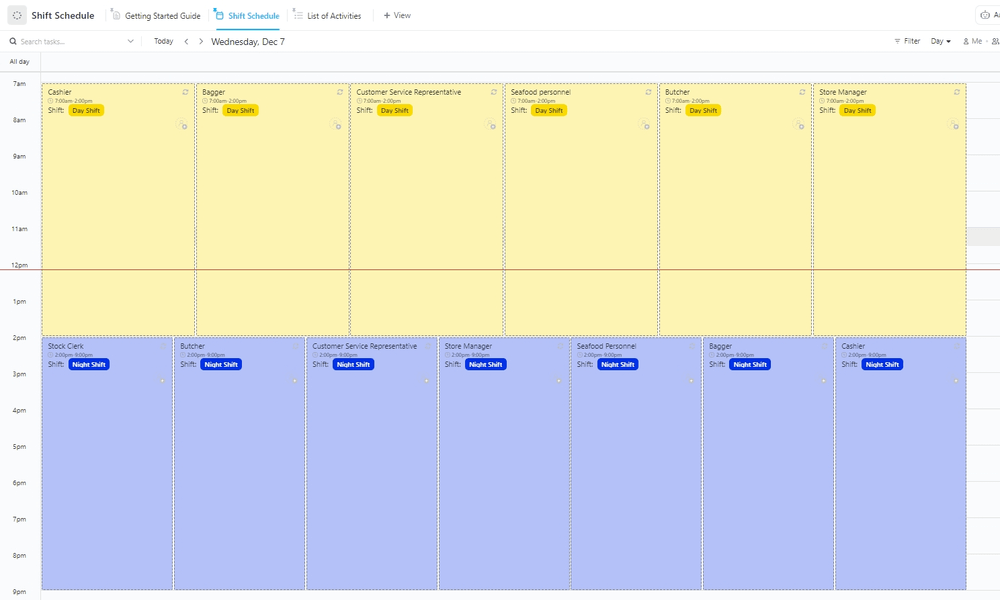
💡Pro tip: Use the ClickUp Shift Schedule Template to organize each team member’s working hours and relevant roles. This template provides you with:
- Visual layout of shifts and tasks
- Flexible drag-and-drop editing for rapid adjustments
- Real-time updates for teams across different locations
Adopt the “yes, and…” approach
The “Yes, and…” approach, a cornerstone of improv comedy, translates surprisingly well to the workplace.
A Harvard Business Review study found that teams that focus on building upon ideas (vs. critiquing them) generate twice as many creative solutions. By saying “yes, and…” you validate your colleague’s idea and open the door for further exploration.
This fosters a more collaborative setting where everyone feels comfortable sharing their thoughts. Here’s the breakdown:
The “Yes” Part:
- Active listening: It means honestly acknowledging your colleague’s ideas and suggestions. You show you’ve heard them by not immediately shutting them down
- Openness: You approach their idea with a positive, “can-do” attitude. This fosters a collaborative spirit
The “And” Part:
- Building on ideas: Here’s where the magic happens! You take their idea and add to it, expanding on it or taking it in a new direction. This builds a more prosperous, more creative solution
- Thinking outside the box: “Yes, and…” encourages you to see possibilities that you might not have before. It breaks you out of a rut and leads to unexpected solutions
Become a bridge builder in conflict
Conflict is a natural part of any collaborative environment. Differing opinions, approaches, and priorities can lead to disagreements. However, the key to successful collaboration lies not in avoiding conflict but in navigating it constructively. This is where you can truly shine by becoming a bridge builder in conflict situations.
Here’s how to be a bridge builder:
- Acknowledge different viewpoints: The first step is to validate each team member’s perspective. Actively listen to their concerns and avoid dismissing their opinions
- Seek common ground: Look for underlying needs and goals that everyone shares. This common ground can be the foundation for finding a solution that works for all parties involved
- Focus on solutions, not blame: The goal is to move forward, not dwell on who is right or wrong. That’s what successful collaboration is about. Facilitate a discussion focused on finding solutions that address the concerns of everyone involved
- Embrace compromise: Finding a win-win solution often involves compromise. Encourage the team to explore options that meet everyone’s needs as much as possible
- Maintain respect: Disagreements can get heated, but it’s crucial to maintain a respectful tone throughout the discussion
By using your emotional intelligence and acting as a bridge builder in conflict situations, you position yourself as a valuable asset to the team.
Practice reverse mentoring with colleagues
Reverse mentoring turns traditional mentoring upside down. It allows younger or newer employees to share their knowledge with more experienced colleagues, creating a two-way learning exchange.
But here’s the kicker—it’s not just about team building or teaching old dogs new tricks (though that’s part of it). It’s about creating this amazing two-way street of learning and team collaboration.
A Deloitte study found that 70% of millennials believe they have valuable skills to offer senior colleagues. Reverse mentoring fosters knowledge exchange, allowing senior members to learn about new technologies, trends, and communication strategies from younger generations. This bridges the knowledge gap and keeps team collaboration flowing.
How ClickUp supports effective collaboration
ClickUp is designed to boost collaboration in the workplace. We’re not just saying it for the sake of it. It comes with instant and live collaboration detection features that enable and encourage teammates to collaborate for the best results.
Real-time collaboration and knowledge sharing
- Docs: ClickUp’s Docs feature goes beyond static documents. It allows for real-time collaboration, where team members can edit and add comments simultaneously. This eliminates version control issues and ensures everyone is on the same page

- Comments and chat view: For asynchronous communication, ClickUp offers threaded comments within tasks and a dedicated ClickUp Chat View. This allows team members to provide feedback, ask questions, and share updates at their own pace, keeping everyone informed within the context of a specific task

Bridging the gap between asynchronous and synchronous communication
- Clips: ClickUp’s Clips feature allows seamless screen recording within tasks and comments. This is perfect for quick demonstrations, explainer videos, or even short team updates, fostering a more engaging communication style and bridging the gap between asynchronous and synchronous communication

Fostering visual collaboration
- Whiteboards and mind maps: ClickUp’s Whiteboards and Mind Maps empower teams to brainstorm visually. These features allow for real-time collaboration on ideas, project roadmaps, or problem-solving sessions and launch tasks directly from the whiteboard. Visualizing information fosters better understanding and engagement and can lead to more innovative solutions

Communicating information effectively with the right people for any project is super important. You can use the ClickUp Communications Plan Whiteboard Template to make things easier.
This template makes it a breeze to communicate with the right stakeholders through a well-organized communications plan. It’ll help you lay out the messages you need to get across, identify your target audience, and determine the best ways to reach them.

Automating your collaboration process
ClickUp Brain, ClickUp’s built-in AI, becomes your secret weapon within Docs. Here’s how:
- Write smarter: ClickUp Brain assists you in composing content within Docs. Need help crafting the perfect sentence? We got you!
- Automate workflows: Turn repetitive tasks into streamlined processes. ClickUp’s Brain can automatically create tasks, set deadlines, and even assign them to team members based on your instructions
- Tame information overload: Quickly grasp complex conversations or lengthy documents. ClickUp Brain can summarize them for you, saving you valuable time and ensuring everyone’s on the same page
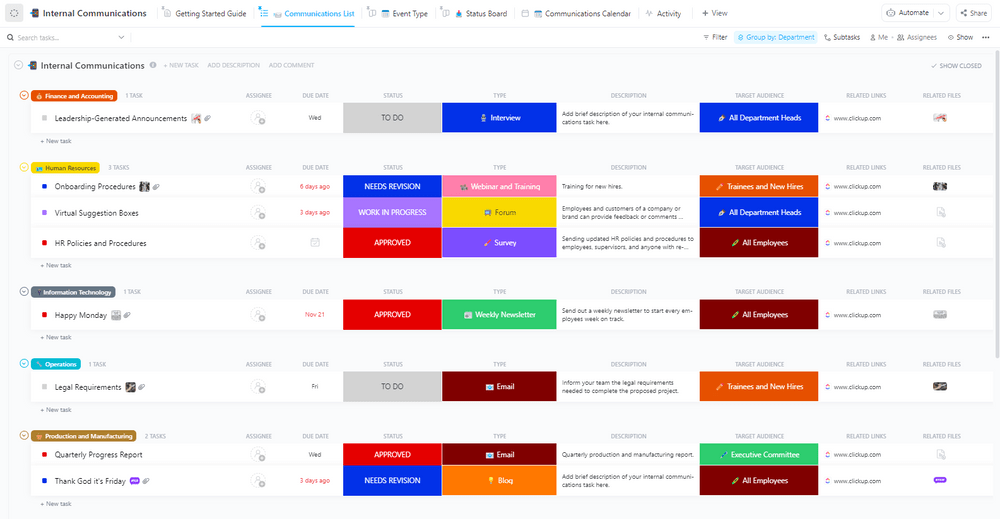
At an organizational level, effective communication and collaboration also depend on accessing the right information at the right time. Your team communication can easily suffer without those timely, critical updates from the leadership teams. This is where the ClickUp Internal Communication Template. This template lets you:
- Streamline the preparation and delivery of internal communications
- Ensure employees have access to the latest information
- Improve employee engagement and promote a collaborative culture
 Summarize this article for me please
Collaborate Better at Work With ClickUp
Strong collaboration skills are the engine that drives a successful team. They spark innovation, fuel productivity, and create a thriving work environment.
ClickUp acts as the high-performance fuel, providing features for real-time communication, knowledge sharing, and visual brainstorming—all while building transparency and accountability within your teams. Remember, collaboration is a continuous journey.
Leverage all of ClickUp’s features to ace your collaborative efforts. Sign up for a free ClickUp account today!


Everything you need to stay organized and get work done.

Recent Articles
Managing Creative Teams: How to Lead Your Team to Success 
Managing Creative Teams: How to Lead Your Team to Success
20 SMART HR Goals & Examples for Real Results in 2026
20 SMART HR Goals & Examples for Real Results in 2026
25 Employee Satisfaction Survey Questions to Pulse Check Your Team
25 Employee Satisfaction Survey Questions to Pulse Check Your Team
