A free Google Slides template can save you hours of design work, but its layout needs to fit your presentation. An investor pitch needs room for financials and traction, whereas a monthly review may need slides you can reuse for results and next steps.
Also check a few more details before downloading. Some templates open directly in Google Slides, while others require conversion or are designed to help you prepare the content. Free templates may also include attribution rules and reuse limits.
This guide covers 11 presentation templates for different jobs, along with their features, formats, and licensing terms to help you find a good starting point.
TL;DR: Choose a template based on the slides you need and the editing format you prefer. Slidesgo, SlidesCarnival, and SlidesMania offer free designs, though each has different attribution and resale rules. ClickUp’s Sales Pitch and Executive Summary templates help you prepare content before you design slides.
Tired of keeping templates up to date?
In 2026, there’s an agentic way to get the job done!
Tell us what you’re working on and get AI agents built for the job, ready to set up right away.
Summarize this article with AI ClickUp Brain not only saves you precious time by instantly summarizing articles, it also leverages AI to connect your tasks, docs, people, and more, streamlining your workflow like never before.
Summarize this article for me please
What Is a Google Slides Template?
A Google Slides template is a ready-made presentation with editable layouts and sample slides you can adapt to your content. A theme, by contrast, controls the deck’s overall design, including fonts, colors, and layouts. You can import a theme into an existing presentation without replacing your slides.
Summarize this article with AI ClickUp Brain not only saves you precious time by instantly summarizing articles, it also leverages AI to connect your tasks, docs, people, and more, streamlining your workflow like never before.
Project overview, problem statement, highlights, finance
ClickUp Doc
For a quick look at how a client presentation comes together before the slides are built, watch this walkthrough.
Summarize this article with AI ClickUp Brain not only saves you precious time by instantly summarizing articles, it also leverages AI to connect your tasks, docs, people, and more, streamlining your workflow like never before.
Summarize this article for me please
What Does “Free” Mean for Google Slides Templates?
A free download doesn’t always mean you can use the template without restrictions. Some providers require visible credit, while others limit how you can share or sell the finished work.
Here’s how the three presentation libraries in this list handle those rules.
Keep the SLIDESMANIA.COM text and credit any external resources
Personal, school, and work presentations
You can’t sell or redistribute the templates, including modified versions
Slidesgo also limits registered free users to three template downloads per month. Also, if you use photos included with a SlidesCarnival template, check their separate credit requirements.
For a client presentation, commercial use and template resale are different things. You can use a free template in a paid project without necessarily having permission to sell the template itself.
Check the terms on the original download page before sharing editable files or selling presentation materials.
Summarize this article with AI ClickUp Brain not only saves you precious time by instantly summarizing articles, it also leverages AI to connect your tasks, docs, people, and more, streamlining your workflow like never before.
Summarize this article for me please
11 Free Google Slides Templates for Every Presentation Job
The Business Pitch Deck Presentation uses a sober palette, large sans-serif titles, and a slab typeface for body text for a formal, understated look. It includes 30 editable slides, plus charts, tables, timelines, and mockups to show your business model and growth plans. You can also change the colors to match your brand before you build the deck. It’s a Premium template, which means you’ll need a paid Slidesgo plan to download it.
Use this template when you’re pitching a business idea and want the content to carry the presentation, with enough visual structure to keep financial details easy to follow.
Use case: You’re a founder preparing for a seed-round meeting. Arrange the slides to introduce the problem, show your product, explain the market opportunity, and share your traction. Use the editable charts for revenue figures and cut any slides that don’t support your pitch.
This template helps you with:
Big sans-serif titles and a slab body font that stay readable on a projector
Five color variants, including cream, blue, and lilac to choose from
Full-bleed photo backgrounds for product shots and team slides
Editable maps and graphics for market-size and expansion slides
Best for: Founders, startup teams, and business leads preparing formal presentations for investors or partners.
Skip it if: You want a photo-heavy pitch where large product screenshots do most of the storytelling. Its sober palette and structured layouts suit financial and business detail better.
A client proposal should make your approach, deliverables, and pricing easy to understand. The White and Gold Project Proposal template offers a clean layout with plenty of white space, gold accents, and customizable slides.
The design uses Bebas Neue and Fira Code fonts, which give the slides a distinct look without crowding the content. You also get charts, shapes, and frames that you can adapt to show project phases, pricing breakdowns, or campaign plans.
It’s a good fit when you’re presenting a paid proposal and want the client to spend more time reviewing your offer than trying to make sense of the slides.
Use case: You run a small marketing agency and need to send a campaign proposal by Friday. Use this template to lay out the brief, your approach, and the fee. Put your own logo on the master slide so it appears everywhere. Our guide to giving a strong client presentation covers the delivery side.
This template helps you with:
More than 25 ready-made slides that cover a full proposal arc
Hundreds of charts, frames, lines, and shapes for pricing tables and process diagrams
Built-in animation and transitions for a live walkthrough
Bebas Neue and Fira Code fonts with a gold accent for a clutter-free interface
Best for: Agencies, consultants, and freelancers presenting paid proposals to clients.
Skip it if: You’re pitching a bold creative concept. The white-and-gold palette suits polished, formal proposals better than colorful campaign pitches.
Its slightly cartoon-like illustrations give the presentation a more relaxed feel than a typical corporate review deck. The file also includes editable graphs, tables, maps, and timelines so you can present results and upcoming plans without designing those elements yourself.
Use case: You lead a six-person growth team with a monthly strategy review. Use this template to keep a fixed agenda, results, and next-steps structure. Duplicate the file each month and swap in the new numbers. For written updates between meetings, pair it with one of our weekly status report templates.
This template helps you with:
Editable graphs and tables for comparing campaign performance, monthly targets, and actual results
Map layouts for showing performance or business updates across different regions
Timelines and mockups for presenting upcoming initiatives and work in progress
More than 500 icons plus the Flaticon extension for adding visual cues to discussion points and team priorities
Best for: Team leads and operations managers who present the same review on a fixed cadence.
Skip it if: Your audience is a board or an external investor. The illustrated style suits internal meetings better than formal reporting.
Sometimes your presentation is ready, but the project timeline still needs its own slide. Slidesgo’s Project Timeline Infographics template includes 32 editable timeline designs you can copy into an existing Google Slides deck.
The layouts let you show a sequence of events, project phases, or major milestones without drawing the timeline yourself. Once you’ve picked a design, you can edit the text, shapes, and colors to reflect your project.
Use case: You’re a project manager presenting a product launch plan to stakeholders. Use one of these timelines to show every launch phase on a single slide. Then label each phase with the owner who runs it. If your team presents in PowerPoint instead, see our PowerPoint timeline templates.
This template helps you with:
Icons and the Flaticon extension for marking approvals, launches, and other important checkpoints
Included editing instructions that walk you through customizing the infographic designs
A 16:9 widescreen layout for displaying project timelines on standard presentation screens
Support for PowerPoint, Canva, and Keynote when you need to use the graphics outside Google Slides
Best for: Project and program managers who need to show timelines, phases, or milestones within a larger presentation.
Skip it if: You need a timeline that updates automatically when project dates or dependencies change. These are presentation graphics, so you’ll need to update them manually.
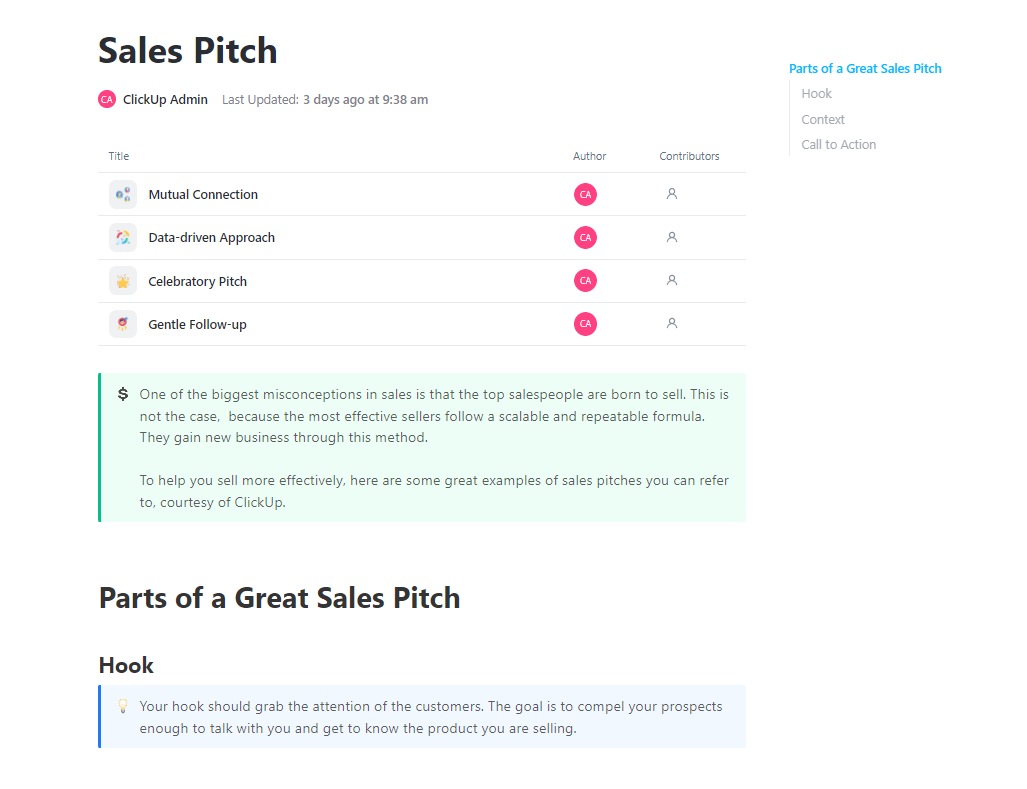
Before you start designing a sales presentation, you need to know who you’re pitching to, what they care about, and how you’ll make your case. The ClickUp Sales Pitch Template comes with a ready-to-use Doc that breaks a pitch into a hook, context, and call to action, plus four sample pitches you can adapt.
Use the Doc to bring together your prospect research, pitch outline, and final script. And if several people are involved, ClickUp lets you build a workflow around it to manage feedback, preparation, and practice sessions. You’ll need to set those parts up separately.
This works particularly well for sales teams that prepare similar pitches for different prospects. They can reuse the same planning approach while tailoring the message to each customer’s needs.
Use case: You’re a sales lead managing three reps who are pitching the same product to different companies. Start by copying the pitch Doc for each prospect, recording their needs, and working with your reps to shape the message. Then assign research and review tasks, schedule rehearsals, and build the approved pitch in Google Slides.
This template helps you with:
A Parts of a Great Sales Pitch section that walks you through the hook, context, and call to action
Four sample pitches (Mutual Connection, Data-driven Approach, Celebratory Pitch, and Gentle Follow-up) to adapt for different prospects
ClickUp Whiteboards you can add for brainstorming pitch angles and collecting feedback
Tasks, recurring reminders, and ClickUp Calendar that you can set up to track research, rehearsals, and pitch meetings
Best for: Sales teams that pitch often and want preparation, owners, and rehearsals tracked in one place.
Skip it if: You only need a good-looking deck for tomorrow. This template outlines the pitch; it doesn’t provide slides.
This Marketing Campaign template brings bright colors, photography, and playful illustrations into one presentation. It’s a good choice when you’re pitching a creative campaign and want the slides to match the tone of your idea.
Use the design to introduce your campaign concept, explain your target audience, and show the creative direction you have in mind. The mix of visual styles also lets you balance campaign imagery with supporting information.
Use case: You’re a marketing manager pitching a spring campaign for a lifestyle brand. Start with the campaign’s central idea, use photography to show the visual direction, and add slides explaining your target audience and channel mix. Then build the budget and launch schedule, and share the proposal with leadership.
This template helps you with:
Blue, pink, and yellow accents that suit lifestyle, retail, and other consumer-focused campaigns
Photo-led slides for showing product imagery, campaign concepts, and creative references
Illustrated elements that can help separate different parts of your campaign presentation
Comic-style speech bubbles, megaphones, and oversized quote layouts for highlighting your campaign message
Best for: In-house marketing teams and creative agencies presenting campaign concepts or plans.
Skip it if: You’re preparing a formal financial review or a presentation for a conservative corporate audience. Its bright colors and mixed visual style may be too playful for that setting.
Presenting at an online conference means designing slides that people can follow on a shared screen. The Online Conference template offers 16 customizable widescreen slides with a soft green palette and clean layouts.
The design works well for business presentations where you need to move between talking points, supporting visuals, and results. You can also use Canva’s presentation tools to add speaker notes, rehearse your delivery, or record a narrated version of your talk.
This template opens in Canva first. To edit it in Google Slides, open it in Canva and export a copy to Google Drive, following the instructions on the template page.
Use case: You’re speaking at a 20-minute virtual industry conference. Organize your talk into three sections, use the available graphics to explain your findings, and finish with a Q&A slide. Add speaker notes in Canva before rehearsing. If you’re recording the session, our guide to adding a voice-over in Google Slides covers the narration process.
This template helps you with:
Hundreds of charts, frames, lines, and shapes for presenting figures and supporting information
Animation and transition options for revealing content during a live session
Canva’s Talking Presentation feature for recording or practicing your talk
Drag-and-drop access to photos, videos, and audio clips when you need extra material for your slides
Best for: Webinar hosts, conference speakers, and business professionals presenting online.
Skip it if: You’re giving a long session. At 16 slides, you’ll likely duplicate layouts to fill a full talk.
A good character analysis lesson gives students room to look beyond a character’s basic traits and examine what the author reveals through their words, choices, and actions.
You can adapt the lesson to a novel, play, or short story, using the layouts to introduce characters, explore their motivations, and discuss evidence from the text.
Use case: You’re teaching 10th-grade English and starting a unit on Macbeth. Use the slides to examine Macbeth’s ambitions, trace how his decisions change throughout the play, and ask students to support their interpretations with quotes. You can also add audio to Google Slides if you’d like students to hear a key passage before discussing it.
This template helps you with:
25+ customizable slides for structuring a lesson from the introduction to the final discussion
Charts, frames, and shapes for comparing characters, tracing their development, or organizing textual evidence
Animation and transition options for revealing quotes, interpretations, or discussion questions one at a time
A five-part lesson outline covering character creation, narrative voice, dialogue, character analysis activities, and a final summary
Best for: High school English and literature teachers planning character-focused lessons and classroom discussions.
Skip it if: You need a complete assessment with ready-made quizzes, grading criteria, and student response tracking. You’ll need to add those teaching materials yourself.
Group presentations can look disjointed when everyone prepares their slides separately. SlidesMania’s Synergy template gives teams a shared design with bold typography, modern layouts, and section dividers to organize different speakers’ contributions.
It includes layouts for text, charts, and images, so everyone can present their research in the way that works best. You can also duplicate sections and change the theme colors to fit your project or organization.
Use case: You’re one of five students presenting a semester research project. Give each person a section divider, agree on the theme colors, and use shared opening and closing slides to connect everyone’s work. Before assigning sections, map out the key topics using one of our Google Slides mind map templates.
This template helps you with:
Ready-made title pages and section dividers for introducing presenters and separating topics
Editable bullet, chart, and image layouts for handling different kinds of project content
A certificate slide that you can customize for course completion or team recognition
A dedicated team introduction slide with photo placeholders, names, and space for each member’s role
Best for: Student groups, university teams, and small work teams preparing a shared presentation.
Skip it if: You present alone with a single storyline. The section-per-person structure adds dividers you’ll end up deleting.
Its understated design leaves room for the information you want to present. You can adapt it for a formal speech, a department report, or a project update without first removing decorative illustrations or bright backgrounds.
The design is a good choice if you plan to bring in your own charts, screenshots, or brand elements and want the rest of the deck to stay consistent.
Use case: You’re an analyst presenting quarterly findings to your department. Use this template as a neutral base, and add your company color as a single accent. Let the charts do the talking. For team-structure slides, drop in one of our org chart templates for Google Slides.
This template helps you with:
Simple layouts for organizing headings, supporting text, and presentation visuals
High-contrast black-and-white styling that keeps text easy to distinguish from the background
Editable theme colors for introducing a brand accent without changing every slide separately
A ready-made timeline slide for showing project milestones, key events, or how results have changed over time
Best for: Analysts, managers, consultants, and students who need a formal, customizable presentation.
Skip it if: Your presentation depends on strong visual storytelling or a distinctive brand identity. You’ll need to bring your own imagery, colors, and graphics to give the deck character.
A presentation can look polished and still leave decision-makers unsure about what you’re proposing. The ClickUp Executive Summary Template gives you a ready-to-use doc to organize your argument before you start building slides.
Each section includes guiding questions to help you decide what information to include. Once you’ve answered them, remove the prompts, refine your summary, and share it with stakeholders for feedback.
The template works well for business plans, project proposals, and other presentations where you need to make a clear, evidence-backed case supported by financial details.
Use case: You’re an operations manager proposing a new customer support system to leadership. Use the template to explain why the current system needs replacing, summarize the expected benefits, and make your budget request. Once leadership approves the proposal, use the key points to build your Google Slides presentation.
This template helps you with:
A Project Overview section for outlining your proposal’s purpose, scope, and expected outcomes
A Focused Issue section for explaining the customer problem or business challenge behind your proposal
Project Highlights for presenting market research, supporting evidence, and your proposal’s strongest points
A Finance section for documenting projected costs, financial requirements, and expected returns
Best for: Project managers, founders, and business leads preparing proposals that need stakeholder or leadership approval
Skip it if: You need a finished presentation with visual layouts. This is a ClickUp Doc template for developing your executive summary, so you’ll still need to create the slides in Google Slides.
Summarize this article with AI ClickUp Brain not only saves you precious time by instantly summarizing articles, it also leverages AI to connect your tasks, docs, people, and more, streamlining your workflow like never before.
Summarize this article for me please
How to Choose the Right Free Google Slides Template
Start with the presentation you need to prepare and how much of the content you already have. Some templates give you a ready-made slide design, while others help you organize your ideas before building the deck. Use this table to find the right starting point.
If you need to…
Start with this template
Pitch investors or business partners
Business Pitch Deck Presentation by Slidesgo
Present a client proposal
White and Gold Project Proposal by SlidesCarnival
Run a recurring monthly strategy review
Monthly Strategy Review Meeting by Slidesgo
Add a timeline to an existing deck
Project Timeline Infographics by Slidesgo
Prepare and rehearse a sales pitch with your team
Sales Pitch Template by ClickUp
Present a creative marketing campaign
Marketing Campaign by SlidesMania
Speak at a webinar or virtual conference
Online Conference by SlidesCarnival
Teach a character analysis lesson
Character Analysis Lesson for High School by SlidesCarnival
Split a presentation between several speakers
Synergy by SlidesMania
Build a formal presentation with a neutral design
Simple and Formal Black & White by SlidesMania
Write an executive summary before building slides
Executive Summary Template by ClickUp
Summarize this article with AI ClickUp Brain not only saves you precious time by instantly summarizing articles, it also leverages AI to connect your tasks, docs, people, and more, streamlining your workflow like never before.
Summarize this article for me please
How Do You Import a Theme Into Google Slides?
If you’re starting a new presentation, making a copy of your chosen template is usually the easiest option. You’ll get its existing layouts and sample slides, ready to edit.
But if you’ve already built a deck and want to change its design, Google Slides lets you import a theme from another presentation.
Here’s how:
Save the template: Open the template and use its Google Slides download or Copy option to save an editable version in Google Drive
Open your existing deck: In Google Slides, go to Slide → Change theme to open the theme panel
Import the theme: Click Import theme at the bottom of the panel, choose your saved presentation, select its theme, and click Import theme
Check the layouts: Review your slides for text or images that no longer fit. Use the Layout menu to apply a better layout where needed
Importing a theme applies its design settings, including colors, fonts, and layouts. It doesn’t copy the sample slides into your presentation.
To bring over individual slides, go to File → Import slides and select the ones you need. You can also choose whether to keep their original theme.
If you’re importing a PowerPoint file, review the formatting after opening it in Google Slides. Our Google Slides vs. PowerPoint guide covers the differences you may encounter when moving between the two.
Summarize this article with AI ClickUp Brain not only saves you precious time by instantly summarizing articles, it also leverages AI to connect your tasks, docs, people, and more, streamlining your workflow like never before.
Summarize this article for me please
How Do You Customize a Free Google Slides Template?
Once your template is in Google Slides, start with the shared design settings before editing individual slides. This keeps the presentation consistent and saves you from making the same changes repeatedly.
A few ways to customize it:
Update your theme: Go to Slide → Edit theme to change shared fonts, colors, and layouts across the presentation
Replace placeholder images: Right-click an image and select Replace image to add your own photo without rebuilding its placement
Choose compatible fonts: Stick to fonts available in Google Slides. If the original design uses an unsupported font, pick a similar one and check how the text fits
Edit grouped graphics: Right-click an editable illustration and select Ungroup to change individual shapes, text, or colors
If several people are editing the presentation, ask them to leave comments on slides that need attention. Google Slides also has version history, which lets you review earlier edits and restore a previous version when necessary.
Summarize this article with AI ClickUp Brain not only saves you precious time by instantly summarizing articles, it also leverages AI to connect your tasks, docs, people, and more, streamlining your workflow like never before.
Summarize this article for me please
What Mistakes Should You Avoid With Free Google Slides Templates?
Even a well-designed template needs a final review before you present or share it. Pay particular attention to these common mistakes:
Keeping every sample slide: A template with 30 slides doesn’t mean your presentation needs 30. Keep the layouts that support your outline and remove the rest
Leaving placeholder content behind: Sample charts, figures, and text can be easy to overlook when you’re editing several slides. Check that every number, label, and example reflects your actual presentation
Crowding a layout with too much content: If a slide needs several paragraphs of text, split the information across two slides or choose a layout with more room. Shrinking everything to fit can make it difficult to read
Forgetting to check sharing permissions: Before sending the presentation, confirm that your audience has the right access. Give reviewers comment access and reserve editing permissions for people who need to make changes
Skipping the presentation preview: Open the finished deck in presentation mode and check how charts, images, transitions, and text appear at full size. Pay particular attention to slides imported from another format
Summarize this article with AI ClickUp Brain not only saves you precious time by instantly summarizing articles, it also leverages AI to connect your tasks, docs, people, and more, streamlining your workflow like never before.
Summarize this article for me please
How Can ClickUp Help You Create and Manage Presentations?
A Google Slides template gives you layouts to fill. If your presentation starts with project updates, research, or a brief already in ClickUp, you can also use that material to do a whole lot more!
Create a first draft with Brain² and ClickUp Artifacts
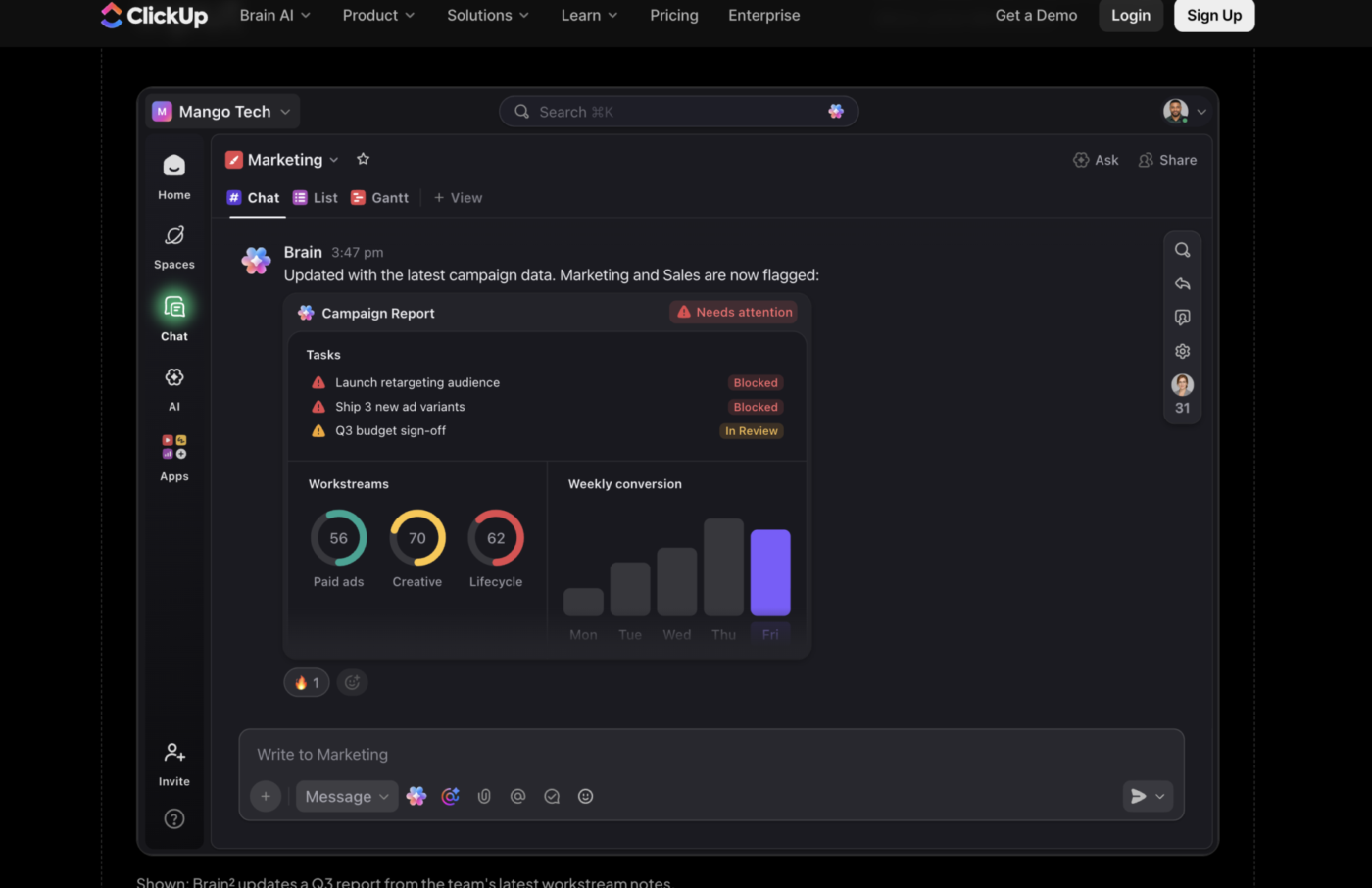
Give Brain² your presentation brief, source files, or links to relevant ClickUp Docs and Tasks. Specify the audience, the purpose of the meeting, and the points the deck needs to cover. Brain² can use that context to create a slide deck as a ClickUp Artifact.
For example, a team lead preparing a monthly review could ask:
Create a six-slide presentation from this project List and monthly report. Cover completed work, results against targets, blockers, and next month’s priorities. Finish with the decisions we need from leadership. Flag missing figures rather than inventing them.
Create artifacts instantly with Brain²
Open the generated deck to check the facts and slide order. Then ask Brain² to shorten crowded slides, change the visual style, or adjust the explanation for your audience. You can also edit text directly and leave comments on specific elements.
This gives you another way to create a presentation when you don’t need to work in a Google Slides file. If your client requires Google Slides, use the templates above and prepare your content in ClickUp.
Coordinate contributors and reviews with ClickUp Tasks
For a presentation involving sales, finance, and product stakeholders, each team needs to supply information, check its accuracy, and finish its review before the meeting.
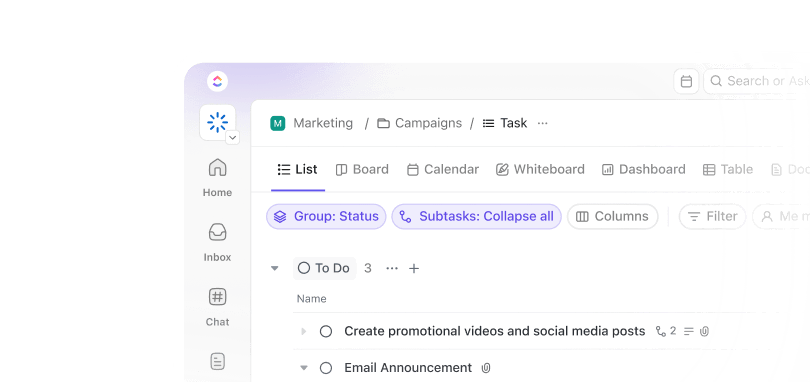
Create a ClickUp Task for the presentation and break the preparation into subtasks:
Assign contributions: Give the sales lead responsibility for customer examples, finance for revenue figures, and product for roadmap updates
Set review deadlines: Schedule content submission, fact-checking, design review, and rehearsal before the presentation date
Track readiness: Set up statuses such as Drafting, In Review, Changes Needed, and Approved so contributors can see what still needs attention
Keep feedback with the work: Link the Google Slides deck or ClickUp Artifact to the task, and use comments to record requested changes and sign-off
Before the review meeting, ask Brain² to summarize the preparation tasks and unresolved feedback. After the presentation, capture agreed actions as tasks with owners and due dates.
Summarize this article with AI ClickUp Brain not only saves you precious time by instantly summarizing articles, it also leverages AI to connect your tasks, docs, people, and more, streamlining your workflow like never before.
Summarize this article for me please
Choose a Template You Can Finish With
Before committing to a design, put your most demanding slide into it: a financial chart, a detailed timeline, or a comparison your audience needs to understand.
That will tell you more about its fit than the cover slide.
Then confirm the editing format and credit requirements before building the rest. Use Google Slides when you need to deliver a Google Slides file, or create a deck with ClickUp when that format is flexible. For a team presentation, give contributors clear deadlines and leave time for a final review.
Summarize this article with AI ClickUp Brain not only saves you precious time by instantly summarizing articles, it also leverages AI to connect your tasks, docs, people, and more, streamlining your workflow like never before.
Summarize this article for me please
Frequently Asked Questions About Google Slides Templates
Can I use Google Slides templates offline?
Yes. You can edit a Google Slides presentation without an internet connection if you’ve enabled offline access beforehand. On a computer, use Chrome or Microsoft Edge, enable offline access in Google Drive’s settings, and mark your presentation as Available offline. Your changes will sync once you’re connected again.
Can I edit Google Slides templates on my phone?
Yes. The Google Slides app lets you open, edit, and present slides on Android phones, iPhones, and iPads. You can change text, add comments, and make basic layout edits. For detailed design work, such as adjusting complex graphics or theme layouts, a desktop gives you more editing options.
Can I change a Google Slides template to portrait orientation?
Yes. Open your presentation and go to File → Page setup → Custom to enter your preferred dimensions. This works for portrait presentations, printable handouts, and other nonstandard formats. Afterward, check the existing layouts because changing the slide dimensions can affect where text and images land.
Can I save a Google Slides presentation as a PDF?
Yes. After you finish editing, go to File → Download → PDF Document (.pdf). This gives you a copy you can send to clients, print, or share without giving recipients access to the editable presentation. Keep the original Google Slides file if you expect to make further changes.
Can I add videos to a free Google Slides template?
Yes. Open the slide where you want the video and select Insert → Video. You can add a video from YouTube, paste a supported video URL, or choose a file from Google Drive. Google Slides also lets you control whether the video plays automatically, on click, or when selected manually.
Can I link Google Sheets charts to a Google Slides template?
Yes. Go to Insert → Chart → From Sheets, select your spreadsheet, and choose the chart you want. Keep the chart linked to its source if you’ll be updating the numbers regularly. When the data changes, click Update on the chart in Google Slides to reflect the latest figures. This is particularly helpful for monthly reviews and performance presentations where figures change between meetings.
Everything you need to stay organized and get work done.