

Sorry, there were no results found for “”
Sorry, there were no results found for “”
Sorry, there were no results found for “”
AI translation tools can produce a workable first draft in seconds. The harder part starts afterward: checking terminology, tone, context, and the small errors that fluent output can hide.
The European Language Industry Survey surveyed 1,058 participants across 45 countries. Among independent translators, 63% now use automated translation in some form. Yet only 23% rated the quality of machine or AI translation as high to very high, down from 40% a year earlier.
While more translators are using the technology, fewer are confident in the output it produces.
That changes how you should compare AI translation tools. Accuracy still matters, but the better question is what happens after the first draft. Can the tool preserve terminology across 200 pages? Does it keep formatting intact? Can a reviewer see what changed? Does it learn from approved translations, or does every correction start from scratch?
This guide compares nine AI translation tools on accuracy, pricing, language coverage, and the review workflow behind the translation.
| Tool | Best for | Standout feature | Starting price* | Where it taps out |
|---|---|---|---|---|
| DeepL | Accurate document and text translation | Layout-preserving document translation, glossaries, Clarify, style rules, tone controls, and DeepL Voice | Free; paid from $8.74/mo | It isn’t a full translation management system for continuous localization workflows |
| Google Translate | Free translation across the widest range of languages | 200+ languages, camera and speech translation, offline use, glossaries, adaptive translation, and document support | Free; Cloud Translation from usage-based pricing | Advanced controls live in Google Cloud, not the everyday Translate app |
| ChatGPT | Tone-controlled translation that you can direct | Conversational refinement, transcreation, live voice translation, file context, Projects, and structured API output | Free; paid from $8/mo | It doesn’t provide translation memory, formal glossary enforcement, approval states, or localization workflows |
| ClickUp | Translating content inside project workflows | In-context translation, Brain, Super Agents, multilingual AI Notetaker, multiple LLMs, and Clips transcription | Free; paid from $7/user/mo | It isn’t a standalone translation platform and doesn’t manage translators, term bases, or translation memory |
| Smartling | Enterprise localization with quality auditing | Translation memory, glossaries, visual context, LQA agent, automatic LLM selection, 50+ connectors, and global delivery | Free with limited usage; Enterprise pricing is custom | The setup and workflow depth are heavier than most small teams or occasional translation needs justify |
| Lokalise | Product and app string localization | Translation memory, branching, screenshots, in-context editing, style guides, integrations, and multi-LLM routing | Paid from $144/mo | Pricing climbs quickly as teams need more automation, AI, integrations, and workflow control |
| Phrase | Routing translation across multiple AI and MT engines | 30+ translation engines, MT Autoselect, quality scoring, translation memory, term controls, and multiple localization surfaces | Paid from $1,245/mo | It assumes a mature localization operation and needs someone to manage routing, terminology, quality, and workflows |
| Weglot | No-code website translation | Automatic site detection, multilingual SEO, Visual Editor, translation memory, AI language models, and human review | Free; paid from $17/mo | Word-count and language limits can push content-heavy sites into higher tiers quickly |
| HeyGen | Video and voice translation | Voice cloning, lip-sync translation, up to 175+ languages and dialects, glossary controls, duration adjustment, and multilingual playback | Free; paid from $29/mo | Shared credits make costs harder to predict, and it’s overkill for text, documents, or software strings |
Our editorial team follows a transparent, research-backed, and vendor-neutral process, so you can trust that our recommendations are based on real product value.
Here’s a detailed rundown of how we review software at ClickUp.
AI translation uses machine learning to turn text, speech, or documents from one language into another. Today, that means either a translation-focused system like DeepL or Google Translate, or a general-purpose language model like ChatGPT or Claude.
The difference shows up in how each handles the job. Translation platforms are built around language pairs, terminology, consistency, and repeatable output. General-purpose LLMs are more flexible with tone, style, and instructions, which makes them useful when the translation needs more interpretation.
That becomes obvious at scale. A translation of one paragraph is easy to review manually. Translating 3,000 product strings is a different problem. Product names, approved terms, formatting, and repeated phrases all need to stay consistent across the batch.
Localization platforms add the controls that make that possible, including glossaries, translation memory, terminology rules, review workflows, and quality checks.
Translation changes content from one language into another. Localization adapts that content for a specific market and manages the context around it, including terminology, cultural fit, formatting, review, and reuse.
That difference explains why the tools in this list look so different. DeepL, Google Translate, and ChatGPT can handle the translation itself. Platforms such as Smartling, Lokalise, and Phrase add translation memory, term bases, reviewer workflows, quality checks, and other controls for content that keeps changing across products and markets. A platform like ClickUp helps you manage the workflows and the content in the same place.
If you only need a translated document, those extra systems may be unnecessary. If you’re shipping software, websites, support content, or campaigns across several locales, they become much more important.
Our guide on using AI for translation covers that workflow in more detail. If you prefer a visual walkthrough on how to use AI for translation, watch this:
A good AI translation tool has to do more than produce fluent text. Past a sample paragraph, the real gaps show up in how well the tool controls key terms, keeps context, handles review, and fits the content you actually translate.
We compared the tools below on five things:
Nine tools made the cut: DeepL, Google Translate, ChatGPT, ClickUp, Smartling, Lokalise, Phrase, Weglot, and HeyGen. They cover a wide range of jobs, from document translation and tone-sensitive copy to product localization, multilingual websites, and video dubbing. Each entry below breaks down standout features, pricing, ratings, real user feedback, and where the tool falls short.

DeepL is an AI translation tool built on a neural machine translation engine that supports text, documents, and speech in 100+ languages. It shines on European language pairs. Legal, marketing, and internal comms teams reach for it when they need a document back in the same shape it went in.
It earns the top slot because most people searching for AI translation tools simply want a document translated well. DeepL handles PDFs, Word files, and slide decks while preserving the layout. That saves you the reformatting work that makes free tools costly in practice. Plus, it comes with glossaries that let you pin down how key terms get rendered.
DeepL also gives reviewers a way to work on the translated file before downloading it. In the document editor, they can move through individual segments, correct the translation, and see where a glossary, style rule, or translation memory affected the output.
A G2 user shared:
I like that DeepL gives simple and natural translations. It usually understands what I am trying to say instead of just translating word by word. It is also quick and easy to use, which makes it helpful when I need to translate something.
Where it taps out: DeepL is strong at translating and polishing finished content, but it still isn’t a full translation management system. Teams running continuous localization across product strings, release branches, multiple reviewers, and multiple vendors will need more workflow support for it.
Best for: Legal, marketing, sales, and communications teams that need polished business docs translated with strong terminology control.
Skip it if: You need one platform to manage the entire localization operation, including string repositories, vendor assignments, reviewer queues, and localization project management.

Google Translate is the tool to reach for when coverage matters more than workflow. The consumer app handles text, speech, handwriting, images, documents, and websites in more than 200 languages. The range covers plenty of languages that specialist vendors tend to skip.
The phone app is where Google Translate stands apart. Point the camera at a sign, extract text from a photo, speak into the app, or download languages. Live Translate adds real-time speech translation. Gemini 3.5 Live Translate supports near-real-time speech translation in more than 70 languages while preserving the speaker’s pacing, pitch, and intonation.
The browser version also covers desk work. It takes Word, PowerPoint, Excel, and PDF files up to 10 MB, with PDFs capped at 300 pages. Website translation opens a translated copy of a page and lets you flip back to the source when needed.
A G2 user mentioned:
Google Translate is one of the most useful Google products I’ve used because it makes understanding and translating multiple languages extremely simple and fast. The interface is clean, easy to navigate, and works smoothly even for quick daily usage. I like how easily it can translate text, voice, images, and even full conversations without making the process complicated. It’s especially helpful when reading international content, communicating with people from different regions, or understanding unfamiliar languages quickly. From my experience, the biggest advantage is convenience because everything feels accessible and beginner-friendly without needing technical knowledge.
Where it taps out: Google’s strongest translation controls live across Cloud Translation and Translation Hub, not inside the everyday Translate app. Teams that need glossaries, adaptive translation, human review, translation memory, and custom models must move to a more complex Google Cloud setup.
Best for: Travelers, support teams, researchers, and anyone who needs fast translation across a huge range of languages.
Skip it if: You’re producing polished brand, legal, or marketing copy and need reviewers to control tone and wording in the same workspace.

ChatGPT earns its spot when the translation needs judgment and taste, along with a language swap. Tell it the locale, audience, reading level, or brand voice. Then refine the result in chat. It works for marketing copy, support replies, product messaging, and any text where a word-for-word rendering would miss the point. OpenAI also offers a dedicated ChatGPT Translate experience for quick text translation, with controls for fluency, tone, and wording.
The same freedom pays off in transcreation. You can ask for three versions of a headline, keep a joke alive, explain why an idiom doesn’t carry over, or rewrite a phrase for Brazilian Portuguese instead of generic Portuguese. ChatGPT also works with uploaded files and longer project context. Reviewers can keep source text, term notes, and style notes right next to the draft.
For recurring work, Projects keep translation chats, files, and instructions together. That gives writers and reviewers a persistent place for the brand guide, locale notes, and source material across related jobs.
A G2 user said:
I love how much ChatGPT helps me in my everyday work. As a freelance translator and business owner, I use it for everything from checking translations and finding the right wording to writing emails, solving technical issues and developing ideas for my business.
Where it taps out: ChatGPT leaves you to build the controls that translation platforms wrap around the model. Projects hold instructions and files, and that’s where it stops. Segment matching, approval states, glossary rules, and release-level reuse are all missing. Output can also shift when context, prompts, or models change, which makes large batches harder to govern.
Best for: Short, tone-sensitive translations and transcreation that will get human review.
Skip it if: You need the same translation repeated across thousands of strings with formal translation memory and review workflows.
Also Read: How to Use ChatGPT for Translation?
ClickUp fits teams that need translation to stay attached to the work around it. A translated campaign brief can live in the same doc as the source copy and can move into review as a task. It stays tied to the people, deadlines, comments, and sign-offs around that piece of work.
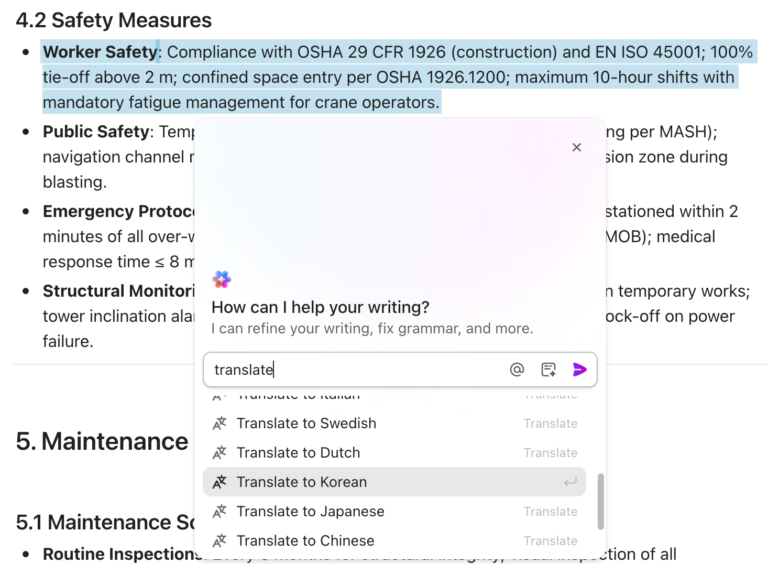
ClickUp Brain, the native work AI, handles translation throughout the workspace, including the chat interface itself. Highlight a passage and choose Edit → Translate, or use the /translate command beneath a block of text. Brain translates between languages like English, French, Spanish, Portuguese, German, Italian, Swedish, Dutch, Korean, Japanese, Chinese, and Arabic. By default, it also replies in the language set in your ClickUp settings.
The translation stays inside ClickUp, which matters when the next step is review or delivery. Teams can move the content through custom statuses and assign a native-language reviewer. The source file and all the feedback sit beside the translated version. There’s no extra handoff tool.
A Reddit user shared:
ClickUp was the best early unlock for our company. ClickUp Meet transcription has become integral for our business ( on calls with clients, most of the tools we use don’t support our language; ClickUp does). In ClickUp, we invited all clients so they have transparency over their projects. Which is a great benefit. In ClickUp, we have team comms with collaboration through agents like Claude <3. We create tickets and resolve them in the same hour. I know it reads like a puff piece, but I am really glad we picked it.
Where it taps out: ClickUp is a work management platform with built-in translation, so there’s no standalone translator to open, paste into, and go. Someone who just needs a quick one-off translation of a stray PDF will get there faster with DeepL or Google Translate.
Best for: Content and ops teams that want translation tied straight to tasks, Docs, reviewers, and approvals.
Skip it if: Your core work means managing translators, bilingual segments, term bases, and reusable translation memory across many locales.

Smartling Translate is built for companies that treat translation as a continuous content operation. It connects localization work to CMSs, code repos, design tools, marketing platforms, and support systems. From there, it manages content as it moves through translation, review, and publishing. More than 50 pre-built connectors ship today, including Adobe Experience Manager, Contentful, GitHub, Figma, WordPress, and Zendesk.
Within the platform, teams can blend AI output, machine output, and human linguists into a single workflow. Translation memory (TM), glossaries, style guides, and visual context keep approved language attached to future work.
Plus, review stages bend to fit your process. The result is a strong fit for product and marketing teams shipping content to many markets, week after week.
Note: The Capterra score is based on a small pool of around 18 reviews, so treat it as a rough signal. G2’s 700+ reviews give a steadier read on how enterprise users rate the platform.
A G2 user mentioned:
What I value most is how well the translation memory holds up across long-running accounts—TM leverage on repeat strings saves real time on updates, and TMX export is reliable when I need to move segments into my own QA and glossary workflows. Locked terminology and context notes also help keep consistency across projects with different style guides.
Where it taps out: Smartling is built around localization programs with ongoing volume, multiple stakeholders, and formal quality controls. That makes the platform heavier than most solo users or small teams need. Setup, workflow design, integrations, linguistic assets, and reporting make more sense once translation is a recurring business process.
Best for: Enterprises running always-on localization across products, websites, and marketing content.
Skip it if: You mainly need one-off text or document translation and won’t use a full localization workflow.

Lokalise lands squarely in product localization. If your team ships software in multiple languages and needs localization to keep pace with development, this is where strings, screenshots, and release branches come together. Developers, translators, designers, and localization managers all work from the same project.
The platform connects with GitHub, GitLab, Figma, Contentful, and other tools that product teams already use. Strings can move in and out of Lokalise without manual copy-paste, while branching, screenshots, and in-context editing keep translations tied to the screens and releases they belong to.
Its AI layer also pulls from translation memory, glossary terms, and style guidance when it translates. Teams get more say over recurring terms and brand language as the product grows.
A G2 user stated:
I would say the user interface of Lokalise is very user-friendly and easy to navigate. It allows for quick work, which I find really helpful. It’s working pretty nicely for my translation projects because I have lots of options from AI, enabling me to select the most accurate translation and adjust it relatively quickly, which allows me to get a lot of work done in a short time. I’m very happy with the choice to use this tool because it works for me. Also, setting up Lokalise was very easy as I was given access to a library, and I can log in without a problem.
Where it taps out: Lokalise climbs up the price ladder fast once you move past basic localization. Paid plans start at $144 per month and jump to $375 and $999 as teams need more automation, AI, connectors, and workflow control. That cost fits teams shipping software in many languages week after week.
Best for: Product and engineering teams localizing apps, websites, and UI strings on a regular release cycle.
Skip it if: Your main workload is long-form documents, marketing copy, or one-off translation instead of software strings and product releases.
Phrase exists because no single translation engine wins every language pair. Its Language AI layer connects to more than 30 neural and LLM-based engines, managed or bring-your-own. Each job routes through the engine set up for that content.
The platform covers more than engine choice. Phrase folds translation management, software localization, machine translation, media localization, and workflow automation into a single platform. Teams can run app strings, documents, websites, and support content through it.
Its CAT editor, translation memory, term controls, and quality scoring sit around that routing layer. Teams get one place to manage how content gets translated, which engine handles it, and which segments still need a reviewer.
A G2 user said:
One thing I really like is how smooth and modern the UI feels. Everything is easy to find, and managing projects is much more organized. The translation matching is excellent and helps avoid repetitive work. I also love how quickly we can assign vendors and send automatic messages directly from the platform. It makes communication much easier and speeds up the entire localization process. Overall, Phrase has become a tool that our team relies on every day.
Where it taps out: Phrase assumes a mature localization setup. Engine profiles, routing rules, term bases, quality bars, workflow logic, and usage caps all need an owner. Smaller teams can end up paying for a powerful routing layer they barely use. The setup cost lands either way.
Best for: Localization teams managing many language pairs, content types, and translation engines at scale.
Skip it if: You mainly want a straightforward translator for occasional documents or short-form content.

Weglot lets you go multilingual without the rebuild. Connect it to a CMS such as WordPress, Shopify, or Webflow and pick your target languages. Weglot then detects the site content, translates it, and serves each language on its own URL. It supports more than 110 languages today.
It also handles the technical SEO work around those pages. Weglot builds a URL per language, adds hreflang tags, and translates metadata. New or updated site content flows into the translation queue automatically. Marketers can review the translated site without going back into the CMS for every edit.
The workflow stays close to the website itself. Teams can review translations in context, invite collaborators, refine terminology, and publish updates as the source site changes. For marketing and ecommerce teams, multilingual publishing ends up feeling like an extension of the existing site workflow.
A G2 user mentioned:
I like Weglot because of its ease of use, which allows me to grow my audience and appeal to the Spanish-speaking population without much effort. It’s a ‘set it and forget it’ type of program; after implementing it on my website, I haven’t had to touch it again. It automatically takes changes from my website and applies them, which I find incredibly convenient. The initial setup was also very easy.
Where it taps out: Weglot’s limits scale with both translated word count and the number of languages. A content-heavy ecommerce or publishing site can burn through the tiers fast, and translation memory sits on the higher plans.
Best for: Marketing teams launching and running sites in several languages with no dedicated localization engineering.
Skip it if: Most of the content you need to localize lives in apps, product strings, documents, or video, with the website a side concern.

HeyGen takes video translation beyond subtitles and dubbed audio. Upload a video or paste a YouTube link and choose a target language. It builds a translation that preserves the speaker’s voice, delivery, and facial movements. In fact, the Video Translator currently covers more than 175 languages and dialects.
That suits training videos, product demos, ads, courses, and creator content. Each would otherwise need a fresh shoot for every market. The translated audio pairs with lip-sync, and the voice cloning keeps the speaker sounding like themselves in every language.
HeyGen also earns its keep when teams need multiple translations of the same asset. Reviewers can adjust scripts, control how names are pronounced, and publish multiple language versions from a single source video. For global video campaigns, translation turns into a repeatable production line.
A G2 user stated:
What I like best about HeyGen is the creative freedom it gives me to turn ideas, images and brand concepts into professional-looking videos. I use it to create multilingual content, avatars and short promotional videos for my brand. The platform makes it possible to build complete visual stories without needing advanced video-editing skills. I especially like the variety of avatars, voices, scenes and motion options, as well as how quickly I can test different concepts and languages.
Where it taps out: HeyGen’s shared credit system makes usage hard to forecast when one account handles translation, avatars, and other video work. The credits a job burns shift with the video length and the model used.
Best for: Marketing, training, and education teams turning recorded video around for several markets.
Skip it if: Your workload is mainly text, documents, or software strings, and you don’t need video dubbing or lip sync.
Also Read: Best HeyGen Alternatives and Competitors
Choose an AI translation tool based first on what you translate, then match the workflow and budget around it. A strong document translator can still be the wrong fit for product strings, websites, or video if it lacks the terminology, review, and publishing controls your workflow needs.
By what you translate
By team maturity
A solo marketer translating a landing page has different needs than a localization team shipping product strings in 15 languages. DeepL, Google Translate, and ChatGPT are ready to go in minutes with no workflow setup. ClickUp and Weglot add structure (tasks, review stages, or CMS hooks) without requiring a dedicated localization role. Smartling, Lokalise, and Phrase assume someone owns the localization process and can manage translation memory, quality rules, and vendor routing.
By budget shape
Free tiers cover light work: Google Translate (consumer), DeepL (50K chars/month), ChatGPT (limited), Weglot (2,000 words), and HeyGen (3 videos/month). For recurring work, DeepL ($8.74/month), ClickUp (from $7/user/month + Brain AI add-on), and ChatGPT Go ($8/month) are the cheapest paid entry points. Lokalise ($144/month) and Phrase ($1,245/month) price for committed teams, not occasional use.
Factor in what happens after translation, too: a cheap tool that forces manual reformatting, term cleanup, or copy-paste into a separate review system can cost more in labor than the subscription saves.
When you compare translation tools, judge the raw output quality first. If a tool gets the meaning wrong, a slick workflow can’t save it.
But once several tools can produce a usable draft, the review process starts separating them.
In a production study, researchers tested 71,262 translated segments across 10 languages and five content domains, then had 60 professional translators review a 6,618-segment sample. The strongest results came from an AI post-editing setup that did more than generate a fresh translation. It pulled in language-specific style guides and approved bilingual examples to refine the first-pass output. That system beat direct LLM translation, Google Translate, and DeepL across the board.
The takeaway: Once translation reaches a usable baseline, context, approved language, and targeted editing lift what reaches the reviewer.
And review still takes real effort. Another 2026 meta-analysis covered 19 studies, 492 participants, and 193 effect sizes. It found a positive link between machine translation post-editing and cognitive engagement. In plain English, checking machine output is active work. Editors still weigh, interpret, and decide what needs changing.
That changes how you should compare the tools in this list. For a one-page document, the quality of the first draft matters most. At 50,000 product strings, the surrounding controls carry far more weight: translation memory, term rules, quality scoring, reviewer assignments, and a record of what got approved.
Here’s a test: what happens after the translation finishes? Can the tool surface the parts most likely to need attention? Does it reuse fixes you already approved? Can the right reviewer see the work without someone having to chase them?
If those steps still run on copied files and chat reminders, faster generation only moves the bottleneck downstream.
AI can handle more of the first draft than it could a few years ago. The dividing line depends on risk, and content type is one signal: how costly would a bad translation be?
A study by Appen found that major AI models were far stronger on literal meaning than on cultural nuance. Idioms, puns, figurative language, and local references were among the most common failure points. Idioms often got skipped outright. Fluent output can still sound natural while missing what the source meant.
Match the review effort to the stakes:
| Content | AI translation | Human review |
|---|---|---|
| Internal notes, rough research, low-stakes reference | Usually fine as a first pass | Optional |
| Support content, product copy, marketing pages | Useful for the first draft | Recommended before publishing |
| Brand campaigns, transcreation, culturally sensitive copy | Useful for exploration and variants | Strongly recommended |
| Legal, medical, financial, or regulated content | Use with caution | Qualified human review required |
| High-volume localization | Useful for scale | Build review, terminology, and approval into the workflow |
The simplest buying rule: the higher the cost of a bad translation, the more human review you should build in.
AI translation can speed up the draft. The harder part is still getting that draft reviewed, approved, and moved into the work it belongs to.
That’s where ClickUp can help. ClickUp’s AI handles translation inside Docs, tasks, comments, and Chat, while reviewers, deadlines, status changes, and approvals stay in the same workspace. For teams already managing multilingual content in ClickUp, that removes a lot of copy-paste and handoff work.
Smartling, Lokalise, and Phrase still own the deep localization stack: translation memory, term bases, and segment-level QA. But if your main problem is keeping translated content tied to the surrounding project, try ClickUp for free and keep the review loop in one place.
There’s no single AI translator that is most accurate across every language pair and content type. Translation quality changes with the language, domain, terminology, tone, and context supplied to the model. For business documents, DeepL remains a strong option; ChatGPT and other LLMs give you more control when tone and interpretation matter.
ClickUp’s Workspace data used by Brain AI isn’t used to train its models or third-party AI models. It also has zero-data-retention agreements with the LLM providers it works with. That makes Brain more relevant for teams translating internal briefs, client material, or operational documents, where sending content through separate consumer AI tools may raise governance concerns. Teams handling regulated or highly sensitive data should still check their own compliance requirements before use.
Translation memory stores previously approved source and target segments and reuses them when the same or similar text appears again. It’s most useful for recurring translation work where consistency matters across releases or projects. DeepL, for example, lets eligible customers upload TMX translation memories and apply them to text and file translations. It can use exact matches, in-context exact matches, and similar matches from those stored translations.
Yes. LibreTranslate and Argos Translate are two notable open-source options.
LibreTranslate is a self-hosted machine translation API powered by Argos Translate, so you can run it on your own infrastructure without sending translation requests to Google, Microsoft, or another proprietary translation provider. Argos Translate is an open-source neural machine translation library that can run as a Python library, command-line tool, or desktop app.
Machine translation is the broad category of software that automatically translates content between languages. AI translation is often used as a looser term for modern systems built with neural networks or large language models.
Yes, several AI translation tools can translate complete documents, but file handling varies widely. Some tools preserve the original structure better than general-purpose chatbots. DeepL supports document translation for formats including PDF, Word, and PowerPoint, while Google Translate also accepts documents through its web and Cloud Translation products. For files with tables, columns, graphics, or complex layouts, check the translated file before publishing, as formatting may still require cleanup.

Manasi Nair
Max 26min read

Arya P Dinesh
Max 18min read
Arya P Dinesh
Max 20min read

© 2026 ClickUp





