AI-powered writing has completely transformed content creation—no more staring at a blank page for hours. Whether you’re a seasoned writer, a marketer balancing tight deadlines, or someone battling a creative block, tools like ChatGPT have become a digital co-writer.
But it’s not all unicorns and rainbows.
We’ve all been there—those frustrating moments when AI produces something generic or, worse, misses the mark entirely. Not everyone realizes this—AI-powered writing isn’t about letting the machine run the show. It’s about guiding the machine to give you what you want.
That’s where the power of well-crafted ChatGPT prompts for writing comes into play. The right prompt can transform AI into your ultimate writing partner, while a vague one can leave you with bland and uninspired content.
In this article, we’ll explore the benefits of ChatGPT prompts for writing, share ChatGPT hacks for better results, and discuss how AI-powered tools can simplify your writing workflow.
50 Best ChatGPT Prompts for Writing

 Summarize this article for me please
What Are ChatGPT Writing Prompts?
A writing prompt is a specific instruction you give to ChatGPT to generate content tailored to your needs.
For example: It can be as simple as ‘Write a blog post introduction about AI in education’ or as detailed as ‘Create a persuasive email campaign for a product launch targeting small business owners.’
Prompts provide the foundation for helping ChatGPT deliver coherent, relevant, and engaging content based on the relevant use case.
In essence, prompts are your way of communicating with the AI tool, steering it toward the desired output. Prompt engineering, or the skill of crafting the right set of ChatGPT prompts, is the name of the game. Whether you’re looking for creativity, technical accuracy, or something in between, learning to craft effective ChatGPT prompts can transform your approach to writing.
Summarize this article for me pleaseBenefits of Good AI Prompting for Writing
Mastering the art of prompting is essential to maximizing the value of ChatGPT in your writing workflow. The quality of your prompts directly impacts the quality of the responses you get from the AI. This is because the machine learning model learns from your prompts and becomes better with each instance.
Here are the key benefits of good AI prompting for writing:
- Boosts creativity: ChatGPT can help you brainstorm and generate creative ideas that you may not have considered. This is especially helpful in generating fresh content since most people have the same ideas on popular social media platforms
- Saves time: With a well-structured ChatGPT prompt, you can research information, generate outlines, write first drafts, and even craft entire blog posts in minutes
- Provides fresh perspectives: Get creative ideas from different angles or viewpoints that may improve the depth of your writing
- Helps overcome writer’s block: When you’re stuck, a few well-thought-out ChatGPT prompts can help reignite your creativity and push your writing forward
Summarize this article for me pleaseHow to Prompt ChatGPT for Writing
Effective prompting goes beyond asking questions—it’s about being specific, clear, and intentional. With the right prompts, ChatGPT can become a valuable partner in brainstorming ideas, refining drafts, generating fresh content, and overcoming writer’s block.
Here are a few key points to remember:
- Be specific: The more detailed your ChatGPT prompt, the more focused the response will be. For example, instead of ‘Write a blog post about AI for businesses,’ try ‘Write an introduction for a blog post about the benefits of AI for small businesses in a conversational tone and relevant examples.’
- Include context: The more context and relevant details you provide, the better the AI will understand your needs. For instance, include who your target audience is or the tone you’re aiming for
- Ask open-ended questions: This will encourage ChatGPT to generate longer, more in-depth responses. Instead of asking, ‘What are the benefits of AI?’ ask, ‘How can AI transform how tech businesses today? Also, provide statistics.’
- Iterate and adjust: Don’t be afraid to tweak your ChatGPT prompts for writing. If the first response isn’t what you want, refine your prompt and try again. Sometimes, a minor adjustment can yield a drastically improved output
It’s important to know that prompt engineering is not yet an exact science (not yet). Even when you write prompts that seem perfect, the response you receive may not be what you were expecting.
Summarize this article for me please50 Best ChatGPT Prompts for Writing
Time to watch some ChatGPT prompts in action. Here are 50 ChatGPT prompts for different use cases:
Blog post writing ChatGPT prompts
- Write a blog outline on time management strategies for freelancers
- Create a blog introduction that grabs attention for a post about remote work benefits
- Generate a list of pros and cons of using AI in project management
- Write a [X word] conclusion for a blog about the benefits of project management tools
- Develop a blog title and meta description for a blog post introducing existing customers to the new look and features of an online shopping portal

Technical documentation ChatGPT prompts
- Write a step-by-step guide on configuring [specific feature] in Company X’s workload view to manage [X type of project]
- Explain how to integrate [specify tool, e.g., Google Calendar or Outlook] with Company X and troubleshoot common integration issues
- Draft a user guide for automating [specific task] in Company X using [specific automation feature], targeting [X type of user]
- Create a comprehensive tutorial for setting up and customizing time-tracking for [remote/hybrid teams] in Company X to ensure [X goal, e.g., better accountability]
- Develop a robust FAQ section covering the top 10 issues users face while managing complex tasks in Company X, with clear troubleshooting steps for each

Marketing copy ChatGPT prompts
- Write a compelling call to action for a [new feature launch] on Company X’s product page for [X type of target audience]
- Create a series of social media posts highlighting how [specific features, e.g., automation workflows] in Company X save [X hours] per week for [X type of professional]
- Generate an email subject line that emphasizes the benefits of [specific feature] in Company X’s latest update, appealing to [X type of user, e.g., project managers]
- Write a detailed product description for [specific template, e.g., agile sprint templates] in Company X that focuses on [specific pain point] for [software developers/designers]
- Craft a catchy headline for a Company X ad [for X target audience, e.g., marketing teams] that highlights the ease of integrating [specify tool] with Company X for streamlined workflows

Email writing ChatGPT prompts
- Draft a follow-up email to attendees of a [webinar/workshop] by Company X, encouraging them to try out the [X feature discussed] and offering a discount or free trial
- Write a persuasive email promoting a new loyalty program for long-term Company X users, offering [X benefits] like exclusive templates or priority support
- Create a warm welcome email for new subscribers to Company X’s newsletter, introducing them to [X feature] and offering tips to get started with [specific tasks]
- Write a personalized thank-you email for users who completed a product demo of Company X, offering additional resources like [X video tutorials] or a free consultation
- Generate an outreach email targeting potential partners, focusing on the benefits of integrating [specific tool/platform] with Company X to enhance [X business operations]

Social media posts ChatGPT prompts
- Create an engaging tweet about the release of [new templates or features] in Company X that helps [X type of user] streamline [specific process]
- Write a Facebook post promoting a limited-time offer for users who sign up for Company X, emphasizing its ability to [solve X pain point] for [X type of team]
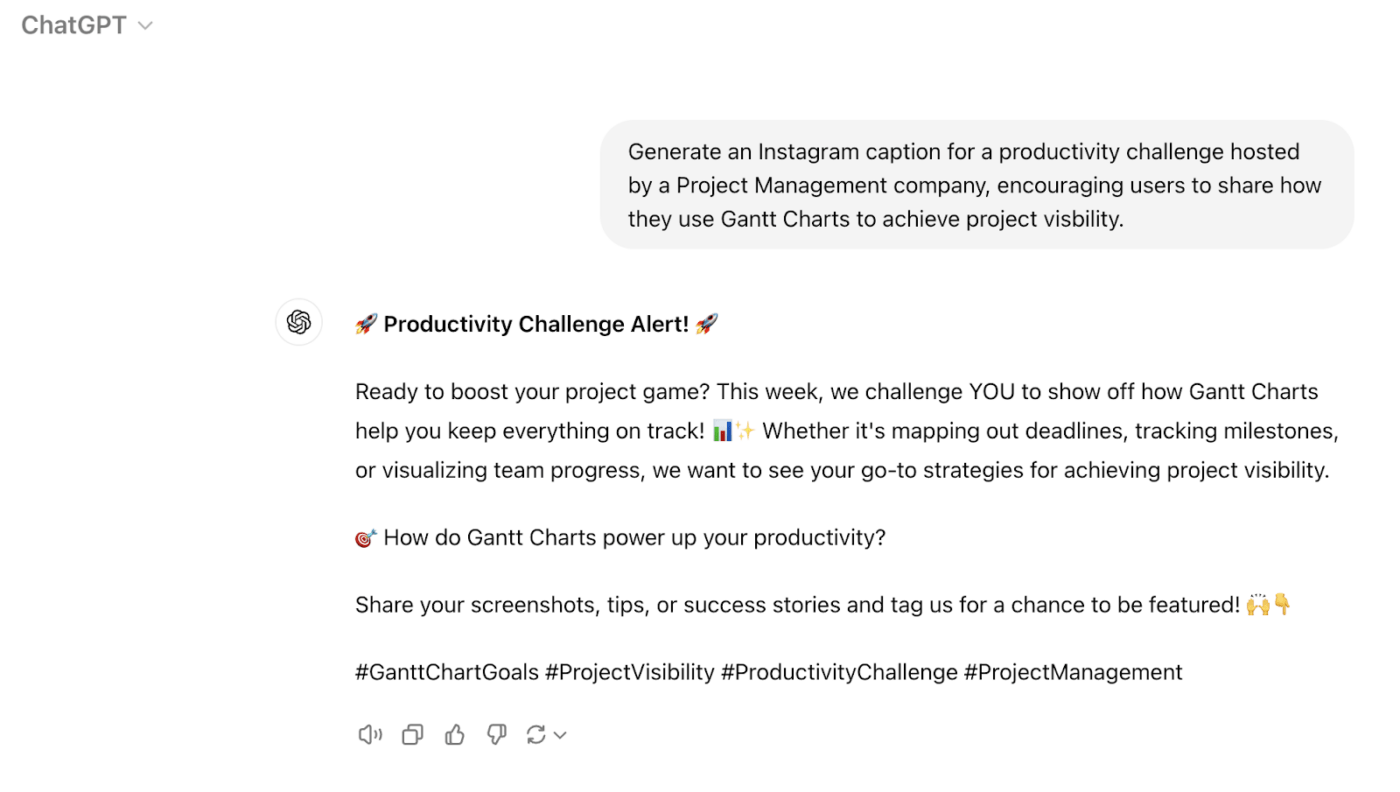
- Generate an Instagram caption for a productivity challenge hosted by Company X, encouraging users to share how they use [specific feature] to achieve [X goal]
- Write a LinkedIn social media post showcasing a real-life case study of a [specific industry] team using Company X to overcome [specific challenge, e.g., remote collaboration]
- Develop a series of LinkedIn tips that demonstrate how [specific feature] in Company X boosts team productivity by [X%], tailored for [X type of team]
Storytelling ChatGPT prompts
- Write a short story about a project manager in [specific industry] who saves a failing project by utilizing [specific feature] in Company X
- Create a character-driven narrative about a remote team that transforms their collaboration and output by switching to Company X, overcoming [specific challenge]
- Generate a fictional case study of a [specific business] that increases project efficiency by [X%] after adopting [specific feature] in Company X
- Write a motivational story for employees learning to use new project management tools like Company X, showing how [specific tool] helps them meet [X challenge]
- Create a futuristic short story where AI-driven project management through Company X allows a company to scale globally while maintaining [X values, e.g., agility, collaboration]

Creative writing prompts
- Generate a poem about how using [specific feature] in Company X transforms daily productivity, weaving in metaphors for teamwork and efficiency
- Write a short scene illustrating the struggles of a creative team managing [multiple projects or client demands] and how they overcome it by using [specific feature] in Company X
- Create a letter from a team leader to their boss, explaining how implementing Company X has revolutionized [specific aspect] of their workflow and improved [X metrics]
- Write a dialogue between two colleagues debating the best use of [specific feature] in Company X to solve [specific work challenge]
- Develop a creative metaphor that compares Company X’s task management features to [a well-known concept or object] that illustrates how it helps a team stay organized

Feedback generation ChatGPT prompts
- Provide constructive feedback on a [white paper] draft discussing remote team collaboration, focusing on how [specific feature] in Company X could be better highlighted
- Write a detailed review of [specific product update] in Company X, including what worked well, where improvements are needed, and suggestions for the next release
- Create a balanced list of pros and cons for using Company X’s [specific feature, e.g., automation], addressing common concerns for [X type of user, e.g., small business owners]
- Generate suggestions for improving a [specific workflow] using [specific automation tool] in Company X, focusing on [X business goal]
- Write a critique of a competitor’s project management tool, emphasizing how Company X outperforms in areas like [specific benefit, e.g., integration flexibility or user experience]

Coding and technical writing ChatGPT prompts
- Write a Python script to automate the creation of [specific task type, e.g., client onboarding tasks] in Company X
- Generate a step-by-step guide on configuring [specific tool, e.g., Google Tag Manager] within Company X to track user engagement on [specific page]
- Write a detailed API integration guide for syncing [specific tool] with Company X, focusing on [specific industry use case, e.g., data migration or team collaboration]
- Create a troubleshooting guide for users facing issues with [specific feature, e.g., task tracking] in Company X’s mobile app, with step-by-step instructions for common problems
- Generate sample code that automates project updates through Company X’s API for [specific action, e.g., auto-generating weekly reports]

Brainstorming ChatGPT prompts
- Suggest three unique ways to improve team productivity using [specific feature, e.g., time-blocking] in Company X for [X type of project or team]
- Brainstorm five creative content ideas for a Company X social media campaign centered around [specific feature, e.g., time tracking]
- Generate a list of potential template ideas for Company X, tailored to [X industry or professional role, e.g., marketing managers]
- Create a brainstorming session outline for a [specific type of team, e.g., software development] using Company X to improve [specific workflow]
- Suggest creative ways to market Company X to small business owners struggling with [specific challenge, e.g., project planning or time management]
 Summarize this article for me please
Limitations of Using ChatGPT for Writing
While ChatGPT is undeniably a powerful tool for writers, it’s important to recognize its limitations.
Limited domain expertise
ChatGPT is trained on vast amounts of data, but it doesn’t possess true expertise in any one field. For writers working in niche areas—whether it’s highly specialized scientific topics, technical documentation, or industry-specific knowledge—ChatGPT’s responses may often fall short.
How to navigate this: As a result, you may need to supplement content generated from ChatGPT prompts with research or expert input to ensure accuracy and depth.
Potential for inaccuracy
One of the biggest challenges with ChatGPT is its tendency to generate plausible-sounding but factually incorrect information. Unlike a human writer, ChatGPT doesn’t have a built-in fact-checking mechanism. It occasionally presents outdated statistics, wrong data, or even fabricated references.
How to navigate this: For any factual writing—especially when accuracy is paramount—it’s crucial that you carefully fact-check AI-generated outputs to avoid misinformation in your final content.
Generic outputs
While ChatGPT excels at generating content quickly, it can also fall into the trap of producing generic or formulaic responses—especially when given vague or open-ended prompts. This means the content may lack depth, nuance, and personality.
How to navigate this: Crafting very specific and detailed ChatGPT writing prompts is essential if you want to create compelling, personalized, or high-impact content.
Lack of human emotion and intuition
Although ChatGPT is skilled at mimicking conversational tones and providing coherent responses, it lacks the subtle emotional intelligence and intuition that human writers possess. Thus, creative writing prompts for AI can be tricky.
ChatGPT can’t fully understand certain phrases’ emotional nuances or cultural sensitivities, which may result in tone-deaf or inappropriate responses.
How to navigate this: Human oversight is indispensable for emotionally charged writing, creative storytelling, or content that must resonate with readers.
Struggles with complex or ambiguous prompts
ChatGPT thrives on clarity, so when presented with ambiguous or highly complex prompts, it might produce results that are confusing or off-target. If a ChatGPT prompt is vague, it tends to default to safe, middle-of-the-road responses that might not align with the original intent.
How to navigate this: This means it’s important for you to be precise and clear when crafting ChatGPT prompts—ensuring the AI understands the context and desired outcome.
Over-reliance on AI can stifle creativity
While ChatGPT is a fantastic tool for generating ideas and overcoming writer’s block, there’s a risk of becoming too dependent on AI for the creative process. Relying solely on AI-generated content can lead to a lack of originality, as it often recycles similar ideas and expressions.
How to navigate this: You should use ChatGPT prompts to enhance creativity—not as a substitute for your voice and innovation.
Understanding these limitations allows you to use ChatGPT prompts more effectively, ensuring your content is accurate, compelling, and aligned with your goals.
Summarize this article for me pleaseChatGPT Alternatives for Writing
If you’re looking for other tools to complement ChatGPT or need a more specialized AI for specific writing tasks, such as Jasper AI, Writesonic, or Notion AI, there are several ChatGPT alternatives.
One tool that stands out is ClickUp Brain, a cutting-edge AI tool that integrates with ClickUp’s project management platform. It is designed to help teams organize ideas, brainstorm, and create workflows that support the writing process.

ClickUp Brain enhances every stage of your writing, from idea generation to final edits. This makes it a unique asset for writers and teams.
Here’s how:
1. Efficient brainstorming and idea management
ClickUp Brain excels in transforming raw ideas into structured, actionable plans. It helps you capture and organize your brainstorming sessions efficiently, ensuring no good idea gets lost.
Imagine having a digital assistant that not only records and understands tasks but also categorizes and prioritizes them; thus making it easier to retrieve and develop ideas when you need them most.
Here is an output for a prompt given to ClickUp Brain:
Prompt: ‘Study existing research papers and environmental data sets. Identify emerging trends and potential gaps in knowledge related to climate change and its impact on marine life. Suggest new research avenues that could lead to significant breakthroughs.’

2. Streamlined workflow integration
Unlike standalone AI tools, ClickUp Brain is embedded within ClickUp’s project management ecosystem. This means that as you develop your ideas, they automatically align with your existing projects and tasks.
This seamless integration ensures that your writing is organized. Each step in the writing process drafting, editing, and reviewing—is tracked and managed within the same platform.

3. Enhanced collaboration
For teams working on writing projects, ClickUp Brain offers collaborative features that are second to none. It allows team members to contribute ideas, provide feedback, and track real-time progress.
The ability to collaborate effectively means that your team can work together well, and leverage collective insights to enhance the quality of your content.

ClickUp Brain ensures that everyone on your team is well-aligned and informed about collaborative writing tasks
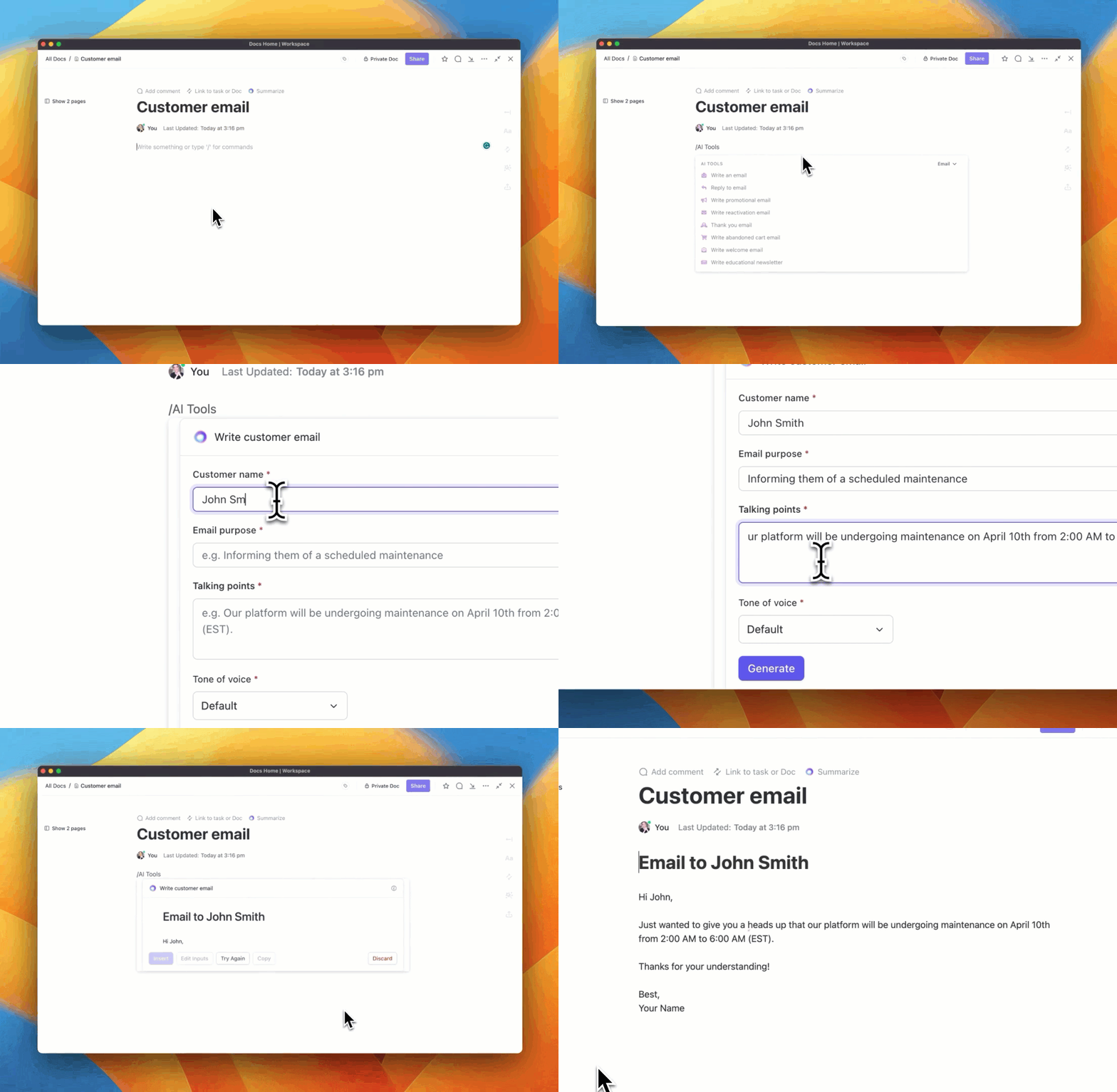
4. Automating routine writing tasks
ClickUp Brain simplifies repetitive tasks like generating summaries, progress reports, and action items. Handling these routine activities frees up time for teams to focus on brainstorming and idea generation instead of administrative work.
5. Customizable workflows and templates
ClickUp Brain provides customizable templates and workflows tailored to different writing needs. Whether drafting a blog piece, creating marketing copy, or outlining a book, you can adapt the workflows to fit your specific requirements.
This flexibility helps ensure that your writing remains agile and responsive to your needs. This further allows you to focus more on content creation and less on process management.
For instance, ClickUp’s ChatGPT Prompts for Writing Template is designed to simplify the creative process for writers, marketers, and content creators.

These 200+ writing prompts leverage cutting-edge natural language processing (NLP) technology to offer deep insights into your writing style.
With these prompts, you can:
- Effortlessly generate ideas for articles, blogs, and various content forms
- Craft engaging stories with unique perspectives that captivate your audience
- Brainstorm new topics and innovative approaches to enhance your writing
With ClickUp’s powerful project management features, you can quickly organize your ideas, improve productivity, and maintain consistency across all your writing projects.
Summarize this article for me pleaseTransform Content Creation with ClickUp Brain
Mastering the art of prompting ChatGPT isn’t just transformative—it’s a productivity powerhouse for any writer. With the right prompts, you can spark fresh ideas, overcome creative slumps, and churn out high-quality content quickly.
Ready to elevate your writing? Get a taste of AI-assisted writing using our 50 ChatGPT prompts to experience the transformative impact AI can have on your creative process.
But why stop there? Take your productivity to the next level by exploring ClickUp’s AI-driven tools. From brainstorming sessions to organizing outlines, ClickUp offers the ultimate solution to keep your workflow seamless and efficient.
Don’t just boost your creativity—simplify your entire writing process with ClickUp.
Sign up for ClickUp for free today!


Everything you need to stay organized and get work done.