

Sorry, there were no results found for “”
Sorry, there were no results found for “”
Sorry, there were no results found for “”
Imagine you’ve joined a new company as a software engineer, and the team lead asks you to debug an old codebase. The kicker? You don’t know the dependencies, test cases, or contexts behind it because there’s no written document to assist you. 😓
🎯
Therefore, mandating software engineering documentation at every level is one of the best ways to bridge these gaps, enrich knowledge bases, and improve collaborations.
So, let’s review how to write software engineering documents and a few best practices. ✍️
Software engineering documentation is the process of organizing and storing technical information for future reference and collaboration. From progress reports and research papers to SOPs, APIs, user manuals, and code walkthroughs—this comprehensive set of internal and end user documentation ensures that all stakeholders, from developers to clients, have easy access to essential information about the software in question.
Additionally, thorough technical documentation supports efficient communication and aligns teams during the software development process. 🤝
As tech stacks grow in complexity, technical documentation becomes essential for seamless teamwork and smart decision-making. Many developers consider software documentation important for easing the onboarding process of new team members, ensuring that they can access project information independently and get up to speed faster.
📌 For instance, imagine a mid-sized software company struggling with onboarding new hires due to limited documentation. By creating a comprehensive knowledge base, the company could reduce onboarding time, allowing new developers to access essential project information independently and ramp up faster.
This is why teams find software documentation important for streamlining communication and collaboration. It ensures workflow efficiency and boosts productivity. Clear process documentation helps teams navigate complex projects without unnecessary confusion.
For engineers, contributing to software engineering documentation has become an essential part of their responsibilities. Companies rely on this documentation for:
Of course, creating and maintaining this documentation is one of the most important considerations in any software company. And tools, such as ClickUp, can help you do this. If you want to write documentation efficiently, leveraging the right tools can make a huge difference in quality and speed. 🛠️
ClickUp, a productivity platform, offers impressive software engineering documentation features and a vast storehouse of templates to make software engineering documentation and project management a piece of cake.
As you probably know, technical documentation comes in many forms. You can categorize the types of software engineering documentation depending on the access levels, technical know-how of the intended readers, and goals.
Here are a few popular types of technical documentation software engineers must create and monitor:
Software engineers are expected to document all the technical details of a project. Project managers use these data points to modify and create pipelines, allowing all teams to be on the same page. While most engineers choose to be as detailed as possible, some may choose different software development methodologies, such as the agile documentation philosophy, to create concise dossiers.
This category includes architecture documentation, test cases, test plans, meeting notes, how-to documents, and incident response plans.
Source code documentation is one of the most popular types of software documentation catering to coworkers and new software developers who might take over the project. Source code documentation explains the purpose and relationships of codes, their ideal behaviors, and design patterns that might be found within code modules.
You can extend the source code explanation with walkthroughs to describe how code reviews should work.
Implementing a consistent development standard is how you stay on track with deadlines and prevent productivity loss. With functional specifications like standards and requirements documents, software engineers can lay out plans in advance to maintain system integrity throughout the project. The technical requirement docs should explain the scope and dependencies of the project early on, which would prevent siloed sprints.
Since these docs act as a blueprint for the entire software development process, you might try functional specifications templates to save time on formatting.
For example, the ClickUp System Requirements Template helps you note down all the system requirements for the project to go smoothly. It’s compact, easy to use, and helps teams stay in sync.
With this template, you can
Unlike the previous types of software documentation, which are intended for the software development team, this one is for external parties such as vendors and customers. Application programming interface (API) documentation offers information on how to use API with their systems. API reference guides that list API methods, parameters, sample requests, and authentication guides are part of this.
Lastly, release documents track features and bug fixes over time. When software engineers write detailed release notes, they help customers understand changes over time and help them set up new versions.
Documenting technical processes can feel daunting, but breaking it into manageable steps makes it easier to write documentation that is both comprehensive and easy to follow. Effective process documentation helps keep everyone on track and aligned with project goals, ensuring that the software documentation process supports long-term success.
Before drafting, do some preliminary research. This is your chance to gather relevant information and outline the software engineering documentation.
Start by checking existing resources related to your project—review previous documents, analyze available data, and plan how you want to proceed. Here’s a checklist to help you out:
The next step is to create the structure and layout for the document. Tailor your approach based on your industry and target audience, and review any relevant organizational standards that may influence the format you should adopt. Usability should be your key focus—ensure the technical document is easy for other engineers to navigate.
Think carefully about how readers will move through the content and the logical hierarchy of information. Organize sections to guide them seamlessly from one point to the next, keeping the ideas coherent.
With the structure in place, it’s time to draft the content. For ease of use, choose a cloud-based document editor instead of pen and paper or simple note-taking apps.
ClickUp Docs can be a great solution here. You might know ClickUp as a platform for managing engineering projects, but it is also a powerful tool for creating software documentation, editing documents, and maintaining a knowledge base.

Whether it’s a product roadmap, a wiki, a research report, or a technical description, here’s a brief look at how you can leverage ClickUp Docs to create top-notch documentation:
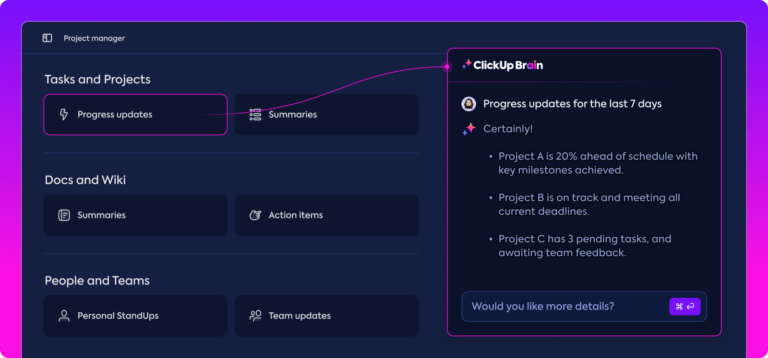
If you want to speed up the process, consider using AI for documentation. And here’s where ClickUp Brain comes to your rescue. You can use ClickUp’s AI tool to edit your existing document, generate a table of contents, explain complex technical jargon in simple words, or draft documentation based on your prompts.

The best thing about ClickUp Brain is that it’s not a separate tool you add to your workflows. It already exists within your ClickUp ecosystem and can browse through docs, tasks, media, projects, and templates to present you with the most relevant information.
ClickUp Brain becomes your assistant writer—no more need to write every word yourself. 📝
With ClickUp Brain, you can
💡Pro Tip: Looking to establish a standardized style or format for your engineering documents? Browse through technical documentation templates and pick ones relevant to your project.
For example, the ClickUp Product Brief Document Template helps you outline project objectives and organize specs and feedback for consistency.
With this template, you can
Once you’ve completed your draft, share the documentation with fellow engineers to gather feedback and identify areas for improvement. If possible, have a subject-matter expert (SME) review it to ensure the technical details are on point.
If you’re using ClickUp Docs, you can collaborate with your team members or SMEs on the same document in real time. The collaborators can share their inputs through comments on the document or directly mention you to draw your attention to something specific.
Finally, remember that your engineering document should often be a living document. As technology and processes evolve, you should proactively update the documentation to reflect those changes.
For example, let’s say you’re maintaining a technical manual for an app, and a new feature allows users to automate reporting. Now, you must add a section on how to use this feature, including step-by-step instructions, screenshots, and troubleshooting tips.
Establish regular evaluations (e.g., quarterly or biannually) to update the documentation occasionally.
When you put so much effort into building documentation, protecting that data from threat actors is essential. Here are some ways you can infuse security while creating software documentation:
Implement role-based access control to allow only authorized users to access data. You can tweak who can view or modify data based on role and experience. For example, software developers can access source code analysis, but the sales department may only check the release notes and deployment instructions. For sensitive documents, consider using multi-factor authentication.
One of the best ways to track changes is to use version control systems. These systems prevent accidental deletion or modification of data and let you log activities. Thanks to the page history and activity view features, it’s super easy to audit and log access in ClickUp Docs.
When you use a secure software documentation tool, you reduce the attack surface and the probability of data leaks. Platforms like ClickUp are built to help you work smarter while shielding proprietary data from threat actors. You should also periodically review who has access to databases and update access controls.
Employees are a company’s last line of defense and, with proper training, can act as moats against cyber criminals. Team members should be trained on best security practices to secure documents and report suspicious activities. These include:
When working with sensitive data or building a company’s knowledge base, it’s not enough to just create and store the documents — you have to prepare for the worst. You can maintain data integrity and document availability by regularly backing up documents, securely storing them, and implementing a disaster recovery plan.
You know how to create helpful software docs and keep them secure. But that’s not enough. Look at technical writing tips and tricks to improve the documents and make them more accessible to the software development team.
Maintain a standardized format throughout your documentation to ensure uniform appearance and structure. This is one way to reinforce company identity.
You should pick a consistent font type and size for headings and body text. Clearly define sections such as Introduction, Methodology, Results, and Conclusions. When it comes to subheadings, use numbers or alphabets consistently to make navigation seamless for readers.
📌 Example: Imagine a project team working with two sets of documentation that follow different formatting styles. One uses bold headers and numbered sections, while the other uses italics and bullet points. This inconsistency can confuse team members and slow their ability to find information. Standardizing the format makes it easier for everyone to follow and understand.
Visuals make your engineering document easily skimmable. Besides text, incorporate diagrams, flowcharts, and graphs wherever applicable. These tools simplify complex ideas and illustrate relationships and data trends effectively.
Always label your visuals and include legends where necessary to provide context. You can also organize data in tables to present comparisons succinctly.
📌 Example: Consider a team documenting a new system architecture. Without a flowchart, developers would have to read through paragraphs of text to understand the workflow. By adding a clear flowchart, team members can grasp the entire system layout at a glance, reducing their review time significantly.
The documentation must be accessible to all team members, from beginners to experts.
While creating software documentation, always focus on helping readers absorb information with little friction. Avoid jargon unless necessary, and define any technical terms you include. Keep your language simple and sentences short to enhance readability. Use an active voice to make your writing more engaging.
📌 Example: Imagine a senior engineer writing a technical document full of industry or even personal jargon and shorthand. New hires struggle to follow it, leading to repeated questions and confusion. Simplifying the language makes the document clearer for everyone, reducing the need for clarification and speeding up the onboarding process.
With technical documents, you can’t afford errors or quality issues, so a thorough review process is essential.
Involve colleagues in peer reviews to gather valuable feedback on the content of your engineering documentation and rectify inaccuracies/problem areas, if any. Use a checklist to confirm that all critical data, visuals, and consistent formatting are in place before finalizing the document.
📌 Example: Imagine a software development team once launched a new feature with an incomplete technical manual. A peer review could have caught missing sections and inconsistencies, preventing confusion during the rollout. Implementing a review process ensures these gaps are identified and fixed before the document is finalized.
You need a central repository for your documents so team members can access them anytime, anywhere.
📌 Example: Imagine an engineering team with documentation scattered across different platforms. When developers need a specific document, they waste time searching multiple sources. The team can quickly access the resources they need by creating a central repository, boosting efficiency and reducing delays.
ClickUp Docs can be useful here. You can create wikis within a doc, serving as your team’s knowledge base. From existing documentation to guidelines on creating a new one, you can store all relevant information in a unified location.
You also have to implement access controls to protect sensitive information, ensuring only authorized personnel can edit documents. If you’re using ClickUp, you can keep your wikis private or set granular permissions, depending on your preference.
Organizations today recognize the need for referenceable, accessible, and detailed documents that improve workplace productivity and simplify decision-making. 📄✨
However, as a software engineer, working on codes and documenting every step simultaneously is difficult. ClickUp was conceptualized as an all-in-one work platform to support high-intensity work. You can create documents, have them peer-reviewed, and monitor for edits and activities — all without leaving the ecosystem. Creating software documentation becomes much easier with ClickUp Brain inside your Workspace, ready to serve relevant answers.
Are you ready to build software documentation and knowledge base for your company? Sign up for ClickUp today! 🚀

Praburam Srinivasan
Max 25min read

Engineering Team
Max 12min read
Praburam Srinivasan
Max 24min read

© 2026 ClickUp





