
A B2B SaaS company had 2,000 MQLs enter their funnel, but only 47 closed deals. They suspected mid-funnel leakage but couldn’t prove it because their CRM, marketing automation, and sales call notes were spread across three systems.
This is a common problem teams face. It leads to wasted marketing spend, a frustrated sales team, and missed revenue targets because you lack visibility into your funnel’s performance.
Funnel leak analysis templates can help. This article walks you through some of the best templates designed to help you quickly identify drop-off points, diagnose root causes, and test fixes across your entire sales and marketing funnel.
10 Free Funnel Leak Analysis Templates at a Glance
| Template Name | Download Link | Ideal For | Best Features |
| Sales Pipeline Template by ClickUp | Get free template | Sales teams and revenue managers who need to spot stalled deals and stage bottlenecks quickly. | Customizable Board and List views; Custom Fields for deal value, close probability, and days-in-stage; AI-powered stuck-deal insights; automations for stage-delay alerts |
| Steps to Create Sales Funnel Template by ClickUp | Get free template | Teams building or rebuilding their funnel with clearer stage definitions and handoff rules. | Step-by-step funnel design tasks; built-in prompts for ownership and handoffs; connected Docs for process documentation; reusable quarterly audit structure |
| Analytics Report Template by ClickUp | Get free template | RevOps, marketing, and sales leaders turning funnel data into clear, recurring stakeholder reports. | Pre-structured KPI and insights sections; live inputs from Dashboards; AI-powered summaries and takeaways; scheduled reporting cadence |
| Data Analysis Findings Template by ClickUp | Get free template | Teams that want a searchable record of past funnel analyses, hypotheses, and recommendations. | Structured sections for hypothesis, methodology, findings, and recommendations; Custom Fields for funnel stage and root cause; collaboration via comments and mentions; easy historical filtering |
| Process Audit and Improvement Template by ClickUp | Get free template | Operations and RevOps teams auditing funnel processes to find broken handoffs and inconsistent execution. | Systematic stage-by-stage audit checklist; gap analysis sections; automations for follow-up actions; post-change validation after major process updates |
| Root Cause Analysis Template by ClickUp | Get a free template | Cross-functional teams diagnosing why a funnel leak is happening before choosing a fix. | 5 Whys framework; fishbone diagram in Whiteboards; AI-driven root cause suggestions; easy sharing for cross-functional input |
| User Flow Template by ClickUp | Get free template | PLG and marketing teams mapping digital journeys to find UX friction and drop-off points. | Visual mapping from landing to conversion; real-time collaboration in Whiteboards; annotations for friction points; validation with behavioral analytics overlays |
| Growth Experiments Whiteboard Template by ClickUp | Get free template | Growth teams prioritizing and testing ideas to fix funnel leaks in a structured way. | Experiment canvas for hypothesis, metrics, and results; visual prioritization in Whiteboards; connected tasks for rollout; impact-vs-effort thinking for faster decisions |
| Marketing Funnel Audit Checklist by HubSpot | Download this template | Marketing teams, especially HubSpot users, auditing inbound funnel performance and nurture gaps. | Checklist-based stage review; strong content and nurture focus; quick marketing-funnel audit framework |
| Transport and Logistics Sales Funnel Analysis Template by Template.net | Download this template | Transport and logistics teams that want simple spreadsheet-based funnel tracking without advanced workflow features. | Pre-built conversion formulas; simple customization; export-friendly structure for basic stage analysis |
What Is Funnel Leak Analysis?
Funnel leak analysis is the process of identifying where prospects drop off at each stage of your sales or marketing funnel, then diagnosing why those exits happen. It’s how you stop guessing and start making data-driven decisions.
A typical funnel moves through these stages:
- Awareness: Prospects first discover your brand
- Interest: They engage with your content or request information
- Consideration: They evaluate your solution against alternatives
- Intent: They signal buying readiness through demos or pricing requests
- Purchase: They convert into paying customers
A “leak” at any stage of the customer lifecycle means you’re losing potential customers. Funnel leak analysis helps you find those holes and fix them.
Instead of wrestling with fragmented data, you can use a funnel leak analysis template to provide a standardized framework for mapping each stage, tracking drop-off points, and documenting root causes.
A good template transforms your workflow into a clear, repeatable process for plugging leaks. This enables comparison of performance over time and across campaigns.
📮ClickUp Insight: The average professional spends 30+ minutes a day searching for work-related information—that’s over 120 hours a year lost to digging through emails, Slack threads, and scattered files. An intelligent AI assistant embedded in your workspace can change that.
Enter ClickUp Brain. It delivers instant insights and answers by surfacing the right documents, conversations, and task details in seconds—so you can stop searching and start working.
💫 Real Results: Teams like QubicaAMF reclaimed 5+ hours weekly using ClickUp—that’s over 250 hours annually per person—by eliminating outdated knowledge management processes. Imagine what your team could create with an extra week of productivity every quarter!
How to Identify Where Your Funnel Leaks
The most common mistake teams make is jumping straight to conversion rates without understanding what’s happening within each stage. Start by examining each funnel stage independently before looking at the transitions between them.
Track conversion rates between stages, the average time prospects spend in each stage, and any changes in velocity that signal friction. A sudden drop in the conversion rate between two stages is a major red flag that points to one of the most common conversion bottlenecks worth investigating.
👀 Look for these common leak patterns:
- Top-of-funnel leaks: You have high website traffic but low form completions. This often indicates a mismatch between your ad copy and your landing page, or too much friction in the sign-up process
- Mid-funnel leaks: Leads go cold after an initial conversation or demo. This suggests gaps in your nurture sequences or that your qualification criteria are too loose, letting unqualified prospects slip through
- Bottom-of-funnel leaks: You’re sending proposals, but deals are stalling before closing. This usually points to pricing objections, pressure from a competitor, or a failure to reach the true decision-maker
To diagnose these issues effectively, you need to consolidate data from your CRM records, marketing automation reports, website analytics, and sales call notes. This is where templates become invaluable, helping you with data analysis and guiding your investigation.
📮ClickUp Insight: 16% of managers struggle with integrating updates from multiple tools into a cohesive view. When updates are scattered, you end up spending more time piecing together information and less time leading. The result? Unnecessary administrative burdens, missed insights, and misalignment.
With ClickUp’s all-in-one workspace, managers can centralize tasks, documents, and updates, reducing busywork and surfacing the insights that matter most, right when they’re needed.
💫 Real Results: Convene unified 200 professionals into one ClickUp workspace, using customizable templates and time tracking to reduce overhead and improve delivery times across multiple locations.
📮ClickUp Insight: 16% of managers struggle with integrating updates from multiple tools into a cohesive view. When updates are scattered, you end up spending more time piecing together information and less time leading. The result? Unnecessary administrative burdens, missed insights, and misalignment.
With ClickUp’s all-in-one workspace, managers can centralize tasks, documents, and updates, reducing busywork and surfacing the insights that matter most, right when they’re needed.
💫 Real Results: Convene unified 200 professionals into one ClickUp workspace, using customizable templates and time tracking to reduce overhead and improve delivery times across multiple locations.
💡 Pro Tip: Use ClickUp Brain MAX to pull together funnel evidence faster. This desktop AI assistant has all the context of your ClickUp workspace, plus connected apps. Search across sales notes, dashboards, docs, and your other tools in one place, then turn scattered findings into a clear summary of where prospects are dropping off and what to investigate next.
10 Best Funnel Leak Analysis Templates
This curated list of templates covers the full spectrum of funnel-leak work—from initial pipeline visualization to root-cause diagnosis to testing fixes.
Each is designed for a specific phase of the analysis process, so you can build a complete toolkit for turning leak diagnosis into a repeatable, scalable discipline. 🛠️
1. Sales Pipeline Template by ClickUp
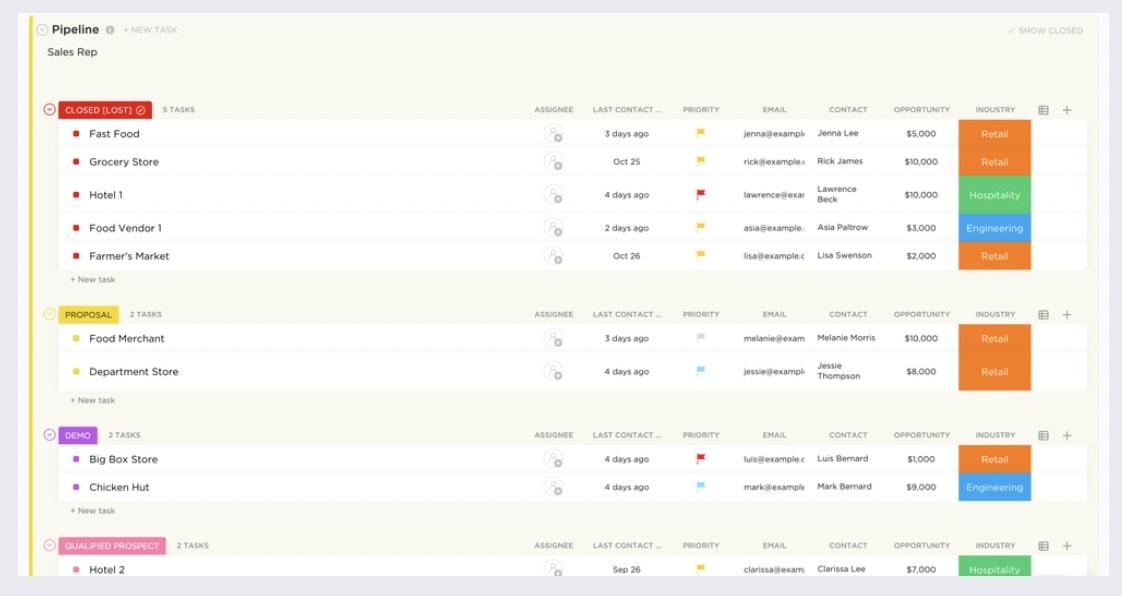
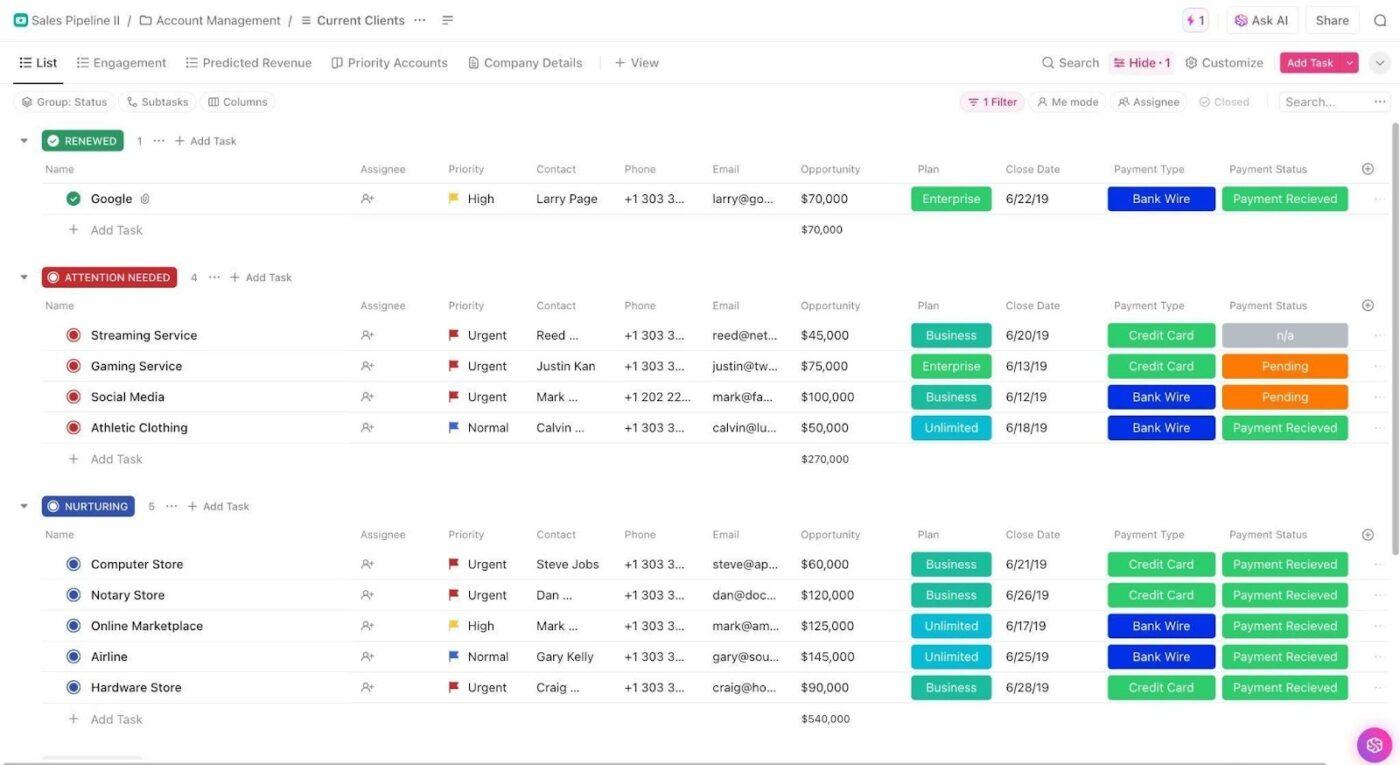
Your deals are stuck, but you can’t see where the logjam is, which is where AI bottleneck identification can help. Without tracking the right sales pipeline metrics, identifying bottlenecks is pure guesswork, and high-value deals can slip away.
Get a visual overview of your entire sales funnel and instantly spot where deals are clustering and stalling with ClickUp’s Sales Pipeline Template. It’s designed for teams that need immediate pipeline visibility to prioritize their efforts and keep deals moving.
Why you’ll like it:
- Customizable views: Track deals across stages with your preferred ClickUp Views. Drag and drop cards in a ClickUp Kanban View for a high-level overview, or switch to a List View for a more detailed breakdown
- Detailed information: Enrich your tasks with crucial data like deal value, close probability, and days-in-stage through ClickUp Custom Fields. This helps you quickly identify which deals need the most attention
- AI-powered insights: Surface deals stuck in one stage for too long with ClickUp Brain. Ask ‘Which deals have been in the Proposal stage for more than 14 days?’ and get an instant list with suggested follow-up actions based on deal history and similar closed-won patterns.
- Automated tracking: Flag deals automatically when they exceed the average time-in-stage with ClickUp Automations, ensuring nothing gets missed
🚀 Ideal for: Sales teams and revenue managers who need to spot stalled deals and stage bottlenecks quickly.
2. Steps to Create Sales Funnel Template by ClickUp
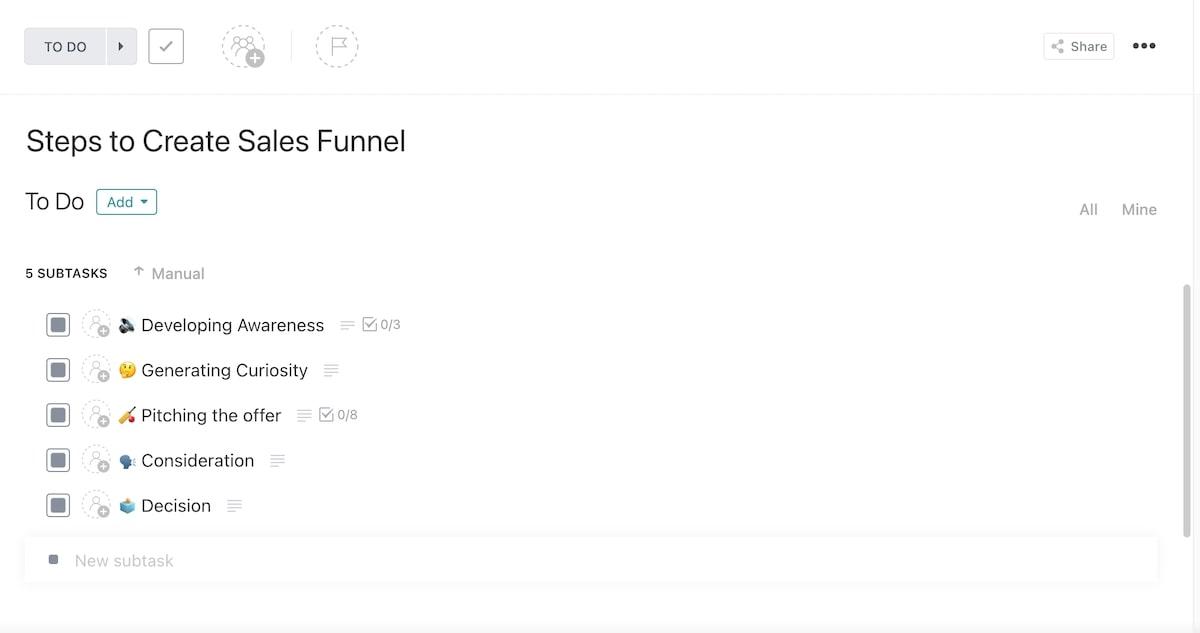
Without a structured approach to the funnel, you risk creating ambiguous stage definitions and unclear handoff protocols, which are primary causes of mid-funnel leaks.
Build clarity into your process with ClickUp’s Steps To Create Sales Funnel Template and prevent leaks before they happen. This is perfect for teams building or rebuilding their funnel, ensuring every stage has a clear purpose and qualification criteria.
Why you’ll like it:
- Step-by-step structure: Break down the funnel creation process into actionable tasks, and define each stage with clear entry and exit criteria
- Built-in prompts: Document handoff protocols between your sales and marketing teams directly within the template, eliminating confusion about who owns what
- Connected documentation: Capture your official process documentation in ClickUp Docs, linked directly to your funnel management tasks
- Quarterly audit process: Use this template every quarter to audit your funnel and confirm that your stage definitions still match actual buyer behavior
🚀 Ideal for: Teams building or rebuilding their funnel with clearer stage definitions and handoff rules.
3. Analytics Report Template by ClickUp
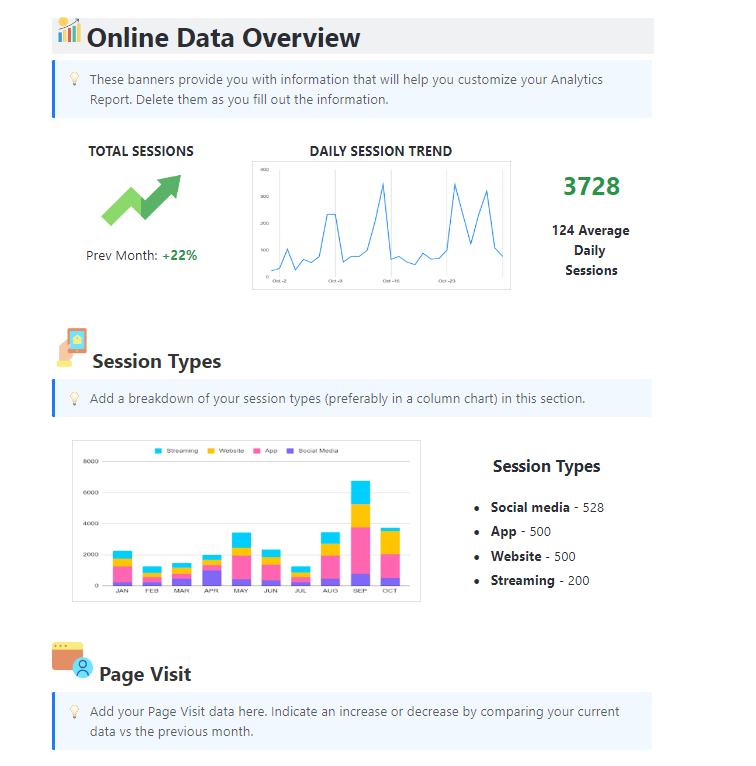
Manually compiling raw data into reports is time-consuming and error-prone, and the final product often fails to convey the key insights needed to drive action.
ClickUp’s Analytics Report Template is designed to help you communicate wins and learnings by consolidating funnel metrics into a single, shareable report.
Why you’ll like it:
- Pre-structured sections: Organize your KPIs, trends, and insights into a consistent format that’s easy for stakeholders to follow
- Real-time inputs: Eliminate manual data entry by pulling live data from your ClickUp Dashboards directly into your reports
- AI-powered summaries: Automatically summarize key findings and generate executive-level takeaways in seconds with ClickUp Brain
- Scheduled reporting: Set up recurring reports to track leak patterns over time, turning one-off analyses into a continuous improvement loop
🚀 Ideal for: RevOps, marketing, and sales leaders turning funnel data into clear, recurring stakeholder reports.
4. Data Analysis Findings Template by ClickUp
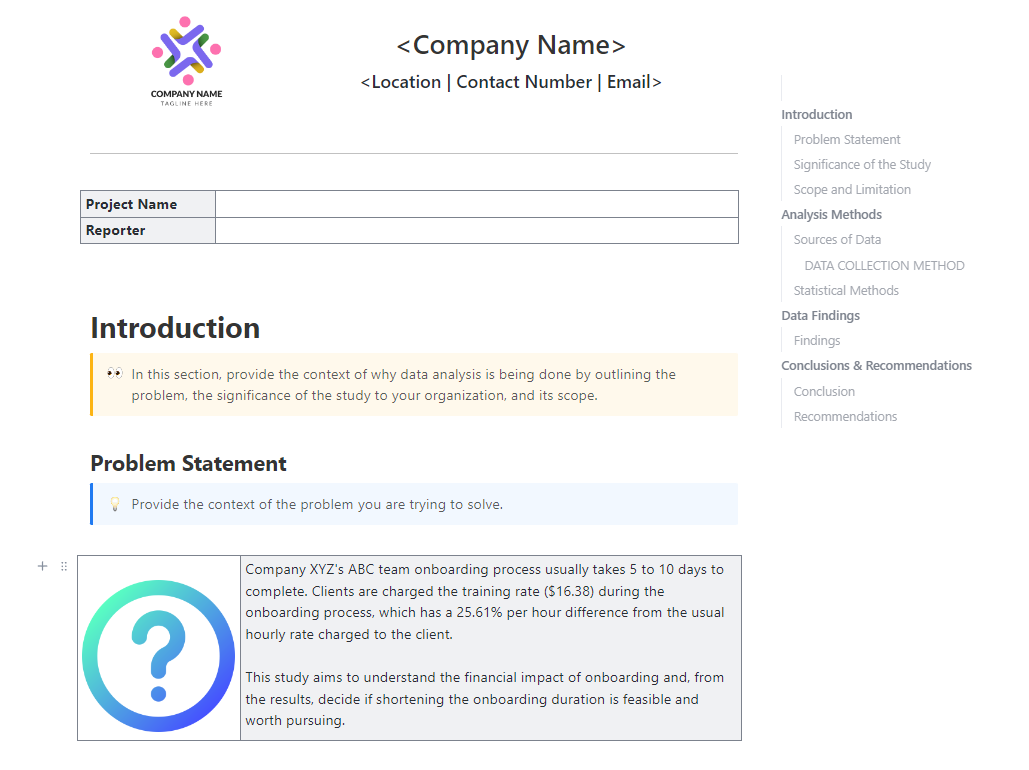
Your team runs an analysis, finds a leak, and then… the findings get lost in a random document. Six months later, you’re solving the same problem all over again because there’s no institutional memory.
ClickUp’s Data Analysis Findings Template creates a structured, searchable knowledge base of your past funnel analyses, ensuring that valuable insights are captured and reused.
Why you’ll like it:
- Organized documentation: Document each analysis thoroughly with dedicated sections for your hypothesis, methodology, findings, and recommendations
- Smart categorization: Categorize findings by funnel stage, severity, and root cause with ClickUp Custom Fields, making it easy to filter and review historical patterns
- Team collaboration: Loop in cross-functional stakeholders for review and feedback directly within the analysis document using Comments and @mentions
- Historical review: Before starting a new analysis, quickly filter past findings to see if your team has ever tackled a similar problem, saving valuable time
🚀 Ideal for: Teams that want a searchable record of past funnel analyses, hypotheses, and recommendations.
5. Process Audit and Improvement Template by ClickUp
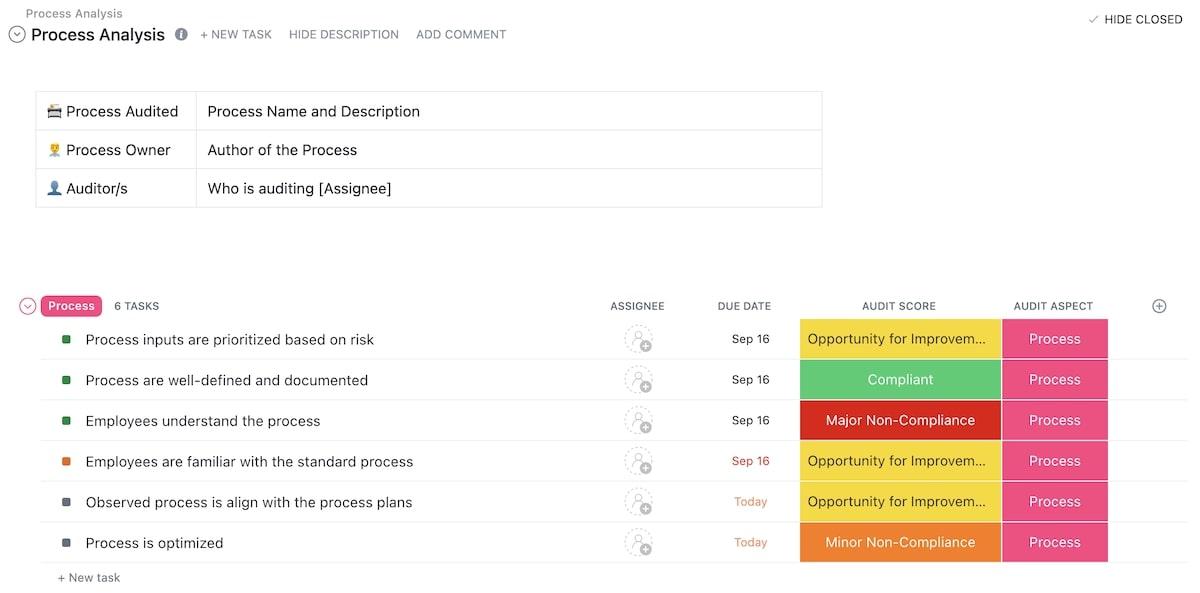
You know your funnel is leaking, but you suspect the problem isn’t the leads—it’s your process. Inconsistent qualification, slow follow-up times, and messy handoffs between teams are silent revenue killers that are hard to spot without a systematic review.
ClickUp’s Process Audit and Improvement Template provides a structured checklist for auditing your existing funnel processes, helping you identify what’s broken versus what’s working.
Why you’ll like it:
- Systematic review: Let the audit checklist structure guide you through a comprehensive review of each funnel stage’s processes, from lead intake to closing
- Gap analysis: Use the dedicated sections to document where your process is failing and identify opportunities for improvement
- Automated action items: Automatically trigger follow-up tasks and assign them to the right person when an item is flagged as “needs improvement” using ClickUp Automations
- Post-change validation: Run this audit after any major funnel change—like implementing a new CRM or restructuring your sales team—to ensure the new process is working as intended
🚀 Ideal for: Operations and RevOps teams auditing funnel processes to find broken handoffs and inconsistent execution.
💡 Pro Tip: A ClickUp Super Agent can review your pipeline on a schedule, flag stalled deals or slow-moving stages, and send a quick summary before small leaks turn into bigger revenue problems.
Think of Super Agents as highly skilled teammates available 24/7. They have the complete context of your converged Workspace, learning and improving from every interaction, job, and piece of feedback.
Try building your first Super Agent today!
6. Root Cause Analysis Template by ClickUp
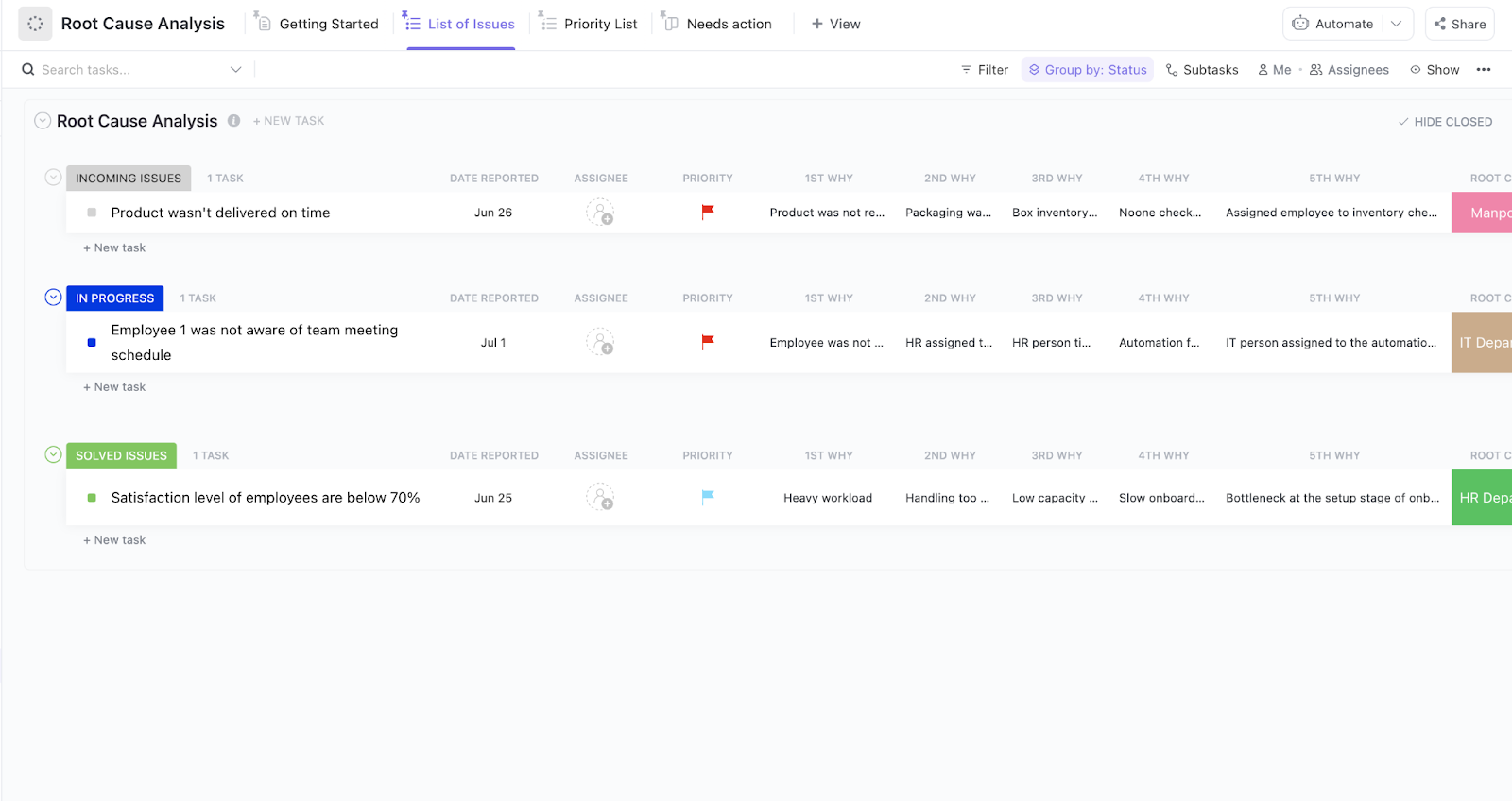
It isn’t enough to identify where your funnel is leaking. Without digging deeper, you risk implementing superficial fixes that don’t address the underlying issue, meaning the leak will reappear.
ClickUp’s Root Cause Analysis Template guides you through a structured root cause analysis, helping you understand the true drivers behind your funnel leaks.
Why you’ll like it:
- 5 Whys framework: Use the 5 Whys methodology of iterative questioning to drill down past surface-level problems to the core issue
- Visual brainstorming: Create a fishbone diagram and visually map out all the potential contributing factors to a leak using ClickUp Whiteboards
- AI-driven suggestions: Surface potential root causes based on the context of the leak and similar analyses from your workspace’s history with ClickUp Brain
- Cross-functional input: Easily share the template and invite stakeholders from sales, marketing, and product to contribute their perspectives, as leaks often span team boundaries
🚀 Ideal for: Cross-functional teams diagnosing why a funnel leak is happening before choosing a fix.
7. User Flow Template by ClickUp

ClickUp’s User Flow Template is perfect for teams analyzing digital funnels —like websites, apps, or product trials—to find hidden friction points.
It helps you understand user behavior and identify opportunities to improve the overall user experience. This naturally helps in plugging leaks in the funnel.
Why you’ll like it:
- Visual mapping: Map out every step of the user path, from the initial landing page to the final conversion event, using its flowchart structure
- Collaborative flow mapping: Collaborate with your entire team on mapping the user flow in real-time using ClickUp Whiteboards
- Friction point annotation: Mark drop-off points, confusing UI elements, and other friction areas directly on the flow diagram with annotations and comments
- Data validation: Overlay behavioral analytics data from tools like heatmaps and session recorders onto your flow map to validate your assumptions with real user behavior
🚀 Ideal for: PLG and marketing teams mapping digital journeys to find UX friction and drop-off points.
🎥 Want to turn disjointed branding and product experiences into a single, cohesive, and improved journey? This video shows you how to.
8. Growth Experiments Whiteboard Template by ClickUp
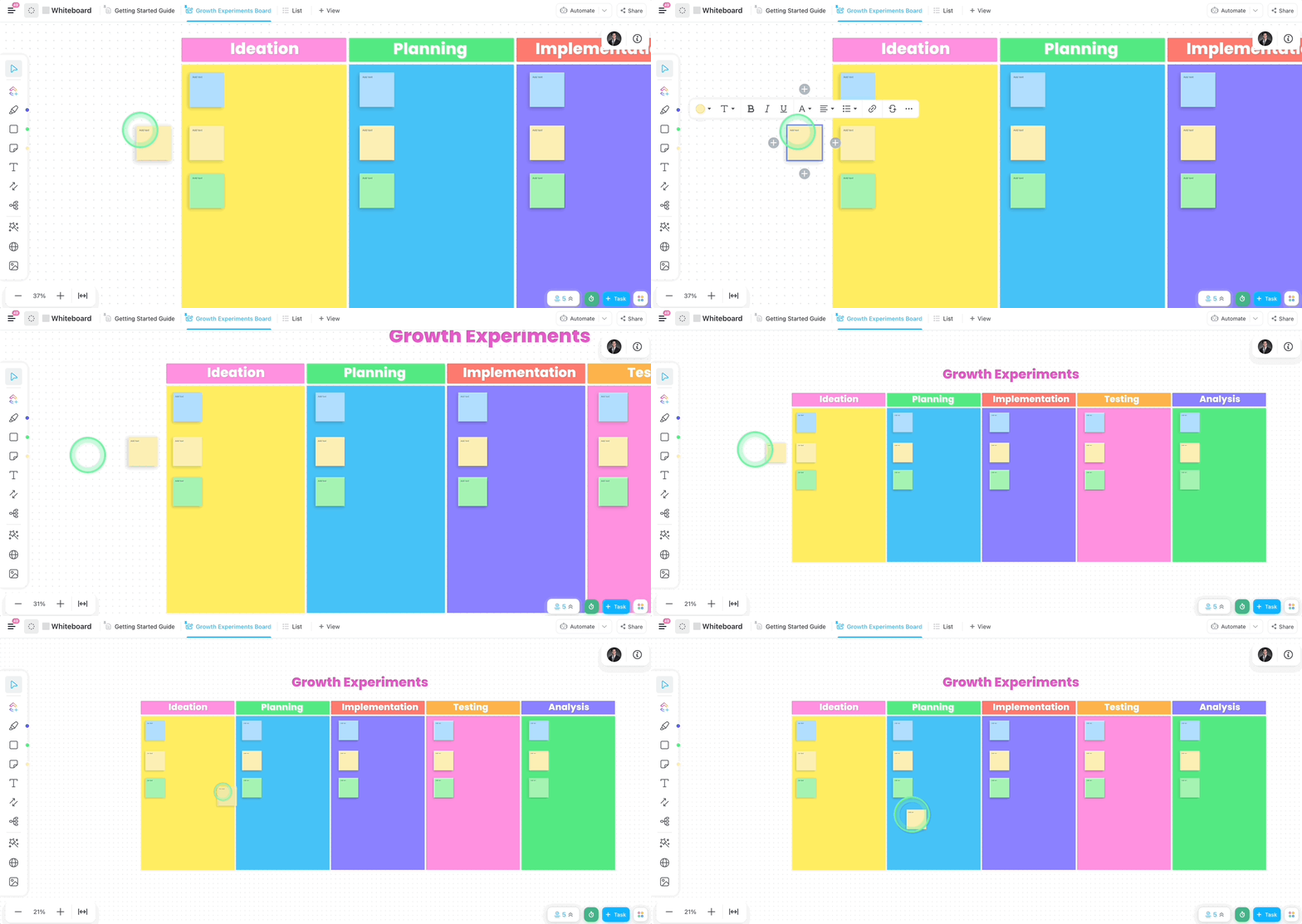
When you have a dozen ideas for fixing a funnel leak, but no structured way to test them, it’s easy to feel indecisive. Good ideas die on the vine because the team can’t decide what to try first or how to measure success.
ClickUp’s Growth Experiments Whiteboard Template provides a structured canvas for designing, running, and analyzing growth experiments to plug your funnel leaks.
Why you’ll like it:
- Experiment canvas: Document your experiment’s hypothesis, test design, success metrics, and results all in one organized view
- Visual prioritization: Brainstorm and prioritize experiment ideas with your team using frameworks like impact vs. effort in ClickUp Whiteboards
- Actionable results: Instantly create tasks to roll out winning variations as permanent process changes by connecting your experiment board with ClickUp Tasks
- ROI-focused approach: Rank experiments by their potential impact and ease of implementation, so you can focus on continuous improvement where they’ll matter most
🚀 Ideal for: Growth teams prioritizing and testing ideas to fix funnel leaks in a structured way.
9. Marketing Funnel Audit Checklist by HubSpot

HubSpot’s Marketing Funnel Audit Checklist offers a quick audit framework for marketing teams focused on inbound funnel performance. It’s best suited for teams already operating within the HubSpot ecosystem.
Why you’ll like it:
- Checklist format: The template provides a checklist for systematically reviewing each stage of the marketing funnel
- Content-centric: It focuses heavily on evaluating lead magnets, nurture sequences, and overall content performance
Limitation: This checklist is primarily marketing-focused and doesn’t deeply cover the sales handoff or bottom-of-funnel stages, which can be a blind spot.
🚀 Ideal for: Marketing teams, especially HubSpot users, auditing inbound funnel performance and nurture gaps.
10. Transport and Logistics Sales Funnel Analysis Template by Template. net
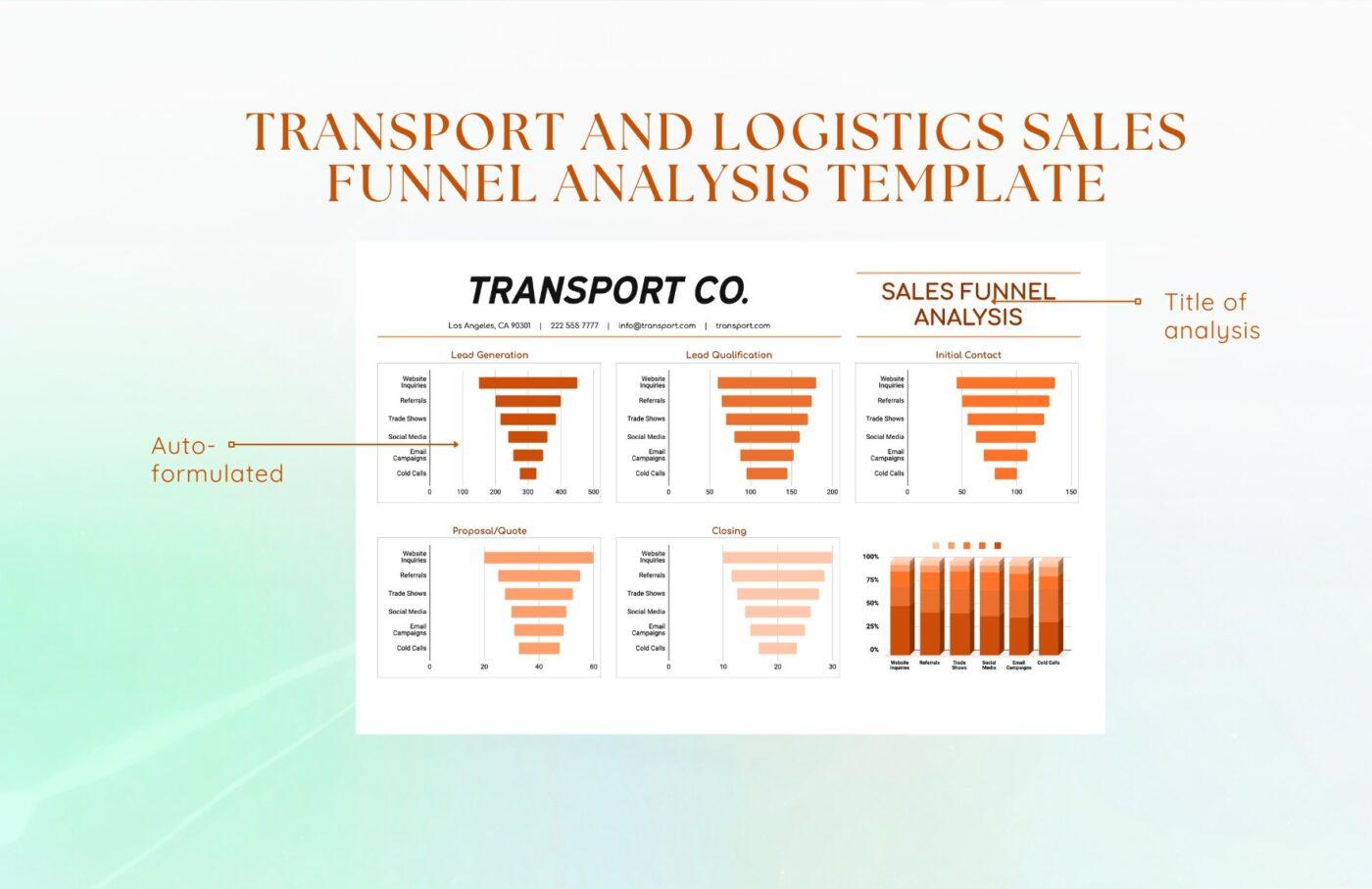
The Transport and Logistics Sales Funnel Analysis Template from Template. net is a simple spreadsheet-style template for those managing a transport or logistics business. It helps you analyze your sales funnel across each stage, from lead generation to closing.
It’s a good option for teams that want basic tracking without advanced workflow features.
Why you’ll like it:
- Pre-built formulas: The template automatically calculates stage-to-stage conversion rates, saving you from building the formulas yourself
- Simple customization: Its basic structure is easy to adapt to various funnel configurations and can be exported to different formats
Limitation: This is a static template that requires manual data entry. It doesn’t connect to live data sources, so it can quickly become outdated and doesn’t offer the collaboration features of an integrated platform.
🚀 Ideal for: Transport and logistics teams that want simple spreadsheet-based funnel tracking without advanced workflow features.
How to Choose the Right Funnel Leak Analysis Template
Picking the right template isn’t about preference—it’s about matching the template to the exact job you’re trying to get done. If you get this wrong, you end up with incomplete insights, disconnected data, and fixes that don’t stick.
Here’s a practical way to choose based on the analysis phase, team structure, and funnel stage focus. Remember, most teams get the best results by using multiple templates together.
Choosing based on analysis phase:
| Analysis Phase | Recommended Templates |
|---|---|
| Discovery & Mapping | Sales Pipeline Template, User Flow Template |
| Diagnosis | Root Cause Analysis Template, Data Analysis Findings Template |
| Testing & Fixing | Growth Experiments Whiteboard Template, Process Audit Template |
| Reporting | Analytics Report Template |
You may also find it useful to choose based on your team type.
For sales-led organizations, a sales pipeline template combined with a root cause analysis template can be powerful. Marketing-led or product-led growth (PLG) teams will find that pairing a user flow template with a growth experiments template yields the best results.
Hybrid teams would benefit from combining multiple templates in a single workspace that connects sales data, product analytics, and marketing performance.
Some teams may also benefit from selecting based on funnel stage focus.
- Top-of-funnel leaks: Use the User Flow Template with marketing-focused templates to diagnose issues like poor targeting, weak messaging, or drop-offs on landing pages
- Mid-funnel leaks: Use the Process Audit Template and the Data Analysis Findings Template to identify friction in nurturing, onboarding, or qualification processes
- Bottom-of-funnel leaks: Combine the Sales Pipeline Template with the Root Cause Analysis Template and focus on deal-stage inefficiencies, pricing objections, or sales execution gaps
📚 Also Read: How to Build Marketing Dashboards That Drive Results
Fix Your Funnel With ClickUp’s Converged AI Workspace
Most teams don’t fail because they picked the wrong template. They fail because their templates live in different tools. Managing analysis across disconnected spreadsheets, documents, and project management apps just creates tool sprawl and forces teams to switch context continuously
This context sprawl kills momentum. Insights get lost, handoffs break, and no one sees the full picture.
ClickUp isn’t just another funnel analysis tool—it’s a converged AI workspace where your entire funnel analysis process lives in one place.
- Build and connect every template—from user flows to sales pipelines—inside a single workspace
- Link tasks, data, dashboards, and docs so every insight is actionable
- Use AI to surface patterns, summarize findings, and accelerate decision-making
- Keep sales, marketing, and product teams aligned around the same real-time context
Ready to plug those funnel leaks? Get started for free with ClickUp and turn leak diagnosis into a repeatable process. ✨
Frequently Asked Questions
A sales funnel template helps you visualize and manage deals as they move through stages, while a funnel leak analysis template is specifically designed to diagnose where and why prospects drop off. Think of the first as operational tracking and the second as diagnostic investigation.
Most teams benefit from quarterly deep-dive analyses, with lighter monthly check-ins on key conversion metrics. If you’ve recently changed your funnel structure, launched a new product, or noticed a sudden drop in conversions, you should run an immediate analysis.
Early-stage leaks, happening between the awareness and interest stages, typically indicate messaging or targeting problems. Late-stage leaks, which occur from consideration to purchase, usually point to issues with objection handling, pricing, or competitive positioning.
Not effectively. Different phases of analysis require different structures. Most teams use two or three templates together—one for mapping the funnel, one for root cause analysis, and another for tracking experiments and reporting findings.