


Sorry, there were no results found for “”
Sorry, there were no results found for “”
Sorry, there were no results found for “”
Imagine if every interaction with artificial intelligence (AI) felt like chatting with an expert—insightful, precise, and on point. That’s the gold standard businesses aim for in GenAI.
But here’s the harsh reality: traditional AI models often miss the mark, relying on static training data that quickly becomes outdated. When the world moves fast, your AI can’t afford to lag.
Enter retrieval-augmented generation (RAG), a pivotal breakthrough in AI. RAG taps into dynamic data from internal knowledge bases or trusted sources, delivering helpful and factually accurate responses.
Has it piqued your curiosity yet? This article breaks down RAG, its real-world use cases, and how to implement it for smarter AI models.
Retrieval-augmented generation (RAG), introduced in 2020 by Meta (formerly Facebook), is a transformative AI technique that enhances text generation by combining retrieval systems with large language models (LLMs).
Instead of relying solely on pre-trained knowledge, RAG systems retrieve relevant information from external data sources and integrate it into their responses, resulting in more contextually relevant information.
It’s like giving AI access to an ever-expanding library of up-to-date knowledge, allowing it to pull in fresh information when needed. In modern computing, RAG is crucial because it helps AI systems stay current without constantly needing to be retrained. It’s a significant step toward AI that can think and adapt like humans!
🧠 Fun Fact: AI co-authored a sci-fi novel, 1 the Road, where it generated text in the style of famous authors. While AI doesn’t ‘feel’ creativity, it can surprise human collaborators with unexpected twists, blending human imagination and machine learning (ML).
Let’s examine how RAG systems combine information retrieval and natural language processing to deliver contextually relevant responses.
At its core, RAG combines two key processes:
This is where vector databases and search engines come in. Imagine you have thousands of documents, books, or articles stored in a digital library. The AI doesn’t search for exact words.
Instead, it transforms both your question and the documents into vectors—numerical representations of meaning and context. The search engine then finds the vectors that are closest in meaning to your query.
Once the system retrieves relevant information, large language models (LLMs) like GPT combine the fresh data with their existing knowledge—delivering more accurate, well-rounded responses.
👀 Did You Know? 72% of businesses globally have implemented AI-driven systems to enhance customer engagement and streamline operations.
Retrieval-augmented generation offers several key benefits that significantly enhance the performance and reliability of AI models. Here are some of them:
🧠 Fun Fact: In Greek mythology, Hephaestus, the god of craftsmanship, is portrayed as a pioneer of artificial intelligence, crafting automata that functioned as intelligent, human-like assistants. These creations reflect humanity’s ancient desire to endow machines with human-like abilities.
RAG isn’t just a theoretical concept—it’s already making waves in various industries. Let’s explore some real-world applications and RAG use cases:
RAG excels in tasks requiring nuanced understanding and precise information extraction. By retrieving relevant documents, RAG can generate summaries that are not only concise but also highly accurate. It is particularly valuable for:
RAG significantly enhances the capabilities of chatbots and virtual assistants, enabling them to provide more accurate and contextually relevant responses. Key applications include:
RAG’s ability to bridge the gap between information retrieval and content generation makes it invaluable for managing and utilizing large data repositories. Examples include:
💡Pro Tip: Integrate the RAG system with a dynamic knowledge base to provide real-time, relevant content, such as textbooks and research papers. This approach enhances response accuracy and depth, improving student learning outcomes.
Several tech giants and service providers have already integrated RAG into their platforms to boost performance:
While RAG offers significant benefits, it also comes with challenges, including:
AI hallucinations occur when the model generates plausible but factually incorrect information. In RAG systems, poor data quality or misinterpreting retrieved data can lead to misleading responses.
Mitigation strategies:
The quality of the generated text relies heavily on the accuracy of the retrieved information. Responses may be confusing or incomplete if the system pulls irrelevant documents or outdated data.
Mitigation strategies:
Handling large datasets efficiently is critical for maintaining performance. As data volumes grow, retrieval times can increase, resulting in slower response times.
Mitigation strategies:
💡Pro Tip: Enhance your skills with a prompt engineering course designed for RAG systems. Craft effective queries that boost retrieval mechanisms and generation capabilities, resulting in more accurate, relevant, and efficient AI outputs.
ClickUp has revolutionized how teams manage projects and retrieve data, making it a powerful tool in retrieval-augmented generation systems.
Here’s how this everything app for work enhances RAG through its AI features and seamless integrations:
Time is precious, and ClickUp gets that. With the ClickUp Connected Search, you can quickly find the documents, tasks, or notes you need across your entire workspace and connected apps.
But that’s not all; what if an AI tool could help you retrieve past data, generate insights, and predict task outcomes to guide smarter decisions?
Meet ClickUp Brain!
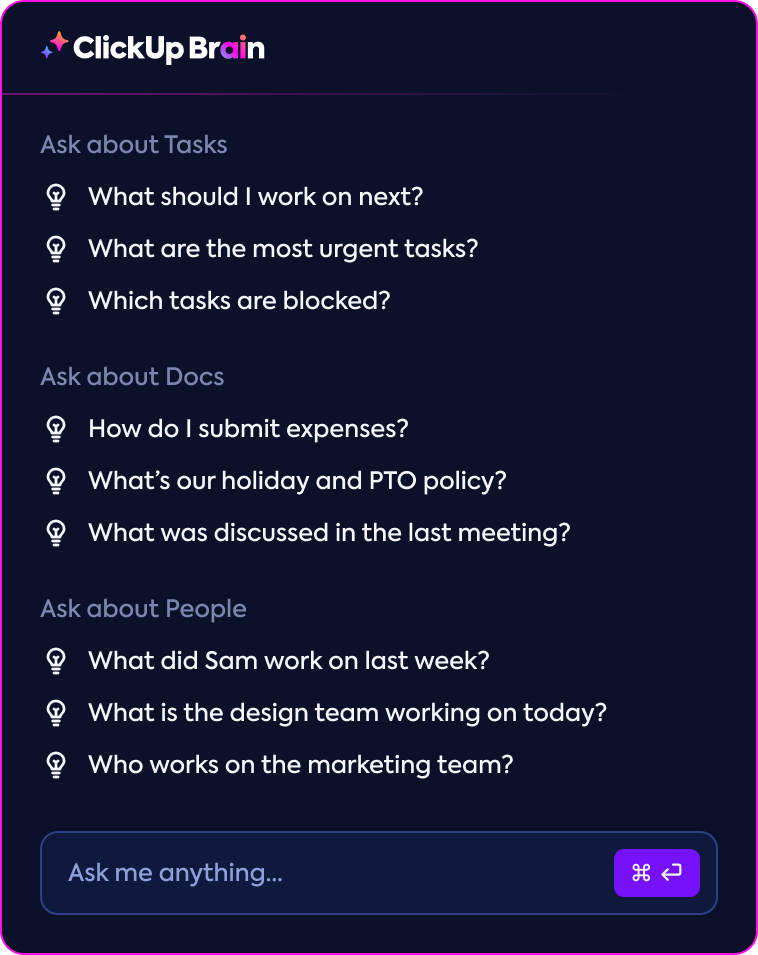
ClickUp’s AI leverages machine learning and advanced language models to analyze internal and external data and tasks, enabling it to generate real-time, actionable insights.
ClickUp goes beyond its platform by integrating with other popular apps—giving you seamless access to your essential documents and code within ClickUp.
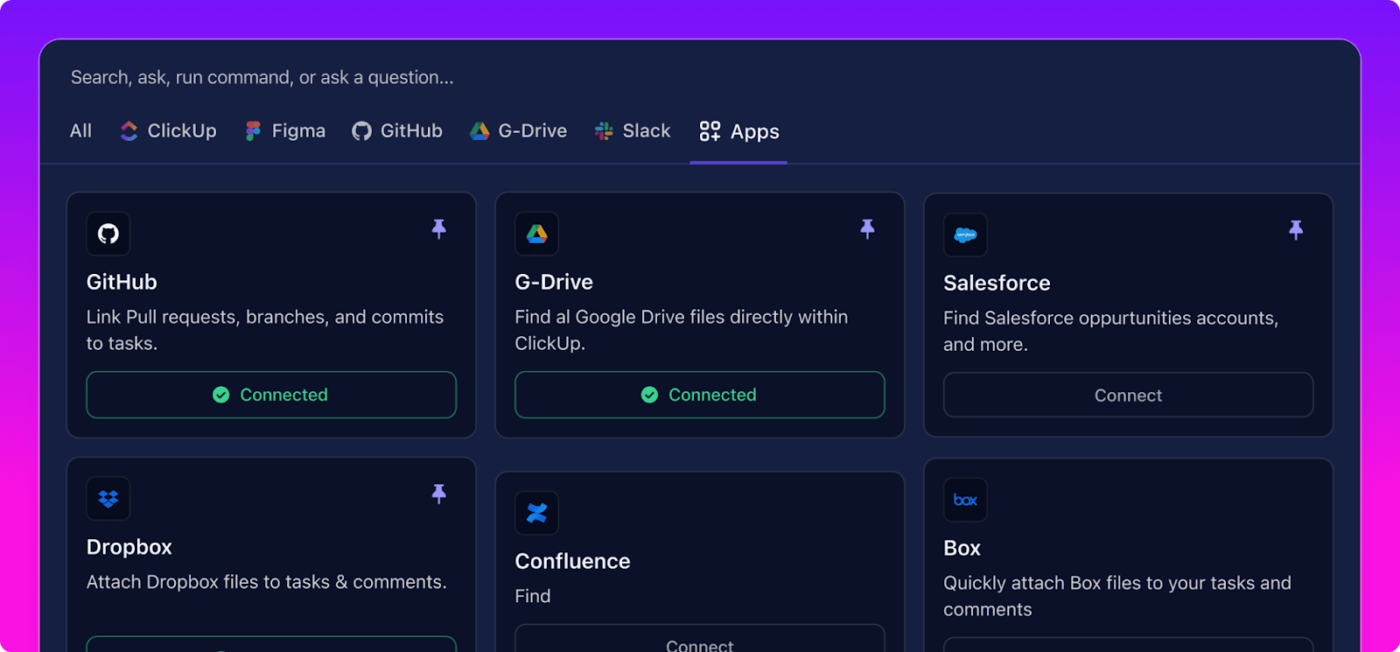
Imagine this: You’re working on a project and need to pull up a file from Google Drive or review a code snippet from GitHub. With ClickUp’s integration, you don’t need to switch tabs or juggle between different platforms.
Just search and retrieve everything from one central location. This unified search experience helps teams stay organized without wasting time hopping between apps.
📮ClickUp Insight: 83% of knowledge workers rely primarily on email and chat for team communication. However, nearly 60% of their workday is lost switching between these tools and searching for information. With an everything app for work like ClickUp, your project management, messaging, emails, and chats converge in one place! It’s time to centralize and energize!
ClickUp’s AI (ClickUp Brain) is your smart assistant for boosting workspace productivity. It simplifies complex workflows and automates repetitive tasks, freeing you to focus on high-impact work.
By streamlining processes, ClickUp Brain helps you work smarter, improve efficiency, and achieve better project outcomes.
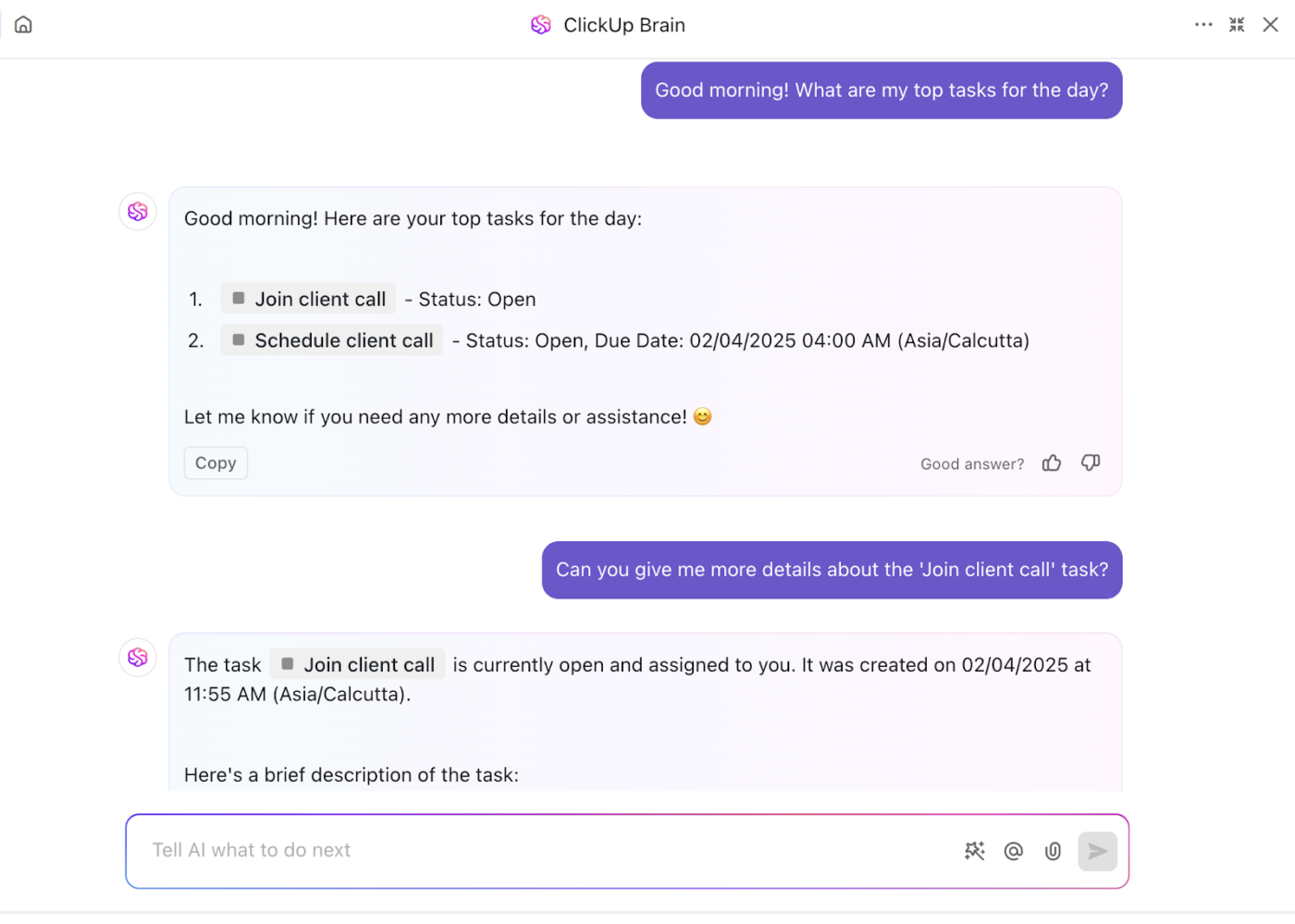
One of the standout features of ClickUp’s AI is its ability to answer real-time questions related to tasks or project details. With just a few clicks, you can generate content or get insights directly from the workspace. This feature enhances collaboration and reduces time spent searching for information.
Say goodbye to generic chatbot responses. Customer support systems powered by retrieval-augmented generation can access real-time data, delivering precise, contextually relevant answers customized to each customer’s needs.
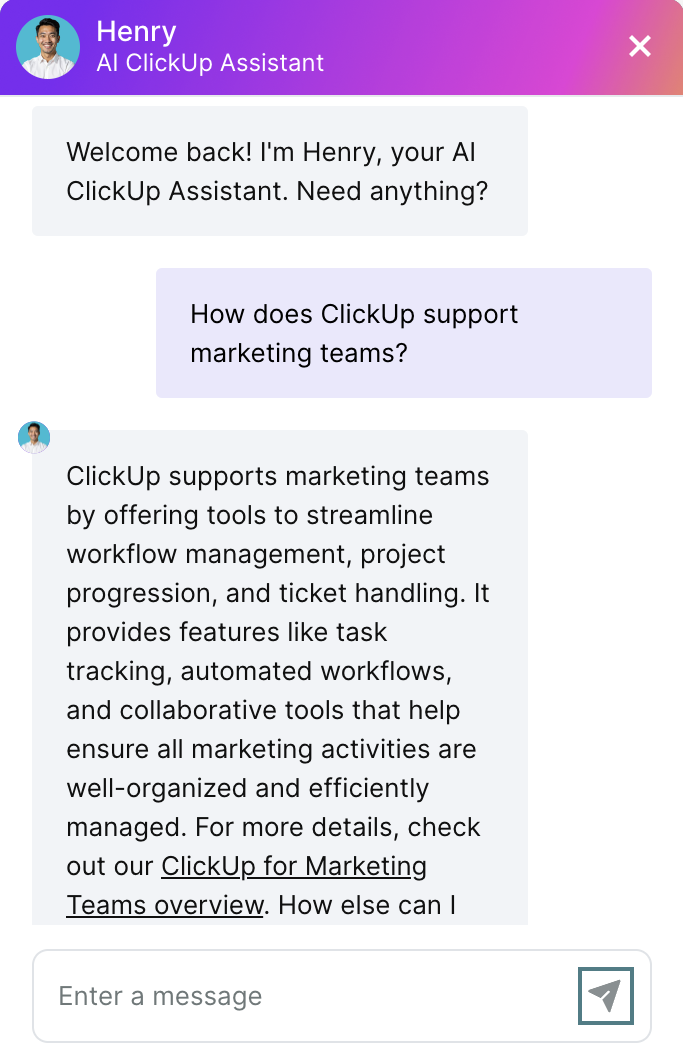
Henry is an AI ClickUp Assistant that helps potential and current ClickUp users solve their problems by giving them more information on ClickUp’s many productivity features and capabilities.
We use ClickUp for all our project and task management, as well as as a knowledge base. It has also been adopted for monitoring and updating our OKR framework and several other use cases, including flow charts and holiday request forms and workflows. It is great to be able to serve all of these within one product, as things can very easily be interlinked.
👀 Did You Know? Businesses can save around 30% on customer support costs by using chatbots, as they efficiently handle routine inquiries. They can reduce the need for human agents on basic tasks and enable 24/7 support without additional labor costs.
Also Read: Workflow Automation Examples and Use Cases
The power of retrieval-augmented generation (RAG) lies in its ability to deliver the right information at the right time. When implemented correctly, AI can enhance various business functions.
With ClickUp Brain, you can unlock the full potential of retrieval-augmented generation by automating decision-making, identifying bottlenecks, and utilizing actionable insights from real-time data powered with features like connected AI.
Explore ClickUp AI’s advanced functionality to efficiently manage business operations, projects, and documents and enhance AI and ML workflows with external knowledge.
Curious to learn more about ClickUp AI?
Sign up for a free ClickUp account and get started today!

Manasi Nair
Max 22min read
Manasi Nair
Max 24min read
Manasi Nair
Max 18min read

© 2026 ClickUp




