Sorry, there were no results found for “”
Sorry, there were no results found for “”
Sorry, there were no results found for “”
You’ve spent months building the perfect product, fine-tuning your service, or identifying a promising new market. But when it’s time to sell, reality hits—prospects aren’t biting, and deals are taking forever to close.
A strategic sales plan keeps your pipeline full, shortens the sales cycle, and consistently helps your team hit revenue targets.
This guide will walk you through real-world sales plan examples, actionable templates, and expert strategies to help you build a plan that delivers results.
🔎 Did You Know? The average B2B sales cycle has increased by 24% in the last two years, now taking 75+ days to close a deal. With longer sales cycles, businesses need a clear, strategic sales plan to keep leads engaged and accelerate decision-making.
A sales plan is a structured blueprint that outlines your business’s approach to reaching sales targets. It defines who your customers are, what sales goals you want to achieve, and the specific strategies and tools you’ll use to close deals.
Think of it as your sales team’s playbook—a step-by-step guide that keeps everyone aligned and focused on revenue growth.
Unlike a business plan covering a company’s operations, a sales plan zeroes in on sales strategy. It includes detailed processes, tactics, and resources to ensure consistent execution.
A well-defined sales plan isn’t just helpful—it’s necessary. Without one, your sales team is left guessing at the best approach, leading to inefficiencies and missed opportunities.
➡️ Read More: Free Sales Report Templates (Daily, Weekly, Monthly)

A strong sales plan includes essential components that provide structure, direction, and measurable outcomes.
🧠 Fun Fact: 42% of salespeople say prospecting is the hardest part of their job, yet 80% of sales require five or more follow-ups to close a deal. A strong sales process ensures that reps stay persistent with structured follow-ups, increasing the likelihood of closing deals.
Every business has different sales challenges, customer behaviors, and industry demands. The right strategic sales plan depends on who you’re selling to and how they make purchasing decisions. Here’s a breakdown of different sales strategies and when to use them:
If your business serves a specific customer demographic, your sales strategy should be built around their behaviors, pain points, and motivations. This means conducting detailed market research, segmenting your audience, and crafting sales messages that directly address their needs.
For instance, if your ideal customers are busy executives, they may prefer quick, data-driven sales pitches rather than long presentations. Conversely, a relationship-building approach might be more effective if you’re selling to small business owners.
Ideal for: Businesses with clearly defined target demographics that require personalized engagement.
If your business relies on direct outreach, an outbound sales plan ensures your team is equipped with the right tactics to initiate contact and build trust. This could involve cold calling, email sequences, or LinkedIn networking to engage potential customers.
For example, suppose your customers are decision-makers in large corporations. In that case, you’ll need a multi-touch outreach plan that includes personalized emails, follow-up calls, and scheduled demos to stand out.
Ideal for: Companies in B2B or industries with long sales cycles requiring direct prospect engagement.
An account-based approach works best for businesses targeting high-value clients. Instead of chasing every lead, you nurture a few key accounts with personalized pitches, exclusive offers, and tailored presentations.
If your business sells enterprise software, you must customize your proposal for each client. Instead of offering a one-size-fits-all pitch, you should highlight how your solution solves their specific problems.
Ideal for: B2B companies targeting large clients with complex sales cycles.
If your potential customers prefer to research before making a decision, an inbound sales plan attracts them through SEO, content marketing strategy, and educational resources. This ensures they come to you when they’re ready to buy.
When you sell digital marketing services, create in-depth blog posts on SEO trends, or run webinars on ad strategy to position yourself as an industry expert and bring in leads without cold outreach.
Ideal for: Companies in industries where research-driven purchases are common, such as software, marketing, and e-commerce.
If your business relies on building trust with clients, a consultative selling approach helps establish credibility. This method focuses on understanding customer needs and offering tailored solutions rather than aggressively pushing a product.
For instance, if you’re a B2B consultant, your sales plan should emphasize discovery calls, personalized marketing and sales strategy sessions, and in-depth conversations rather than a scripted sales pitch.
Ideal for: Industries where trust and expertise are key factors in decision-making, like financial services or high-end consulting.
Customers don’t just buy products—they buy solutions to their problems. A solution-based sales plan shifts the focus from product features to how your offering addresses a pain point directly.
An example is when you sell cybersecurity software. Rather than discussing encryption algorithms, you should demonstrate how your software prevents costly data breaches and protects customer information.
Ideal for: Businesses selling complex or customizable solutions, such as software, healthcare, or professional services.
A transactional sales plan is the way to go if your business revolves around quick, high-volume sales. This method focuses on efficiency, pricing strategies, and conversion tactics rather than relationship-building.
Suppose you run an e-commerce store that offers limited-time discounts, easy checkout processes, and automated follow-ups. These features almost always help close deals quickly without lengthy interactions.
Ideal for: Retail, e-commerce, and any business where price is a major factor in buying decisions.
For businesses whose audience engages on social media, social selling leverages platforms like LinkedIn, Twitter, and Instagram to build relationships and drive sales. The key is to create valuable content, interact with potential customers, and establish authority in your industry.
For example, you can generate inbound leads without direct pitching if you sell personal development courses and consistently share success stories, expert insights, and client testimonials on LinkedIn.
Ideal for: Businesses that thrive on personal branding and relationship-based selling, such as consulting, coaching, and B2B services.
💡 Pro Tip: 80% of B2B sales interactions are now conducted virtually, making digital sales strategies more critical than ever. Since most sales interactions happen online, businesses should prioritize content marketing, automation, and digital engagement strategies in their sales plan.
A well-crafted strategic sales plan isn’t just about setting goals—it’s about implementing the right tactics to reach them. Here are X high-impact sales strategies businesses use to generate leads, nurture prospects, and effectively close deals.
A drip campaign is an automated email sequence designed to nurture leads over time by providing valuable, relevant content. Instead of pushing for an immediate sale, this approach builds trust and engagement by delivering information in small, digestible pieces.
Drip campaigns keep your brand top-of-mind without overwhelming prospects. They help educate potential customers, answer common objections, and gradually guide them toward purchasing.
This approach is especially useful in industries with long sales cycles, such as B2B SaaS, real estate, and consulting.
🎁 Bonus: Use behavior-based triggers in your drip campaigns. If a lead clicks on a pricing page but doesn’t sign up, send a follow-up email addressing common pricing concerns or offering a free consultation.
Despite the rise of digital sales tactics, cold calling remains a powerful tool—when done correctly. Instead of scripted sales pitches, a structured cold-calling campaign focuses on personalization, persistence, and value-driven conversations.
Cold calling helps businesses reach decision-makers directly and gather real-time feedback. It is effective in industries where personal interaction is key, such as enterprise software, B2B services, and financial consulting.
🎁 Bonus: Use the ‘2-Call Approach’. The first call is purely research-based, where you ask about their challenges without pitching. On the second call, you tailor your pitch based on the insights gathered, making it highly relevant and hard to ignore.
Some sales require face-to-face interaction to build trust and close deals. Whether a physical meeting or a video call, demonstrating your product live allows for real-time engagement and customization.
In-person and video demonstrations help address objections instantly, showcase product value, and create stronger relationships. They are crucial for industries like high-ticket SaaS, real estate, and consulting, where customers need detailed explanations before purchasing.
🎁 Bonus: Use the ‘Reverse Demo’ technique. Instead of walking through every feature, ask the prospect their biggest challenge. Then, tailor the demo to that pain point, keeping it short and impactful.
A 30-60-90-day sales plan is a structured framework that outlines key goals and activities for the first three months in a sales role or initiative.
The first 30 days focus on learning, the next 30 on implementation, and the final 30 on optimization and performance improvement.
This plan is critical for onboarding new sales hires, launching into a new market, or restructuring sales strategies. It provides a clear roadmap to ramp up productivity, measure progress, and ensure accountability while reducing the risk of slow adaptation.
🎁 Bonus: Use a reverse engineering approach—define what success looks like at 90 days and work backward to structure the plan.
A territory-based sales plan focuses on geographical or industry segmentation, ensuring that sales and marketing teams tailor their approach to target the right regions or customer segments. Organizations enhance engagement and conversion rates by understanding each area or sector’s unique characteristics and demands.
This approach is widely adopted in various sectors, including B2B sales, retail environments, and field sales teams, where localized knowledge can significantly influence outcomes.
Without a structured territory plan, sales reps may waste time on unqualified leads or overlap with teammates. A clear structure allows for better resource allocation, personalized outreach, and increased conversion rates.
📚 Also Read: Exploring a Day in the Life of a Sales Manager: Duties, Challenges, and Resources for Success
This plan is designed for businesses focusing on high-value, long-term clients rather than one-time transactions. It involves deep relationship-building, personalized solutions, and ongoing engagement to maximize customer lifetime value.
Losing a major account significantly impacts revenue. A key account management plan ensures top clients receive priority support, personalized strategies, and consistent engagement, reducing churn and increasing retention.
🎁 Bonus: Implement a “customer health score” metric to identify and proactively re-engage at-risk key accounts before churn occurs.
A strong sales plan provides a clear roadmap for reaching your sales goals. It outlines your target market, sales strategies, and actionable steps to close more deals. Here’s a step-by-step guide to creating a high-impact sales plan that drives results:
Set specific, measurable, achievable, relevant, and time-bound (SMART) goals. Your objectives should align with overall business growth targets and be broken down into short-term and long-term sales goals.
▶️ Example: Instead of setting a vague goal like ‘increasing revenue’, define a SMART goal: Increase monthly sales by 15% over the next six months by improving lead conversion rates.
Your sales plan must clearly define your ideal customers. Create detailed buyer personas based on the following:
▶️ Example: A B2B SaaS company might target mid-sized marketing agencies struggling with automating their reporting process.
Your sales strategy should include attracting, engaging, and converting leads into customers in detail. Choose an approach that aligns with your audience, such as:
▶️ Example: If your audience prefers to research before engaging, focus on creating educational content and use email nurturing sequences to guide them through the funnel.
Map out your sales team’s steps to convert a lead into a paying customer. A clear sales process ensures consistency and efficiency.
▶️ Example: A sales rep at a B2B cybersecurity firm might first conduct a free security audit and then present a tailored risk mitigation plan before closing the deal.
Your sales plan should define key performance indicators (KPIs) to measure success and track progress.
Here are some common KPIs, including:
| KPI | What It Measures | Why It’s Important | How to Improve |
|---|---|---|---|
| Lead-to-Customer Conversion Rate | The percentage of leads that turn into paying customers | Indicates the effectiveness of lead nurturing and sales efforts | Optimize lead qualification, improve follow-ups, and refine sales pitches |
| Average Deal Size | The average revenue generated per closed deal | Helps forecast revenue and determine pricing strategies | Upsell, cross-sell and target high-value customers |
| Sales Cycle Length | The average time it takes to convert a lead into a customer | Shows how efficiently the sales process moves prospects through the funnel | Automate repetitive tasks, improve objection handling, and streamline processes |
| Customer Acquisition Cost (CAC) | The total cost of acquiring a new customer | Ensures profitability by balancing marketing and sales spend | Enhance targeting, reduce churn, and improve sales efficiency |
| Retention Rate | The percentage of customers who continue doing | Measures customer loyalty and long-term revenue potential | Improve customer experience, offer loyalty |
▶️ Example: To identify training needs, a sales manager might track monthly sales growth and individual rep performance.
Your sales plan should include a clear action plan with timelines and responsibilities. Break down goals into weekly or monthly tasks so sales teams know exactly what to focus on.
▶️ Example: If your goal is to increase inbound leads by 30% in Q2, your timeline might include:
💡 Pro Tip: Use a CRM system to track each lead’s progress in the sales pipeline and set automated follow-ups to prevent lost deals.
Technology is crucial in optimizing sales processes, improving efficiency, and driving revenue growth.
Here’s a complete list of the sales tech stack that you must have and how each one of it enhances sales capacity planning and execution:
➡️ Read More: Must-Have Tools in Your Sales Tech Stack
ClickUp, the everyday app for work, helps teams organize their sales process, track leads, automate workflows, and collaborate seamlessly.
Whether you need a custom CRM, workflow automation, or real-time reporting dashboards, ClickUp Sales provides an all-in-one solution for managing your entire sales funnel, from lead generation to customer onboarding.

Plus, ClickUp Sales allows the integration and optimization of lead tracking systems, enhances customer onboarding processes, and enables seamless collaboration on deals within a centralized platform.

Moreover, ClickUp Automations eliminates repetitive manual tasks by automating lead assignments, follow-up reminders, and deal status updates. It integrates with key sales tools like HubSpot, Gmail, Slack, and Zapier, ensuring all data stays connected across platforms.
With productivity dashboards, sales teams track pipeline health, deal progress, and team performance all in one place. ClickUp also enables workflow automation, ensuring leads move seamlessly through the sales pipeline. Real-time tracking keeps teams updated on deal status and priorities.

ClickUp Task helps sales reps stay organized and on top of their daily activities. Custom task lists, checklists, and reminders make assigning follow-ups, tracking deal progress, and setting priorities effortless.
The built-in Chat, document sharing, and commenting features foster seamless collaboration between sales reps, managers, and cross-functional teams.
📮 ClickUp Insight: 92% of knowledge workers risk losing important decisions scattered across chat, email, and spreadsheets. Critical business insights get lost in the digital noise without a unified system for capturing and tracking decisions.
With ClickUp’s Task Management capabilities, you never have to worry about this. Create tasks from chat, task comments, docs, and emails with a single click!

ClickUp Goals feature allows teams to set and track sales targets, ensuring everyone is aligned and focused on achieving key revenue milestones.
Automations handle repetitive tasks like deal status updates, lead scoring, and task assignments, freeing time for sales reps to focus on closing deals.
With ClickUp for sales teams, you:
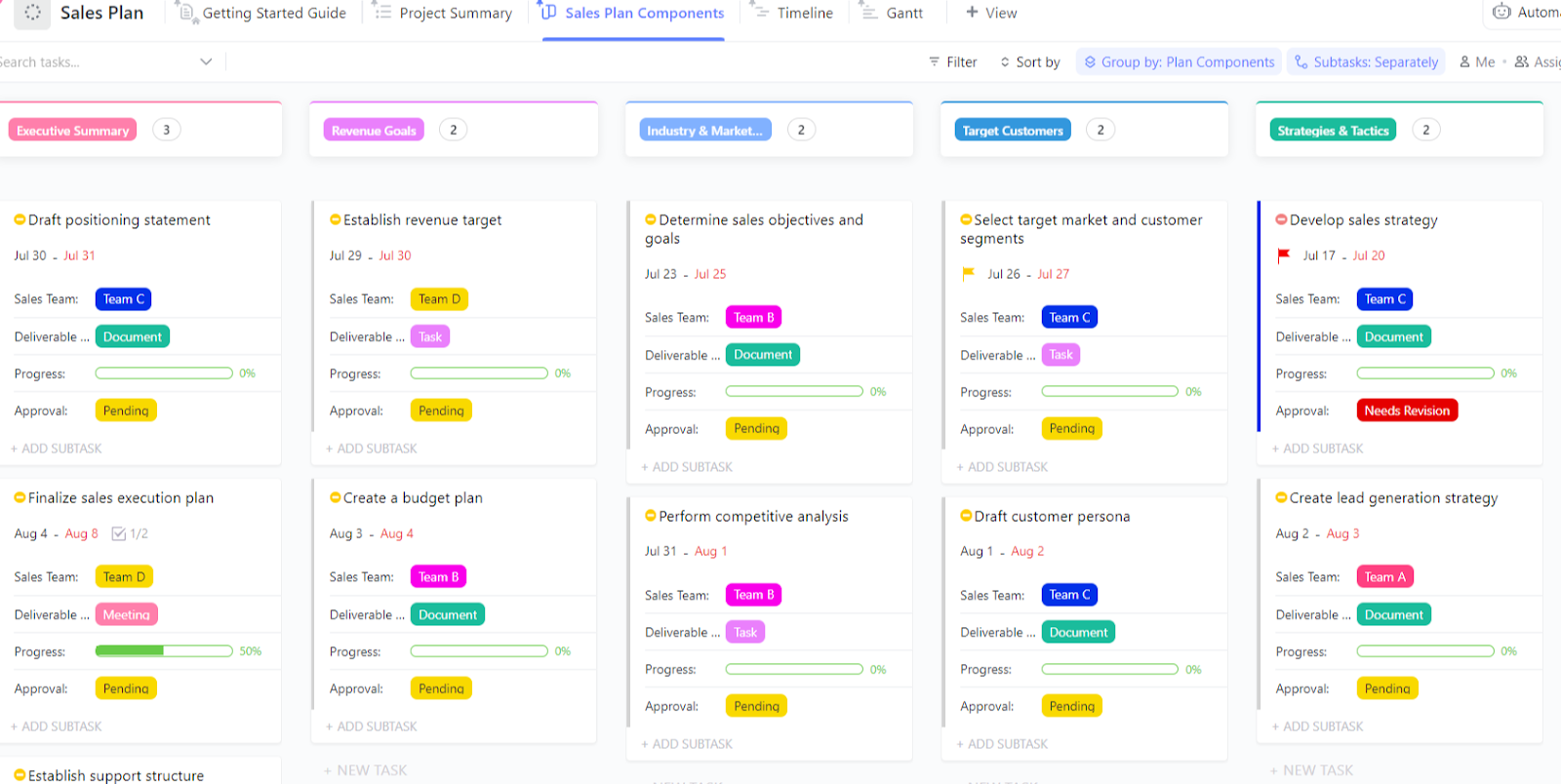
ClickUp’s Sales Plan Template provides a ready-to-use framework to help sales teams set SMART goals, create action plans, and track progress efficiently. This template helps businesses:
ClickUp offers specialized templates designed to streamline sales processes and enhance team productivity. The ClickUp Sales Pipeline Template helps teams visualize and track deals at every stage, ensuring they monitor progress and identify real-time bottlenecks.
The ClickUp Sales Process Template standardizes workflows, making it easier for teams to follow a structured approach to lead management and deal closures. These templates help sales teams stay organized, reduce inefficiencies, and ensure consistency in their sales approach.
Here’s what Blaine Labron, VP of Digital Commerce and Technology at Pressed Juicery, had to say about ClickUp for sales:
ClickUp has been the tool that has really helped us bring innovation to this business, which has allowed us to grow from 2% digital sales to over 65% digital sales post-pandemic.
➡️ Read More: Free Sales Plan Templates in Word, Excel, & ClickUp
A well-structured sales plan is the backbone of a high-performing sales team. It provides clear direction, measurable goals, and actionable strategies to ensure consistency and efficiency in achieving revenue targets.
Whether leveraging targeted outbound campaigns, inbound lead nurturing, or account-based sales, having a defined roadmap helps streamline processes, maximize conversions, and improve overall sales effectiveness.
By integrating technology-driven solutions like CRMs, sales analytics, and workflow automation, sales teams reduce inefficiencies and close deals faster. This is where ClickUp takes the sales planning process to the next level by centralizing task management, automating repetitive processes, and providing real-time performance tracking.
If you’re ready to optimize your sales strategy, track progress, and drive revenue growth, get started with ClickUp today.

Sudarshan Somanathan
Max 23min read

Sean Hardy
Max 44min read
Sudarshan Somanathan
Max 30min read

© 2026 ClickUp