
Sorry, there were no results found for “”
Sorry, there were no results found for “”
Sorry, there were no results found for “”
Tacit knowledge is expertise built through years of practice that people apply without being able to fully explain it. Michael Polanyi, who named the concept, summed it up as “we can know more than we can tell.”
But tacit knowledge can beome an organizational risk when critical information sits inside the head of one expert. What happens when they’re not available? Transfering that knowledge to others is essential, but if the expert cannot explain it, that’s when you have a problem.
Dorothy Leonard and Walter Swap spent years studying how expertise actually moves between people. They found that it moves when the learner does the work and the expert corrects. If the knowledge transfer is one-directional, then it’s not as effective.
What this means is that simply asking people to document their tacit knowledge is not enough. Instead, have them record themselves working, then get someone else to write it up. Finally, attach the results to the actual task.
We’ll break down the exact process of transferring tacit knowledge in seven steps. We’ll also cover the five mistakes that undo it.
TL;DR: In operations, the ‘Bus Factor’ is the number of team members who can unexpectedly leave (or get hit by a bus) before your company completely stalls. If your daily workflows rely on a few veterans who ‘just know things,’ your Bus Factor is dangerously close to 1.
The fix starts with a sort. Procedural know-how (exceptions, thresholds, workarounds) is capturable this week: record the expert narrating a live run, let a non-expert write the draft, attach it to the recurring task, and assign an owner plus an update trigger. Judgment (reading a client’s tone, pricing ambiguity) never survives as text; it transfers only through shadowing and paired decisions. Sort first. Everything downstream depends on it.
Tacit knowledge is the unwritten, experience-built know-how that people carry in their heads; judgment calls they apply without consulting a document. It survives through conversation, shadowing, and the continued employment of the people who hold it. So when one of these holders of tacit knowledge leaves, it leaves with them.
Tacit knowledge is particularly common in small businesses, with smaller headcounts. For these SMBs, anything that a new hire couldn’t find on their own and would have to interrupt someone to learn is tacit knowledge. That includes the client whose PO number must go in a specific field and the founder’s read on which deals aren’t worth chasing.
The PO number rule is not tacit in the strict sense. The account manager can state it in one sentence. Nobody ever asked them to. Knowledge management literature has a separate name for that category: implicit knowledge, meaning writable but not yet written. Polanyi’s tacit knowledge is the harder one, the part that stays out of reach of language, no matter how carefully you ask.
The distinction decides your method:
These four terms overlap, and usage genuinely varies between the academic literature and everyday business writing, which is why people swap them freely. Here is where each one sits and how it changes your knowledge transfer method.
| Type | Where it lives | Can you write it down? | What it looks like in a small business | What to do about it |
|---|---|---|---|---|
| Tacit knowledge | One person’s experience, partly below conscious awareness | Only partly, never fully | Sensing from a customer’s tone that a renewal is at risk, estimating a job from a quick site visit | Transfer through coached practice: shadowing, paired decisions, guided experience |
| Implicit knowledge | People who have done the work, never asked to write it up | Yes, it just never has been | The billing exception only one person knows, or the onboarding step that everyone skips | Recorded walkthrough; a non-expert drafts it |
| Institutional knowledge | Across the whole company, formal and informal | Partly | Why you stopped offering a service line, or the reasoning behind a pricing model | Capture the decision log and the reasoning; accept that some context fades |
| Explicit knowledge | Documents, systems, and records | Already is | Your published refund policy, your employee handbook | Only needs maintenance |
‘Tribal knowledge’ is the group-held, procedural portion of what your team knows: the undocumented steps a small group shares and passes on by talking. In the table above, it maps to implicit knowledge, named for how it travels rather than for why it resists writing. Many teams now prefer tacit knowledge, institutional knowledge, or know-how instead.
The term remains standard in manufacturing and engineering, where it has been in use for decades. The objection is to the word itself: it borrows the anthropological sense of ‘tribe,’ and applying it to corporate ignorance strikes some people as dismissive of Indigenous peoples. Enough teams have raised it that the most common follow-up question is what to say instead.
If it does not sit well at your company, these alternatives describe the same thing:
The idea does not depend on the label. If swapping the phrase gets your team to engage, swap it.
Capturing what your team knows gives a small business six things it cannot get any other way: the option to step away from the business entirely, recovered expert time, continuity when someone is absent, consistent output on repeatable work, the ability to automate, and onboarding measured in weeks instead of months.
Five of the six come from the writable portion, which is why capturing that first pays back fastest.
Documentation projects stall because the person who holds the knowledge is the worst person to document it. The standard advice tells you to build a knowledge base and have your experts fill it. That advice skips two things. First, writing a procedure is a separate skill from performing one. Second, the expert has to describe steps they no longer think about consciously.
Dorothy Leonard, Professor Emerita at Harvard Business School, studied this transfer problem for years with Walter Swap.
They called it ‘deep smarts’: experience-built judgment, developed over decades, that shows up as pattern recognition rather than recall. Their transfer hierarchy runs from directives and lectures at the bottom to learning by doing at the top, which is inconvenient for anyone planning a documentation sprint.
Walter Swap, professor of psychology emeritus at Tufts University and co-author of Deep Smarts, put it this way in an interview with ACM Ubiquity:
Rather than thinking about transferring the knowledge out of the head of an expert and into the head of a novice, we talk more about re-creating knowledge through guided experience… The coach has to guide the protégé’s practice, engage in joint problem-solving, and provide opportunities for guided observation.
The practical translation for a small business: a recorded walkthrough where the expert narrates the process is closer to guided observation than a blank-page writing assignment.
Leonard also proposed ‘dual-purpose projects,’ in which the work itself becomes the learning environment. That principle carries directly into how you store what you capture. A document attached to the recurring task describes updates as the work changes. A document filed in a separate wiki drifts from day one.
The fix for both problems is the same: treat documentation as a byproduct of how work already gets discussed, not as a separate project with a finish line. Record the conversation instead of requesting the document. Attach the result to the task instead of filing it in a folder. Then the work and the record stay together, and updating one updates the other.
Four methods move knowledge out of someone’s head: recorded walkthroughs, reverse shadowing, structured interviews, and written documentation sprints. Three of them capture writable processes. Structured interviews are the only one that reaches judgment.
Pick based on one question: is the knowledge procedural or judgment-based? Procedural work responds to recording and live correction. Judgment responds to questions, and only partially.
| Approach | Strength | Weak spot | Best for |
|---|---|---|---|
| Recorded walkthrough | Lowest friction for the expert; captures rare scenarios they forget when writing | Raw output needs heavy editing before it’s usable | Processes done on a screen or workbench that can be narrated live |
| Reverse shadowing | Surfaces gaps the expert doesn’t know they’re skipping | Requires a real task to arrive; you can’t schedule curveballs | Exception-heavy workflows where the expert corrects on instinct |
| Structured interview | Targeted; you control what gets covered and in what order | The expert summarizes instead of demonstrating, so the steps get compressed | Judgment and decision-making knowledge, where the reasoning is worth capturing even though the instinct isn’t transferable in text |
| Written documentation sprint | Produces a polished document directly | Highest friction; the expert avoids the task for weeks | Simple, short procedures that the expert can write in under 30 minutes |
Also Read: How to Write Procedures in 7 Clear Steps
Capturing the writable portion takes seven steps: identify the single points of failure, pick one process, record the expert’s work, run a reverse shadowing session, have someone else write the draft, attach the document to the work, and assign an owner with a trigger.
The sequence is tool-agnostic. A voice memo app, a screen recorder, and a shared document will get you through all seven.
List two things: which process stops, and whose absence stops it. Keep the list to five or fewer. Then mark each item as procedural or judgment. Procedural items follow the six steps below.
This list is your Bus Factor inventory: every name on it is a 1.
You are looking for three signals:
Teams skip this step and start with whatever is easiest to write, which is usually half-documented already. Resist that instinct. The uncomfortable items carry the real risk. For example, how pricing exceptions actually get approved, or which clients need a call before the invoice goes out.
Pro Tip: Frame it as a vulnerability exercise, not a documentation project. Ask: ‘If this person quits with no notice on Friday, what breaks on Monday?’ The answers write your list for you.
Choose the highest-consequence item from your list and document only that. One finished, trusted, used document changes more behavior than a half-built wiki with 40 empty pages.
The first document you complete has a second job beyond its own content: it proves that the knowledge base is worth checking. That proof only works if the document is correct, complete, and actually used the first time someone relies on it.
Have the expert perform the process while narrating what they are doing and why. Screen recording covers anything on a computer. A phone camera covers anything physical. Talking while working adds roughly five minutes to a task they were doing anyway, which is why this beats the writing assignment that never gets started.
Keep the instruction loose: ‘Do the job, talk through it, include the parts you would normally skip.’ The exceptions an expert handles on autopilot are the highest-value content in the finished document. They are also exactly what disappears when someone writes from memory.
How to run it:
Skip it if: The knowledge is judgment-based rather than procedural. ‘How I decide which projects to decline’ produces a rambling monologue. Use a structured interview instead.
Hand the work to the newer person, have the expert watch, and log every correction as it happens. Traditional shadowing has the novice observe. Reverse shadowing inverts it, and the inversion is what surfaces the gaps.
Every correction the expert makes is a piece of undocumented knowledge announcing itself. A specific instruction can look like this: ‘No, not that field; that client needs the PO number in the description line.’
Interviews cannot produce that. Asked to describe the same process, the expert compresses six steps into two sentences because they have done it a thousand times. Watching someone do it wrong triggers the corrective instinct instead of the summary instinct.
How to run it:
Stop when the novice can complete the task with only minor corrections. That signals the captured material is close to complete, and it doubles as a test of the document you are about to write.
Skip it if: No novice is available, or the cost of an error during the session is too high. You would not reverse-shadow a live financial reconciliation with a first-week hire. Record a walkthrough instead.
The person who does not know the process writes the document from the recordings. They produce clearer instructions than the expert would, precisely because they have to translate rather than summarize. Every step that confuses them will confuse the next new hire.
This person’s job is to notice the gaps. The unexplained jumps, the assumptions, and the steps that are not obvious to anyone outside the expert’s head. Those gaps become questions back to the expert, and the answers fill the document.
The expert’s role shrinks to reviewing and correcting, which takes minutes.
For the first pass:
Pro Tip: Make the first draft testable. Hand it to someone who has never done the process and ask them to follow it. Every point where they get stuck is a gap in the document.
Put the finished document where the work happens, not in a separate documentation tool. This curbs context sprawl and avoids wasting your team’s time that otherwise would be spent connecting scattered dots.
A procedure linked to the recurring task that runs it gets opened every cycle. On the other hand, a procedure filed in a documentation folder gets opened when someone remembers it exists, which is almost never when it actually matters.
The placement test: If finding the document takes more effort than asking a colleague, the colleague wins. Position it so the path of least resistance leads through the document, not around it.
Where to attach and organize SOPs:
Assign one named owner and define the event that forces an update. Instead of a calendar block, shape it as an event.
‘Review annually’ is a date nobody honors. It arrives, the owner glances at the document, decides it looks fine, and marks it complete. ‘Update this when we change the payment process’ triggers when accuracy matters, because the process just changed, and the document is now wrong.
Two triggers that keep the document alive:
At higher volumes, the same habit makes a knowledge management system worth running.
Note: The owner is not necessarily the expert. It is whoever is closest to the work daily and notices when the document drifts. Often, that is the person who took over the process after it was documented, not the person who originally held the knowledge.
Tacit knowledge looks different at every company, and so does the artifact you produce when you capture it. A returns team needs a decision table, a founder’s judgment needs a precedent log, and a production line needs a card taped to the machine.
The three scenarios below are composites, built from patterns that repeat across small businesses in every industry.
One supervisor handles every return exception. The team processes normal returns fine. Out-of-the-box scenarios pile up until the supervisor returns to their desk.
The right method: Reverse shadowing on live returns tickets. The output is a decision table (condition → action → threshold → escalation), attached to the returns workflow.
What makes this one different: Curveballs only surface when real tickets arrive. You cannot document them from memory. Reverse shadowing on live work is the only method that catches the full range.
The founder decides which projects to take, how to price ambiguity, and when to absorb a cost. None of it follows a sequence. Documenting it as a procedure will fail.
The right method: A structured interview covering five past decisions, plus a running decision log going forward. The log becomes a precedent that the team can reference.
What makes this one different: You are building a library of precedent, not a procedure. The team stops asking ‘should we take this?’ and starts asking ‘is this similar to the one we turned down in March?’
Two operators have run the same line for eleven years. The machine has quirks that appear in no manual. The second shift learns them by breaking things.
The right method: A recorded walkthrough on the physical machine using a phone camera, paired with a structured interview on the failure precursors. The output is a one-page startup and handoff card posted at the station. Plus, it includes a short video library linked from the shift-change task.
What makes this one different: Some of this knowledge is sensory, so it does not survive as text. ‘It sounds different’ cannot be written into a procedure, but it can be recorded. Capture the audio and video, then let the text handle the sequence and the thresholds. It is also the one scenario where the document has to be readable in 30 seconds while standing up.
Five things kill documentation efforts that otherwise look healthy: building structure before content, documenting everything at once, making the expert the author, storing documents away from the work, and selling documentation as insurance. Each one produces visible activity and zero adoption.
Building the structure before the content. Someone spends a week setting up a wiki with a category tree, naming conventions, and a folder for every department. Then nothing gets written. The structure sits there, clean and empty, teaching your team that the knowledge base is not where answers live. Every empty visit reinforces the habit of asking a colleague instead.
The fix: Write three documents people actually use. Then organize what you have. Structure should follow volume, not precede it.
Documenting everything at once. A ‘documentation sprint’ produces 40 thin pages in two weeks. Nobody knows which ones were verified. One bad experience and the team concludes that ‘the docs are unreliable’. Trust is earned per document, not per project.
The fix: Finish one process, use it, then move to the next. Sequence by consequence, not by ease. A single document that is right the first time someone relies on it does more for adoption than a library that nobody has tested.
Making the expert the author. A task lands on your busiest person: ‘Please document the returns process.’ It sits open for six weeks. They are not procrastinating. They are busy completing the work they were hired for, while this seemingly ‘low-priority’ task sits in their queue.
The fix: Take the writing off their plate. Their job is 15 minutes of red ink on a draft.
Storing documents away from the work. The document exists with accurate information. People still ask the question anyway, because finding it requires opening another tool and hoping the search works. Asking a colleague seems easier than encountering tool sprawl.
The fix: Link the document to the task, list, or workflow it governs.
Selling documentation as insurance. You pitch the project as ‘what if Sarah leaves?’ The project gets approved, but nobody feels urgency because Sarah has not left. If you sell documentation as just a safety net for “what ifs,” it’ll lose to today’s house fires every single time.
The fix: Justify it by what it unlocks this quarter. The expert stops fielding the same five questions every week. The team runs the process without interrupting anyone. You can automate the workflow because it is finally written down. The ‘what if they leave’ benefit still exists. It is just not what gets people to do the work.
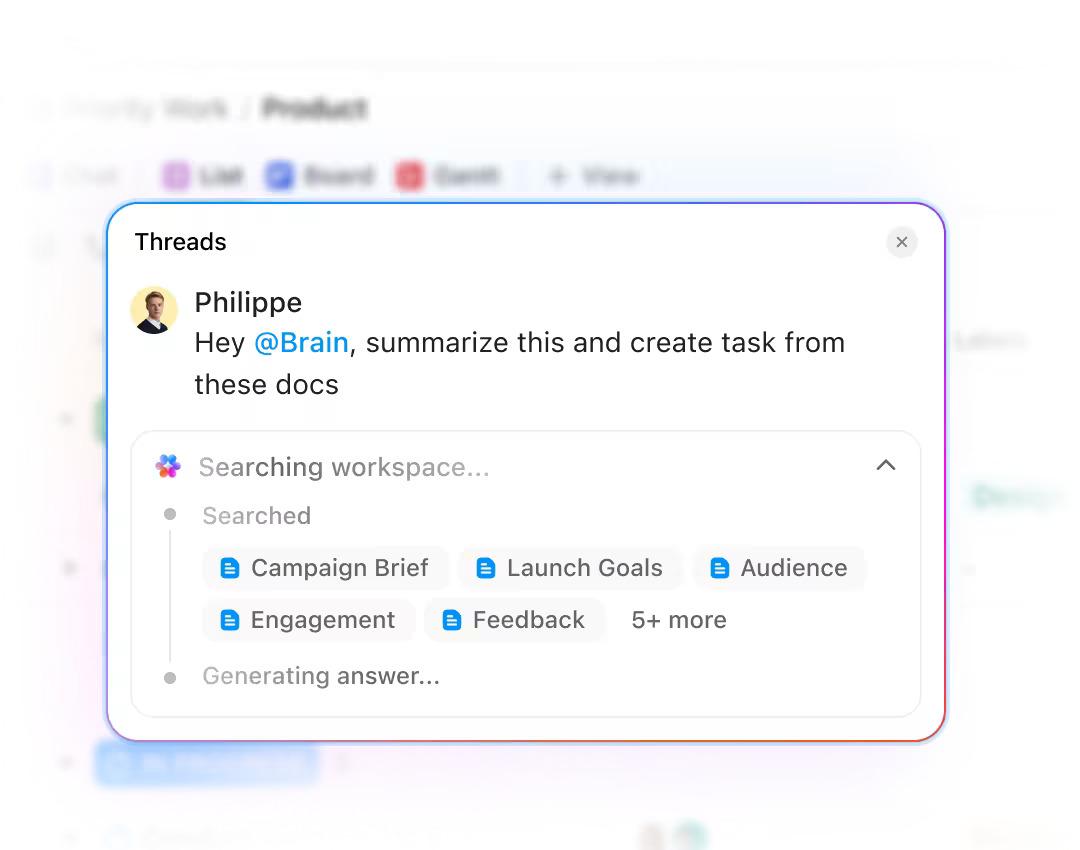
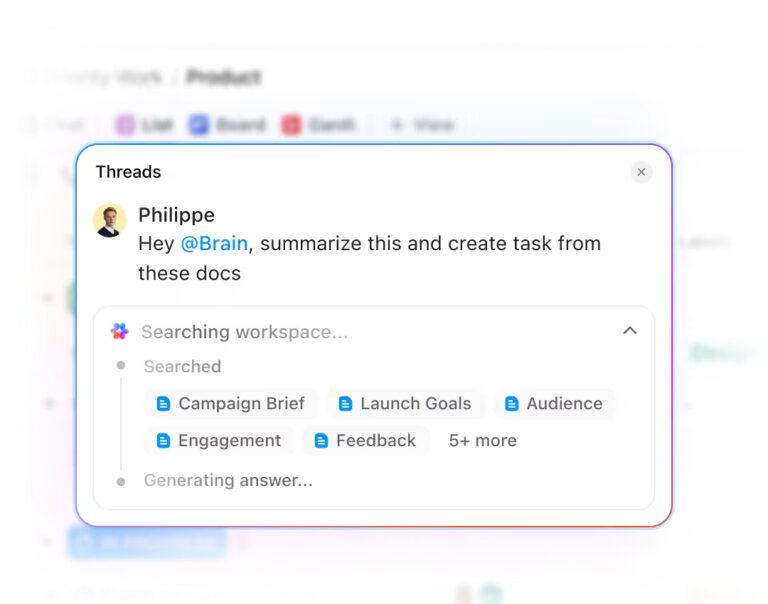
ClickUp brings together capture tools, documentation, and work in a single workspace. That directly addresses the two failure modes this article covers: the writing tax on experts and the gap between the document and the job it describes.
As a small business assembling this workflow from separate tools, you would pay for a meeting recorder, a documentation platform, a chat tool, and an AI subscription. Then maintain the connections between them. ClickUp bundles all of those natively for teams of 5 to 100 through its Small Business Suite.
What works well for tacit knowledge capture specifically:
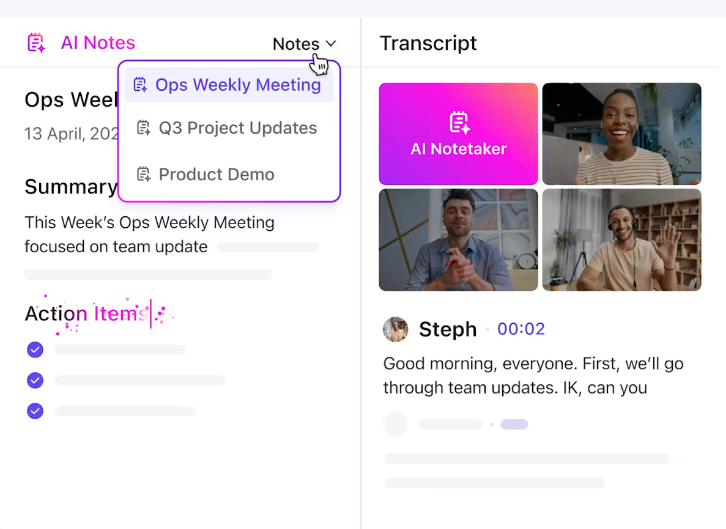
This walkthrough shows how AI turns a single meeting into tasks, Docs, and follow-ups without manual note-taking:
What this looks like at scale: MTM Logix, a logistics company moving thousands of shipments across Mexico and Latin America. It built its entire operation on ClickUp Small Business Suite.
Founder Mario Veraldo used ClickUp’s flexible data architecture to build 78 specialized Super Agents.
Every shipment used to require someone typing, copying, and relaying data between systems. We now connect internal platforms and external data sources to one command layer, then let specialized agents interpret the signals and execute within defined controls. Today 95% of our recurring shipment activities are automated or agent-orchestrated, from intake to delivery.
Each agent has a defined role:
The result: Shipment volume tripled with no headcount increase, and output improved 5x.
Those agents work only because someone first wrote the rules down: what counts as a valid bill of lading, which cost signals mean a billing error. 78 of them run alongside 12 people, doing what used to take a team four times the size. You cannot hand an agent a rule that only exists in a person’s memory.
ClickUp’s limitations:
Skip it if: Your team is two people with a single procedure to capture. A shared document gets you there faster.
Best for: Small teams (5-100) where multiple processes need to stay documented, current, and connected to the recurring tasks they govern. Also, if the goal is to eventually automate those processes with AI.
Pick one person on your team whose absence would stop operations. Ask them to do that process out loud this week while you record it. Have a teammate draft it. Attach it to the recurring task. Give it an owner and a trigger.
Then test it. The next time that person is out, does the work continue without them? If yes, you just converted tacit knowledge into an operational asset. Do the next one.
In ClickUp, the recording becomes a Doc, the Doc attaches to the task, and the process eventually runs itself through a Super Agent. Try ClickUp for free.
AI can capture tacit knowledge for you, but only partially. AI transcription and drafting tools turn a recorded walkthrough into a rough first draft. A human then corrects it, which removes most of the ‘writing tax.’ But AI can only act on knowledge it can read. Capture first, automate second. Tools like ClickUp Brain answer from documented content, but the documentation has to exist before any agent can run the workflow.
Tacit knowledge is valuable expertise, and the risk comes from it being undocumented rather than from the knowledge itself. The workarounds and exceptions exist because they solve real problems. This is why deleting them in favor of a clean process usually reintroduces old failures. The danger is concentration: when know-how sits with one or two people, work stops when they are away, quality varies by who does the task, and onboarding stretches into months. The goal is to capture it, not eliminate it.
In manufacturing, tacit knowledge is the undocumented machine and process know-how held by long-tenured operators. It can include the startup sequence a temperamental line actually needs, or the tolerance the spec sheet doesn’t mention. It matters more on the factory floor than in most functions because the knowledge is sensory and shift-based, so it never makes it into a written SOP.
Long-tenured employees in operational roles hold the most tacit knowledge, and the clearest signal is whoever colleagues interrupt most often. In small businesses, that is usually the founder, the office manager, the senior technician, or whoever originally set up the current systems. Tenure matters more than seniority: a five-year coordinator typically holds more undocumented process detail than a recently hired director.
No, though they overlap. Intuition is the felt experience of knowing without conscious reasoning; tacit knowledge is the underlying expertise that produces it, built through years of pattern exposure. Per Polanyi, tacit knowledge also includes learnable components, like procedural shortcuts and workarounds, that can be articulated when prompted. Intuition can’t be documented; the procedural layer of tacit knowledge can.
An SOP is the documented, approved version of a process. Tacit knowledge is the unwritten version people actually follow, including the exceptions the SOP never captured. Most teams have both, and the gap between them is where errors live. The SOP describes the standard path while tacit knowledge covers the deviations. A useful test is to hand your SOP to a new hire and log every question they still have. Those questions are your tacit knowledge inventory.

Manasi Nair
Max 24min read
Manasi Nair
Max 20min read

Sudarshan Somanathan
Max 22min read

© 2026 ClickUp




