


What’s your next big goal? 🎯
Whether it’s launching your dream business or expanding your user base, we all have that next big thing in mind.
But, when planning for those big goals, it’s important to ensure your team is on the same page. That’s where objectives and key results (OKRs) come in. Think of them as a handy tool for setting goals and actually achieving them.
The OKR framework can help you set clear, ambitious goals—the objectives—and then track your progress with specific things you can measure—the key results.
But how exactly do you implement OKRs? How do you make sure that everyone in your team knows what they’re working toward and can track their progress effectively?
In this blog, we will discuss everything you need to know about how to successfully implement OKRs, including planning your objectives, tracking progress, and iterating along the way so you hit those goals.
How to Implement OKRs: Effective Methods for Goal Setting

 Summarize this article for me please
What Are OKRs and Why Are They Important?
Coming back to those big dreams, you may want to become the leading startup in your field over the next five years. To get there, you need an incremental approach rooted in the concept of continuous improvement. That’s exactly what OKRs are.
The OKR framework can act as a bridge between you and your team, translating that strategic vision into quarterly or yearly goals shared and owned by everyone in the company.
OKRs can help move your business in the right direction by facilitating:
- Alignment: Everyone in the company knows what the overall goals are and how their work contributes to them
- Transparency: Progress is tracked openly, often company-wide, so everyone can see how they’re doing
- Focus: By setting clear goals, OKRs help teams stay focused on what matters most
- Stretch goals: OKRs encourage teams to aim high and achieve more than they might have thought possible
Did you know? Building on Peter Drucker’s management ideas, Intel’s former CEO Andrew Grove created the OKRs framework in the 1970s. The framework added measurable results to goal-setting and gained popularity when John Doerr, a former Intel employee, brought it to Google in 1999.
Key components of the OKR methodology
Now we know what OKRs can do. But exactly what do they entail? OKRs consist of two primary components: objectives and key results.
- An objective is a clearly defined goal that aims to drive specific outcomes. It should be concrete, significant, and inspirational enough to motivate and engage the team
- Key results, on the other hand, are measurable outcomes that track progress toward the objective
Together, these two will help you define “What does success look like at the end of my project?”.
Objectives and key results should be quantifiable to achieve this, using metrics that clearly define success or completion. This structure ensures that every team member understands exactly what they need to do to implement the objectives and how their efforts will contribute to specific improvements within the business.
Here’s an example of an OKR setting process:
Objective: Enhance our mobile app’s user experience (UX) and increase user engagement.
Key results:
- Achieve a Net Promoter Score (NPS) of 70 (indicating high customer satisfaction) within the next quarter
- Reduce app uninstalls by 15% within 6 months
- Increase the average daily active users (DAUs) by 2 million within a year
Here’s a breakdown of what each key result means:
- Net Promoter Score (NPS): Measures customer loyalty and satisfaction
- App Uninstalls: Reducing uninstalls indicates users are finding the app valuable and keeping it on their devices
- Daily Active Users (DAUs): Shows how many users are actively engaging with the app on a daily basis
By implementing OKRs, you can align team efforts, enhance strategic execution, and foster a culture of ownership and continuous improvement. Plus, they are highly flexible, so you can adapt and iterate at any point based on your unique needs.
Summarize this article for me pleaseSteps to Plan and Implement OKRs
While OKRs offer a powerful goal-setting framework, they can easily go off track without careful planning. Consider your company’s overall strategy and how you can cascade OKRs from leadership to individual teams, creating a cohesive path toward the bigger vision.
And get creative! The right OKRs should be able to inspire your team and help them become laser-focused on achieving those moonshots!
Here are some broad guidelines to help you plan your OKRs:
1. Set a clear vision and goals
When planning your OKRs, your long-term vision is a beacon that guides all subsequent objectives and key results. Look back to your original goals. What’s the ultimate result you’re striving for? Better yet, what problem are you trying to solve with your product or services?
If we take the example of X (Formerly Twitter), we know that the entire organization underwent significant changes under Elon Musk’s leadership. While the company may have adjusted its immediate revenue goals and OKRs to accommodate these changes, X still serves the larger goal of “being the town square of the world.”

When operating in a constantly changing environment, building OKRs rooted in your core vision can carry you through the most turbulent times, acquisitions included!
2. Identify key performance indicators (KPIs)
KPIs and goals are somewhat inseparable within the context of the OKR framework.
You can use KPIs to understand where improvements are needed and set your OKRs accordingly. Or start with OKRs and tie them to specific KPIs to track their impact on the business.
Here are some guidelines:
- Use your existing KPIs to inform your objectives: Take a deep dive into historical data, including financial performance, customer dashboards, and employee surveys, to identify areas for improvement or growth. Look for KPIs that connect to your strategic goals to ensure you’re moving in the right direction
- Choose KPIs that provide actionable insights: Make sure they directly measure the success of your objectives. The KPIs should clearly show how achieving the objective will impact the business. Don’t settle for vanity metrics! For instance, if you’re trying to improve your employee turnover, track metrics like attrition rate rather than settling for pulse survey results
- Monitor your KPIs alongside OKRs: Implementing OKRs is a dynamic process. By staying on top of your KPI data, you can identify trends and potential roadblocks in your OKR planning early on. However, be prepared to adjust your OKRs or strategies as needed
3. Define and communicate objectives
Objectives are the qualitative descriptions of what you aim to achieve. However, despite this qualitative nature, they should be action-oriented and inspirational:
- Go for two or three objectives rather than a laundry list of goals meant to solve every single problem for your business
- Ensure each objective is connected to at least two to five SMART key results, aka specific, measurable, achievable, relevant, and time-bound outcomes that will indicate success
- Clearly document your OKRs and create an OKR performance dashboard visible to everyone across the company
Communicating OKRs to your team
Use an All-Hands or Ask Me Anything meeting format to unveil your company’s OKRs to the team. During the meeting, clearly explain the company’s vision and strategic goals and showcase how the OKRs connect to the bigger picture.
Include visuals and real-world examples to make your OKRs relatable and engaging for the entire team. Leave ample time for questions and open discussion. This clarifies doubts and fosters a sense of ownership and shared accountability for achieving these goals.
By making OKRs transparent and sparking conversation in this company-wide setting, you’ll set the stage for a more focused and motivated team moving forward.
Read more: Check out these goal-setting templates to bring structure to your big ideas.
Summarize this article for me pleaseImplementing OKRs Step-by-Step with ClickUp
Planning is great, but execution is where many falter. A phased approach to implementing OKRs can help ensure clarity and alignment throughout the process.
Alongside your master plan, you need powerful project management software to clearly define and document your OKRs and track every aspect of progress. ClickUp can be the Watson to your Sherlock here.
As an all-in-one project management platform, ClickUp can help you build and maintain end-to-end visibility across planned OKRs—from setting goals and assigning tasks to measuring impact. Let’s explore a step-by-step process for implementing OKRs with ClickUp.
1. Creating your OKRs
The OKR framework may seem like a top-down approach to goal setting. However, the more collaborative your OKRs are, the higher the chances of success. To enable this, engage your team to brainstorm the OKR messaging, key results, and KPIs.
This will allow you to tap into your team members’ specialist knowledge and identify potential roadblocks early on. Use tools like ClickUp Whiteboards to visualize your broad goals and break them down into smaller, achievable goals.
Make it a point to thoroughly explore plausible ideas—from the execution and results phases—and evaluate how they connect with your bigger vision using ClickUp Mind Maps.
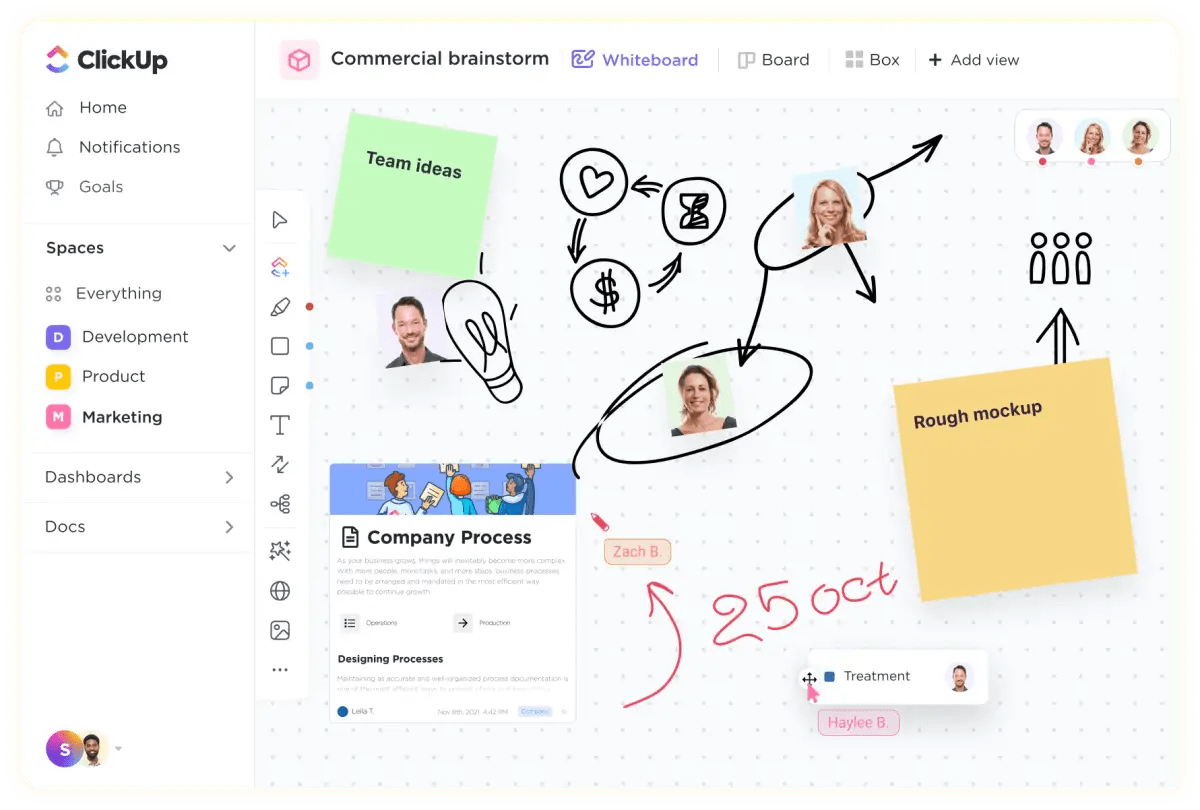
The best part? You can create tasks and workflows from the whiteboard, making it easier to launch into execution mode faster.
Struggling to phrase your OKRs? If you can’t quite hit that balance with an inspirational yet formal tone, enlist the help of ClickUp Brain, ClickUp’s AI assistant. ClickUp Brain’s AI writer can help you generate ideas, experiment with phrasing, and polish your tone.

2. Assigning and tracking OKRs
Once you’ve identified your OKRs, it’s time to break them down into actionable goals and assign them to your in-house experts. Not sure where to start? Enter ClickUp Goals.
ClickUp Goals allows you to build a detailed goal hierarchy, making it easier to track your OKRs. With it, you can set a larger goal, break it into smaller sub-tasks, and assign these to specific team members, with details like due dates, milestones, progress tracking, and more.
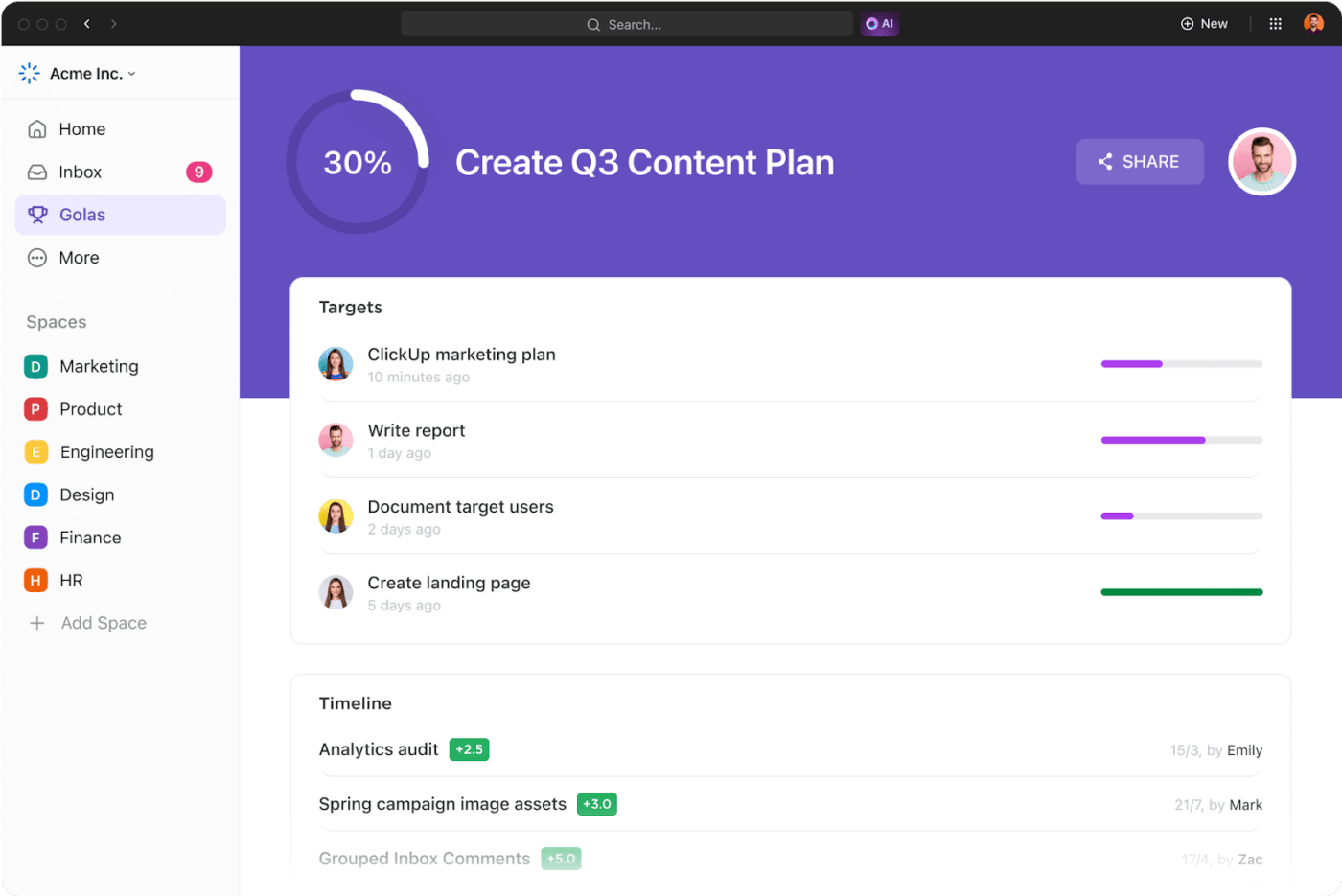
Here’s a step-by-step process to get started:
- Create a top-level goal for your overall OKRs. Then, create sub-goals for each individual Objective
- Customize the ‘Targets’ field as ‘Key Results.’ Choose the appropriate target type (for example, Number, True/False, Currency, etc.) based on your specific metrics
- Track progress visually for both Goals and Targets (Key Results) based on timelines, progress rollup, and more
With ClickUp Goal’s versatile views, different teams can filter and customize their view to focus on the parts most relevant to them.
For instance, your project manager might be more interested in specific due dates, whereas individual contributors may benefit from detailed descriptions of the task.
Pro tip: Don’t forget to share the resource within your team and provide open access to ensure transparency.
Even with a step-by-step guide, the OKR implementation process can sometimes be quite daunting. If you don’t want to start from scratch, we got you!
ClickUp’s OKR Folder Template
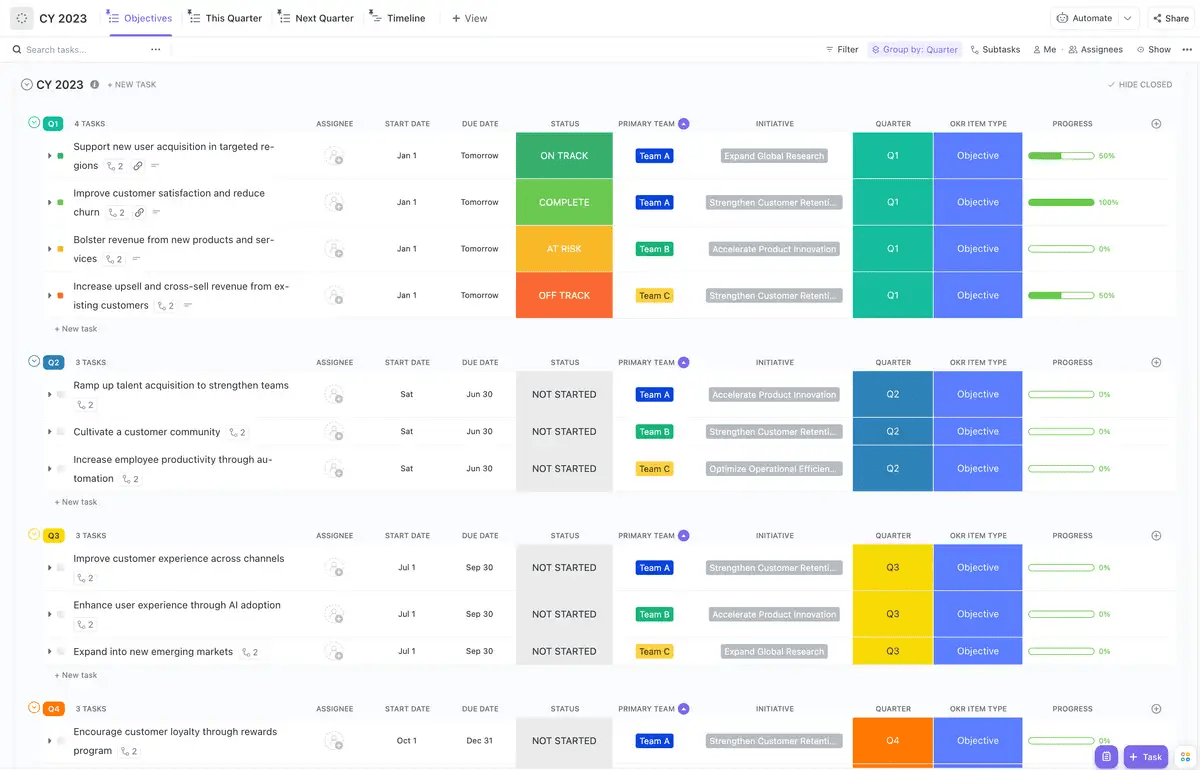
ClickUp OKR Folder template can help you plan and execute your OKR implementation process easily. This beginner-friendly OKR template includes a pre-defined planning cadence that outlines the basic structure for OKR development and OKR Lists to help you break down your goals and monitor progress throughout the year.
It provides custom views, including List, Board, Calendar, Activity, and seven custom statuses, to build the perfect project tracking workflow for your OKR implementation process.
ClickUp OKR Framework Template
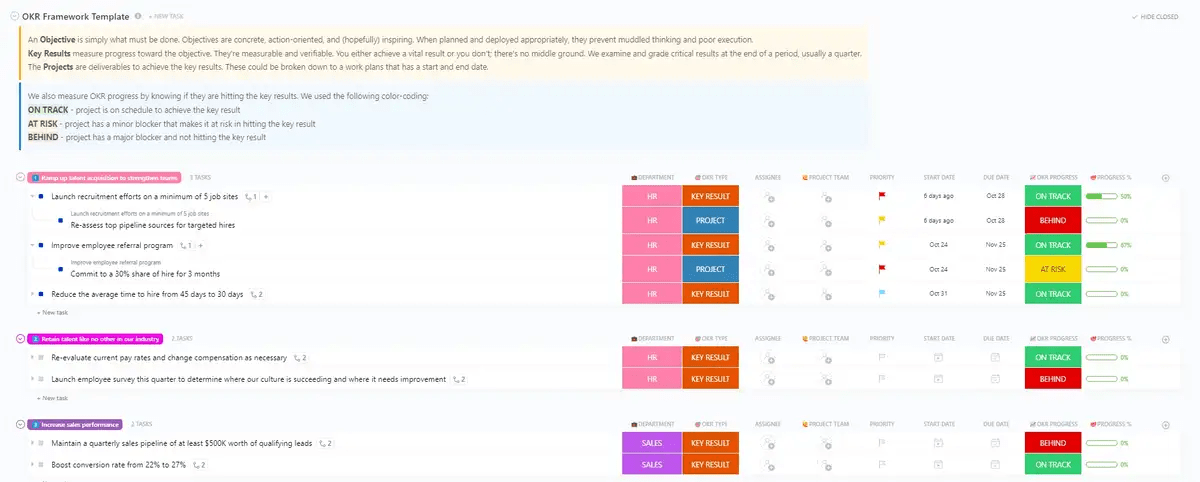
If you need a more feature-rich template to set and manage OKR expectations across a bigger team, use the ClickUp OKR Framework Template. For instance, the Global OKR View allows for creating and tracking the progress of overarching objectives and goals.
The OKR Progress Board View offers a clear view of each team’s progress toward their assigned objectives to enhance team visibility. Other helpful features, like the Timeline View and customizable task statuses, enable you to stay on top of the process with the flexibility to adjust as needed.
Pro tip: Consult your team members when assigning tasks. This will help you assign the right people to the tasks and ensure bidirectional input and alignment.
3. Scheduling regular check-ins and updates
OKR check-ins are brief, structured meetings where teams review progress, discuss challenges, and adjust priorities for the upcoming period. Depending on the complexity of the project, they can be conducted weekly or every two weeks.
ClickUp Dashboards can be handy here, giving you a quick overview of the progress and identifying areas of improvement. Ideally, your OKR check-in meetings should end with clear action steps and assigned responsibilities to address any challenges or changes in priorities.

Remember, to ensure the successful implementation of your OKRs, you need to actively manage and revisit them to adapt to changes and ensure continuous alignment with organizational goals.
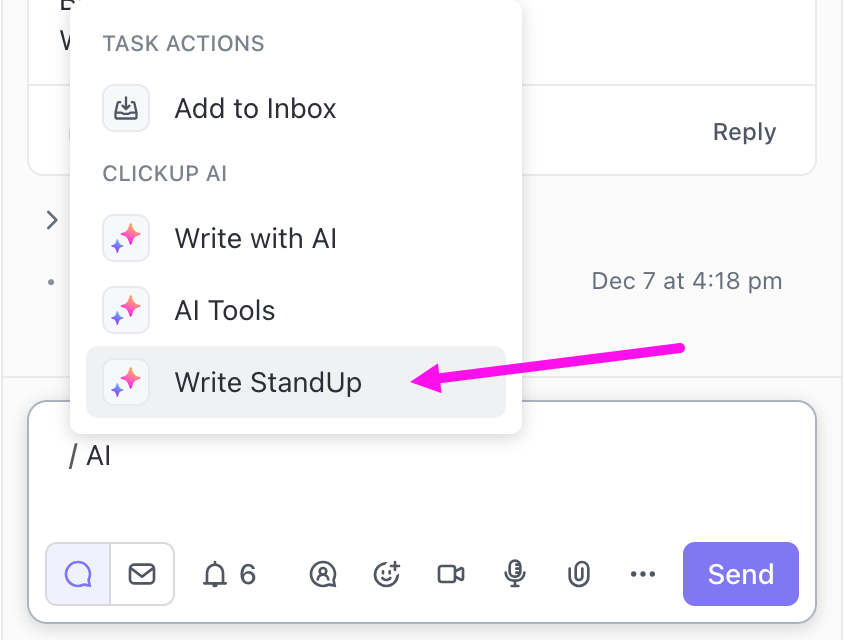
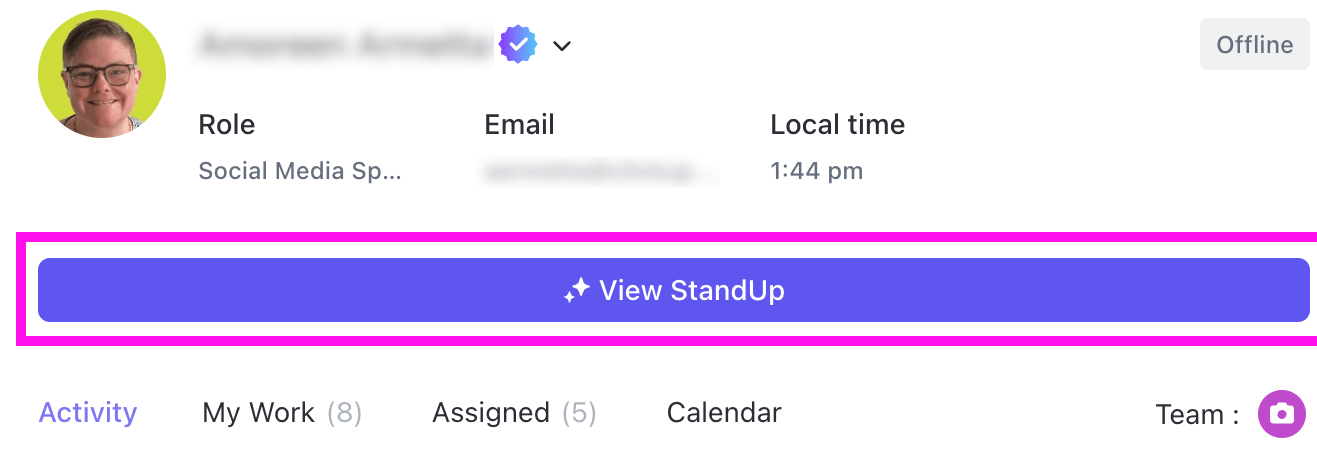
However, these check-ins do not always have to be in-person meetings. You can also use ClickUp Brain’s AI stand-up to see where your team is at.
Here’s how it shows up for others in your team.
 Summarize this article for me please
Maintaining and Scaling Your OKRs
With implementation figured out, the next step in the OKR process is continuous monitoring and scaling goals—based on your business needs.
Now, this part can be tricky. Maintaining focus and alignment across teams can become challenging, especially if teams get competitive. But, with a generous dose of open communication and agility, you can avoid most of those hurdles.
Let’s look at how.
1. Evaluating your key results
Success is simple in an OKR framework. Did you deliver the key results or not? But, to effectively maintain and scale OKRs, you also need to assess whether these results have truly advanced the KPIs tied to them.
For instance, you successfully implemented a new reward recognition system as part of the OKR to reduce attrition rates. The program is a resounding success and receives high praise on the pulse survey, but the attrition rate remains the same or similar. If this happens, it’s time to retrace your steps and learn how to make a measurable impact rather than surface-level wins.

Here are some additional aspects to look at while evaluating the success of your OKR implementation process:
- Timelines: Compare the time estimated against the actual time it took to meet the goals using ClickUp Time Tracking
- Dependencies: Record the dependencies that either accelerated results or held your team back with ClickUp’s Dependencies
- Milestones: Document the key moments along the project process with ClickUp Milestones, i.e., 50% close to the original goal
- Goals: Check whether you were able to achieve all the goals, pay attention to the ones that lagged or are lagging with ClickUp Goals Dashboard
Apart from these, also look at individual performances from key OKR owners using the ClickUp Performance Review Template. You can use this template to build review documents into the relevant project tasks and use the Board view to assess how the work progressed over the project period. Depending on the results, you can also set follow-up tasks to stay on track with any performance improvement-related action items.

To ensure that OKRs remain relevant and impactful, conduct regular reviews, ideally quarterly, to allow for adjustments in response to evolving business needs and market conditions.
2. Iterating and improving OKRs
Working with OKRs requires you to make agile adjustments based on feedback, sudden changes in the market, and observed outcomes.
For example, if a new feature within the tool becomes buggy and affects the user experience, you may not be able to meet the NPS score planned earlier in the process. Leaving room to accommodate such sudden changes can help keep your OKRs more achievable within the business context.
Embracing a culture of feedback and adaptation contributes significantly to the sustained success and relevance of the OKRs. To enable this, conduct a round of regular feedback at the close of every OKR project to capture key learnings and best practices.
Leverage resources like the ClickUp Feedback Form Template to gather ideas and recommendations from your team members.

This template will help you create short surveys to collect and collate information. Custom views like The Feedback View, Provider Rating View, and Overall Recommendation Board View allow you to filter and find inputs based on specific criteria.
3. Scaling OKRs across teams
Getting OKRs to work across a whole company can be a massive undertaking. The last thing you want is for teams to crush their own goals at the cost of others. 🌚
Here’s how you can avoid that mess:
- Start small: Pick a pilot team to be your guinea pig, iron out the kinks in processes and collaboration, figure out best practices, and slowly bring more teams on board as you learn what works best. This way, you catch and fix any bumps in the road early on and build a solid, adaptive system for everyone
- Keep everyone on the same page: Make sure every team understands the big-picture goal and how their own piece fits into it. This helps prevent confusion and keeps everyone rowing in the same direction
By focusing on these best practices, you can keep up the momentum for your OKRs and take them from one team to the whole company without too many hiccups.
Summarize this article for me pleaseSet and Meet Your OKRs Faster With ClickUp
When implemented well, OKRs can bridge the gap between ambition and achievement. Even if your team doesn’t hit all those big numbers and goals, aiming high can push them to achieve more than they initially thought possible.
With OKRs, what you’re really doing is telling them exactly what to go after.
ClickUp can fast-track your OKR implementation with unique features like ClickUp Goals and pre-built templates. These features allow you to create a transparent, structured framework for crafting clear OKRs and tracking them at every stage in the build-up toward success.
By embracing a culture of continuous improvement—through the combined power of OKRs and ClickUp’s functionalities—you can achieve results faster and set yourself up for long-term success.
Sign up for a free ClickUp account and get cracking on your OKRs today!


Everything you need to stay organized and get work done.

Recent Articles
Sprint Planning: How to Run a Meeting That Survives the Sprint 
Sprint Planning: How to Run a Meeting That Survives the Sprint
What Is a Tiger Team? Definition, Origin, and When to Use One 
What Is a Tiger Team? Definition, Origin, and When to Use One
Marketing Agency Productivity: Where Your Margin Actually Goes
Marketing Agency Productivity: Where Your Margin Actually Goes
