

Sorry, there were no results found for “”
Sorry, there were no results found for “”
Sorry, there were no results found for “”
Ever wonder what your competitors are doing behind the scenes to stay ahead? A good 74% of business leaders recognize the importance of improved market intelligence, but many still find it challenging to stay ahead.
Learning how to do a competitor analysis can be your answer. It gives you the inside scoop, revealing your competitors’ advantages, disadvantages, and strategies—a key to unlocking your own business growth!
It may not have the thrill of an old-school espionage thriller, but it can be equally enlightening and help you spot market gaps.
In this guide, we’ll walk you through the steps to effectively conduct competitor analysis and leverage that knowledge to strengthen your business strategy. Ready to see what your competitors are up to? Let’s go!
To conduct your own competitive analysis:
Competitive analysis is the process of evaluating your competitors to understand their strengths, weaknesses, and market positioning.
It’s all about taking a deeper look at how your competitors have been working and their playbook for marketing and selling. These insights can help you improve your own offering better.
For example, when Netflix entered the streaming space, it clearly understood what its competitor, Blockbuster, was doing—and, more importantly, what it wasn’t.
Netflix aimed to fill the gaps by offering subscription-based pricing, convenience through mail delivery (and later streaming), and a focus on customer experience. By addressing these pain points, Netflix quickly gained traction and transformed the entertainment industry.
Competitive analysis is your strategy cheat sheet that helps you:
It’s a key piece of your broader competitive intelligence strategy.
👀 Did You Know? Coca-Cola and Pepsi have analyzed each other’s moves for over a century. In the 1970s, Pepsi famously conducted the ‘Pepsi Challenge,’ a blind taste test to highlight their product’s sweetness. Coca-Cola responded by launching ‘New Coke in 1985—only to revert to its original formula after public outcry. This rivalry shows how competitive analysis can spark bold moves (and sometimes big lessons)!
The only sustainable competitive advantage is to learn faster than your competition and to be able to act on what you have learned.
Thanks to an array of software and the development of AI tools, conducting a competitive analysis has never been more straightforward.
One standout option is ClickUp, an everything app for work that helps you organize all your research and insights in one place. With features like Task Tracking, Customizable Dashboards, and document sharing, ClickUp ensures you make the most of your competitive analysis.
Now, let’s understand how to conduct a competitive analysis that sets you up for victory!
The first step to conducting a competitor analysis is identifying your competition and gathering essential details about your business.
Here’s what you need to consider:
Once identified, you can investigate their strategies, pricing, marketing tactics, and customer engagement to better position your own business for success. To keep them all in one place, consider using ClickUp Docs.

With ClickUp Docs, you can create dynamic documents that organize your competitive insights. These documents can include nested pages, templates, and embedded tables.
When you find a competitor’s strength that you need to deploy, tag your team in the comments and assign tasks to them. This way, you can turn your idea into an actionable step! Plus, you can link Docs to tasks, track updates, and manage projects directly within your documents. The Docs Hub lets you sort, search, and access verified wikis and templates with ease.
You can also manage permissions and securely share Docs with your team, guests, or even the public.
🧠 Fun Fact: Your brain can hold just 3–5 items at a time. Reading a doc packed with insights? Odds are you’ll forget plenty. Assign tasks as you go to avoid missing important details!
Once you’ve identified your direct competitors, it’s time to start your market research. This step helps you understand the broader industry landscape and your competitors’ standing in it.
Start by gathering data on industry trends, market size, and growth. Look at demographic information through primary research (surveys, interviews, focus groups) and secondary research (industry reports, competitor analysis, academic studies) to collect valuable insights
Additionally, assess both points of parity (shared traits with competitors) and points of differentiation (what sets you apart).
One way to collect information and keep all your data centralized in one place is to use ClickUp Forms. It’s perfect for designing and sharing surveys and feedback from your target audience, making the process simple and efficient.

Here’s all that you can do with Forms:
👀 You Know? A study by Hanover Research found that 91% of businesses reported an increase in sales after using market research data.
Understanding your competitors’ strengths and market standing is a crucial step in creating your own go-to-market strategy.
This step involves evaluating their operational efficiency, product offerings, marketing efforts, and overall market position.
Explore metrics like market share, pricing strategies, and customer reach to identify what they excel at and where they fall short. Focus on areas such as product quality, brand reputation, and innovation to gauge their competitive edge.
Wouldn’t it be great to visualize all this data in one place? ClickUp Dashboards help you quickly transform complex insights into actionable visuals.

With ClickUp, you can create a winning competitor dashboard by:
I use ClickUp as a tool for Product Management. Broadly managing the account of our clients and taking their follow-up as well is helpful in the analysis portion. Its dashboard helps us in the depiction of data in a meaningful manner, and it’s a time saver also. I can also create different spaces where I can work with the issues & enhancement part. Moreover, our day-to-day work can also be monitored, and the time tracking which we are spending on a specific task also helps to improve the efficiency of the work. Notifications, reflection, and regular day-to-day conversation make the path a way easier.
Want to outpace your competitors?
Get a feel of their marketing strategies—a key part of competitive analysis. Understand their social media presence, SEO performance, digital ad campaigns, and content marketing efforts.
Identify what resonates with their audience and where they fall short. This comparison helps optimize your social media audits and refine your marketing planning process to engage your target market effectively.
With ClickUp, you can create Custom Fields on your competitor dashboard to track crucial metrics like social engagement, keyword rankings, and content strategy.

You can tailor these fields to monitor competitors’ activities or evaluate your own strategy. For example, create Custom Fields to track metrics like Social Media Engagement, SEO Keyword Rankings, or Ad Spend Performance.
According to Forbes, 53% of consumers say a company’s experience is just as necessary as its products or services. This highlights the need to analyze customer reviews and feedback thoroughly.
Start by gathering data on purchasing habits, browsing behavior, and feedback through surveys, social media, and analytics tools. Look at factors like how often customers buy, what influences their decisions, and their level of engagement with your marketing campaigns.
Analyzing customer experience involves assessing how easy it is for customers to navigate your website, make purchases, and interact with your support team.
Doing so lets you understand where competitors shine or stumble and use these insights to elevate your customer experience.
Want to see where you stand in the market? Perceptual mapping is a visual tool that compares your brand to key competitors based on crucial attributes like price, quality, and service.
Another valuable method is profit analysis, which involves analyzing financial data—such as pricing, costs, and market share—to assess profitability and identify areas for improvement.
Here’s how you can use these tools effectively:
Perceptual mapping and profit analysis provide a clear view of your market position and where improvements can lead to greater profitability and market positioning.
💡 Pro Tip: Pair competitive analysis with gap analysis to spot where you’re lagging and focus on closing those gaps for a more decisive edge.
To stay ahead, you need to spot opportunities that propel you forward and threats that could trip you up. Opportunities might be hidden in new markets or untapped niches, while threats could lurk in competitor moves or industry shifts.
A fun way to stay on top is to conduct a SWOT analysis—a study of strengths, weaknesses, opportunities, and threats.
For example, in project management, you could discover an opportunity to boost efficiency with a new tool or a threat where a competitor is underpricing your services. With this insight, you can turn challenges into wins and keep your strategy sharp!
📮 ClickUp Insight: 37% of workers send follow-up notes or meeting minutes to track action items, but 36% still rely on other, fragmented methods.
According to research by ClickUp, without a unified system for capturing decisions, key insights you need may get buried in communication channels like chats, emails, or spreadsheets. With ClickUp, you can instantly turn conversations, especially important ones about gaining a competitive advantage, into actionable tasks across all your tasks, chats, and docs—ensuring nothing falls through the cracks.
A well-executed competitive analysis gives companies the insights they need to make informed decisions and stay ahead of the game.
⭐ Let’s assume we’re a company called Brew Haven, conducting a competitive analysis to understand the local coffee shop market better and refine our business strategy. Our key competitors are Bean & Co. and Aroma Bliss.
🔎 Key Insights:
🥇 Next Steps:
We must launch an online ordering system and improve our social media strategy. We must also explore partnerships with local vendors to enhance our offerings. These steps will strengthen our market position and attract new target customers while retaining our loyal base.
Even the sharpest strategies can falter if common pitfalls trip you up. Here’s what to watch out for when diving into competitive analysis:
Avoid these pitfalls; you’ll transform your competitive analysis into a powerful growth engine.
Having the right tools can transform your competitive analysis from basic to brilliant. Different competitor analysis tools excel in specific areas, so it’s crucial to align your choice with your business goals and needs.
Let’s help you cut through the noise. Here are a few tools with the best competitive analysis templates you should consider using:
ClickUp stands out with reporting tools, over 1,000+ templates, and native integrations tailored to make the process stress-free.

You can use ClickUp to:
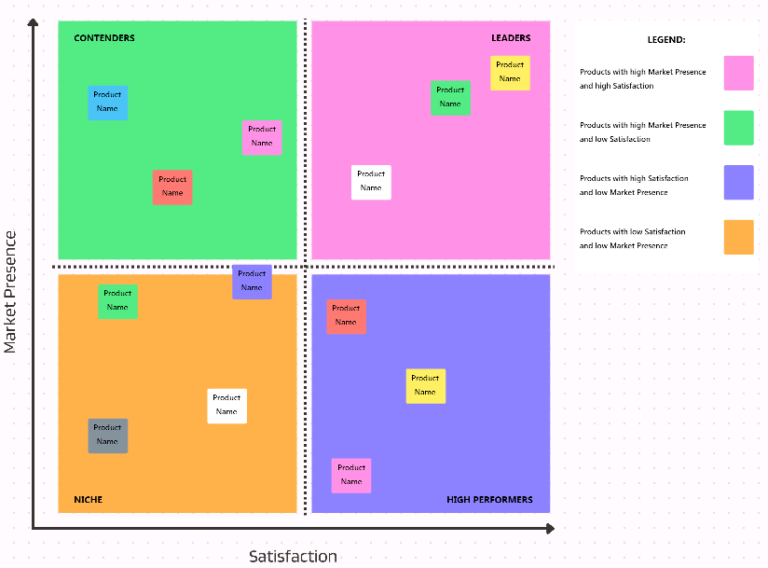
As a bonus, you can start your competitive analysis immediately with the ClickUp Competitive Analysis Template. This template makes competition analysis easy and engaging by building an Ansoff Matrix.
The interactive Whiteboard allows you to add, adjust, and arrange your insights cohesively. Each quadrant compares elements based on your chosen metrics, guided by a clear legend.
With this industry analysis template, you can uncover competitor strengths and weaknesses, understand the market landscape, and develop strategies to stay ahead—whether you’re launching a new product or expanding an existing one.
Also Read: Free Ansoff Matrix Templates

Google Analytics offers valuable insights into your website traffic, revealing visitors’ demographics, location, and behavior patterns.
It also tracks user engagement, showing the pages they browse, how long they stay, and the actions they take—like completing a purchase or submitting a form. These insights empower you to enhance your website’s user experience and boost conversions effectively.
💡 Pro Tip: Integrate Google Analytics into an analytics template with ClickUp to compare your website performance against competitors.

Crayon offers a comprehensive suite of AI-powered tools for competitor analysis. It provides a detailed overview of competitor strategies and tracks everything from social media activity to website updates in real time.
Top features include insights into pricing, products, and market trends, helping businesses stay ahead of industry shifts. With integrations and real-time alerts, Crayon ensures you’re always in the loop on competitor activities.
Today, staying ahead means leveraging every tool at your disposal. Traditional competitor analysis methods can fall short of providing the agility and insights you need to thrive.
That’s where ClickUp comes in.
With powerful features like Custom Dashboards, Collaborative Whiteboards, and optimized integrations, ClickUp helps you analyze your competition, adapt to new markets, and act swiftly.
It’s not just about keeping up—it’s about leading the way. Ready to turn insights into impact?

Sudarshan Somanathan
Max 23min read
Sudarshan Somanathan
Max 22min read
Sudarshan Somanathan
Max 22min read

© 2026 ClickUp





