
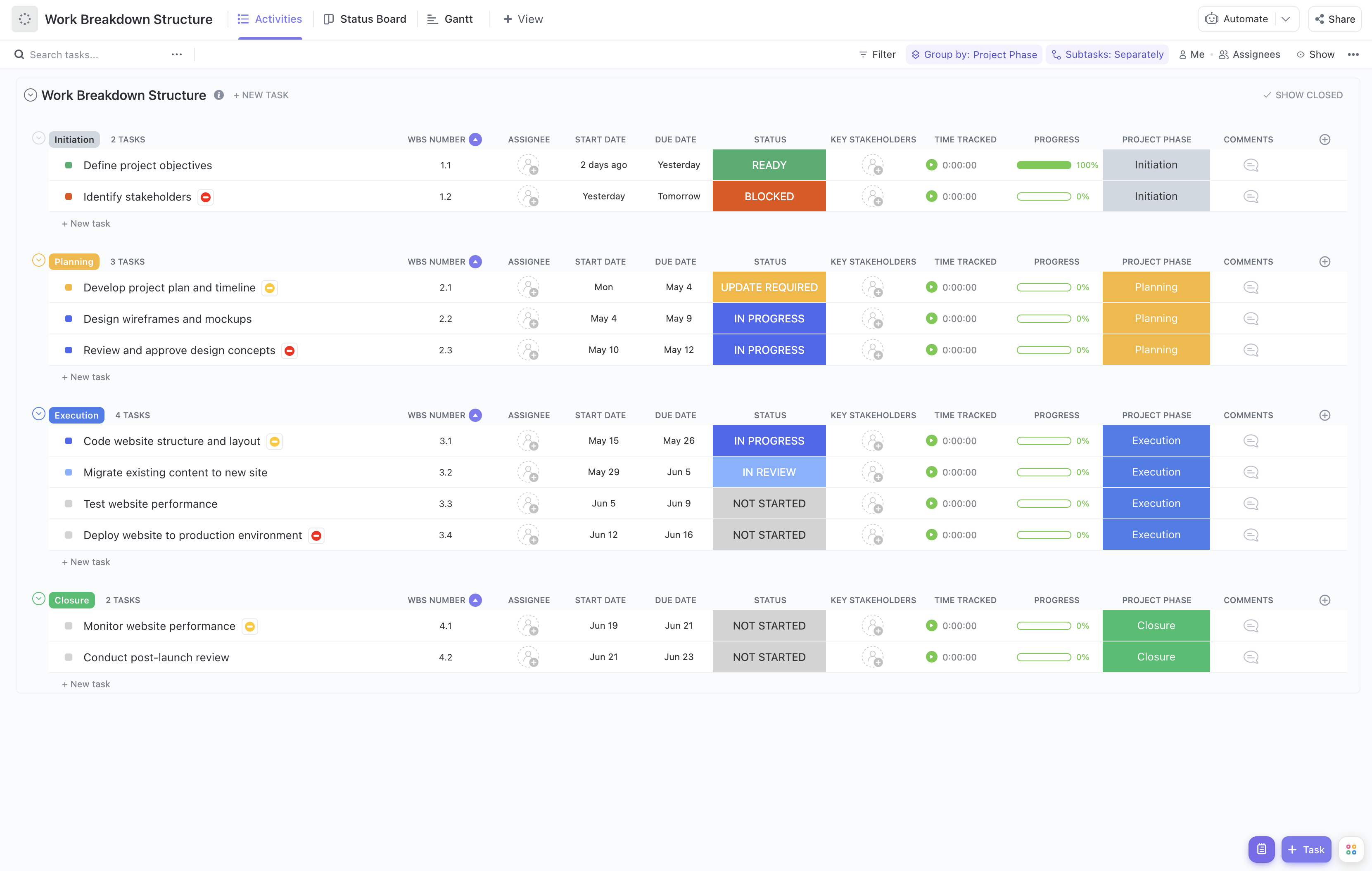


Managing platform incidents requires a structured approach to quickly identify issues, coordinate resources, and implement solutions. This Platform Incident Execution Work Breakdown Structure (WBS) Template is designed to help incident response teams break down the incident management process into manageable, clearly defined tasks.
This specialized template enables you to:
- Segment the incident lifecycle into distinct phases such as detection, diagnosis, resolution, and recovery for enhanced clarity
- Assign specific roles and responsibilities to team members, ensuring accountability and streamlined communication
- Monitor incident progress and key milestones with real-time updates to keep stakeholders informed
Best of all, this template is user-friendly and requires no coding knowledge—just use ClickUp to start organizing your incident response efforts effectively.
Benefits of a Platform Incident Execution Work Breakdown Structure Template
Utilizing a WBS for platform incident execution provides numerous advantages that enhance your incident management capabilities:
- Clearly defines and organizes incident response deliverables and objectives, reducing ambiguity during high-pressure situations
- Clarifies team member roles and responsibilities, minimizing overlap and ensuring critical tasks are covered
- Improves communication flow among incident response teams and stakeholders, facilitating faster decision-making
- Enhances overall efficiency by breaking down complex incident processes into actionable steps, enabling quicker resolution and recovery
Main Elements of the Platform Incident Execution Work Breakdown Structure Template
This template structures the incident response into key components to provide a comprehensive roadmap for execution:
- Incident Identification:
Tasks related to monitoring systems, detecting anomalies, and logging incident details.
- Incident Assessment:
Activities for initial triage, impact analysis, and prioritization to determine the severity and scope.
- Incident Containment:
Steps to isolate affected systems, prevent further damage, and mitigate risks.
- Incident Resolution:
Actions to diagnose root causes, implement fixes, and validate solutions.
- Incident Recovery:
Processes to restore systems to normal operation and verify stability.
- Post-Incident Review:
Conducting retrospectives, documenting lessons learned, and updating incident response plans.
Each task within these elements can be assigned to specific team members with deadlines and progress tracking, ensuring a coordinated and efficient incident response workflow.
By leveraging this Platform Incident Execution Work Breakdown Structure Template, your team can navigate the complexities of incident management with confidence, reducing downtime and improving platform reliability.












