Forrester: ClickUp pays for itself in 6 months
A Forrester study puts three-year ROI at 384% for a composite ClickUp customer, with break-even inside 6 months. We commissioned the study and Forrester built the model.
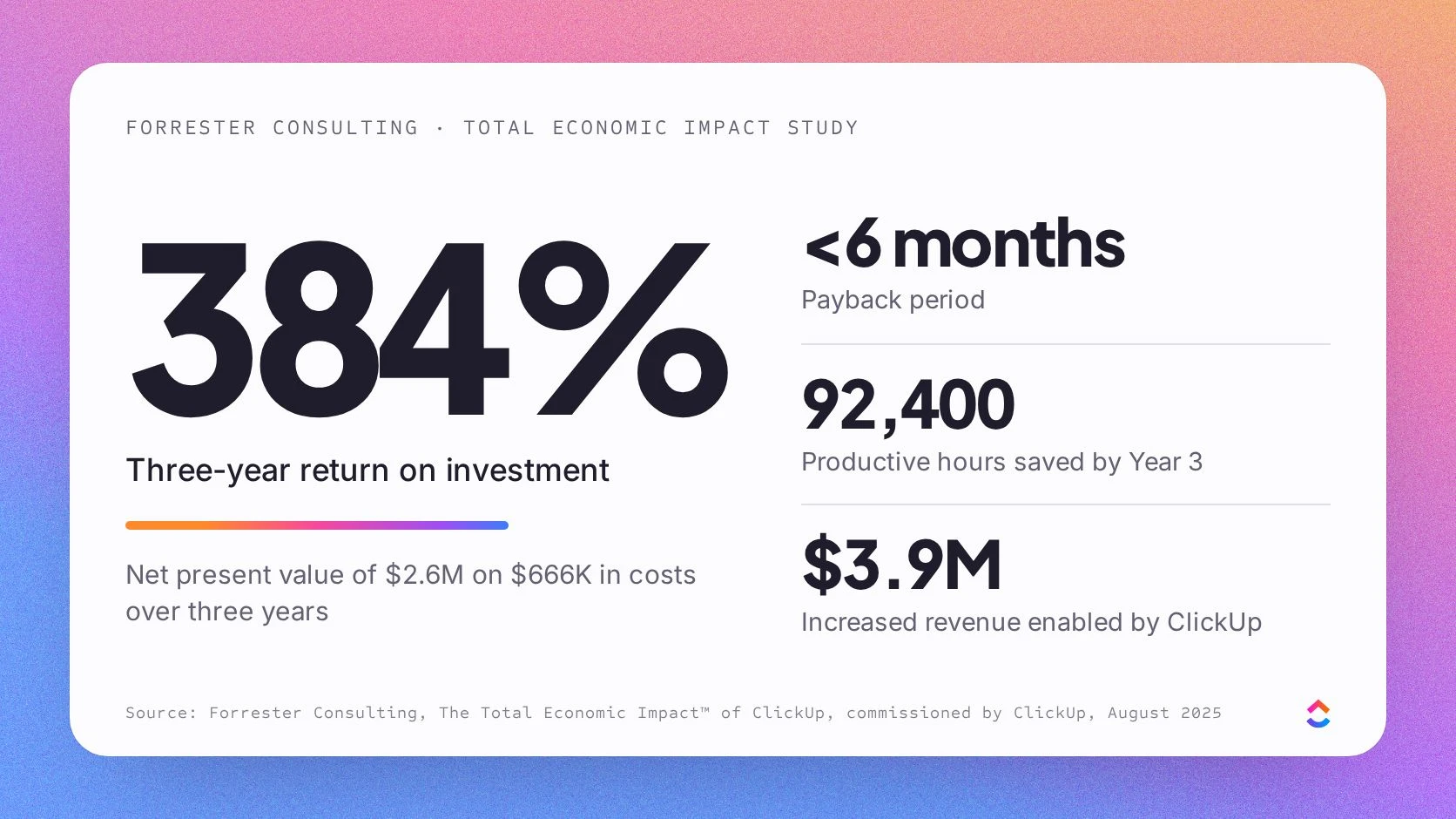
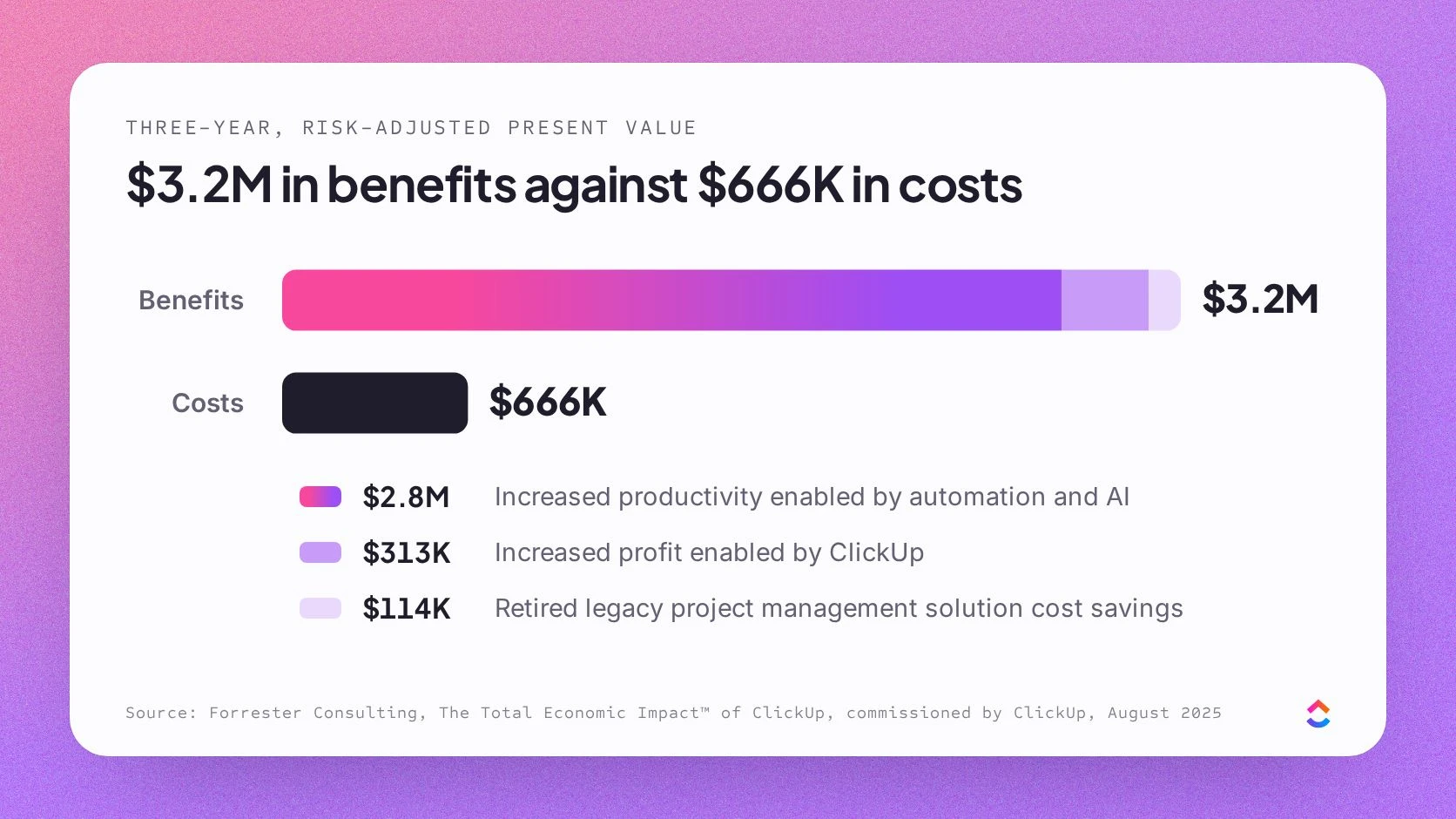
Forrester Consulting puts the three-year return on investment for a composite ClickUp customer at 384%, with break-even inside six months, in a Total Economic Impact study we commissioned and Forrester published in August 2025. The model counts 92,400 productive hours saved by year 3 and $3.9 million in new revenue, against $666,000 in three-year costs. Forrester interviewed five decision-makers at four ClickUp customers, built the financial model, and kept editorial control over what the study says.
The composite behind the 384%
The 384% belongs to a composite organization rather than any single customer. Forrester built it from five interviews at four ClickUp customers in professional services, engineering, crowdfunding, and gaming, ranging from 200 to 2,000 employees. The composite it assembled from them is a global company headquartered in the US with $150 million in annual revenue and 1,000 employees, rolling ClickUp out across five departments and reaching 60% of staff by year 3. Every figure runs against that profile, discounted at 10% a year, and Forrester adjusted each benefit downward for risk before reporting it. Individual results vary.
Where the 92,400 hours come from
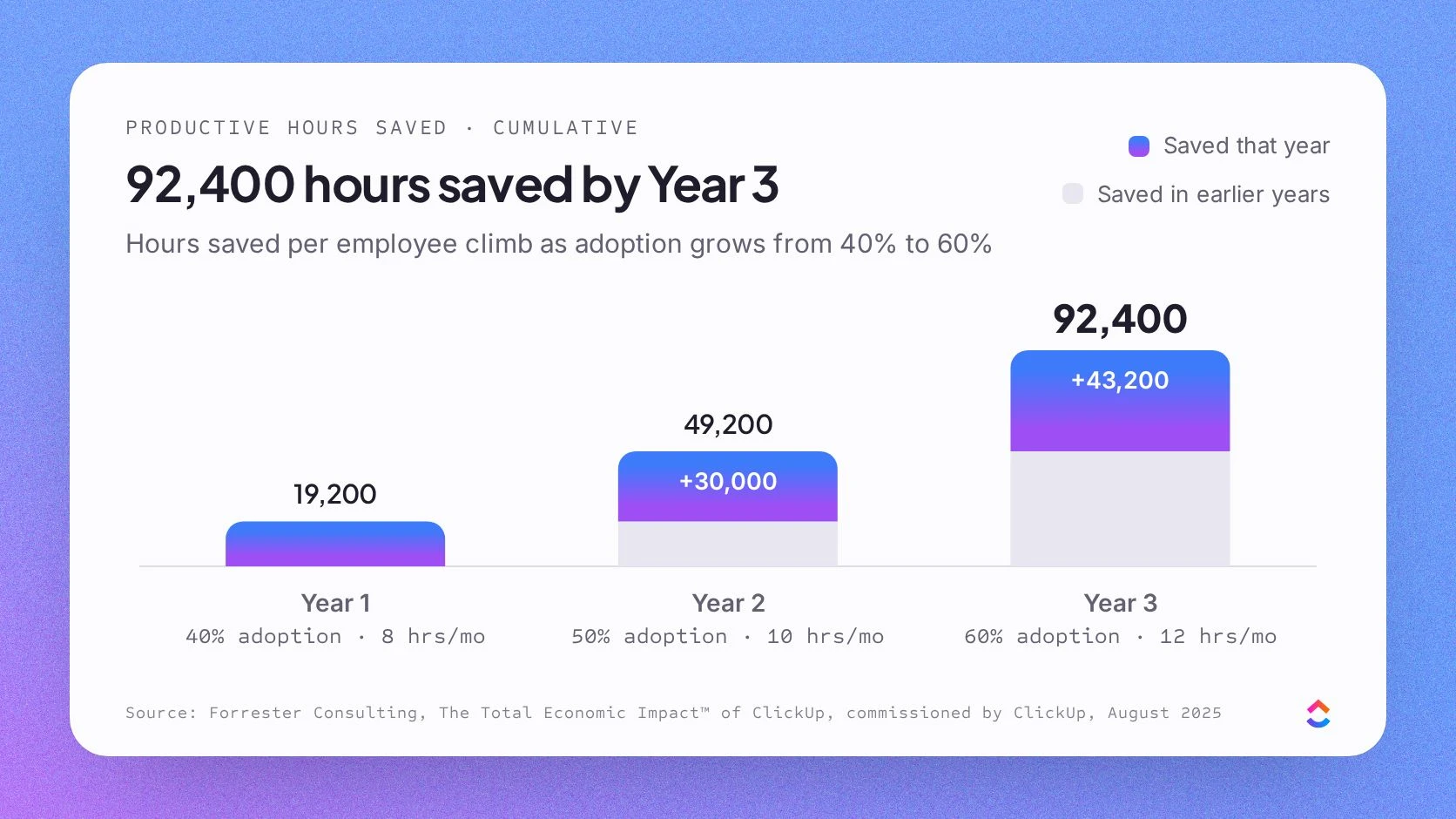
Forrester puts the saving at 8 hours per employee per month in year 1, 10 in year 2, and 12 by year 3, sourced from the interviews and scaled upward as teams get more out of the platform. It counts only half of that time as recaptured value, on the standard reasoning that not all saved time gets redeployed into work that produces value. Run against adoption of 40%, 50%, and 60% of 1,000 employees, that gives 19,200 hours in year 1, 30,000 in year 2, and 43,200 in year 3, which add up to the 92,400. At a fully burdened rate of $44 an hour and a 15% downward risk adjustment, those hours are worth $2.8 million, the largest single benefit in the model.
Automating task creation, updates, and notifications accounts for part of it, along with AI features such as automatic standup summaries, enterprise search, and suggested actions. One interviewee described what happens when the status chatter around every finished action disappears.
"And sometimes you're saving seconds, but you're saving multiple seconds or multiple minutes on every single action that happens in the organization every day. Cumulatively, for an organization of 200, that saves tens of thousands a month on costs."
CTO and managing director, gaming
$3.9M in revenue, $313K in profit
Teams in the study moved reclaimed time into revenue-driving projects, three in year 1, four in year 2, and six in year 3, each worth an average of $300,000. That comes to $3.9 million in new revenue across three years. Forrester carries the profit on it rather than the revenue, at an 11% margin and a 10% risk adjustment, which lands at $313,000 in the benefit model. The gaming company in the study went from producing 12 games a year to 84, a 7x increase in output. A professional services team reported running about 500 marketing operations tasks a month, roughly double what it could handle before.
Legacy tool spend drops 60% by year 3
The composite spent $100,000 a year on project management point solutions before ClickUp, and retires 40% of that in year 1, 50% in year 2, and 60% by year 3. Its IT admins get back the 120 hours a year they had spent maintaining those tools. Together that comes to $114,000 over three years, the smallest of the three quantified benefits. One interviewee put their own savings at over €100,000 a year after decommissioning three point solutions, and another removed a single tool that had cost $50,000 annually.
What Forrester left unquantified
Three benefits appear in the study with no dollar value attached. Client satisfaction scores rose above 90 at the gaming company after response times improved and issues got tracked properly. Interviewees also reported that centralizing tasks, communication, and goals left people feeling more in control of their day, and that real-time updates in one system gave teams a record they could trust instead of chase.
The complete cost model, the risk adjustments, and the interview detail behind every figure above sit in the 20-page report.