







Still downloading templates?
There’s an easier way. Try a free AI Agent in ClickUp that actually does the work for you—set up in minutes, save hours every week.
Sorry, there were no results found for “”
Sorry, there were no results found for “”
Sorry, there were no results found for “”


Offering a token apology after you miss a meeting can make your manager or colleagues feel like you take them for granted or aren’t serious about your work. You must offer a thoughtful and genuine apology and ensure you don’t damage relationships.
While on the surface, this may seem like a minor issue, things like these add up fast, and sometimes, you can’t shake off a perception after it’s created.
Whether it was a last-moment health emergency, simply mismanagement, a genuine reason, an honest mistake, or pure carelessness, apologizing the right way is helpful to everyone.
A well-crafted apology can make a world of difference. It conveys your sincerity, satisfies the other person, and can save professional relationships.
If you’re unsure how to craft a sincere, explanatory response that promises to make things right, you’ve come to the right place.
People miss meetings for many reasons—conflicts, emergencies, technical issues, or simple oversight—but explaining the cause is essential for maintaining professionalism and trust. A strong apology email acknowledges the mistake, shares the reason, and commits to making things right. To prevent repeat misses, tools like ClickUp’s One-on-One Meeting Template help you stay organized, prepared, and aligned for future meetings.
Missed a meeting? Stay on track next time with ClickUp’s free One-on-One Meeting template—stay organized and effortlessly connected.
Before you write an apology email, let’s go over some common reasons why a meeting could have been missed: 🤳🏼
Whatever the reason for missing an important meeting, whether it is acceptable or unacceptable, explaining the reason is a must because it:
An apology email lets you explain why you missed a meeting and express your regret. It mainly consists of three things: the reason for absence, an apology for inconvenience, and a commitment to making amends or rescheduling, if necessary.
Now, the reason you missed the meeting determines the tone of the apology email. If a personal emergency kept you from the meeting, the tone would be matter-of-fact. However, if it was an oversight, sincerely express your respect and value for the meeting organizer’s time.
Even though the ultimate conclusion of all such emails is a genuine apology, how you say it and your sincerity can make all the difference.
If you miss a meeting, the most important thing is to act quickly instead of ignoring it. Start with a prompt, sincere apology, then assess your role in the meeting and what information was missed. Ask for meeting minutes, share your input asynchronously, or propose a new time if decisions are still pending. These quick steps help repair trust, reduce friction, and keep the project moving despite your absence.
It’s okay if you miss a meeting as long as you take prompt action after that. Here’s what you can do to make up for it.👇🏼
When you miss a meeting, time is of the essence. Apologize before someone mentions your absence and questions you about it.
A prompt response is a sign of responsible behavior and taking accountability. Listed below are reasons why reaching out promptly is essential:
What was your role in the meeting? Did you have to share vital information with others?
Was there a crucial decision that required your input? Or was some information meant to be shared with you?
Regardless of the meeting agenda, take remedial actions into account. For example, if you still want to offer your input, write it down in an email or simply propose another time to meet.
If you aren’t fully aware of what happened in the meeting, ask your peers to pass down meeting minutes to learn the meeting outcomes.
Once you are aware of the scope of the meeting, you can begin working on the remedial action. 🔧
Including all the essential details in an apology note is crucial, whether you’re sending an email or a message on Microsoft Teams or Slack.
We will provide several examples to inspire you and help you create a comprehensive checklist of important elements to include. 🙌🏼
An apology must explain the circumstances that led you to miss the meeting, propose corrective actions, and assure the other person you will be more mindful.
Here’s a brief explanation of what you must include in an apology email:
Your apology tone and wording should change depending on whether you missed a meeting due to personal emergencies, overlapping priorities, or technical issues. The examples in this section show you how to admit the mistake, give enough context without oversharing, and offer concrete next steps. Each template balances professionalism with empathy, making it easier to adapt to your situation. You can reuse and customize these structures whenever similar scenarios occur.
Let’s go through a few sincere apology samples for varied scenarios you can take inspiration from.
Dear [Recipient’s Name],
Please accept my apologies for missing our meeting today due to an unexpected personal emergency (explain the reason if shareable; for example, there was a childcare issue that needed immediate attention). I deeply regret any inconvenience this may have caused. I understand the importance of our discussions and assure you this will not happen again.
To prevent missed meetings in the future, I will arrange a backup plan to notify in case of any emergencies and ensure my schedule is more closely monitored. I am committed to making up for lost time and can reschedule at your earliest convenience.
Thank you for your understanding.
Best regards,
[Your Name]
Dear [Recipient’s Name],
I sincerely apologize for missing our meeting today. An urgent task arose unexpectedly, overlapping with another project. The client required immediate attention, and I had to resolve critical issues that could not be deferred.
I understand the inconvenience this caused and assure you this won’t happen again. I will implement better time management and prioritize our meetings accordingly. I am available to reschedule at your convenience.
Thank you for your understanding.
Best regards,
[Your Name]
Dear [Recipient’s Name],
I apologize for missing our meeting today due to severe network connectivity issues. I attempted to connect through multiple devices and networks, including troubleshooting with technical support and trying alternative methods. Unfortunately, none of them established a stable connection in time for the meeting. I regret the inconvenience.
To ensure this doesn’t happen again, I am upgrading my internet service and will have a backup device ready. Additionally, in the future, I will join all the meetings early to address any potential issues beforehand. I am committed to avoiding such disruptions in the future and am available to reschedule at your convenience.
Thank you for your understanding.
Best regards,
[Your Name]
While these are general emails you can use, the tonality and details to be mentioned change based on who you are addressing and the problem faced.
Let’s now look at apology emails based on the email’s recipient. 👥
When writing an email to your superior, you must express your sincerity and understanding of how missing the meeting impacted the entire team and their progress with a project.
Here’s an example email:
Dear [Manager’s Name],
I apologize for missing today’s meeting due to an unforeseen emergency requiring immediate attention. I understand the impact this has on our team’s progress and the project at hand, and I deeply regret the inconvenience.
Could you please share the meeting minutes with me? I want to ensure I am up to speed and can contribute effectively. I can reschedule and discuss any missed points at your earliest convenience.
Thank you for your understanding and patience.
Best regards,
[Your Name]
When writing to your peers, it is essential to express mutual respect. Since there is no hierarchy here, they should not feel that you disrespect their time or take them lightly.
Here’s how you can write an apology email to your colleagues:
Dear Team,
I apologize for missing today’s meeting. I was unexpectedly called into another urgent matter that required my immediate attention. I deeply regret any disruption this caused and fully acknowledge the importance of our collaboration.
I respect your time and the effort you put into these meetings. To avoid this in the future, I will better coordinate my schedule and ensure all commitments are met. I appreciate your understanding and will review the meeting notes to stay updated.
Thank you for your patience.
Best regards,
[Your Name]
Clients are key in any business. While your manager or colleagues might understand why you were absent, missing a business meeting with a client is crucial to handle correctly to avoid losing their trust.
Here’s how to craft a sincere client apology:
Dear [Client’s Name],
On behalf of our team, I’d like to sincerely apologize for missing yesterday’s scheduled meeting. We deeply value your business and the partnership we have built with you.
We understand the importance of our discussions and the impact of our absence on your priorities. Please accept our apologies for any inconvenience caused. Your business is crucial to us, and we are committed to ensuring such oversights do not happen again.
We would greatly appreciate the opportunity to schedule the next meeting as soon as possible. Thank you for your understanding and continued partnership.
Warm regards,
[Your Name]
[Your Position]
[Your Company]
ClickUp helps you manage the whole “missed meeting” lifecycle—from drafting apologies to rescheduling and tracking follow-up actions. You can use ClickUp Docs to draft and store email templates, ClickUp Brain to generate AI-powered apology messages, and ClickUp Tasks to turn meetings and follow-ups into actionable items. Calendar views, automations, and meeting templates keep everything organized so fewer things slip through the cracks.
Are you confused about how to manage meetings?
Do tasks such as drafting emails, sending timely apologies, and rescheduling meetings take up much of your time?
It’s time you simplify your to-do list with an effective project management tool like ClickUp.
It has various features to help you with the distinct processes necessary to collaborate with your team and manage your schedule.
Let’s explore! 🗺️
If you miss a meeting, you can use ClickUp Docs to draft an email, refine it, and review it.
You can also draft an apology message on Docs and collaborate with others to review it before you send it to a client on behalf of your company.
With features like rich formatting, comments, and task assignments within documents, Docs ensures clarity and consistency in email communication.
Plus, Docs is an excellent place to store email templates you have created to use in the future if similar unforeseen circumstances arise.

You might lack the inspiration to write an apology email; sometimes, you don’t have time for it.
That’s where the power of AI tools for meetings comes in.
ClickUp Brain helps you draft and automatically send emails while focusing on more strategic tasks.
It acts as your writing assistant, with built-in grammar and spell checks to help you quickly write messages and reply to missed meetings.
With ClickUp Tasks, you can create a task for a meeting directly from an email.
You can directly link the apology message in the task to convey your apology to everyone involved without switching to your email.
This makes the whole process easier and eliminates the need to send separate emails.
With ClickUp’s task management features, you can schedule meetings, set reminders, and attach relevant documents or notes directly to tasks. This integration prevents oversights by providing clear timelines and priorities.

Further, task dependencies and recurring task options automatically schedule recurring meetings or follow-up actions, keeping teams aligned and on track.
ClickUp’s Email Project Management and Calendar View let you see all your commitments in one place and quickly reschedule missed meetings. You can create new meeting tasks, invite the right stakeholders, and attach recordings or Docs for notes. Comments within tasks make it easy to propose new times and confirm availability asynchronously. Automations and calendar integrations ensure future meetings are synced and visible, minimizing repeat mistakes.
ClickUp for Email Project Management lets you link your calendar and access the ClickUp Calendar View to see which dates are occupied to reschedule the meeting.
Once you have clarity, you can create a meeting task and add relevant stakeholders.

Create a task for each meeting and tag all the members who must attend. You can attach meeting recordings to these tasks for those who missed the meeting or even for later reference.
You can easily add ClickUp Docs to the meeting so the group can jot down meeting notes and refer to them later.
The best part is adding comments within the task after the meeting. You can propose an alternate time for the meeting and tag team members.
As soon as everyone confirms their availability, you can schedule a meeting.

You can also set up automation within ClickUp to create meeting tasks or reminders. For example, you can create an automation that triggers a meeting reminder when a specific condition is met, such as a due date approaching.
ClickUp also integrates with calendar applications like Google Calendar and Outlook. Sync your Tasks with these calendars to automatically create meeting events.
ClickUp offers meeting templates like the One-on-One Meeting Template and Agenda Template to help teams run structured, efficient sessions. These templates allow you to organize agendas, assign tasks, create checklists, collaborate with attendees, and track progress in real time. They streamline preparation and ensure every meeting runs smoothly and consistently.
ClickUp provides meeting templates to help you set up meetings for your team, one-on-one or skip-level meetings.
We’ll walk you through some templates to see how they can help you execute meetings better. 🧑💻
The ClickUp One-on-One Meeting Template can help you set up fruitful meetings with your colleagues. It includes a list of tasks, subtasks, and checklists for clear purposes and meeting agendas.
Collaborate with your team and personalize the template to get started!
With this template, you can:
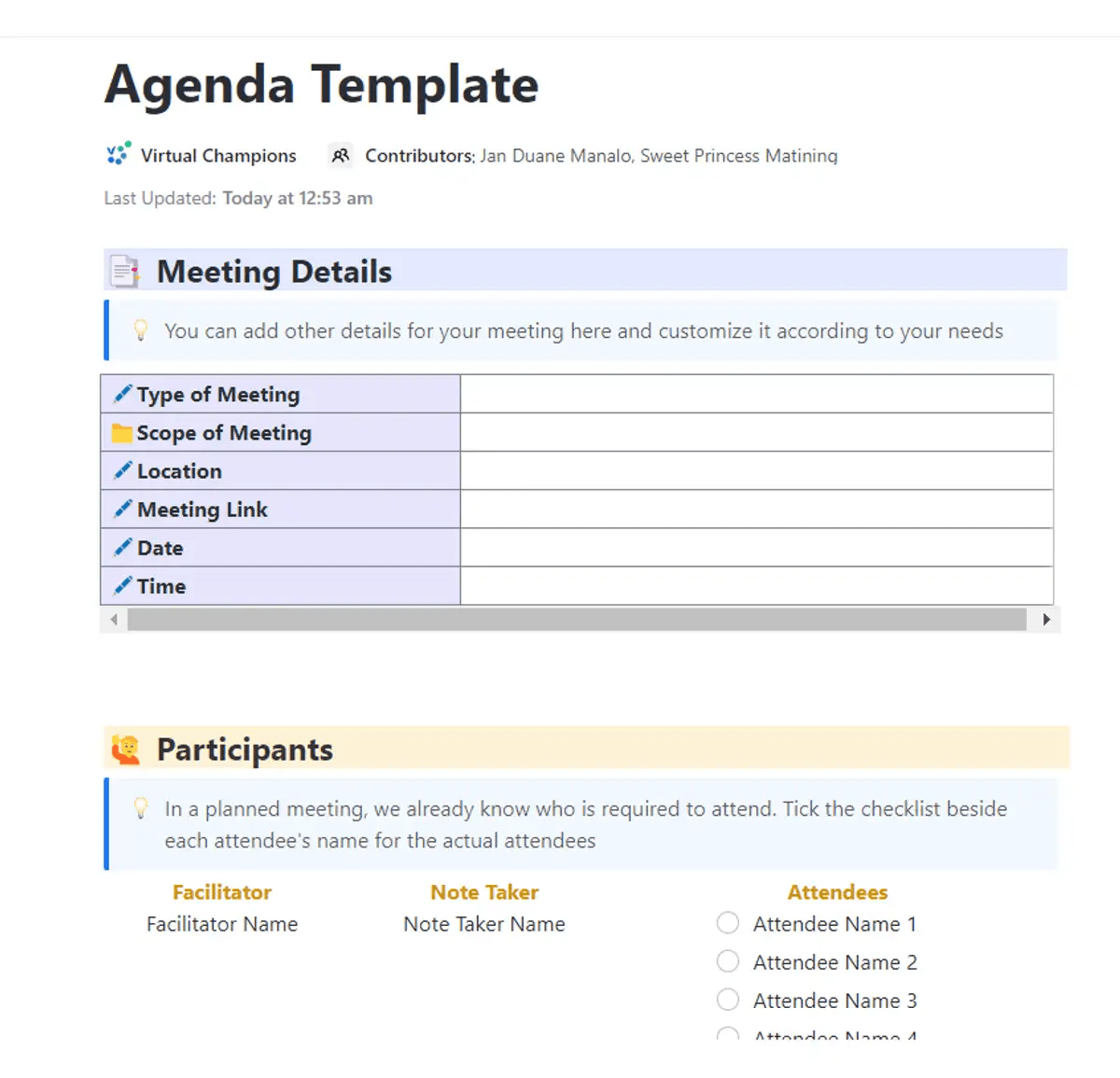
Use the ClickUp Agenda Template to set an agenda for your meeting and track details such as the meeting’s type, scope, location, meeting links, and a participant checklist.
With this template, you can:
Preventing missed meetings starts with simple habits—confirming details, prioritizing commitments, and maintaining balance. ClickUp’s Google Calendar Integration gives you a unified view of all engagements, while ClickUp Reminders and Zoom Integration make it easy to stay on schedule and join meetings directly from tasks. Together, these tools create a reliable safety net that minimizes oversights and keeps you consistently prepared.
Missing a meeting is unfortunate, but you can prevent it from happening again. Let’s dive deeper into how you can stay on top of future meetings. 👀
ClickUp’s Google Calendar Integration simplifies this by presenting all your engagements in one place, preventing overlaps and helping you better prioritize.


Use ClickUp’s Zoom Integration to streamline your meeting management process further. One of the most convenient features is the ability to start a Zoom meeting directly within a task.
Simply click the Zoom meeting button or use the /zoom slash command to quickly schedule and join meetings without switching between apps.

After the meeting, ClickUp also makes it easy to track and manage the recording. The integration automatically updates the task with meeting details and an optional recording link, so you can easily access the recording later if needed.
Apologizing for missing a meeting is essential for maintaining good professional relationships, following up on lost information, and ensuring no miscommunications occur.
You can minimize the impact and keep yourself guilt-free when done appropriately and on time.
ClickUp provides online meeting tools to quickly craft a sincere apology email and schedule new meetings when necessary. Reminders and digital calendars also ensure you never miss a meeting again.
Sign up for ClickUp today to better manage damage control for missed meetings. 🗓️

© 2026 ClickUp

There’s an easier way. Try a free AI Agent in ClickUp that actually does the work for you—set up in minutes, save hours every week.