
Choosing an AI app builder sounds simple, especially now that 84% of developers use or plan to use AI tools in their workflow, according to Stack Overflow’s 2025 Developer Survey. But the real decision is not about which one generates prettier code. It is about whether you want full control over your stack or the fastest path to a working app.
That single trade-off shapes everything from your launch timeline to what happens when you outgrow the platform. This guide breaks down Base44 vs. Lovable across AI generation, backend control, code ownership, integrations, and use-case fit. It also looks at how ClickUp, a Converged AI Workspace, supports the requirements, sprint planning, and team coordination that neither builder is designed to handle on its own.
Base44 vs. Lovable: Which AI Builder Is Right for You?
- Base44 vs. Lovable at a Glance
- What Is Base44?
- What Is Lovable?
- Base44 vs. Lovable: Key Feature Comparison
- Why ClickUp Is a Strong Alternative to Base44 and Lovable
- Should You Choose Base44, Lovable, or ClickUp?
- Frequently Asked Questions
- Can I migrate an existing Base44 project to Lovable?
- Is Base44 or Lovable better for the developer team collaboration?
- Can you use Base44 or Lovable without any coding experience?
- What are the best Base44 and Lovable alternatives for managing app development work?
- What happens when you outgrow Base44 or Lovable?

 Summarize this article for me please
Base44 vs. Lovable at a Glance
At a high level, Base44 is a fully managed, prompt-to-app builder designed for non-technical users who want a working prototype quickly. Lovable generates exportable React and TypeScript code from AI prompts, giving developers more ownership and deployment flexibility.
| Feature / Category | Base44 | Lovable |
|---|---|---|
| Primary approach | No-code, prompt-to-app builder | AI-generated React/TypeScript with full code export |
| Target user | Non-technical founders, ops, marketers | Developers and technically-comfortable builders |
| AI capabilities | Prompt-based generation with Builder Chat and Plan Mode | Agent Mode, Chat Mode, and credit-free Visual Edits |
| Backend | Fully managed (NoSQL, serverless, auth, file storage) | Supabase (PostgreSQL, auth, file storage)—you own it |
| Code ownership | Frontend export only; backend stays on Base44 servers | Full-stack two-way GitHub sync; deploy anywhere |
| Integrations | Curated built-ins (payments, email, AI, auth) | Granular external APIs (Stripe, Clerk, OpenAI, Resend) |
| Learning curve | Minimal—zero setup, prompt-driven | Moderate—requires Supabase config and GitHub familiarity |
| Team collaboration | Link-based sharing, no co-editing | GitHub sync enables developer handoff; no sprint tools |
📮 ClickUp Insight: Low-performing teams are 4x more likely to juggle 15+ tools, while high-performing teams maintain efficiency by limiting their toolkit to 9 or fewer platforms. But how about using one platform? As the everything app for work, ClickUp brings your tasks, projects, docs, wikis, chat, and calls under a single platform, complete with AI-powered workflows. Ready to work smarter? ClickUp works for every team, makes work visible, and allows you to focus on what matters while AI handles the rest.
Summarize this article for me pleaseWhat Is Base44?
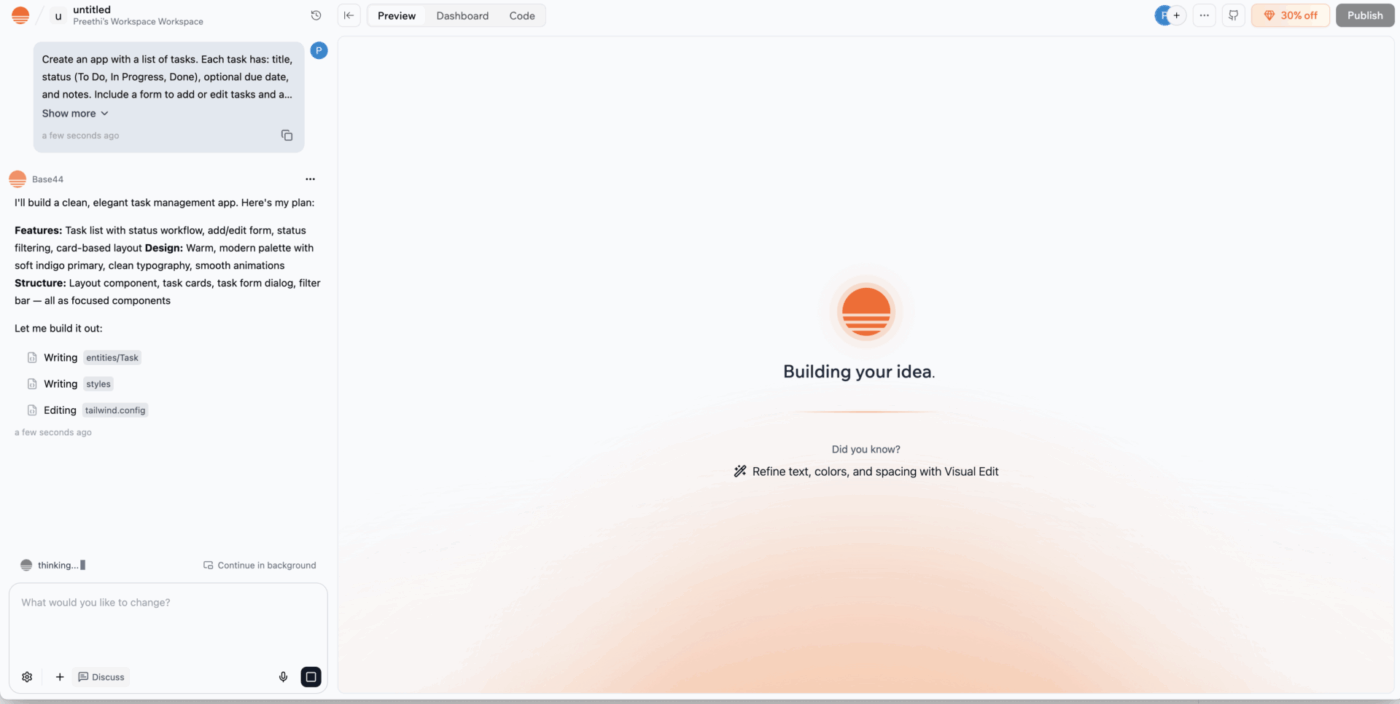
Base44 is a browser-based AI app builder that turns natural-language prompts into full-stack web apps—complete with databases, authentication, and UI—in about a minute. It’s a complete no-code app environment where you refine output through follow-up prompts, telling the AI what to change rather than editing files directly.
You describe what you want in plain English, pick an AI model (GPT-5, Claude Sonnet, or Gemini), and Base44 scaffolds the entire app—frontend, backend, database schema, and auth—in one step. Builder Chat lets you refine the app conversationally after the initial generation. Plan Mode adds a checkpoint layer: the AI shows you a proposed plan of what it intends to modify, and you approve or adjust before anything is applied.
Non-technical teams—founders validating an idea, ops managers who need an internal tool, or marketers building a landing page—can go from concept to live app without touching a terminal.
⚠️ While the output is visually polished and ready for immediate sharing, there is a clear trade-off: even on paid plans, Base44 only exports frontend code. Backend logic and data stay on Base44’s infrastructure—you can’t self-host the full stack. For rapid prototyping and internal tools, that trade-off may be acceptable. For anything you plan to scale, migrate, or hand off to a development team, it becomes a much more serious limitation.
📖 Also read: Best No-Code App Builders
Summarize this article for me pleaseWhat Is Lovable?
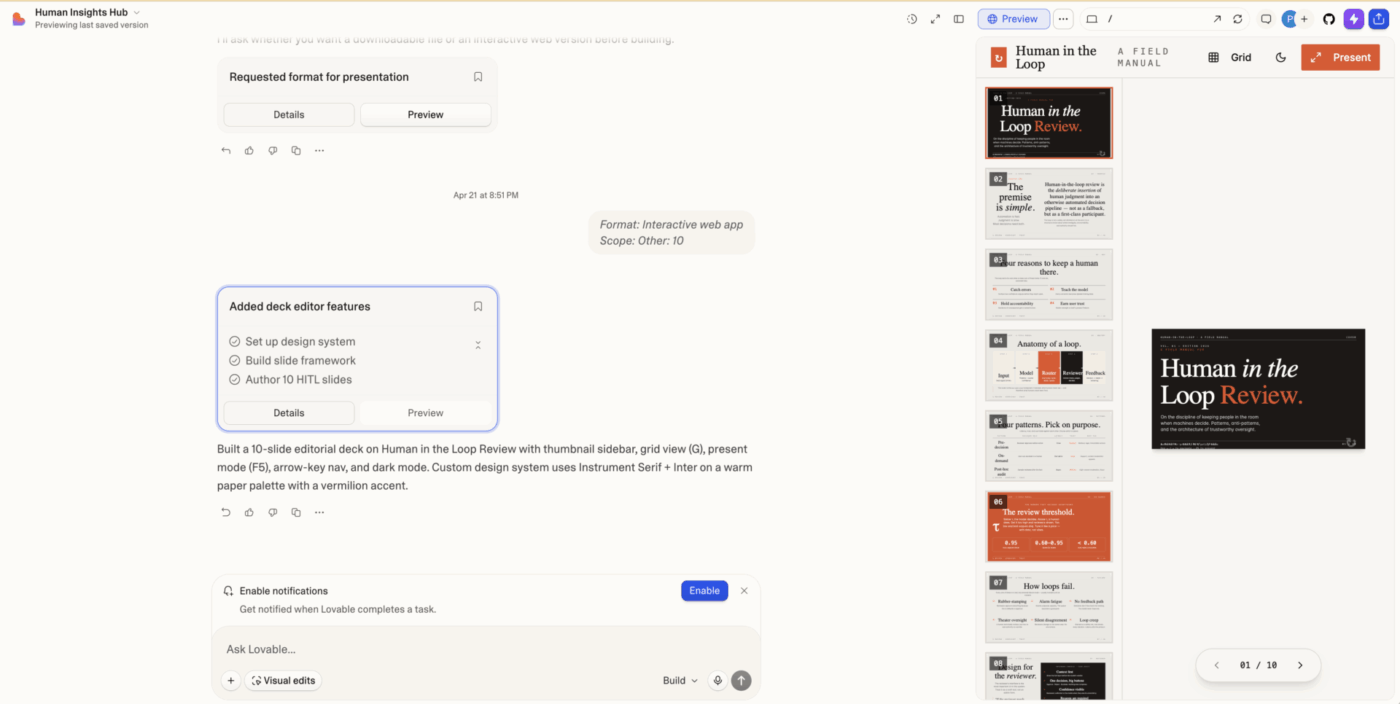
Lovable is an AI app builder that generates real, exportable React and TypeScript code from natural-language prompts. Unlike fully managed builders, it is designed around code ownership: everything it builds syncs to GitHub, and you can deploy the codebase on your own infrastructure whenever you want.
Lovable splits its AI capabilities across three distinct working modes. Agent Mode is the most autonomous—you describe a feature or an entire app, and the AI builds it end-to-end, writing React components, setting up routing, and connecting APIs without step-by-step guidance. Chat Mode is collaborative: you discuss architecture, ask the AI to explain trade-offs, and refine requirements before any code is generated, essentially pair-programming with an AI partner. Visual Edits is a credit-free mode that lets you make UI changes directly in a visual editor without consuming generation credits.
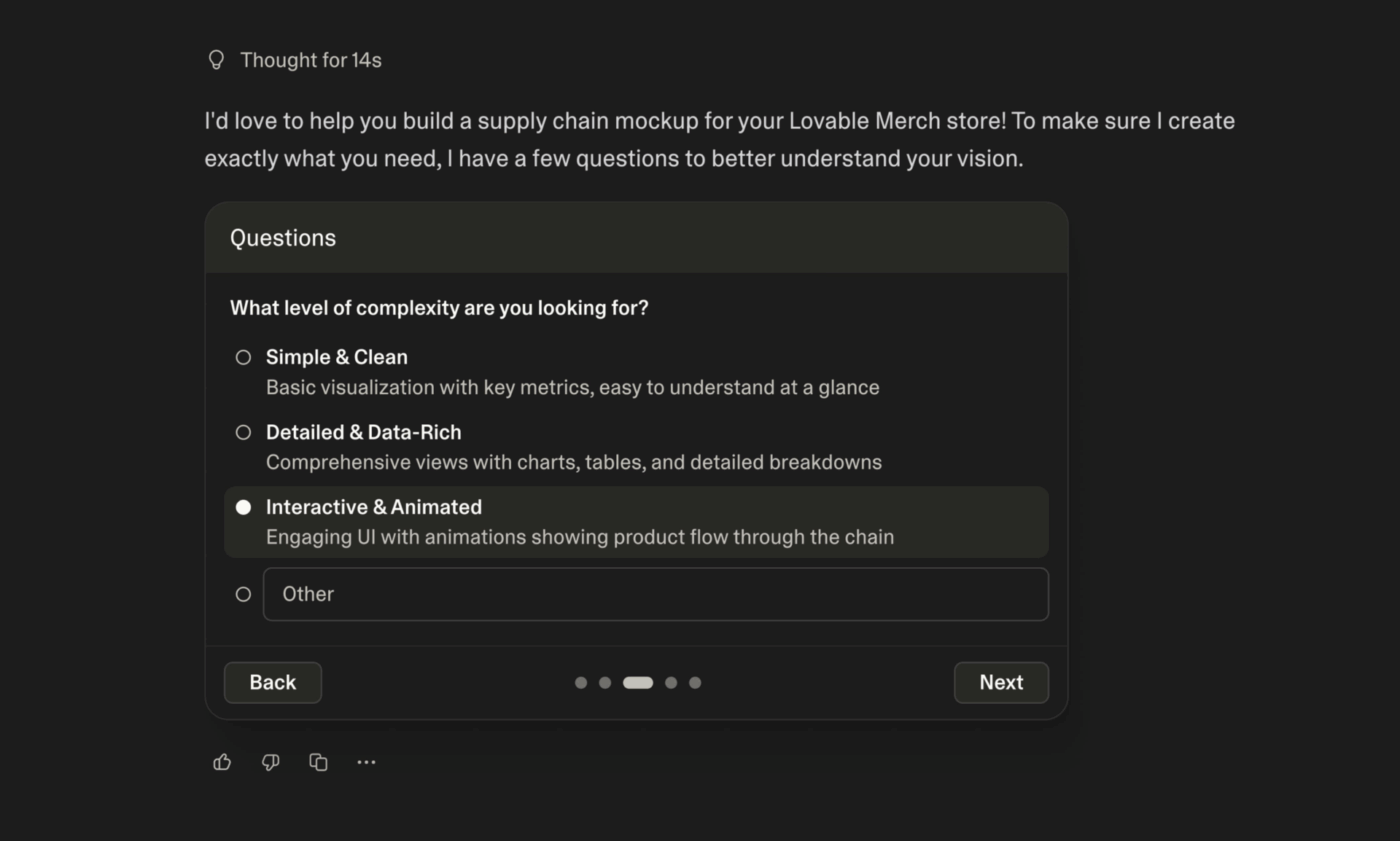
Lovable connects to Supabase for PostgreSQL, authentication, and file storage. It also integrates with Stripe (full payments API), Clerk (SSO and user management), OpenAI (direct LLM access), and Resend (transactional email). Two-way GitHub sync means every change the AI makes is committed to your repo, and changes you push from your local environment are reflected in Lovable’s editor.
⚠️ The trade-off for this flexibility is upfront configuration. Non-technical users may find the Supabase setup, GitHub workflows, and architectural decisions intimidating. Credit consumption also scales with prompt complexity—detailed multi-step builds burn through credits faster in Agent Mode.
📖 Also read: Best AI App Builders
Summarize this article for me pleaseBase44 vs. Lovable: Key Feature Comparison
Choosing the right tool depends on where you want that AI to sit in your workflow. While both platforms generate working apps from natural-language prompts, they serve entirely different builders: one prioritizes the fastest path to a live product. In contrast, the other prioritizes the developer’s long-term ownership.
Each section below compares how Base44 and Lovable handle the core pillars of app development.
AI-powered app generation
Base44’s core promise is speed. You type a description, select a model (GPT-5, Claude Sonnet, or Gemini), and the platform generates a complete full-stack application in one pass. After the initial build, Builder Chat lets you iterate conversationally—tell it to “add a search bar” or “change the user permissions,” and it rewrites the underlying architecture without you touching code. Plan Mode adds a review layer before any changes are applied, giving non-technical builders a confidence checkpoint at each iteration.
Lovable approaches generation differently by splitting it across three modes. Agent Mode handles full autonomous builds—you describe a feature, and the AI writes components, sets up routing, and connects APIs end-to-end. Chat Mode is for planning and architecture discussions before code is written, acting more like a collaborative design session than a prompt box. Visual Edits handles cosmetic changes at zero credit cost, so you’re not burning tokens on spacing and color tweaks.
Neither system is foolproof. Base44 can struggle when your app logic becomes highly layered, sometimes requiring repetitive prompting to get complex features right. Lovable’s Agent Mode can consume credits quickly on large builds, and the quality of output depends heavily on how clearly you articulate the architecture upfront.
👀 The verdict: Base44 is best for fast, single-pass app generation when you want minimal technical involvement. Lovable gives you more control over the generation process through its three-mode system, but you’ll need to understand what you’re asking for.
Code ownership and portability
This is where the gap between the two platforms is widest—and it’s often the deciding factor.
On paid plans, Base44 lets you export frontend code via GitHub integration or as a ZIP download. This gives you access to the UI layer—React components, styling, and routing. However, the backend (database, serverless functions, auth logic, file storage) stays on Base44’s infrastructure. You can’t export it, self-host it, or migrate it to another provider. For quick prototypes and internal tools where long-term portability isn’t a priority, this is fine. For anything you plan to scale or hand off to a development team, it’s a serious limitation.
Lovable’s entire codebase—React components, TypeScript logic, routing, API connections—syncs to your GitHub repository with two-way synchronization. Changes you make in Lovable appear as commits in your repo; changes you push from VS Code or any local editor are reflected in Lovable’s interface. You can clone the repo, run it locally, deploy it to Vercel, Netlify, or your own servers, and never open Lovable again. The code is standard React and TypeScript built with Vite, so any developer can pick it up without learning a proprietary framework.
👀 The verdict: Lovable wins on code ownership—there’s no comparison. Base44’s frontend export is a useful escape valve for simple projects, but Lovable’s full-stack GitHub sync is the only real answer if you plan to build on, scale, or hand off what you create.
Backend and database management
Base44 provides a fully managed backend with a NoSQL-style database, serverless functions, file storage, and built-in authentication. All of this is auto-generated from your initial prompt—the AI infers the data model, creates collections, and sets up relationships based on what you described. You can view and edit data through a built-in admin panel, but you can’t write raw database queries, modify the schema outside of what the AI supports, or migrate the backend to your own servers.
Lovable connects to Supabase, which gives you a full PostgreSQL database—admired by 65.5% of developers in Stack Overflow’s 2025 survey—with row-level security, real-time subscriptions, file storage, and built-in authentication. You own the database entirely: it lives in your Supabase account, and you can access it via SQL, the Supabase dashboard, or any PostgreSQL client. Lovable’s AI can generate database schemas, write queries, and set up auth flows, but you have full control to modify anything directly.
👀 The verdict: For non-technical users who don’t want to think about databases, Base44’s managed backend is a genuine time-saver. For teams that need real relational data, custom queries, or the ability to migrate away from the platform, Lovable’s Supabase integration is the only option.
Set up complexity and ease of use
Base44’s setup is effectively zero. You sign up, type a prompt, and the platform generates a working app with backend, database, hosting, and auth already configured. There’s no external service to connect, no API key to paste, no infrastructure decision to make. The entire environment is self-contained. This makes it the fastest path from idea to live app, especially for product managers, founders, or anyone who doesn’t want to think about DevOps.
Lovable starts with the same natural-language prompt experience, but the setup path diverges quickly. To use a database, you need to connect to Supabase—which means creating a Supabase account, generating API keys, and linking the project. For payments, you configure Stripe credentials. For auth beyond Supabase’s built-in system, you set up Clerk. Each integration adds a configuration step. This isn’t difficult for developers, but it requires architectural decisions that non-technical users may find intimidating.
📌 Important: Base44 and Lovable help you build applications. They do not replace the operational layer required to ship them. You still need a system for capturing requirements, assigning owners, tracking bugs, managing approvals, and keeping stakeholders aligned—and neither tool provides that.
👀 The verdict: Base44’s simplicity wins on day one for non-technical builders. Lovable’s complexity is a hurdle upfront, but it’s a feature once you need to perform a custom override or hand the project to a developer.
Integrations and extensibility
Base44 bundles integrations directly into the platform. Payments, email, AI model access, and authentication are all available as built-in features you enable through the interface or via Builder Chat—no separate accounts required for common workflows. It also connects to Zapier, opening access to 6,000+ apps without managing API keys or custom webhooks. The trade-off is granularity: you’re limited to what Base44 exposes and can’t customize underlying API calls, webhook configurations, or event handling.
Lovable takes the opposite approach—it connects to specialized external services and gives you direct access to their full APIs. Stripe integration includes the complete payments API: subscriptions, invoices, webhooks, and custom checkout flows. Clerk handles SSO, multi-factor auth, and user management with its own dashboard. OpenAI access lets you call GPT models directly from your app’s code. Resend manages transactional email with deliverability tracking. Each integration requires its own account and configuration, but you get the full power of each service with no platform abstraction getting in the way.
👀 The verdict: Base44 is faster for common integrations and non-technical users. Lovable is the only real option for teams building production-grade B2B SaaS that need granular control over their payments, auth, and communication stack.
📮 ClickUp Insight: Context-switching is silently eating away at your team’s productivity. Our research shows that 42% of disruptions at work come from juggling platforms, managing emails, and jumping between meetings. ClickUp unites your workflows and chat under a single, streamlined platform—while AI-powered features keep the context connected, searchable, and manageable.
Summarize this article for me pleaseWhy ClickUp Is a Strong Alternative to Base44 and Lovable
The real tension in the Base44 vs. Lovable debate isn’t just how you build—it’s how you manage everything around the build. Both platforms can generate and ship apps, but neither solves the coordination problem that stalls most teams: scattered requirements, bug reports in chat, feedback in docs, and status updates spread across tools. That fragmentation is a form of work sprawl.
🧠 Fun Fact: Workers toggle between apps 1,200 times a day—nearly 4 hours a week in attention resetting, or 9% of annual work time.
ClickUp is built to eliminate that sprawl by bringing tasks, docs, chat, meetings, dashboards, AI, and connected knowledge into one place. It doesn’t replace Base44 or Lovable—it manages everything else, so the build doesn’t get lost in tool fragmentation.
Customer story: Pressed
Pressed uses ClickUp to prioritize engineering work through automated sprints while giving Product and Marketing clear visibility into progress. That makes it a strong fit here because the challenge is not just building faster. It is keeping the whole team aligned once work is in motion.
Keep the delivery context connected with ClickUp Brain and Super Agents
Base44 and Lovable can build apps, but they don’t understand the full workflow behind them. ClickUp Brain helps teams connect tasks, docs, chats, meetings, and related knowledge so they can quickly surface blockers, shifting requirements, and next steps without manually piecing everything together.
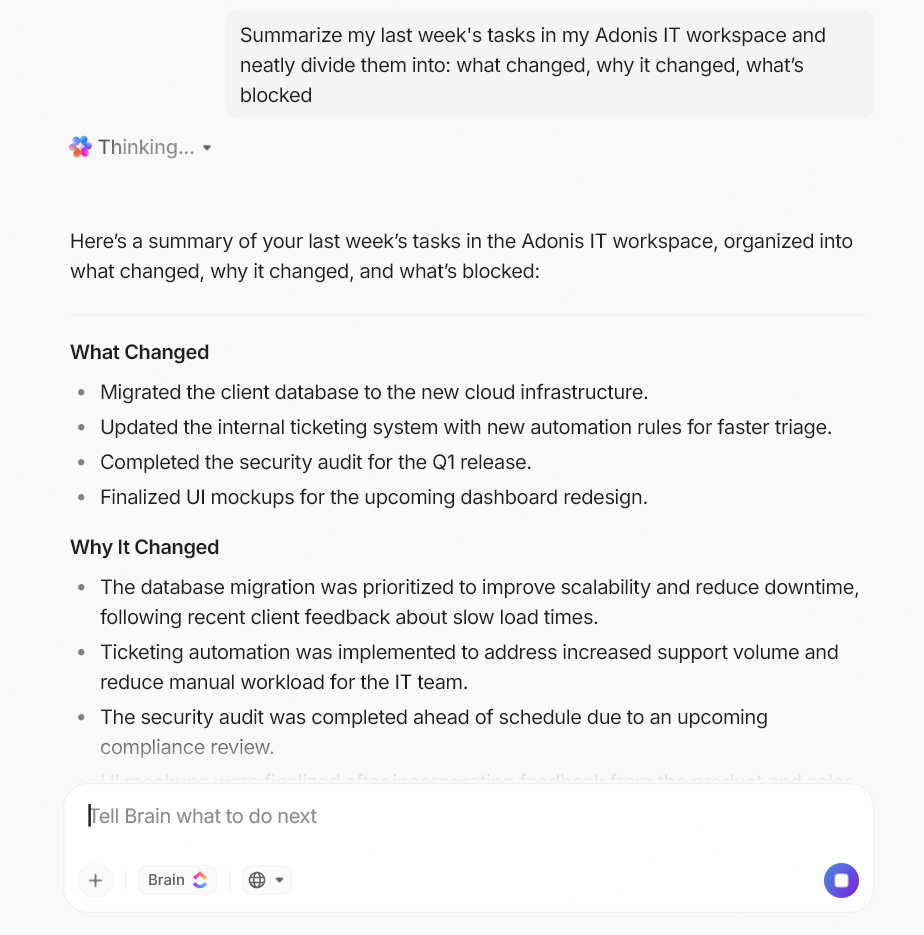
ClickUp Enterprise Search further strengthens this by making it easier to find decisions, updates, and context across the workspace and connected tools.
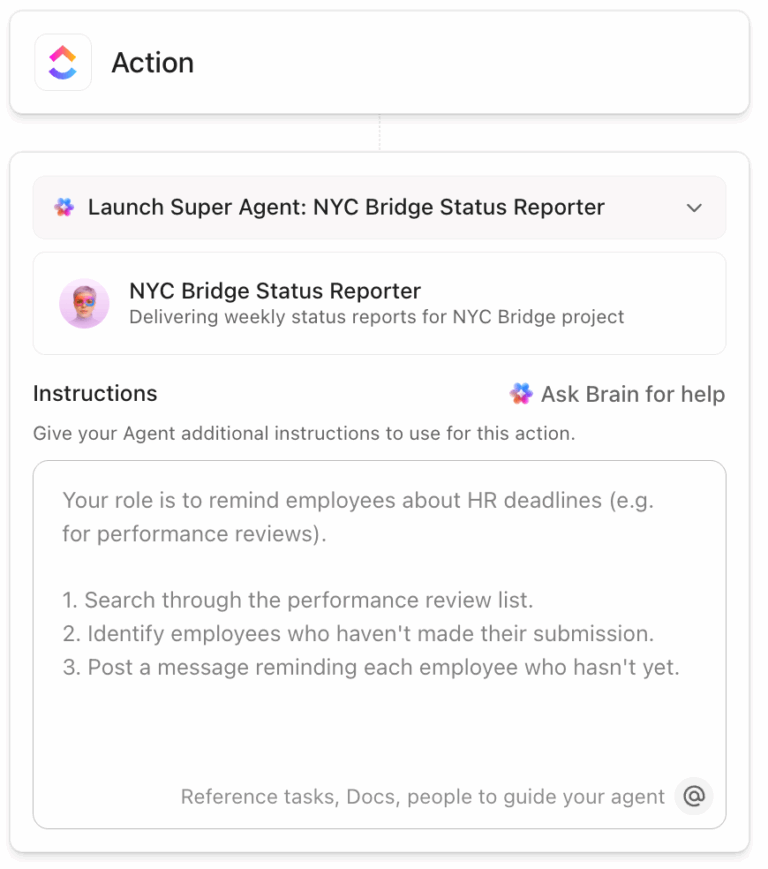
ClickUp Super Agents add a more powerful agentic layer. Using ClickUp’s no-code builder, teams can configure it to handle multi-step work across the delivery cycle, whether that means monitoring deadlines, surfacing blockers, summarizing progress, updating stakeholders, or triggering the next action when work changes.
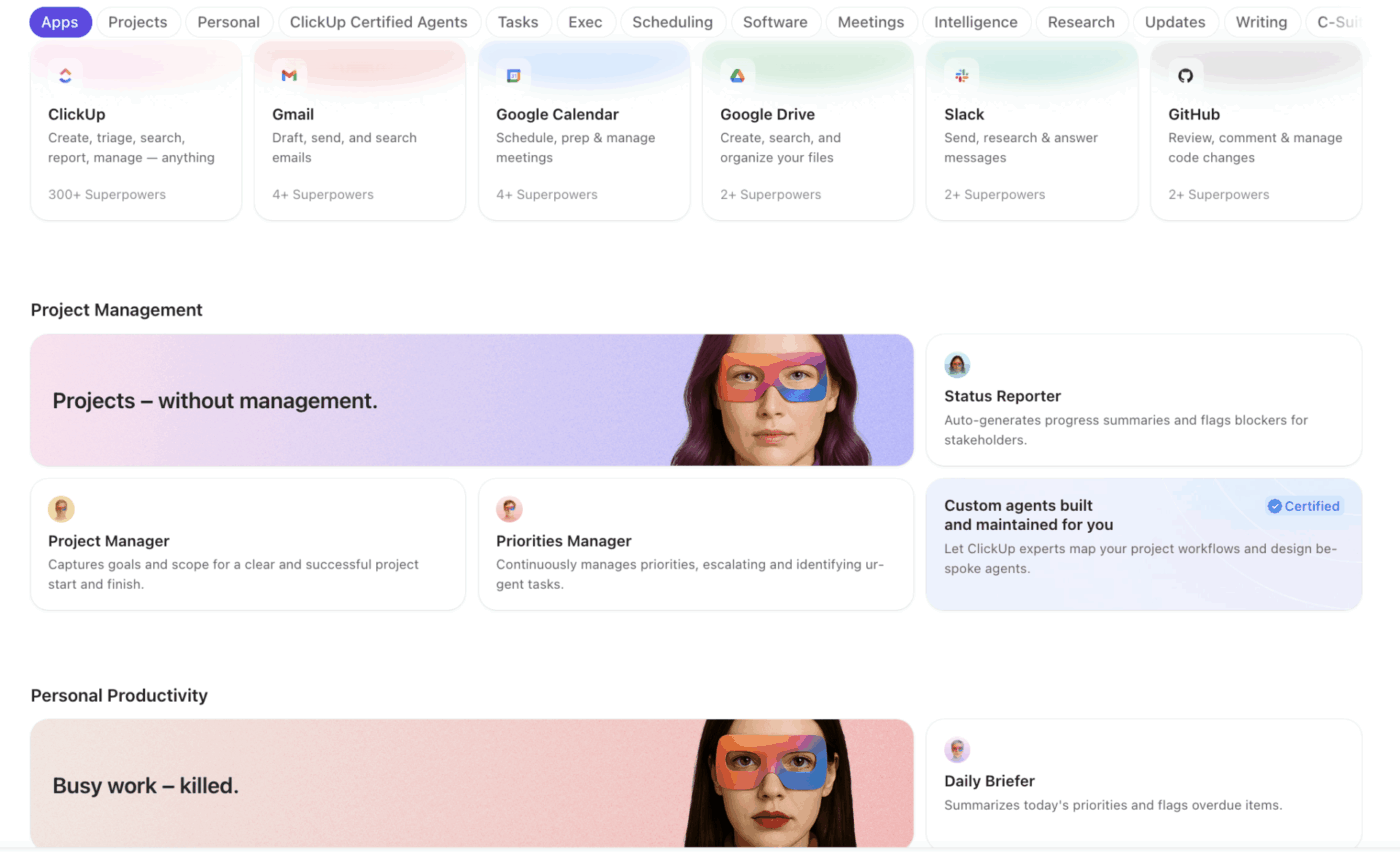
💡 Pro Tip: ClickUp lets you deploy AI Super Agents that function like context-aware teammates with infinite memory. You can @mention them in a chat to audit a task, assign them work to guard a deadline, or have them autonomously summarize weekly build progress for stakeholders—inside the same workspace where your product plans, tasks, and docs already live.
Streamline delivery operations with no-code ClickUp Automations
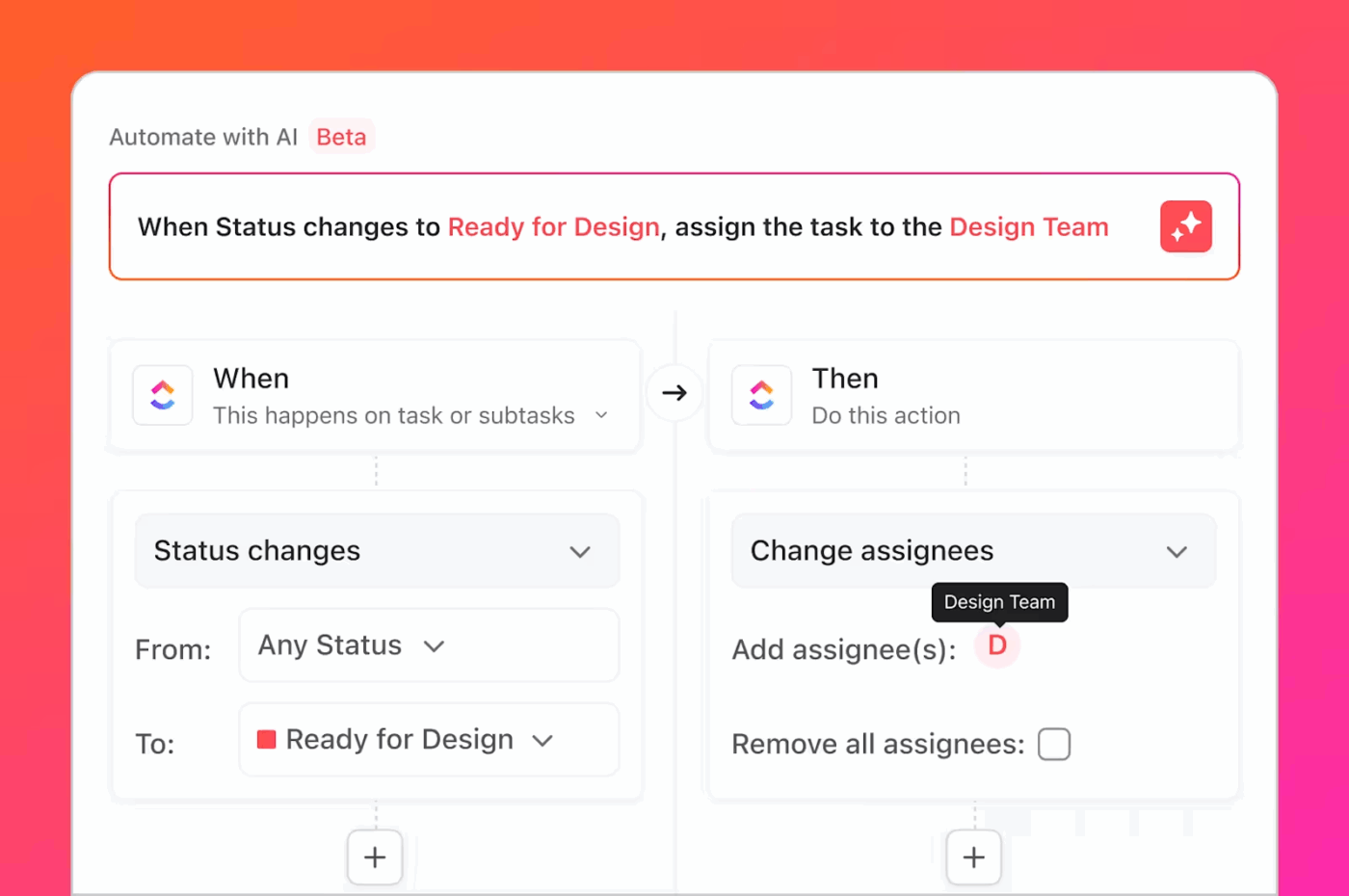
A common mistake teams make when using Base44 or Lovable is automating the product behavior while leaving delivery operations entirely manual. You may build an automated experience for your users, but your team is still chasing approvals, moving tasks forward by hand, and manually updating stakeholders. ClickUp Automations removes that operational drag so the project moves forward on its own:
- Build workflows with natural language: Use the AI Automation Builder to describe your desired workflow in plain English, and the AI will configure the trigger and action for you
- Trigger AI-powered updates: Set an automation to generate an AI summary of a task’s progress and auto-populate a Custom Field for project health at a glance
- Sync with your tech stack: Use native ClickUp Integrations and ClickUp Webhooks to connect GitHub, HubSpot, and Twilio, so a commit in your Lovable repo translates to a status change in your workspace
- Maintain a clear audit trail: Monitor every automated action taken across your workspace, keeping handoffs transparent and verifiable
Connect your technical specs to execution with ClickUp Docs and Tasks
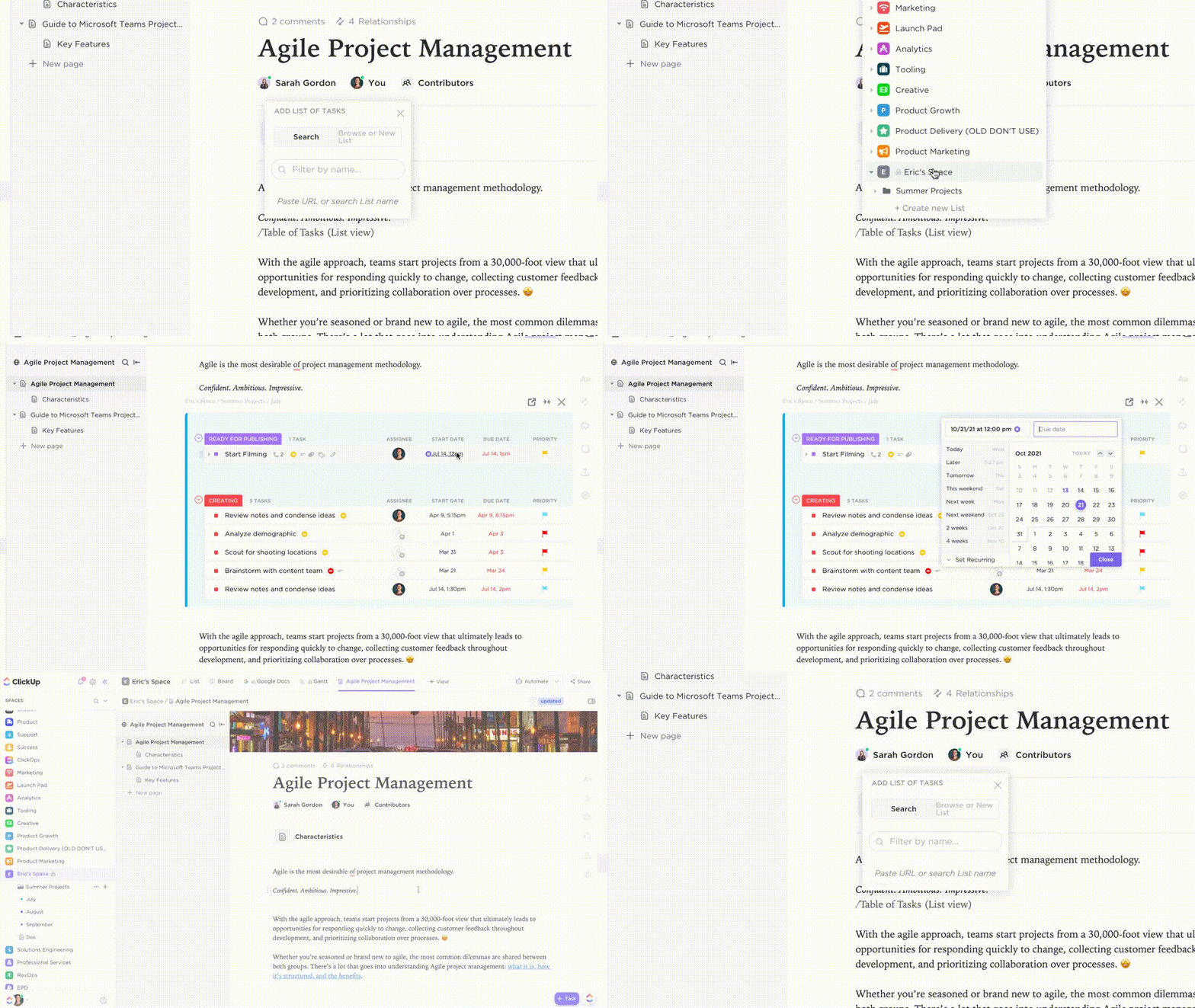
In software projects, execution breaks when documentation and delivery drift apart. ClickUp keeps technical specs, decisions, tasks, and sprint work connected so teams can move from requirement to release without losing context.
ClickUp Docs and ClickUp Tasks converge to eliminate the hunt through folders for decisions made weeks ago:
- Turn requirements into action: Collaborate in real-time on technical specs inside ClickUp Docs and convert any inline comment into a ClickUp Task with one click
- Maintain a living knowledge base: Use the Docs Hub to organize nested pages for complex projects and link directly to your ClickUp Sprints
- Scale execution with tasks: Break down a large Lovable build into manageable ClickUp Subtasks, set ClickUp Dependencies to map blockers, and use Multiple Assignees to loop in the right developers and QA testers
- Keep documentation current with AI: Deploy Super Agents to autonomously pull updates from completed tasks and meeting transcripts, and refresh your Docs without manual effort
Gain full visibility into your build cycle with ClickUp Dashboards
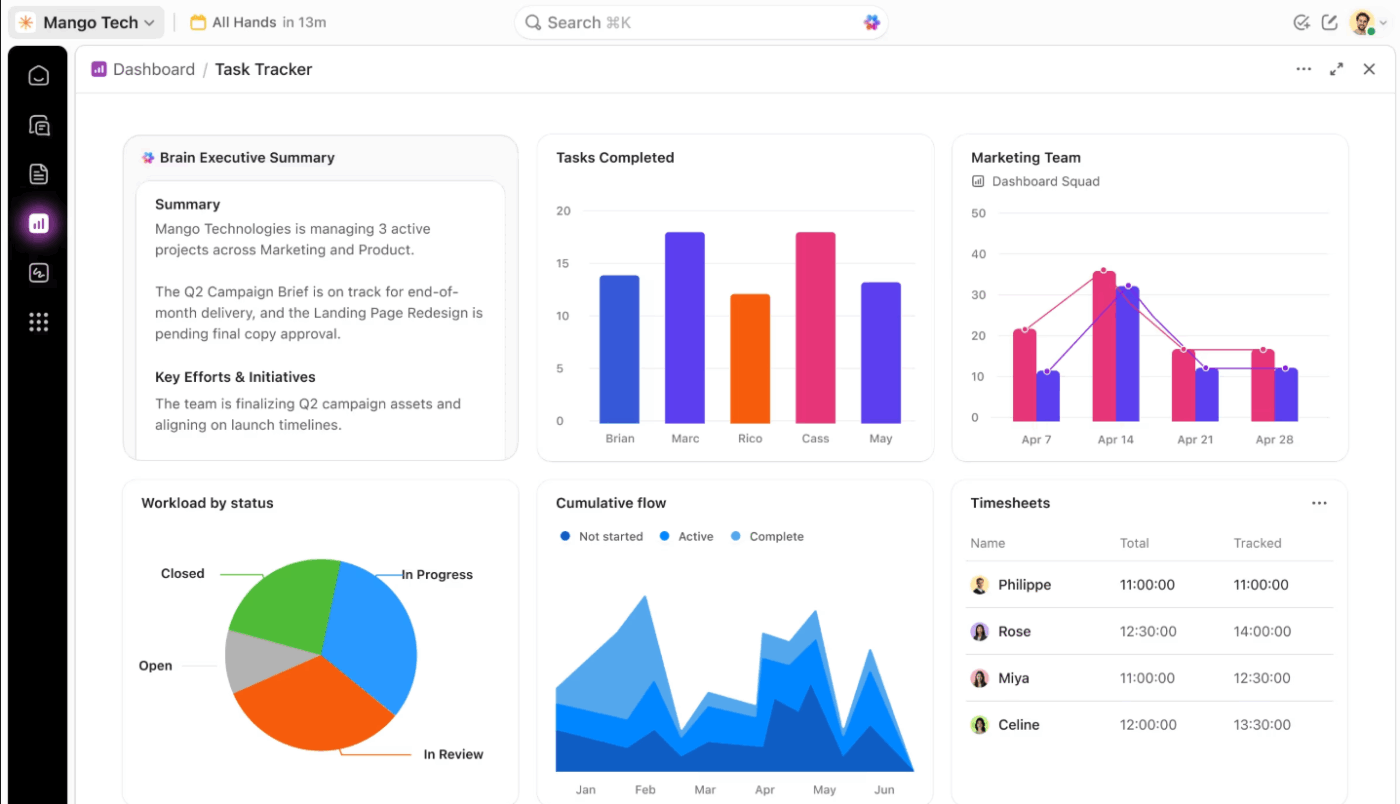
While AI builders speed up development, they often reduce visibility for everyone outside the coding flow. Product leaders, operators, and stakeholders still need to know what changed, what is blocked, and whether the release is on track. ClickUp Dashboards provide that reporting layer in real time:
- Act without switching tabs: Reassign owners, update statuses, or change priorities directly from the dashboard, the moment you spot a stalled initiative or a surge in bug reports
- Centralize project health and workload: Mix charts, sprint metrics, and team workload distribution into a single canvas with specific ClickUp Views for different stakeholders
- Eliminate manual status updates: Use Super Agents to build autonomously and send Monday morning status reports, capturing what changed in your build cycle and delivering the summary on your schedule
- Bridge the stakeholder gap: Give clients or partners a window into your Base44 MVP or Lovable deployment with granular permissions that keep internal notes private while surfacing live development milestones
Nick Foster, Director of Product at Lulu Press, reviewed ClickUp:
Summarize this article for me pleaseShould You Choose Base44, Lovable, or ClickUp?
The Base44 vs. Lovable decision comes down to who’s building and how much they need to own what they create.
Choose Base44 when:
- You need a hosted MVP fast, and don’t want to make infrastructure decisions
- You’re non-technical—a product manager, founder, or ops lead—and want to validate an idea before investing in custom development
- You’re building internal tools, admin dashboards, or prototypes where long-term code portability isn’t a priority
- You want everything—backend, database, hosting, auth—managed in one place with zero setup
Choose Lovable when:
- You need to own the code and plan to hand it off to a development team
- You’re building a production-grade SaaS, client-facing tool, or any app that needs to scale beyond a prototype
- You want to deploy on your own infrastructure—Vercel, Netlify, AWS, or your own servers
- You need deep, granular integrations with Stripe, Clerk, or direct LLM APIs
- You’re comfortable with (or have access to someone who understands) Supabase, GitHub, and basic architectural decisions
Whichever you choose, the app builder handles the product. But the project planning, team coordination, bug tracking, and launch workflows around that product need a home too. Pair your builder with ClickUp to manage the work that makes the product happen—from initial requirements through sprint execution to launch day.
ClickUp doesn’t replace Base44 or Lovable. It replaces the fragmented system teams use to manage everything around them.
✅ Get started for free with ClickUp
Summarize this article for me pleaseFrequently Asked Questions
Can I migrate an existing Base44 project to Lovable?
Not directly. Base44 exports frontend code on paid plans, but the backend logic and database stay on Base44’s infrastructure. To move to Lovable, you’d need to rebuild server-side logic in Supabase and reconnect your integrations. If code portability matters to you from day one, Lovable’s GitHub sync is the safer starting point.
Is Base44 or Lovable better for the developer team collaboration?
Lovable is the stronger choice for developer collaboration. Its two-way GitHub sync means developers can clone the repo, work locally in any editor, and push changes that reflect in Lovable’s interface. Base44 allows link-based sharing and preview URLs for stakeholder feedback, but doesn’t support synchronous co-authoring of the app’s logic or code.
Can you use Base44 or Lovable without any coding experience?
Base44 is designed for non-technical users—it handles backend, hosting, and database automatically,y so no coding knowledge is required at any stage. Lovable is usable without code for simple apps, but connecting to Supabase, configuring API keys, and making architectural decisions benefit from at least basic technical familiarity. If you have no technical background, Base44 is the more accessible starting point.
What are the best Base44 and Lovable alternatives for managing app development work?
If your team needs help with planning, documentation, feedback, sprint execution, and release coordination for app development, ClickUp is the best option. Rather than acting as another app builder, it gives teams one AI-powered workspace to centralize requirements, bugs, tasks, docs, meetings, and reporting—filling the operational gap that neither Base44 nor Lovable addresses.
What happens when you outgrow Base44 or Lovable?
With Lovable, you can export your full codebase via GitHub and continue development independently with any React and TypeScript team. With Base44, you can export the frontend, but the backend stays on their infrastructure—so outgrowing the platform means rebuilding server-side logic elsewhere. If you anticipate significant growth, Lovable’s portability is a meaningful long-term advantage.


Everything you need to stay organized and get work done.

Recent Articles

Monday vs. Asana vs. ClickUp: Which Saves Small Businesses the Most Money? 
Monday vs. Asana vs. ClickUp: Which Saves Small Businesses the Most Money?
