Sorry, there were no results found for “”
Sorry, there were no results found for “”
Sorry, there were no results found for “”
Company policies help you build an effective organizational culture, navigate workplace incidents, ensure compliance, enable risk management, and promote a positive work environment.
But, drafting company policies can be daunting—you need to check legal requirements, align the policy with the company’s culture and values, consider the needs of diverse stakeholders, and a lot more.
So, if you’re an HR manager or a business owner looking for detailed yet simple ways to create effective company policies, you’re at the right place.
We’ve created a step-by-step guide to draft policies, alongside company policy examples, and tips and tools to help you fast-track the policy-making process.
But first, let’s discuss what company policies are.
Company policies are frameworks that describe workplace rules and regulations. They define practices and guidelines to manage potential business issues. Company policies direct how employees, employers, and all relevant stakeholders must act and carry out the company’s work. They set clear expectations for everyone’s actions in different scenarios.
With these policies in place, you can review the existing compliance environment, including project compliance and change policies based on updated laws and industry best practices.
As organizations scale, company policies often fall victim to Work Sprawl, living across emails, folders, PDFs, and internal tools. When policies aren’t centralized, employees struggle to find the latest version, or follow them consistently.
Here are a few standard policies your company policy must contain:
Workplace health and safety procedures and policies lay down procedures to prevent workplace accidents. The Occupational Safety and Health Administration (OSHA), a federal agency in the US, sets guidelines for protecting workers and creating a safe workplace. For instance, it provides the steps to handle hazardous materials, file a complaint, report severe injuries and fatalities, and more.
The employee code of conduct dictates how employees must behave in the workplace. It outlines specific rules regarding dress code, accountability, compliance with laws, data security, confidentiality, sexual harassment, substance abuse, and even the use of social media during work hours.
💡Pro Tip: If you haven’t yet established a solid code of conduct policy within your organization, use code of conduct templates to establish proper guidelines for employee behavior and respectful workplace practices that align with your company’s values.
An equal opportunity policy applies to all current and future employees of the company. It underscores the company’s commitment to providing equal employment opportunities without discrimination.
This policy adheres to US Equal Employment Opportunity (EEO) laws that prevent workplace discrimination based on race, religion, color, sex, nationality, or disability. Equal opportunity policy is essential to ensure inclusivity and diversity within the company.
A disciplinary policy outlines appropriate disciplinary action employers can take in response to employee misconduct, poor performance, or rule violations. It covers various reprimands—from warnings for minor infringement to severe actions like demotion, suspension, and termination for major violations.
The attendance and leave policy details how much time off employees receive based on their job position, how to request time off, who they should contact, and the approval process. Leave policies also include details about company leave types, accruals, mandatory leaves, floater leaves, and more. Attendance and leave policy ensures that employees adhere to schedules.
This policy streamlines how employees work from home and at the workplace. According to the Gallup Survey Report 2025, 26% of US employees work remotely, and 52% work in hybrid environments. So, you need to have a remote and hybrid work policy that answers questions like:
Keep all your company policies organized and easy to find with the ClickUp Company Wiki Template. It’s a central spot where your team can access the latest guidelines anytime, helping everyone stay on the same page.
Drafting policies and procedures requires a clear plan on what to include, how to express to the participants, who should follow the policy, and when the policy takes effect.
Here are all the policy-related details to help you draft the perfect company policies.
Here’s a step-by-step process to help you create a company policy.
Start with identifying the policy need—whether you want to implement a policy to meet legal requirements or set standard procedures at the workplace to improve efficiency. Connect with different teams and managers to understand the complete requirements of the policy.
The first step is to gain unanimous support for the proposed policy from the management and employees. Explain to them why the policy is necessary, seek suggestions from them, and clear their doubts. Once everyone is on the same page, start the real planning.
Whether you’re drafting a company policy or a process documentation template, collaboration is a must. Bring the entire team together and use everyone’s ideas to create a more unified policy message.
Make sure you involve managers, leaders, and other staff who are experts in the specific policy topic. For instance, if you are creating an IT policy for the company, seek input from the IT team.
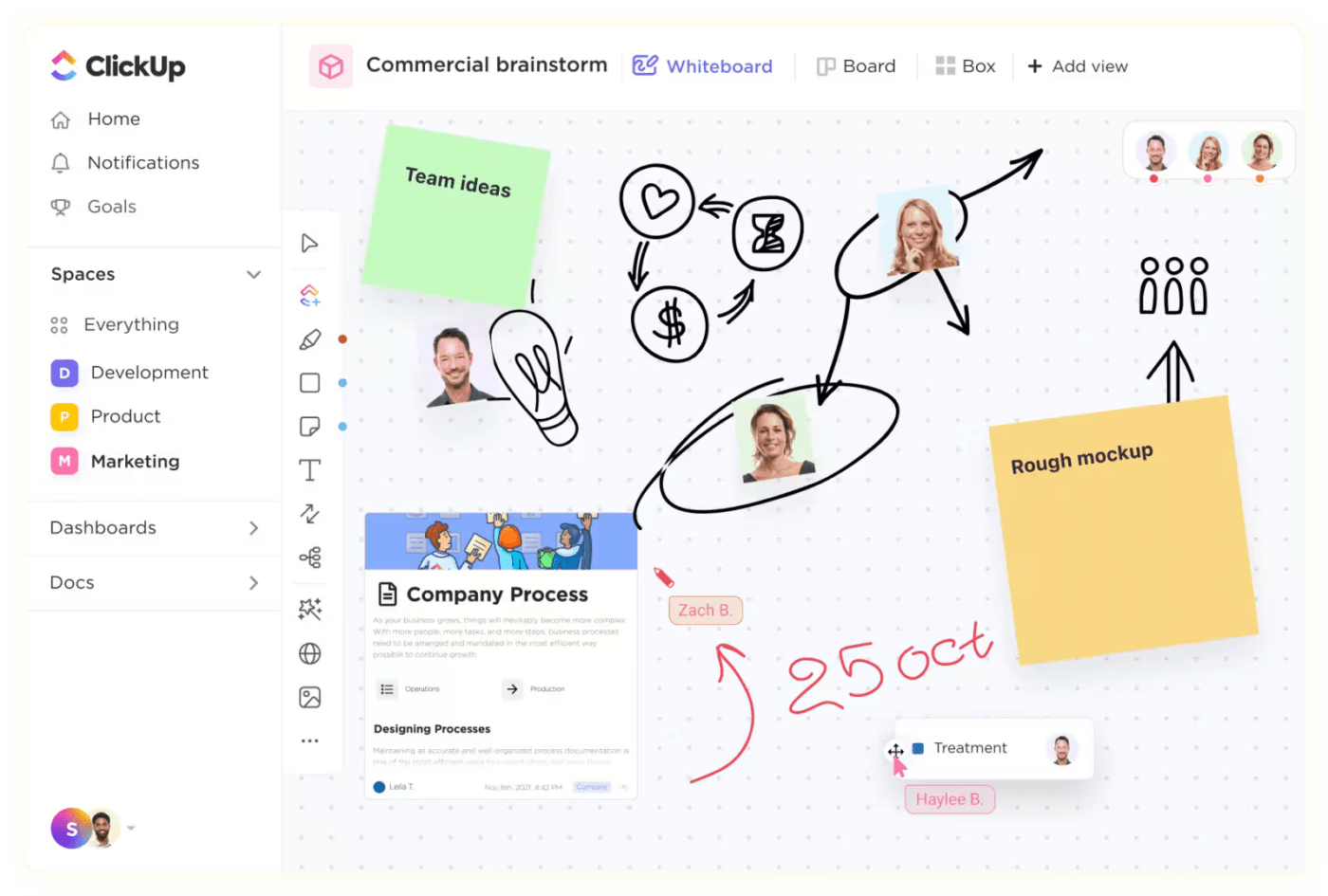
💡Pro Tip: A brainstorming session with relevant stakeholders can help you capture all the expectations and ideal outcomes in one place. Collaborate on ClickUp Whiteboards to capture input from all concerned teams.
Company policy structures vary based on business needs. Nevertheless, ensure a standardized structure. For example, if you plan to write an employee handbook detailing all policies and procedures, make sure you write the policies in a standard format.
Here are a few things you must include in a policy:
Here’s a sample company policy for your reference:

💡Pro Tip: Standardizing policy structure is no easy feat. Use ClickUp’s ready-made company policy templates to save time and effort.
Do your homework before you begin policy writing. Gather data on your company and the policy topic to create a solid policy everyone abides by. Thorough research can also help you bridge the gaps in your existing policies with relevant info. Here are a few ways to gather information:
💡Pro Tip: Use ClickUp Form View to build surveys and forms to collect input from your employees.
Your company policy may not be perfect on the first try. After creating the first draft, gather experts, leaders, and employee feedback. Use the feedback to gain valuable insights and make changes until everyone signs it off. Lastly, seek approval from the legal team and management to implement the policy.
💡Pro Tip: Use ClickUp Docs to easily draft your policies and collaborate with others to get real-time feedback

Share your company policy in a centralized system that’s easily accessible, like an employee handbook software. Such platforms help you create, customize, and distribute company policies and procedures. They make onboarding employees a breeze, facilitate collaboration and communication, and align with company regulations and values.
Writing effective company policies helps create a cohesive work environment. But, before we give you tips to craft effective policies, here are a few real-life company policy examples:

Unilever’s workplace safety policy instructs employees on Unilever sites on how to work safely with the ‘musts’ and ‘must nots’ sections. The policy also states when and how to report an incident.

Starbucks’ code of conduct policy promotes a workplace free from harassment, bullying, and discrimination. It explains the forms of discrimination and provides an example of what one should do when experiencing workplace harassment.
AWS’s employee disciplinary action policy states the corrective measures that an employee’s manager or supervisor can administer to restore workplace discipline. It covers reprimand forms like counseling sessions, verbal warnings, dismissals, and written reprimands.

Qutrix’s leave policy covers the leave types employees are entitled to and the eligibility for each type. The policy also includes public holidays, the procedure for requesting leaves, and the people responsible for their approval.

This is not your typical company policy example. HubSpot’s hybrid work policy covers three work options for HubSpotters—home, office, and flex—and states what employees get at each work mode. The policy also has separate tabs for how the hybrid system works, company culture code, and FAQs.
Though the company policy examples will help you understand and write better policies, applying a few universal best practices will hone your policies further. Let’s see what these best practices are.
But are these tips enough to help you draft policies without getting overwhelmed? You can simplify the policy-making process by using a collaboration and project management software like ClickUp.
Here’s how ClickUp, paired with best practices, can help you create the most effective policies.
ClickUp’s HR management platform helps you create a central hub of employee information and company policies. It lets you track employee engagement and performance and saves time with onboarding, hiring, and policy-making templates.

Use ClickUp Docs to collaborate with your policy-building team. Team members can suggest ideas, edit policies in real time, tag other members in comments, assign tasks, and update workflows within the Docs editor to speed up the process.
ClickUp Docs gives you the perfect space to publish your company policies. You can create centralized wikis and employee handbooks where employees can view the latest policy updates.
With advanced version control, you can manage who can access, view, and edit what. This ensures that confidential information, including details about the company’s intellectual property, is available only to a selected few.
That’s not all; ClickUp’s Employee Handbooks, Policies & Procedures Template makes policy-making easier with its comprehensive content. This template helps you create a comprehensive employee handbook.
With this template, you can:
Use this template to bring everything under one roof—from code of conduct to vacation and payroll policies. You can quickly add the template to your ClickUp Workspace and start editing based on your business needs.
Another template that can help you implement well-defined processes in your company is ClickUp’s Process and Procedures Template.
This template lets you organize company processes and procedures using Kanban boards for quick access. You can create instructions for repetitive tasks so you can focus on other things that demand your attention.
Use this template to have a consistent approach for all relevant tasks to stay on track, streamline operations, and improve performance measurement accuracy. You can also use multiple views, such as board view, to assign process documentation and table view, to create custom process reports and spreadsheets.
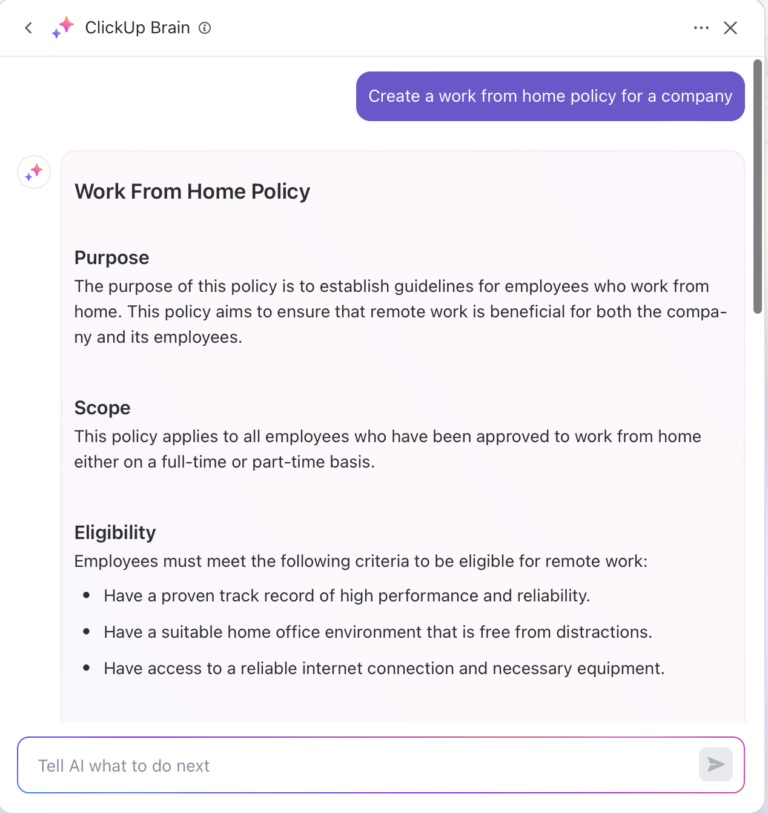
We haven’t revealed the best part yet—ClickUp Brain. Leveraging AI for policy documentation means you don’t have to do everything alone. ClickUp Brain can help you generate multiple company policy outlines.
You can ask ClickUp Brain to suggest sections for your policy so you don’t miss out on anything important. For specific company policies, you can provide prompts to generate the policy’s first draft. Once your other team members review the draft, use it as a reference to prepare your subsequent policies. This will give you a solid base and save time building everything from scratch.

With ClickUp Brain, you can streamline your policy creation process, especially if you have multiple policies in your mind. However, once you generate the policy, refine the content to meet your unique business needs.
Writing company policies takes a lot of time and effort. But you don’t need to reinvent the wheel. We recommend reviewing the steps and company policy examples above and finding what works best for you. Using tools like ClickUp can cut down your manual work significantly.
Once you decide on the policy you want to create, give ClickUp a shot. It provides employees, managers, and all other stakeholders easy access to the company’s policies with centralized document management features like ClickUp Docs. Plus, you can generate the entire company policy in just a few clicks with AI.
Sign up for ClickUp now to create fair, clear, and actionable company policies that promote a healthy work environment.
HR leaders should lead the process while involving legal teams, managers, and relevant stakeholders to ensure accuracy and adoption.
Policies should be reviewed at least once a year or whenever there are changes in laws, company structure, or work models.
A policy defines what is expected, while a procedure explains how those expectations are carried out step by step.
Clear language, easy access, regular training, and centralized documentation significantly improve policy adherence.
Yes, using a centralized tool helps teams draft, update, track versions, and share policies without confusion or duplication.

Sudarshan Somanathan
Max 17min read
Sudarshan Somanathan
Max 20min read
Sudarshan Somanathan
Max 12min read

© 2026 ClickUp