What Is Ambient AI?
Ambient AI refers to intelligent systems that operate continuously in the background, sensing their environment, learning patterns of behavior, and proactively assisting users without requiring direct commands.
Think of it as artificial intelligence that blends in and acts without being prompted at each stage. It is not something you switch on or off, but something that continuously supports your work, adjusts to your habits, and improves over time.
Instead of simply reacting to your instructions, ambient AI notices context and acts proactively to execute everyday tasks. Here are its core characteristics.
Context awareness through multi-modal sensing
Ambient AI systems draw on a variety of inputs, including continuous physical security monitoring via motion sensors, cameras, microphones, device telemetry, calendar data, location, and environmental sensors (such as temperature and occupancy). Computer vision intelligence plays a major role here.
Together, these multi-modal signals feed into a system that builds an automated situational context of the user’s environment and behavior. As one analyst put it, “sensor technology is getting cheaper and less visible, allowing [organizations] to capture insights from your most hidden processes.”
Proactive rather than reactive assistance
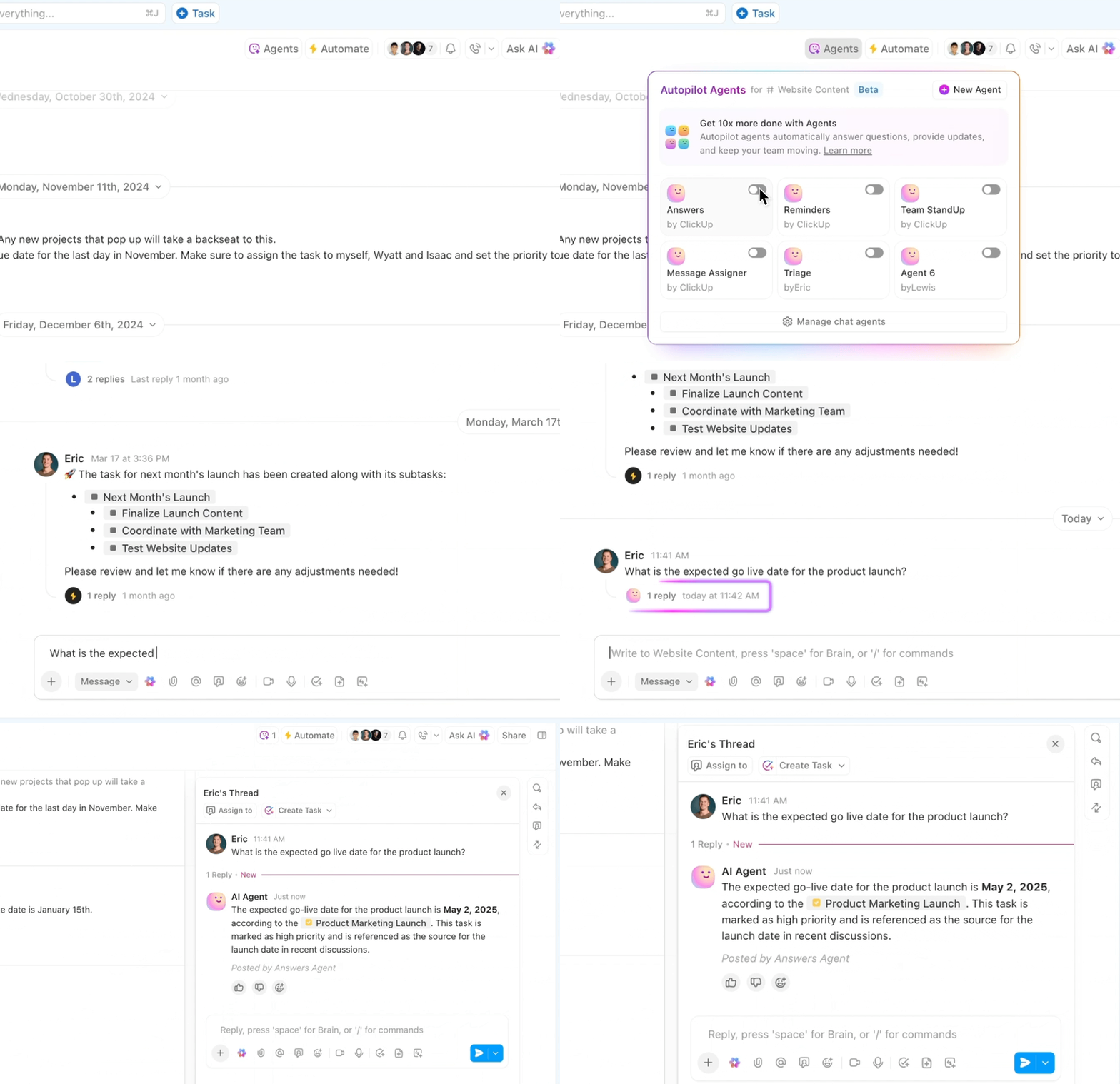
Unlike traditional AI, which waits for user prompts (“Schedule a meeting”, “Generate a report”), ambient AI anticipates. It might detect that you’re in back-to-back meetings, infer you need a summary and a follow-up slot, and take action without being asked.
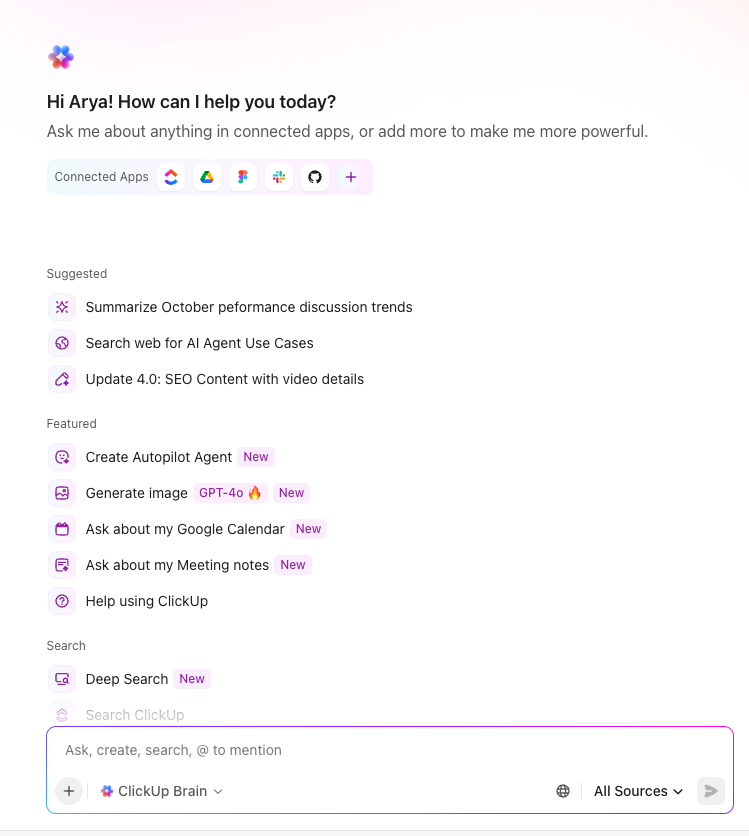
ClickUp Brain, the ambient AI agent within ClickUp's converged AI workspace, already knows your most recent tasks and is ready to jump in and help as you need, because the context is already built into it.
Seamless integration into existing workflows
Ambient AI does not stand alone as an app you open, it blends into the workplace, devices, systems, and routines you already use. It operates in the background, changing the thermostat, preparing your next meeting, suggesting actions, allocating resources, without requiring you to shift how you use AI to manage your workflow.
Researchers reviewing ambient-intelligence systems highlight the need for “intelligent tools that adapt to lived user behavior rather than requiring explicit instruction.”
Continuous learning from the environment and user behavior
These systems improve over time by gathering data on user behavior, context changes, and outcomes. They learn what works and what does not, refining their predictions and actions accordingly. Ambient intelligence literature emphasizes adaptability, and personalization is a key outcome of this approach.
Autonomous decision-making within defined parameters
Ambient AI moves beyond suggesting actions, it executes tasks autonomously within predetermined boundaries, makes decisions, orchestrates resources, and triggers workflows.
This is where ambient AI overlaps with agentic AI tools (AI agents that set goals, act, and plan). For example, a smart office system might detect low occupancy and automatically redirect room allocation or adjust HVAC settings without human intervention.
Or, in ClickUp Brain’s case, it can review recent meeting notes, extract action items, create Tasks, and then help assign them to the right team members using features like AI Assign and Prioritize. This is made possible by a suite of powerful primitives working together within a Converged AI Workspace, which includes:
- An integrated Calendar that can automatically schedule tasks and block time based on your defined priorities
- A built-in AI Notetaker that captures meeting details and action items
- ClickUp Brain, which acts as the ambient AI that understands context and takes the next steps
- Built-in project management suite, which keeps work on the same platform and traceable with real-time AI intelligence
Taken together, ambient AI transforms the computing model from passive assistants you explicitly invoke to always-on systems that understand, anticipate, and act.
Read More: Context Is Your Competitive Advantage in the Age of AI