Sorry, there were no results found for “”
Sorry, there were no results found for “”
Sorry, there were no results found for “”
The best online sticky notes app depends on what happens after you capture the note. For instance:
That choice matters because notes are great at capture, but they fail when they have to be found, grouped, shared, or later turned into action.
The McKinsey Global Institute found that the average interaction worker spends 28% of the workweek managing email and nearly 20% of it looking for internal information or tracking down colleagues. A good sticky notes app should cut that chase, not create another place for ideas to sit.
We compared the 10 best online sticky notes apps in 2026 by ease of capture, collaboration, organization, AI usefulness, integrations, free-plan limits, and how well each note can move into action.
| Tool | Best for | Standout feature | Starting price* | Where it taps out |
|---|---|---|---|---|
| Miro | Real-time team brainstorming | Bulk-mode sticky entry on an infinite canvas, with AI clustering | Free (3 editable boards); paid from $8/member/mo | Free plan locks all but 3 boards to view-only; very large boards reward a paid tier |
| Microsoft Sticky Notes | Quick desktop notes in Microsoft 365 | Instant capture that syncs into Outlook and OneNote | Free with a Microsoft account | Little value outside Windows and Outlook |
| ClickUp | Turning sticky notes into trackable work | One-click conversion of a sticky into an assigned task | Free; paid from $7/user/mo | Learning curve; more than a solo note-taker needs |
| Padlet | Educators and visual content boards | Media-rich walls anyone can join by link, no account | Free; Platinum $15/mo or $120/yr | Free plan caps at 3 active padlets; no task workflow |
| Google Keep | Fast personal capture across devices | Type, voice, photo, or checklist capture that syncs instantly | Free with a Google account | No folders or nested tags; no board view |
| Notion | Sticky notes inside a knowledge base | Database cards you regroup by any property on the fly | Free; paid from $10/user/mo | No native sticky object; full AI sits in Business tier |
| Stormboard | Structured workshops that produce reports | One-click export of a board to a formatted Word/PPT/Excel doc | Free; Business $8.33/user/mo | Heavy with large groups; reporting focus is overkill for casual notes |
| Post-it App | Digitizing physical Post-it notes | One photo captures a wall of notes as editable tiles | Free | Light on live multi-editor collaboration; sync best on Apple |
| IdeaBoardz | Free, no-login retrospectives | Spin up a shared retro by URL with no accounts | Free | Public-by-URL with no privacy controls; no timer or integrations |
| Lino | A no-frills personal digital corkboard | Tactile pinboard with email-to-board and bookmarklet capture | Free | Stays personal, not a team workflow; limited templates or integrations |
Short answer: The best online sticky notes app for most teams is ClickUp, because it converts any sticky into an assigned, trackable task. For fast personal capture, Google Keep is the lightest pick. And for live team brainstorming, Miro leads the pack.
Our editorial team follows a transparent, research-backed, and vendor-neutral process, so you can trust that our recommendations are based on real product value.
Here’s a detailed rundown of how we review software at ClickUp.
The right pick depends on what you do with a note after you write it. If you only want to spin up a quick visual board, our roundup of sticky notes generators covers the lightweight options. For everything else, these are the criteria each tool below is scored against:
We tested the top tools to bring you the 10 best online sticky notes apps for 2026: Miro, Microsoft Sticky Notes, ClickUp, Padlet, Google Keep, Notion, Stormboard, Post-it App, IdeaBoardz, and Lino.
The key takeaway is to look beyond the sticky note itself and choose the platform that best matches how your notes need to behave. Some are built for fast solo capture, others for live team workshops, and a few for turning ideas into tracked work:
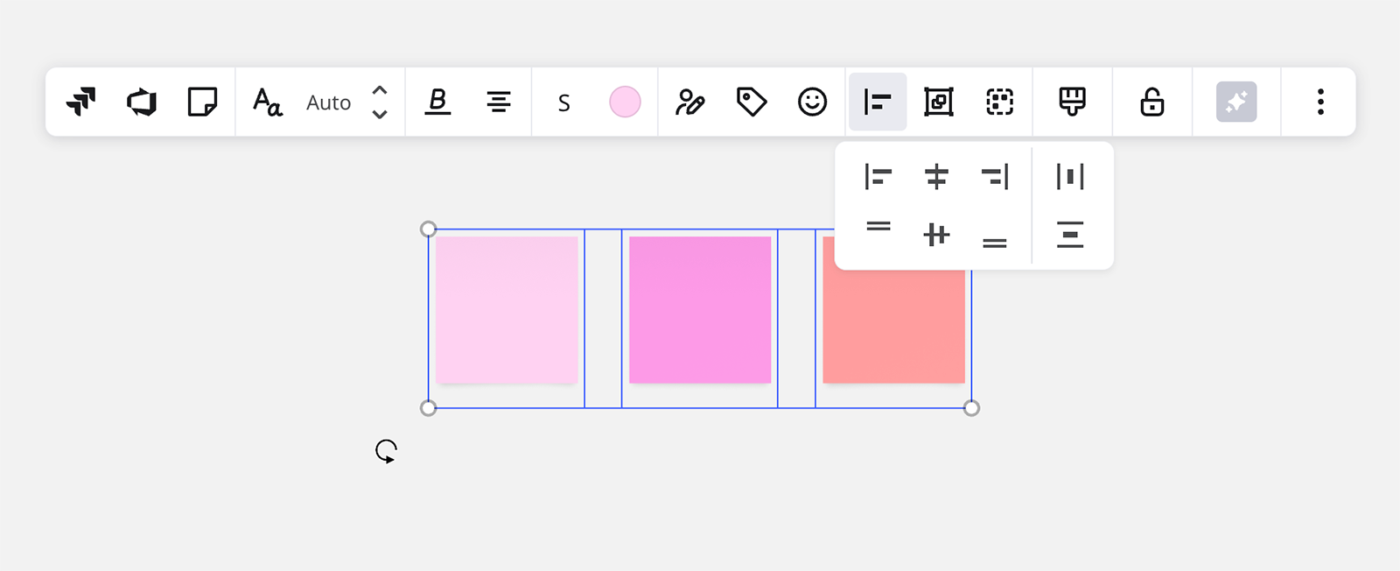
Miro is the closest a digital tool gets to a wall-sized whiteboard your whole team crowds around. It pairs an infinite canvas with sticky notes, templates, voting, and timers, which is why facilitators reach for it first. It’s also one of the strongest picks in any roundup of whiteboard software.
The sticky notes are built for speed. Turn on bulk mode and you just type a note, press Enter, and type the next one, so you can drop dozens in seconds without clicking around. Each note comes in one of 16 colors, and you can snap a photo of real paper sticky notes and let Miro turn them into digital, editable ones. Nothing from the workshop gets left on the wall.
Once the ideas are up, Miro AI does the sorting. It clusters notes by color, tag, author, or keyword. It reads the text to group similar ideas, then names each group for you. So a remote team can run a live retro where everyone posts at once, then watch the board organize itself before the call ends. Dot voting helps the group pick winners, and the board connects to Jira, Slack, Zoom, and 160+ other tools. Miro AI is included with limited monthly credits even on the free plan, with more on paid tiers.
One G2 reviewer sums up the brainstorming appeal, along with sticky notes:
What I like best about Miro is that it gives us a very flexible visual space where we can organize ideas, map processes, and create clear diagrams. It is useful when we need to move from a rough idea to a more structured workflow, because we can use sticky notes, arrows, frames, charts, and different visual elements in the same board. It helps us be more creative and collaborative, especially when we need to explain a process or brainstorm with other people.
Where it taps out: The free plan keeps only your three most recently created boards editable, locking the rest to view-only. On very dense boards, big sessions can feel the weight, so heavy real-time use rewards a paid tier.
Best for: Teams of 3+ running live workshops, retros, or research synthesis, where many people post and sort notes together in real time.
Skip it if: You’re working solo or just need to jot and glance at notes. Miro’s power only pays off with a group on the canvas, and a simple sticky-note app will be faster and cheaper.
Also Read: Weighing Miro against the other big canvas? This Miro vs. Mural breakdown helps.
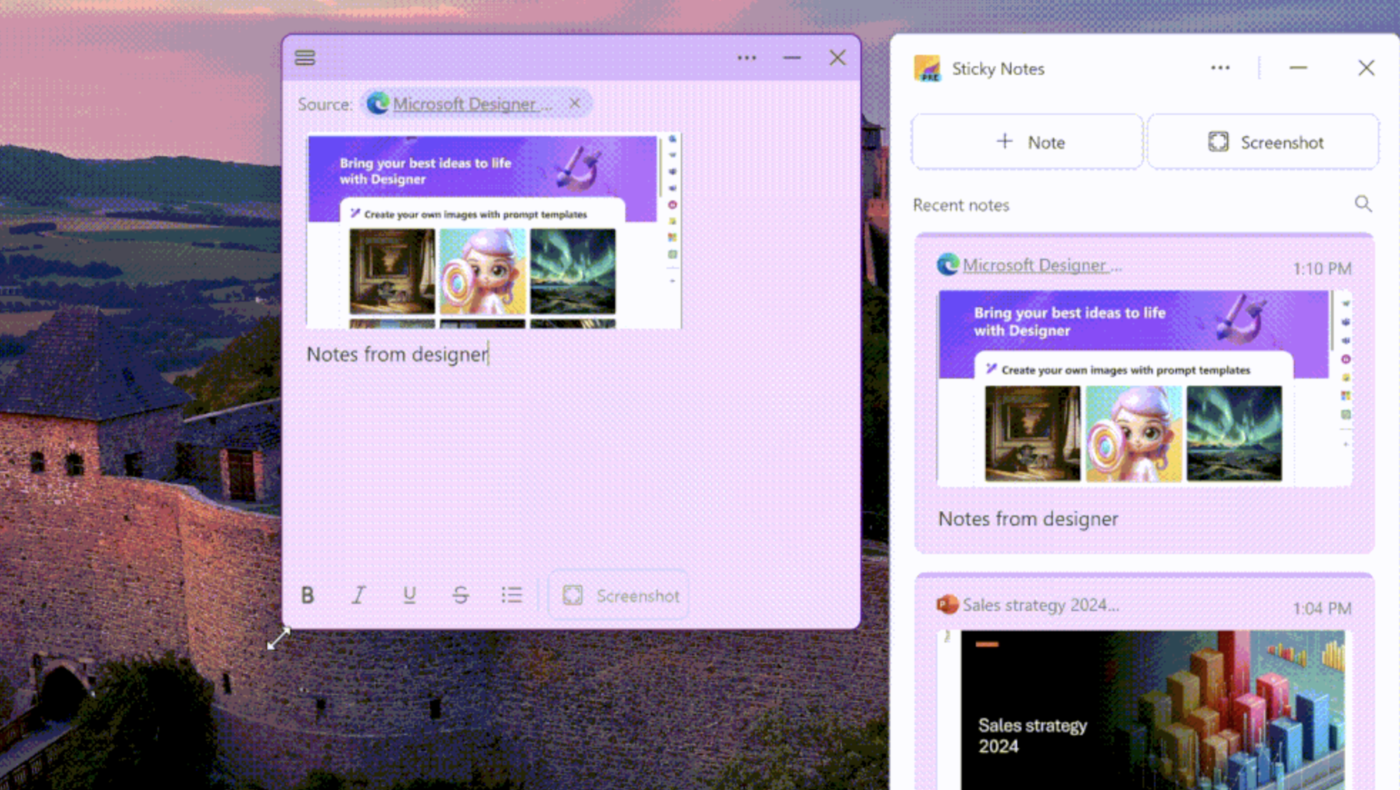
Microsoft Sticky Notes is the yellow square that has shipped with Windows for years and has been upgraded with cloud sync. It is built for jotting a quick note without opening anything heavier. If you’ve used Windows, you already know how it works.
Your notes sync to Outlook.com and OneNote, following you across Windows and the web. So, a reminder you type on your work PC shows up later in your Outlook mail sidebar. You get basic text formatting and color coding, and you can pin the note list to the taskbar for one-click capture. A student can scribble a due date between classes and find it waiting in their email that evening.
Today, there are actually two versions. The classic app is the simple yellow square most people know. The newer Sticky Notes experience, built into OneNote and auto-installed on Windows, adds one-click screenshot capture and automatic recall that links a note back to its source. Neither has Copilot-style AI, and the classic app stays deliberately bare. That simplicity is the point: it opens instantly and asks nothing of you.
Note: Microsoft Sticky Notes hasn’t accumulated a meaningful pool of public G2 or Capterra reviews yet, so we’re leaning on our own testing.
Where it taps out: It heavily leans on the Microsoft ecosystem to be useful, so outside Windows and Outlook, much of the appeal falls away.
Best for: Windows and Microsoft 365 users who want frictionless quick notes that follow them into Outlook.
Skip it if: You need shared team boards, structured retros, or notes that work outside the Microsoft world.
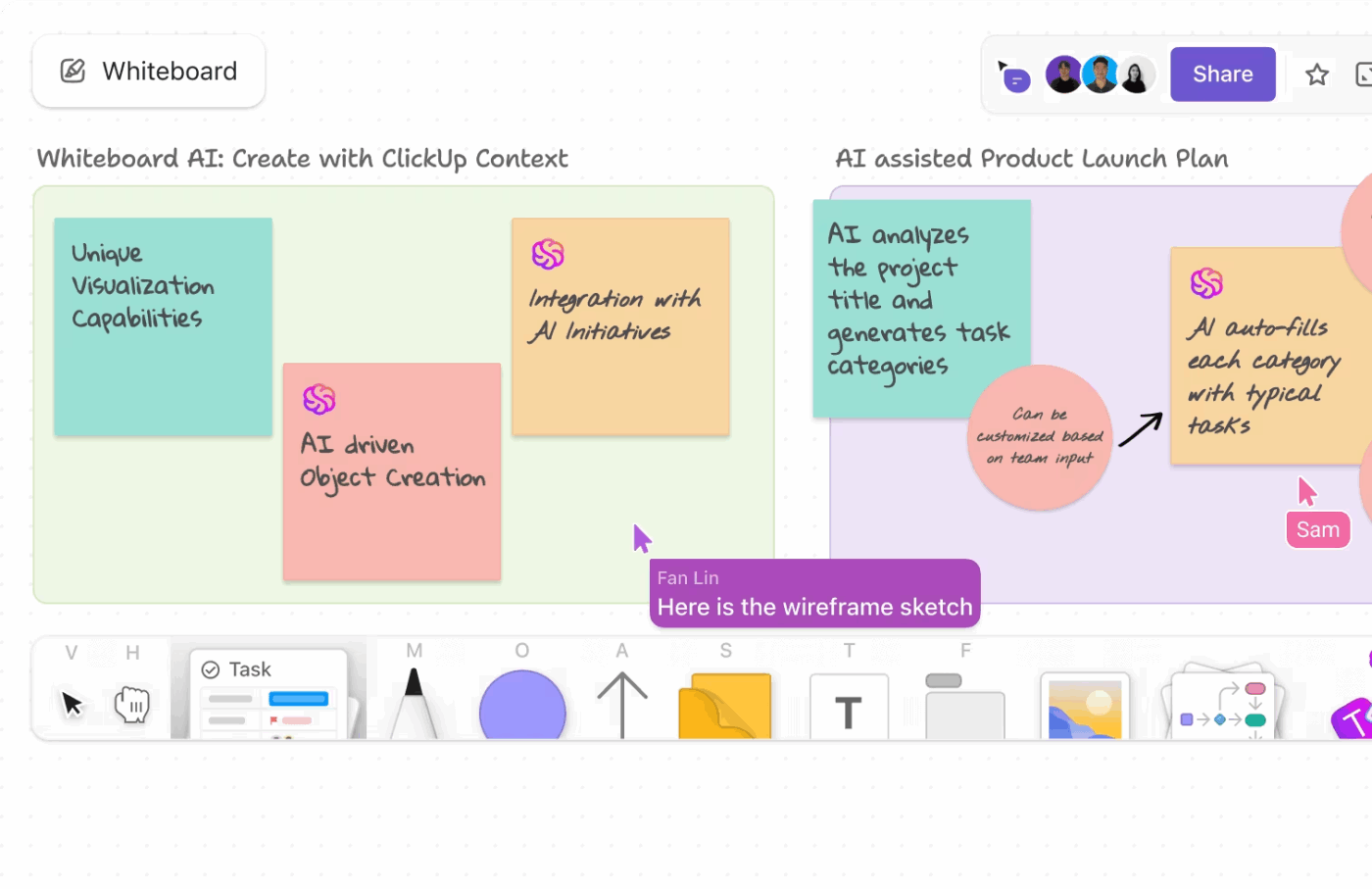
ClickUp earns its place because it carries a note all the way into action, from idea to tracked work. ClickUp Whiteboards serve as a visual hub: an infinite canvas for color-coded sticky notes, which you can scale, arrange, link into workflows or mind maps, and edit with your team in real time. When a sticky is ready to move forward, a single click converts it (or an entire cluster) into a real task with an assignee and due date.
If you don’t need the full canvas, ClickUp Notepad covers the lighter job. It’s a minimalist scratchpad reachable from the global nav bar anywhere in the platform, with Markdown shortcuts, bullets, and checkable to-do lists, and the same one-click task conversion. So whether an idea starts on a team whiteboard or in a private note, it leaves as a linked task and stays in sync.
A product team can sticky-storm a feature list on a Whiteboard, convert the winners into tasks, and watch them move through the sprint without re-entering anything. ClickUp Brain can summarize a messy board or draft next steps from it, and Docs, Chat, and Tasks all live in the same workspace, so the note always has somewhere to go.
One G2 reviewer admired Whiteboards, among other solutions:
I like ClickUp’s interface; it’s satisfying to use. I also like the text editor because it’s simple and versatile. The diversity of products and features makes it feel like good value, even though there’s a lot going on. The whiteboards feature is a great way of planning things out and is easy to use. I find the variation in views really helpful, as I’m able to move between board views and lists easily.
Where it taps out: ClickUp front-loads its capabilities, so coming from a single-purpose notes app, there’s a real learning curve while you get set up. It’s more than a solo note-taker needs, and best suited to teams whose ideas have to turn into tracked work.
Best for: Scaling teams that want notes to become assigned, trackable work.
Skip it if: You only need a personal reminder board with nothing attached to it.
Want to try the idea before you commit to a workspace? ClickUp’s free online sticky notes tool lets you open a board and start dropping notes in seconds, no signup, no download. When you’re ready for those notes to become tracked work, the same ideas carry straight into ClickUp Whiteboards.
Padlet is the sticky board teachers reach for, and the design shows why. It is friendly, colorful, and quick to share with a whole class. Each padlet is a wall, and you can lay it out as a grid, a stream, a freeform canvas, a timeline, or a map. The same tool works for a class debate, a group mood board, or a content calendar.
What makes it click is how much a note can hold. You can drop in text, photos, video, voice clips, links, or files, and watch the board grow. People join using a link and don’t need an account, so a teacher can post a QR code and watch 30 students add answers in seconds. Each post can accept comments, reactions, or star ratings, turning a wall into a real back-and-forth.
There is built-in AI, too. Give it a prompt, and it can spin up a starter board or generate images on the spot. A one-click slideshow then plays the wall back as a presentation, and everything works on any device, even on the free plan.
A Capterra user loved Padlet’s simplicity:
Padlet is very easy to use and doesn’t take long to understand. I like how you can quickly post notes, images, or links in one place. It’s great for sharing ideas with others and keeping everything organized.
Where it taps out: The free plan caps you at three active padlets, and the common workaround is deleting old boards to free a slot. That is fine for one-off use, but it does not hold up if you want to keep a growing body of work.
Best for: Educators, students, and anyone building visual, media-rich content boards.
Skip it if: You need notes tied to a project workflow with assignees and due dates.
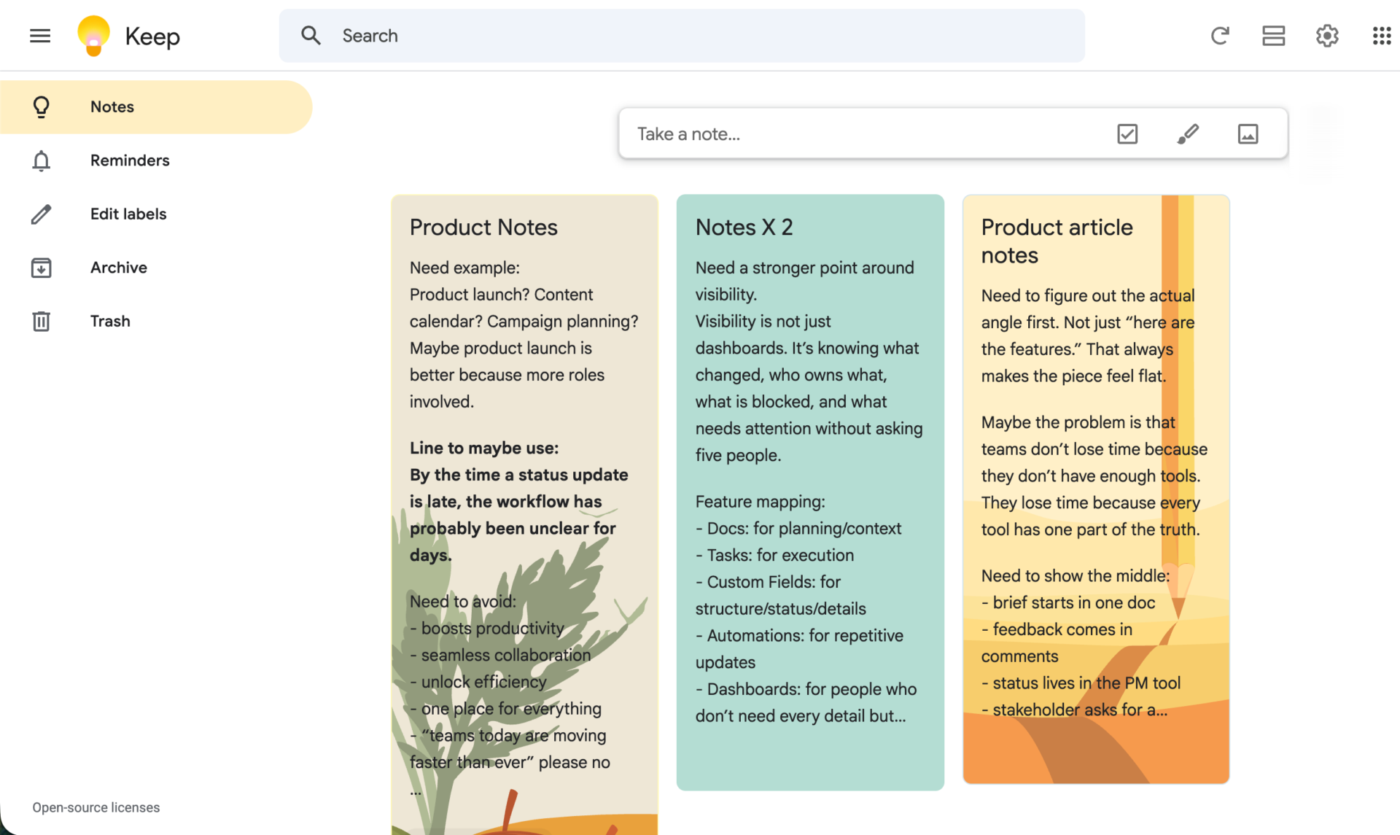
Google Keep is the fastest way to get a thought out of your head if you already live in Google. A new note takes a couple of seconds, and you can capture it by typing, by voice, with a photo, or as a checklist. The whole app is built to open, jot, and close before the idea slips away.
Your notes sync the moment you save them, across your phone, the web, and the Gmail and Docs sidebars. So a grocery list you start on your laptop is on your phone by the time you reach the store. You can color-code notes, add labels, pin the important ones, and share a single note for live collaboration with someone else. It is genuinely free, with no premium tier and no ads.
For a long time, Keep stayed bare, but that changed recently. Gemini now plugs into it, so you can search your notes in plain English, summarize a long one, or turn a loose paragraph into a checklist by asking. The core app is still deliberately simple, but it is no longer standing still.
A Capterra user loves the simplicity and synchronization of Google Keep:
Very handy app for making quick notes, lists or even sketches. I often use Google Keep to take notes during meetings and don’t need to keep a diary and pen. It’s super easy to copy and transfer into a Word Doc later. Most importantly, it autosaves in real time, so you don’t miss even a single word you typed, in case you accidentally close the app
Where it taps out: There are no folders or nested tags, so past 200 notes, you lean on search and color labels to find anything. And there is no board view for visual arranging. It is built for quick capture, not for organizing a large library at scale.
Best for: Fast personal notes and reminders for anyone already in the Google ecosystem.
Skip it if: You need structured boards, nested organization, or team facilitation. If you’re torn between this and Microsoft, the Google Keep vs. OneNote comparison lays out the trade-offs.
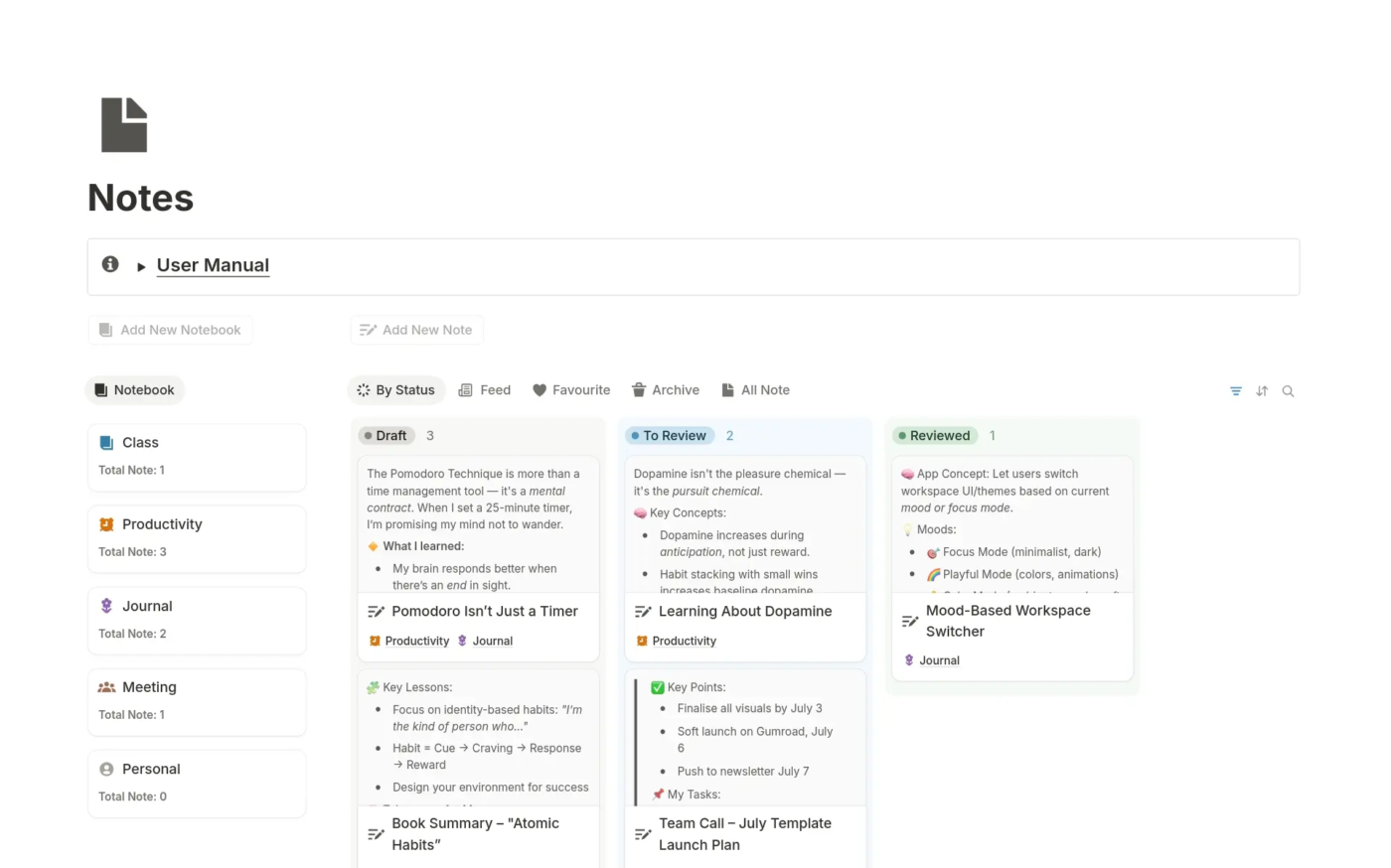
Notion is not originally a sticky notes app, but it does a convincing impression of one when your notes need to sit beside your docs and wikis. The trick is a database set to board or gallery view. Each entry shows up as a card you can drag between columns, and the card can even preview its own contents.
The depth is in how those cards behave. You group the board by any property, status, assignee, priority, or a custom tag, and the same notes regroup the moment you switch. A content team can group an idea board by writer one minute and by deadline the next. Cards carry real fields, too: select tags for color-coding, dates that feed a calendar view, and relations that link one note to another note in another database. With a synced block, you can mirror that exact board onto another page, and it updates everywhere at once.
The AI now goes well beyond simple summaries. Notion Agent builds or edits a board from plain-English requests, while Custom Agents triage notes or post weekly digests automatically.
A G2 reviewer points to Notion’s flexibility as the draw:
What I like best about Notion is its flexibility; it adapts to how you want to work instead of forcing you into a rigid structure. You can build everything from simple notes to fully customized workflows using databases, linked views, and templates. I especially value how it brings multiple use cases into one platform. Instead of juggling separate tools for documentation, project management, and knowledge bases, Notion lets us manage everything in a single place.
Where it taps out: There is no native sticky-note object, so you build the board yourself before you can use it. And as of early 2026, full Notion AI sits in the Business tier, since new Free and Plus users can no longer buy the old add-on separately.
Best for: People who want sticky-style boards living inside a broader knowledge base.
Skip it if: You want a board that’s open and usable in ten seconds.
Watch how an expert describes the sticky-note-to-task workflow on a real board:
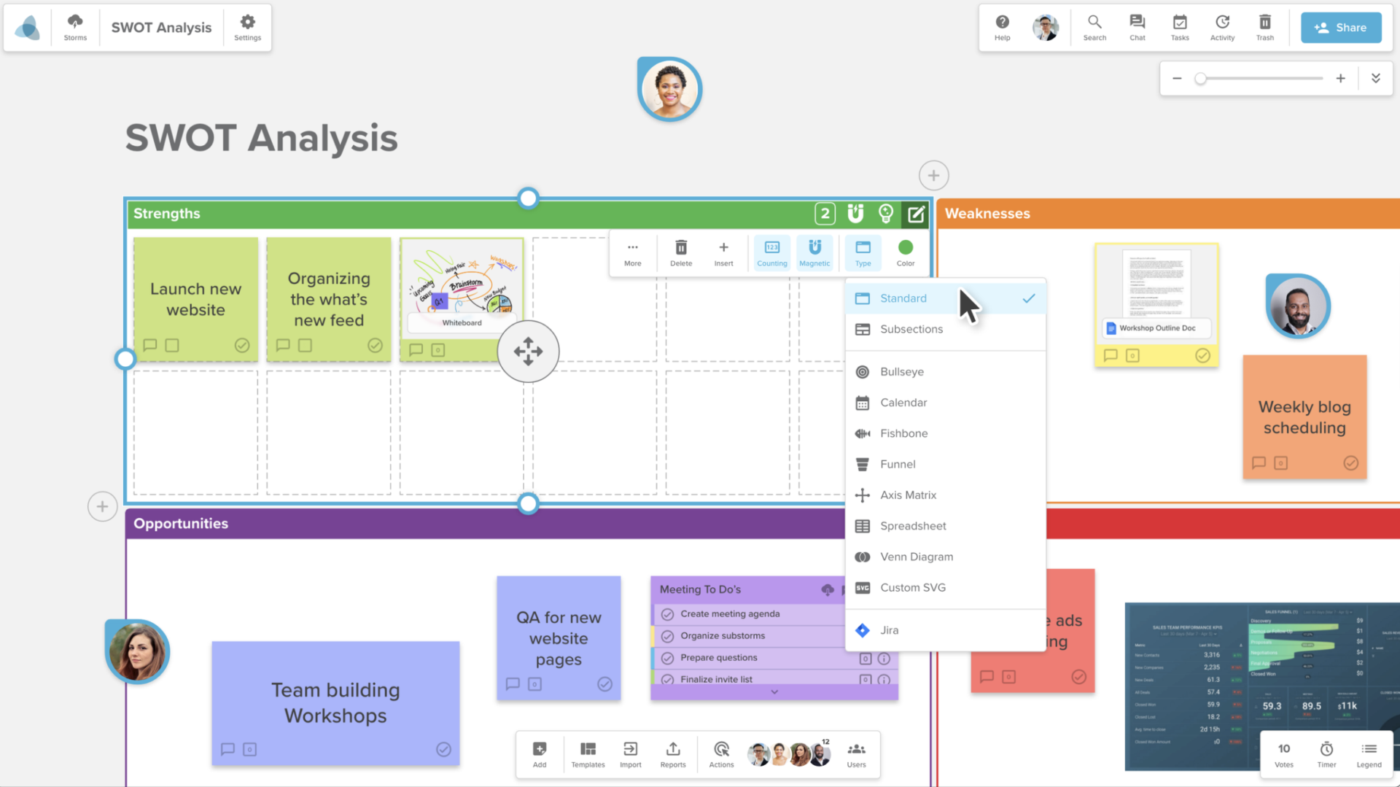
Stormboard is built so that a brainstorm turns into a usable document by the time you’re done. The sticky notes come in five flavors: text, image, video, file, and freehand whiteboard, so a single board can hold several things at once. Index cards then act like folders: drag a stack of related stickies into one, and a busy wall stays readable.
You can also drop notes into smart sections shaped like a bullseye, a fishbone, a funnel, or a calendar, and Stormboard’s reporting knows exactly where each note sits inside that shape. When the session ends, one click turns the board into a formatted Word, PowerPoint, Excel, or Google document, with your notes already sorted by the structure you used.
A consultant can run a prioritization workshop on a bullseye template and hand the client a written, ranked summary minutes later. StormAI rounds it out, building templates and grouping loose ideas from the content already on the board.
A G2 user leans on it as an everyday hub:
My main Stormboard is used as my go-anywhere digital whiteboard. It’s where I collate my to-do lists, park ideas, plan, organize, and stratagise everything I have going as the managing director of a new business start-up. Now that I’ve been able to link my Stormboard to my Google Workspace (Documents), I’m able to add/access important documents to my Stormboard and access these quickly.
Where it taps out: It can get resource-heavy with large groups, so very big live sessions may see performance dips, and the reporting focus is more structured than a casual note-taker needs.
Best for: Facilitators who need a written report after every session.
Skip it if: You want a lightweight personal board with nothing to export.
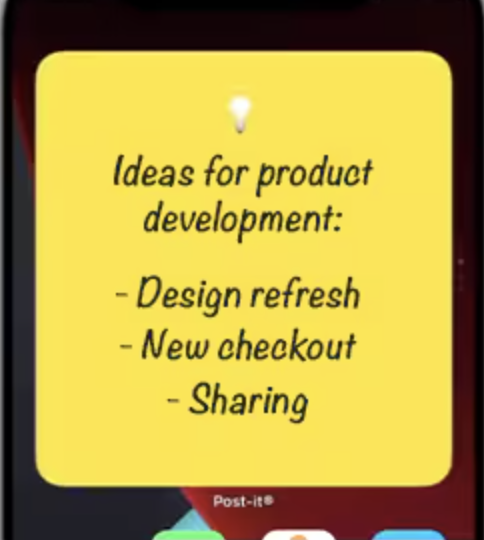
The official Post-it App from 3M does one satisfying thing better than anyone: it turns a wall of real Post-it notes into a digital board. Point your phone at the wall, and a single photo captures up to a few hundred individual notes at once, rebuilding each one as its own movable digital tile. The hours you’d normally spend transcribing a brainstorm just disappear.
From there, the board comes to life. You can turn handwriting into searchable text, recolor and edit notes, group them on a board, and export the whole thing to Miro, Trello, PowerPoint, Excel, Dropbox, or PDF.
It runs on iPhone, iPad, Mac, Android, and Chromebook, and syncs across Apple devices through iCloud, so you can snap a wall on your phone and rearrange it on a bigger screen. Handwriting recognition is built in, though there’s no generative AI.
Note: Post-it App hasn’t accumulated a meaningful pool of public G2 or Capterra reviews yet, so we’re leaning on our own testing.
Where it taps out: It’s built around capture and personal organization, so live, multi-editor collaboration is lighter here than on the big canvas tools. Cross-device sync also runs through iCloud, so the capture-then-arrange flow runs smoothest on iPhone, iPad, and Mac.
Best for: Anyone who still brainstorms on paper and wants it digital in seconds.
Skip it if: Your team already works entirely online with no paper in the loop.
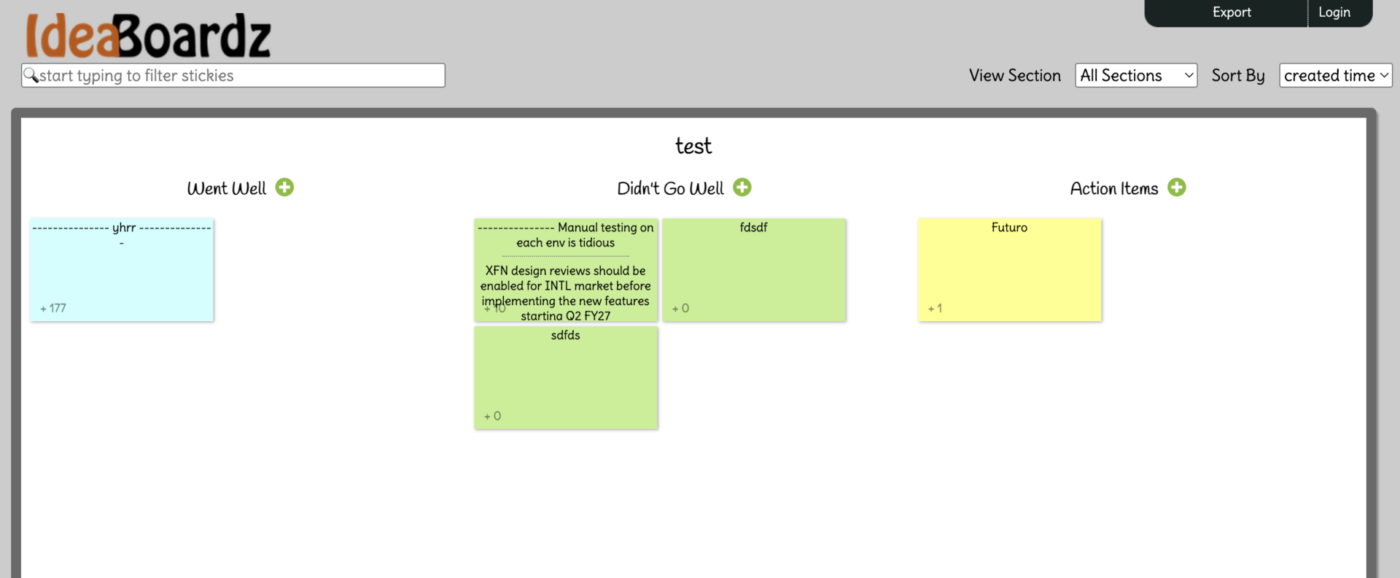
IdeaBoardz is a long-running free board built for one job: spinning up a shared retro or brainstorm in seconds. You create a board, choose how many sections you want, share the URL, and everyone can add and vote on notes.
Nobody needs an account to join, which makes it handy for a quick session with people outside your usual tools.
The setup covers the common retro formats. You get ready-made layouts for Starfish, Pros and Cons, and To-Dos, plus custom sections for a Start/Stop/Continue or 4Ls board. Contributors can pile in asynchronously over a few days, vote to surface priorities, and export the finished board as a PDF or Excel file for follow-up. A distributed team can run a sprint retro across time zones without anyone having to sign up for anything.
A G2 user admired its idea management process:
It is one of the easiest tools to organize and manage ideas regarding anything that we want to implement in the future.
1) The best thing that I like about this is it is well organized and looks like a simple notice board with notices/ideas pinned on that and comes with different color templates to categorize the types of ideas you have. This way we can conclude the fine-grade solutions.2) Also, it comes with shareable features where team members can edit the ideas and can vote for the ideas posted by others. This way, all team members can focus on one platform to know more about the ideas shared by the individual team members and can give suggestions, vote, etc.
Where it taps out: Boards are public by URL with no stated privacy controls, and there’s no timer, idea grouping, facilitation phases, or integrations. There’s also no visible roadmap, so it’s safest for one-off sessions rather than anything ongoing or sensitive.
Best for: Fast, free, distributed retrospectives with people who won’t log in.
Skip it if: You need privacy controls, facilitation phases, or a tool under active development.
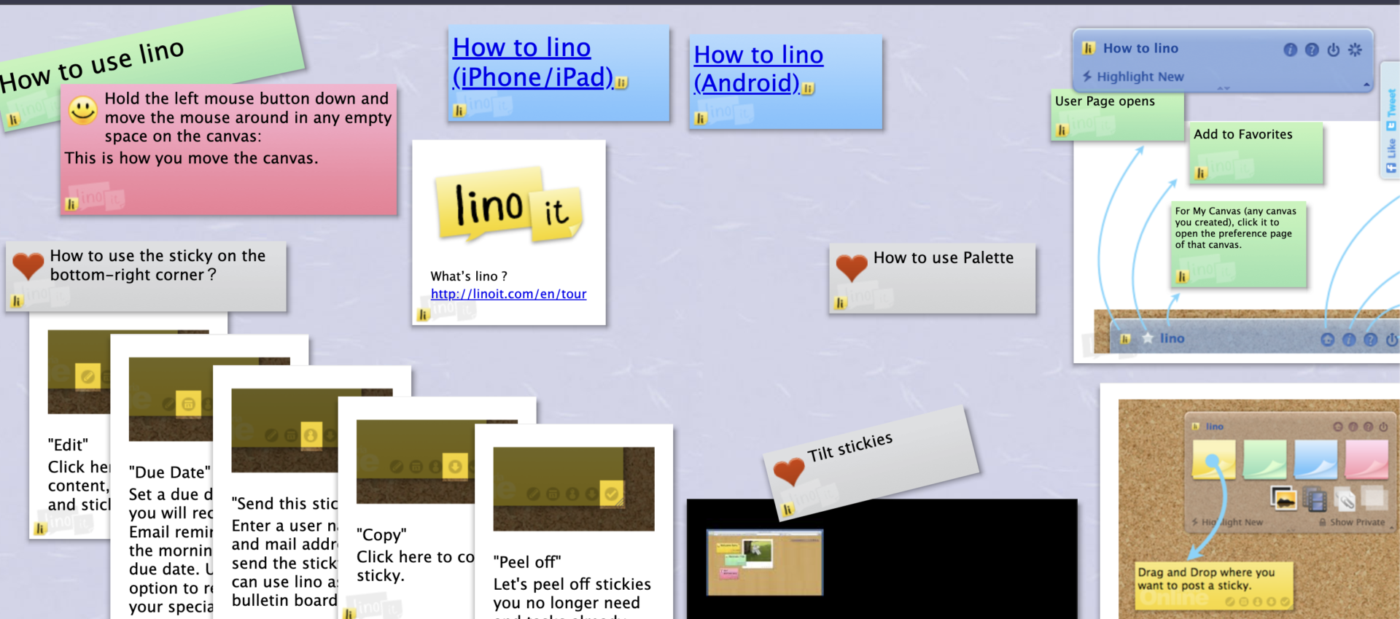
Lino is the most literal digital corkboard on this list. It mimics a real pinboard, allowing users to stick colored notes and photos, move, recolor, and peel them off. There’s a tactile simplicity here that the heavier tools have engineered away.
Capture is easier than the plain look suggests. You can post a sticky by emailing it to your board, or clip a headline, link, or image straight from a web page with the “lino it” bookmarklet. Set a due date on any note, and Lino emails you a reminder that morning. Those dates can surface in Google Calendar or Outlook, too.
Attach files to share with a group, and a board becomes a light shared space for a family or a small team. It runs in any browser and as iOS and Android apps, with offline notes syncing once you reconnect.
Note: Lino hasn’t accumulated a meaningful pool of public G2 or Capterra reviews yet, so we’re leaning on our own testing.
Where it taps out: It stays a personal or lightly shared board rather than a team workflow, and it hasn’t evolved much over the years. That means it lacks the templates, voting, and integrations the bigger tools offer.
Best for: A simple, tactile personal pinboard with light sharing.
Skip it if: You need team facilitation, voting, or notes that turn into tracked work.
Choose an online sticky notes app based on what you need to do after you write the note. If the note needs to become a task, choose a work management tool like ClickUp. If it needs to support a live brainstorm, choose a whiteboard app like Miro or Stormboard. If it is only for fast personal capture, Google Keep, Microsoft Sticky Notes, or Lino will feel lighter.
Start with these decision points:
For solo reminders, grocery lists, and quick thoughts, you do not need a full whiteboard. Google Keep works well for quick capture across Google apps, while Microsoft Sticky Notes is best for Windows and Outlook users. Lino is better if you want a simple corkboard-style space.
For team brainstorming, look for an infinite canvas, voting, templates, comments, and live cursors. Miro is stronger for active workshops and retros. Stormboard is better when the session needs to produce a structured report afterward.
For classrooms or content boards, Padlet is usually the easier pick. It supports text, links, files, images, audio, video, reactions, and simple sharing without turning the board into a project management system.
For physical sticky notes, use the Post-it App. It is the clearest fit if your team still brainstorms on paper and needs to capture the wall digitally.
A sticky note app is useful for capture. It becomes more valuable when ideas can move forward without manual copying.
If you want sticky notes to become assigned work, ClickUp is the strongest choice in this list. You can turn notes from a whiteboard or notepad into tasks with assignees, due dates, and workflow context. Notion also works if you want notes inside a knowledge base, but you will need to build the board structures yourself.
If you only need to write, pin, and revisit notes, a lighter app will save time.
For real-time team use, check whether the app supports guest access, comments, voting, roles, and board-level permissions. A no-login tool like IdeaBoardz is useful for quick retros with outside collaborators, but it is not the right fit for sensitive work.
For internal teams, Miro, ClickUp, Padlet, Stormboard, and Notion give you more control. They are better when the board needs to stay active after the meeting.
Some sticky note apps are intentionally loose. Others help you sort ideas into workflows, reports, databases, or project plans.
Choose a loose canvas when you want open-ended thinking. Choose a structured tool when notes need owners, statuses, deadlines, exports, or long-term organization.
Quick Hack: If your board gets messy after 30 notes, you need grouping, search, tags, templates, or AI-assisted sorting.
AI is useful when you have a crowded board and need help summarizing, clustering, or turning notes into next steps. Miro, ClickUp, Notion, Padlet, and Stormboard offer AI features in different ways.
But do not choose an app only because it has AI. For sticky notes, the basics still matter more: fast capture, easy rearranging, reliable sync, and a board that people can understand without training.
The best app is often the one that already fits where you work.
Choose Google Keep if your notes need to sit beside Gmail and Google Docs. Choose Microsoft Sticky Notes if your work lives in Windows, Outlook, and OneNote. Choose ClickUp if your notes need to connect to projects and tasks. Choose Notion if your notes belong inside docs, databases, and team knowledge.
Free sticky note apps are not all equal. Some are fully free but simple. Others give you strong features with limits on boards, AI credits, collaborators, or active spaces.
Before choosing, check:
For one-off use, free may be enough. For recurring workshops, classrooms, or team workflows, free-plan limits usually show up fast.
The easiest way to choose:
Choose a desktop sticky notes app if you need fast personal reminders. Choose an online sticky note board if you need to brainstorm, organize, share, vote, export, or turn ideas into tasks.
| Decision factor | Desktop sticky notes apps | Online sticky note boards |
|---|---|---|
| Best for | Quick personal capture, reminders, lists, and private notes | Team brainstorming, retrospectives, workshops, planning, teaching, and visual collaboration |
| Best examples from this list | Microsoft Sticky Notes, Google Keep, Lino | Miro, ClickUp, Padlet, Stormboard, IdeaBoardz, Notion, Post-it App |
| How they usually work | You open a small note, type quickly, color-code it, and come back later | You add notes to a shared board or canvas, move them around, group ideas, and collaborate with others |
| Collaboration level | Light sharing at best. Better for solo use or one-to-one note sharing | Built for groups. Many support comments, voting, guest links, live editing, templates, and exports |
| Organization style | Simple colors, labels, pins, reminders, and search | Boards, sections, columns, clusters, tags, templates, frames, task links, and exports |
| Best device fit | Desktop, phone, browser sidebar, or OS-level note access | Browser-first workspace, whiteboard, classroom board, or project workspace |
| When it works best | You need to capture a thought in seconds without setting up a board | You need to make sense of many ideas with other people |
| When it falls short | It can get messy when notes pile up or need structure | It can feel too heavy for basic reminders or personal scratch notes |
| Choose this if | You want a low-friction place to jot reminders, lists, and personal ideas | You want sticky notes to support brainstorming, prioritization, teaching, reporting, or project follow-up |
| Skip this if | You need shared workshops, voting, exports, or task ownership | You only need a private note that opens fast and stays out of the way |
The best online sticky notes app is the one that fits how you work and does not leave good ideas stranded on a board. For personal reminders, the free quick-capture tools are hard to beat. For teams, the deciding factor is whether a note can become work.
That is the gap ClickUp Whiteboards close: brainstorm on an infinite canvas, then convert any sticky into a trackable task with an owner and a due date, with Brain on hand to summarize the board and ClickUp Docs, Chat, and Tasks in the same workspace.
New to it? This beginner’s guide to ClickUp Whiteboards walks through the basics. Get started with ClickUp for free and give your next brainstorm somewhere to go.
Yes. Miro, Mural, ClickUp Whiteboards, Padlet, and Stormboard support real-time multi-user editing with live cursors, so several people can add and move notes on one board at once. Miro and ClickUp also show who’s editing and let guests join by link. Desktop apps like Microsoft Sticky Notes and Google Keep are built for solo capture and only allow light one-to-one sharing, not simultaneous board editing.
Yes. Google Keep, Microsoft Sticky Notes, Lino, IdeaBoardz, and the Post-it App are free, while Miro, Padlet, Notion, Stormboard, and ClickUp offer free plans. The catch is that free team plans often cap something: Miro’s free plan keeps only three boards editable, and Padlet’s free Neon plan includes three total padlets.
It depends on the tool’s sharing model. Account-based apps like ClickUp, Miro, Notion, and Padlet offer board-level permissions, guest controls, and private workspaces. No-login tools like IdeaBoardz make boards public by URL with no stated privacy controls, so best to avoid them for sensitive work. For confidential notes, choose a tool with SSO and role-based access
Yes. Microsoft Sticky Notes syncs to the web through onenote.com/stickynotes, and Google Keep works as a web app through keep.google.com. Microsoft also syncs Sticky Notes across Windows, OneNote mobile, the web, and Outlook, while Google Keep syncs notes across phone, computer, and other devices.
Yes. Google Keep is Google’s sticky-notes-style app. It supports notes, lists, photos, drawings, audio, labels, colors, pins, search, sharing, and real-time sync across devices. It is best for quick personal capture, not large visual boards or structured team workshops.
Do online sticky notes work offline?
Some do. Lino and the Post-it App store notes locally and sync once you reconnect. Microsoft Sticky Notes works offline on Windows and syncs later through Outlook/OneNote. Browser-first boards like Miro and IdeaBoardz need a connection for real-time collaboration. Check for an offline mode if you capture notes on the move.
Yes. IdeaBoardz lets you use boards without logging in, and its FAQ says login is optional. It is useful for quick retrospectives or brainstorming sessions where people need to add notes through a shared URL. Avoid using no-login boards for sensitive work unless you are comfortable with the sharing model.
In ClickUp Whiteboards, for instance, you can convert sticky notes into tasks, which makes it the strongest option here when brainstormed ideas need owners, due dates, and workflow follow-through. Miro and Stormboard can connect notes to external tools, and the Post-it App can export captured notes to tools like Trello, but ClickUp is the clearest pick when the sticky note needs to become native project work.
Yes. The Post-it App can capture up to 200 individual Post-it Notes at a time with your camera, turn them into editable digital notes, transcribe handwriting, and export boards to PowerPoint, Excel, PDF, Dropbox, Trello, Miro, and more. It is the best fit if your team still brainstorms on paper but wants a digital board afterward.
The Post-it App from 3M is the closest digital match: one photo captures up to 200 physical notes at once and rebuilds each as an editable, movable tile. For teams that want those notes to go further, Miro can import photos of stickies, and ClickUp Whiteboards can convert each captured note into an assigned task.
Padlet is the easiest classroom pick: students can join a wall via a link or QR code without an account, and each post can include text, images, audio, video, or files, plus comments and reactions. Teachers use it for class debates, mood boards, and exit tickets. Google Keep suits individual students for quick study capture, while Miro suits older students working on group projects or research synthesis.

Manasi Nair
Max 26min read

Arya P Dinesh
Max 18min read
Arya P Dinesh
Max 20min read

© 2026 ClickUp