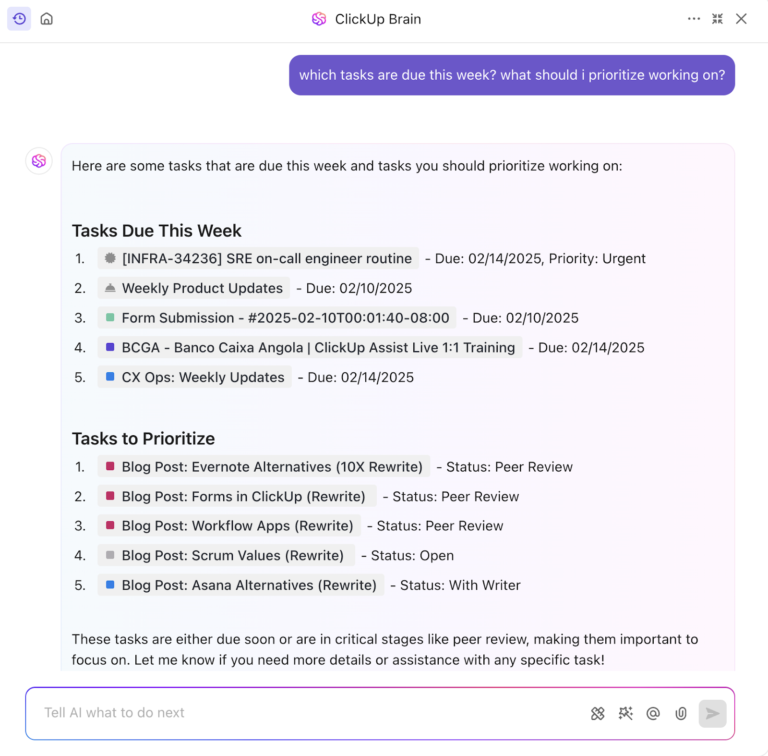
Still downloading templates?
There’s an easier way. Try a free AI Agent in ClickUp that actually does the work for you—set up in minutes, save hours every week.
Sorry, there were no results found for “”
Search engine optimization today, as you well know, is no longer just about the blue links. It’s a complex dance between AI Overviews, LLM citations, and hyper-personalized results.
Manually building keyword clusters or guessing at search intent doesn’t work anymore. You need tools that can handle some of the heavy lifting. ChatGPT is useful, but it’s a little generic. Custom GPTs, specifically trained for particular tasks, are your ideal pick.
The challenge? Finding the best GPTs for the job.
In this blog post, we’ve compiled a list of the best GPTs for SEO to help you save time and boost efficiency. These are custom GPTs actually worth your API credits for technical audits, topical authority, and ranking.🎯
| Tool Name | Best For | Key Features | Pricing |
| Quality Raters SEO Guide | Aligning content with Google’s E-E-A-T standards | E-E-A-T evaluation, quality rater guidelines breakdown, structured audit feedback | Custom pricing |
| SEO Link Building GPT | Scalable backlink prospecting and outreach automation | Link opportunity identification, outreach drafts, backlink gap analysis | Custom pricing |
| Julian Goldie GPT | Battle-tested link-building strategies and AI-powered SEO playbooks | Advanced link-building frameworks, keyword optimization, scalable outreach prompts | Custom pricing |
| Is It a Ranking Factor GPT | Clarifying real Google ranking signals vs. SEO myths | Ranking factor evaluation, SEO update breakdowns, optimization prioritization | Custom pricing |
| Search Query Analyzer | Decoding SERP intent and ranking page patterns | Ranking page type breakdown, intent identification, structural pattern analysis | Custom pricing |
| Search Intent Optimization Tool | Aligning content intent with Google’s quality expectations | Primary/secondary intent identification, draft-vs-SERP gap analysis, quality alignment | Custom pricing |
| GSC Keyword Ranking Changes Scatter Plot | Visualizing algorithm update impact on keyword performance | Before/after position comparison, scatter plot visualization, outlier detection | Custom pricing |
| FREE SEO Blog Content Outline Creator | Building SERP-aligned blog structures fast | SEO-focused outlines, heading structures from ranking patterns, topical depth suggestions | Custom pricing |
| SEO Topical Map Maker | Building structured topical authority across your niche | Topical map building, TOFU/MOFU/BOFU clustering, internal linking support | Custom pricing |
| Keyword Clustering Tool | Preventing keyword cannibalization at scale | Semantic keyword grouping, duplication reduction, topical authority strengthening | Custom pricing |
| GA4 Implementation Assistant | Fixing messy GA4 setups and tracking gaps | GA4 setup diagnosis, event structure recommendations, attribution clarity | Custom pricing |
| Post Cheetah SEO | Instant page-level SEO performance analysis | Keyword alignment evaluation, on-page SEO gaps, content quality assessment | Custom pricing |
| She Knows Alt Text | Scalable, accessibility-first image optimization | Context-aware alt text generation, accessibility + keyword balance, batch optimization | Custom pricing |
| Web Performance Engineer | Improving Core Web Vitals and technical performance | Core Web Vitals diagnosis, asset optimization recommendations, UX-focused fixes | Custom pricing |
| Schema Advisor GPT | Implementing precise, impact-driven schema markup | Tailored Schema.org recommendations, rich result eligibility, structured data alignment | Custom pricing |
How we review software at ClickUp
Our editorial team follows a transparent, research-backed, and vendor-neutral process, so you can trust that our recommendations are based on real product value.
Here’s a detailed rundown of how we review software at ClickUp.
A Custom GPT is a personalized AI assistant built on OpenAI’s ChatGPT, designed to carry out specific tasks. It has three core components:
| Feature | What it does |
|---|---|
| Instructions | A permanent set of “rules” that tell the AI how to act, what tone to use, and what steps to follow (so you don’t have to repeat your prompts every time) |
| Knowledge | You can upload your own files (PDFs, spreadsheets, docs) that the GPT will prioritize over its general training data |
| Capabilities | You can toggle specific powers on or off, such as Web Browsing, DALL-E (image generation), or Code Interpreter (data analysis). |
For SEO, GPTs are essential tools for optimizing content, creating keyword-rich copy, and boosting user engagement with insightful, contextually relevant content suggestions.
As an added benefit, you can upload your brand guidelines, keyword lists, and examples of content you prefer. The custom GPT then generates outputs that meet your brand and SEO standards, without you needing to explain everything again.
⚙️ Bonus: Learn how to accurately cite ChatGPT in your SEO reports and ensure proper attribution in your research.
A high-quality SEO GPT doesn’t just write text; it follows a specific strategic logic. It consistently produces search-aligned, intent-aware, and structurally sound outputs that actually rank and drive traffic.
Top-performing models produce contextually relevant content, generate meta descriptions, and help with schema markup and structured data.
Key characteristics that make a GPT model excellent for SEO include:
Important considerations:
📖 Also Read: LLM vs. Generative AI: A Detailed Guide
Not all GPTs are worth your time for SEO. These are the ones that get it right.
Note: Pricing for GPT-based SEO tools is usually custom and depends on usage, features, and scale.

Ranking in competitive niches means meeting Google’s quality standards. This GPT helps you think like a quality rater, not just a content writer.
It reviews your content against E-E-A-T principles and flags what’s missing. The result? Stronger, more credible pages that are built to rank.
💡 Pro Tip: Talk your way to polished writing with ClickUp Brain MAX. You can dictate content into Talk to Text, instead of typing it all manually. Brain MAX:
📖 Also Read: How to Use ChatGPT for Marketing

Backlinks still matter, but manual outreach doesn’t scale. This GPT helps you turn link building into a repeatable process.
It finds opportunities, structures prospect lists, and drafts outreach messages. That means faster execution without losing direction.
📮 ClickUp Insight: 88% of people now use AI in some form, with an impressive 55% using it multiple times a day. As AI becomes a daily tool for professionals, its role in research, task management, and decision-making continues to grow.
ClickUp enhances these AI-driven workflows by embedding intelligence directly into your workspace. It extracts key insights from dense documents, compiles real-time project updates, and turns discussions into actionable tasks. It streamlines complex processes, allowing you to focus on high-impact work.
📖 Also Read: How to Use ChatGPT-4o at Work

If you want proven SEO strategies, this GPT delivers. It’s built on real-world link-building frameworks and playbooks such as the Link Building Mastery Ebook .
You get structured guidance, not surface-level tips. That makes it easier to plan, execute, and scale what actually works.
📖 Also Read: How to Conduct User Research

SEO is full of opinions. This GPT helps you separate facts from noise.
It explains what actually impacts rankings, and what doesn’t. So you can focus your efforts where they count.
🤝 Friendly Reminder: AI learns from existing data, which means it can inherit biases. Always analyze results critically and be aware of potential inaccuracies, especially when dealing with sensitive topics.
📖 Also Read: How to Create a Virtual Assistant With ChatGPT?

Before you create content, you need to understand the SERP. This GPT breaks down what’s already ranking, and why.
It shows intent, formats, and patterns across top results. That means you can create content that fits what Google is rewarding.

Good SEO starts with matching intent. This GPT helps you align your content with what users actually want.
It goes beyond surface-level keyword optimization and highlights gaps between your draft and the SERP. As a result, your pages feel more relevant and perform better.
🤝 Friendly Reminder: GPTs can generate convincing but nonexistent academic references. Always double-check AI-generated sources to ensure accuracy before citing them in research.

When traffic shifts, you need clarity fast. This GPT turns your Search Console data into clear visuals.
You can quickly spot gains, drops, and outliers. That makes it easier to respond to algorithm updates with confidence.

This GPT helps you go from keyword to outline in minutes. No more blank page anxiety.
It builds structured, SEO-friendly frameworks based on what’s ranking. This way, you can write faster without missing key sections.

SEO isn’t just about individual posts. This GPT helps you plan entire topic clusters, so you build visibility that compounds over time.
It works as a topical authority generator, mapping your content strategy around a central pillar. This ensures that your websites send clear relevance signals to search engines.
📖 Also Read: How to Use AI in Marketing With Effective Examples

More content isn’t always better. If pages overlap, they compete with each other.
This GPT groups related keywords into clear clusters. So your content stays focused, organized, and easier for search engines to understand.
📖 Also Read: Best Marketing AI Tools to Stay Productive

Most teams install GA4. Few configure it properly. This GPT helps you turn your Google Analytics setup into a reliable source of decision-making insights.
It identifies gaps and suggests better event structures, so your data becomes something you can actually trust.

Sometimes all you need is a quick, practical diagnosis. This GPT gives you a fast, practical SEO check for any page.
It breaks down how a page aligns with target keywords, search intent, and on-page SEO signals. This lets you prioritize improvements without running a full technical audit.
📖 Also Read: How to Use AI for SEO (Use Cases & Tools)

Alt text often becomes an afterthought. This GPT helps you do it right, every time.
It generates clear, context-aware descriptions for your images to improve accessibility and SEO. This strengthens how your website communicates with users and search engines.
📖 Also Read: How to Build an SEO Roadmap (+ Free Templates)

Your website’s speed directly affects how users experience your website and how search engines evaluate it. This GPT helps you spot what’s slowing things down.
It breaks down performance issues and suggests fixes to improve load times, responsiveness, etc. So your site loads faster, runs smoother, and performs better overall.

For agencies and technical marketing professionals, this GPT is a strategic layer within your AI tools stack. It helps you add structured data that boosts search visibility—without piling on unnecessary markup.
It also guides you on what schema to use and how to use it. Everything is tailored to your business model, content, and SEO goals. The result? Search engines understand your site better, and your pages are more likely to perform.
📚 Also Read: How to Build an SEO Roadmap (+ Free Templates)
There are dozens of GPT tools for isolated SEO tasks. For example, the Keyword Clustering Tool will serve a different purpose from Schema Advisor GPT. But when you add too many tools, you’ll land in the tedious cycle of AI sprawl.
That’s where a complete workflow management platform like ClickUp shines. Instead of treating AI as a collection of one-off tools, ClickUp turns it into a connected system.
ClickUp’s converged AI workspace keeps tasks, discussions, keyword research, analytics, and delivery tracking connected. Instead of jumping between GPTs, documents, and spreadsheets, you can manage everything in one place—from research to execution.
Here’s how it works.
Start at the beginning with ClickUp Brain, the AI integrated within ClickUp. Ask it to analyze trends, competitor data, search intent, and generate a list of high-impact keywords for your niche.
Unlike GPT tools and their narrow approach, ClickUp Brain consolidates keyword insights. This helps you determine which terms to prioritize, how to structure them within the content, and where they fit your overall SEO strategy.

🦸🏻♀️ Try the Keyword Research Automator Agent in ClickUp.
Feed the agent a topic, a competitor URL, or a set of seed keywords, and it returns a structured, scored, and clustered keyword plan that would otherwise require a full-time analyst working for days.

From writing to editing to polishing it with SEO elements, ClickUp Brain is a powerful AI-based creative partner.

The AI writing assistant can help spin up your first draft. The spell checker can correct your typos gently. Brain can also help you create meta descriptions, headings, internal links, and readability improvements.
The best part? Since it has the context of your work, it learns from your past SEO performance. Its recommendations are tailored to your SEO goals and objectives, so optimizations are more strategic.
💡 Pro Tip: Use ClickUp Super Agents to keep task follow-through consistent.
Super Agents are ClickUp’s AI-powered teammates designed to run multi-step workflows using your workspace context. They’re ambient agents that can work continuously while keeping access controlled. You can @mention them, assign tasks, and message them directly.
Build a team of agents to manage each step of your workflow, from keyword research and brief creation to SERP analysis, content writing, and meta description generation.
See how a Super Agent can take over the task of generating SEO-friendly blog titles at scale!
Super Agents can perform keyword gap analysis, audit on-page elements, monitor backlink profiles, and generate prioritized optimization recommendations. Check out our full complement of pre-built SEO Super Agents!
Most SEO work ends up fragmented—keyword lists in spreadsheets, outlines in docs, feedback in comments, and final drafts somewhere else.

ClickUp Docs brings all of that together. You can create briefs, draft content, embed research, and collaborate with your team in one place. Everything stays connected to ClickUp Tasks, so execution doesn’t drift from planning.
It also makes iteration easier. You can update content, track changes, and keep your SEO assets current without digging through multiple tools.
SEO data is often scattered—rankings in one tool, traffic in another, tasks somewhere else. That makes it hard to see the full picture.

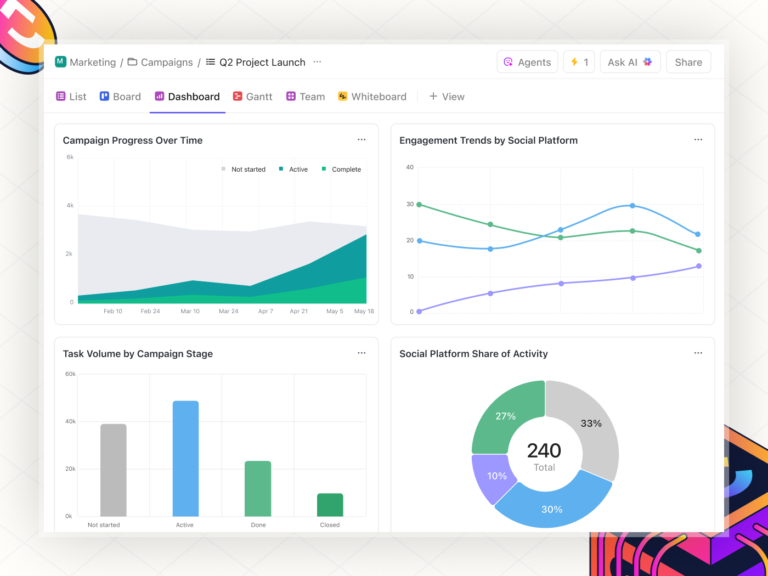
ClickUp Dashboards bring everything together. You can track content progress, monitor key SEO metrics, and visualize performance in one place.
This makes reporting faster and decision-making clearer. Instead of digging for updates, you can instantly see what needs attention and where to focus next.
Good SEO requires the right mix of research, planning, and implementation—but without suitable tools, it can be difficult.
That’s why ClickUp’s SEO Research & Management Template is such a valuable resource. It provides everything you need to monitor and control your SEO efforts, including:
📚 Also Read: Streamline Your SEO Workflow with ClickUp
Search engine optimization today isn’t limited by tools. As you’ve seen, AI tools can help you research keywords, analyze SERP, and optimize copy in minutes.
The real gap is execution. When you work across multiple disconnected tools, context breaks, and insights are lost.
GPTs help you do specific SEO tasks better. ClickUp helps you connect those tasks into a system that actually drives results. It brings your research, content, tasks, and decisions into one place, so your SEO work actually moves forward.
What are you waiting for? Try ClickUp today for free!
There isn’t a single “best” GPT for SEO. The right choice depends on your workflow — whether you need keyword research, content structuring, technical audits, or schema. Most agencies combine specialized GPTs to support different parts of their SEO strategies.
No. GPTs complement tools like Ahrefs and SEMrush, but don’t replace them. Traditional platforms provide proprietary data, backlink indexes, and search volume metrics. GPTs help interpret that data, generate insights, and streamline content creation workflows
AI-generated recommendations can be highly useful for ideation and structure, especially around keywords and on-page SEO. However, accuracy depends on context and input quality. Human validation and real performance analytics are still essential for strategic decisions.
GPTs act as acceleration layers within long-term SEO strategies. They support research, optimization, and content strategy development, but sustainable rankings still rely on strong fundamentals — technical health, authority building, and consistent data-driven execution.
© 2026 ClickUp
There’s an easier way. Try a free AI Agent in ClickUp that actually does the work for you—set up in minutes, save hours every week.