

Sorry, there were no results found for “”
Sorry, there were no results found for “”
Sorry, there were no results found for “”
The difference between a chatbot and an agent comes down to one thing: context. Proprietary agentic technology embeds that context directly into your workspace, along with memory, permissions, and execution. But not all agents are built this way.
In this article, we’ll break down what proprietary agentic technology means, how it works at a systems level, and why it changes how work gets done. You’ll also see how ClickUp applies this model to bring intelligent, context-aware, and human-like agents, aka Super Agents, to your workspace.
A proprietary agentic technology is an AI agent architecture that functions on a platform’s native data model. It gives agents the same access patterns, permissions, and memory as your human team members. Put simply, the architecture separates an AI that just follows commands from one that understands your workflows.
This covers a significant gap often overlooked by generic AI agents. They ask a question, get an answer, and immediately forget the conversation. It happens because they lack persistent memory and are unable to learn your team’s preferences, forcing you to repeat yourself endlessly.
Proprietary agentic technology models AI agents as full users within your platform. This means you get:
The agent’s capabilities allow context to flow naturally because they’re a part of the platform’s fabric.
🔎 Did You Know? Organizations now use an average of 3.6 separate AI tools, correlating with higher anxiety and eroded productivity. This frustration is the direct result of using generic AI agents bolted onto your tools rather than built into them.
Proprietary context is the specific, internal data that defines how your business operates. It includes your project hierarchies, historical task data, team relationships, and documented decisions.
When an AI agent drafts a weekly project update without this context, it delivers a generic template. You then spend 15 minutes manually feeding it the details it missed.
This manual oversight undermines automation’s efficiency and reduces AI to a basic text predictor rather than a true collaborator. Generic agents only know what you manually type into a prompt. But a proprietary agent sees your entire operational history because it lives where your work happens.
This deep integration allows the agent to automatically understand:
You can’t automate processes using AI if your data lives in disconnected tools.
🧠 Fun Fact: Nearly 48% of employees and 52% of leaders struggle with chaotic and fragmented work.
No AI agent can build a complete picture if it must bridge gaps between platforms that do not communicate with each other. A Converged AI Workspace, like ClickUp, serves as the essential foundation for agentic AI in this case. It consolidates your data, communication, and projects into a single unified environment, and the agent moves beyond simple text generation to deliver context-aware organizational results.
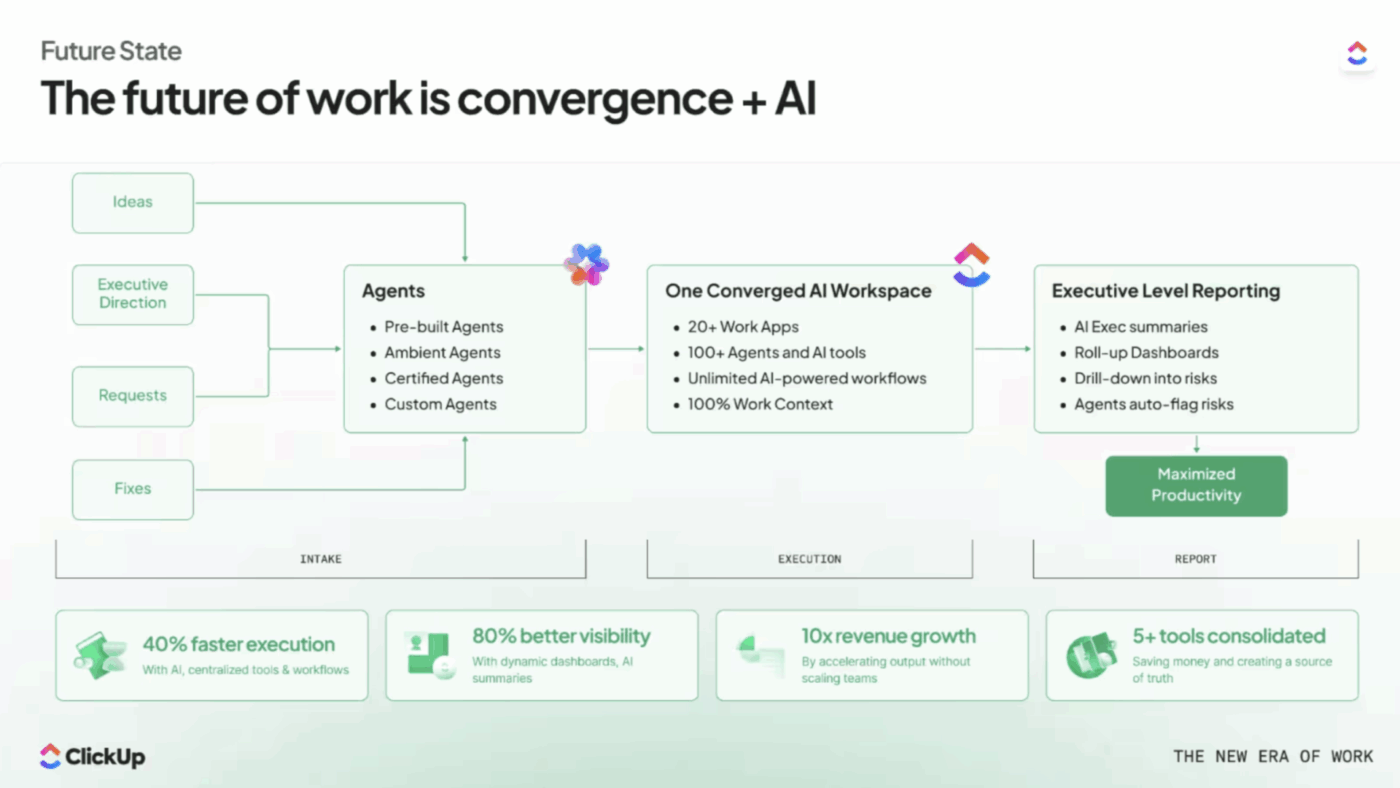
📮 ClickUp Insight: The average professional spends 30+ minutes a day searching for work-related information—that’s over 120 hours a year lost to digging through emails, Slack threads, and scattered files. An intelligent AI assistant embedded in your workspace can change that. Enter ClickUp Brain. It delivers instant insights and answers by surfacing the right documents, conversations, and task details in seconds—so you can stop searching and start working.
💫 Real Results: Teams like QubicaAMF reclaimed 5+ hours weekly using ClickUp—that’s over 250 hours annually per person—by eliminating outdated knowledge management processes. Imagine what your team could create with an extra week of productivity every quarter!
Proprietary agentic AI models maintain three distinct layers of memory that mirror how humans build tacit knowledge. Without this, an agent treats every interaction as its first, meaning it can’t learn, adapt, or improve.
Recent memory captures your immediate actions to provide real-time relevance. This layer tracks the current conversation thread, the task you are viewing, and the document you just closed.
📌 Because the agent maintains this immediate context, you can simply say, ‘update the due date on that task,’ without re-specifying which task you mean. This requires a deep, native integration with the platform’s data layer that most bolted-on AI tools cannot replicate.
Preferences memory observes the specific patterns and unwritten rules followed by your team. Instead of requiring manual configuration, the agent learns your formatting conventions, naming standards, and typical workflows through observation.
📌 It recognizes, for example:
Long-term episodic memory serves as a permanent record of specific events, decisions, and outcomes across your entire workspace. This layer allows the agent to reference historical context, such as remembering that a specific marketing approach failed last quarter due to budget constraints.
Unlike an isolated system, this memory lives in a format humans can inspect and edit—like a ClickUp Doc. It forms a centralized knowledge hub for your entire organization.
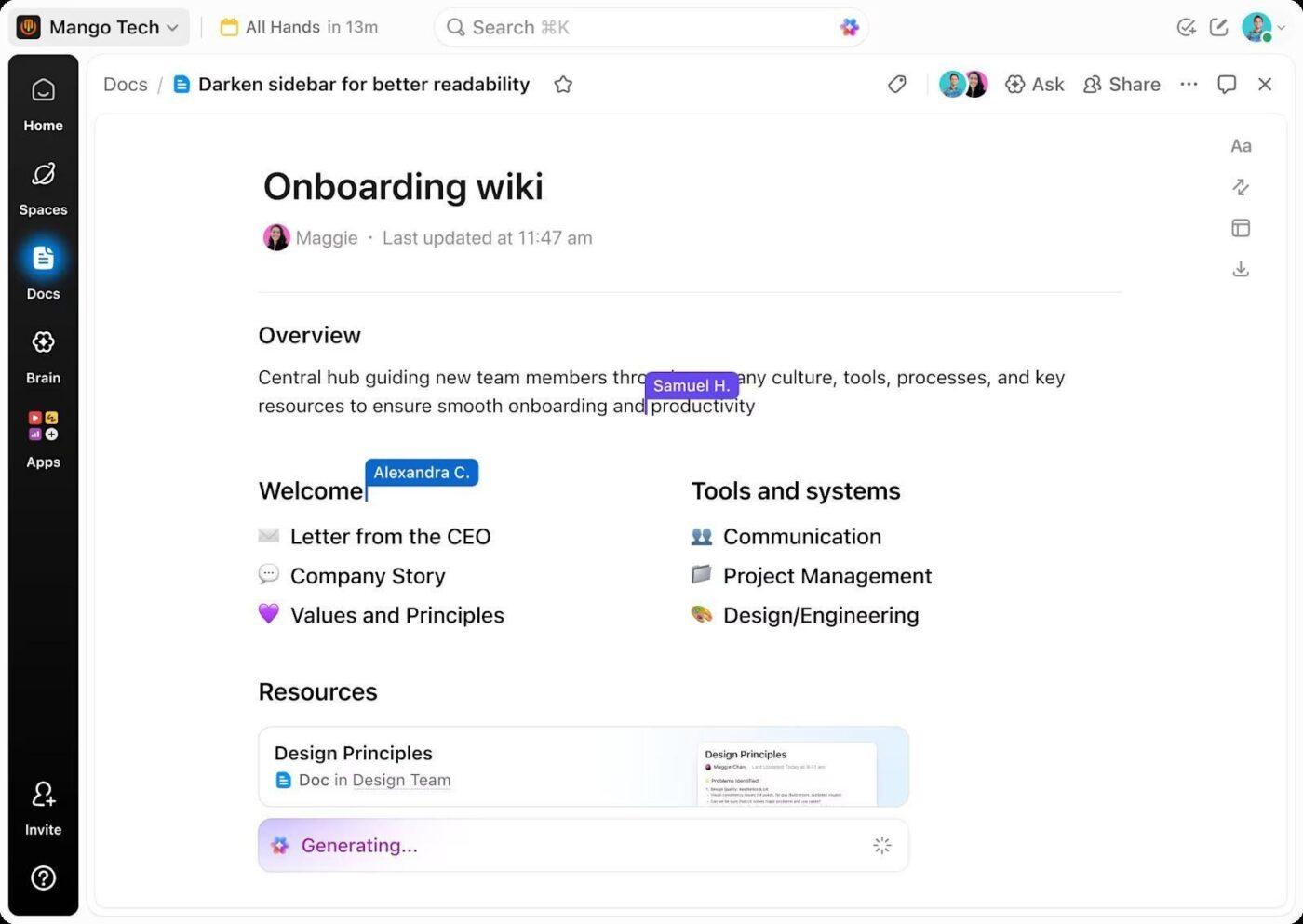
ClickUp Docs and ClickUp Tasks are natively connected. It helps the agent understand the relationship between a project brief and the ongoing work. This integration ensures that your team’s knowledge compounds rather than decays.
When your documentation and tasks live together, the agent can bridge the gap between historical decisions and current actions by:
The ability to inspect and edit this memory within a Doc ensures that your agent’s knowledge is transparent and manageable. You can view version histories, adjust permissions, and correct the agent’s understanding in real time. This oversight ensures that as your knowledge base grows, while the agent remains a predictable, accountable, and trustworthy collaborator that drives your operations forward.
🔎 Did You Know? 22% of our survey respondents still have their guard up about using AI at work. Out of the 22%, half worry about their data privacy, while the other half just aren’t sure they can trust what AI tells them.
This distrust stems from four core structural issues:
Trust requires transparency at work, not vague promises of accuracy. To work effectively, agents must operate under a system that provides total visibility and granular control.
You achieve this level of reliability only by building agents directly into your primary workspace. This way, they use the exact same permission sets and audit logs as human users. When an agent follows the same rules as your team, it moves from an unpredictable tool to a dependable collaborator.
Want a step-by-step guide to implementing AI in your team’s workflows? Download ClickUp’s free AI implementation playbook—built for teams making the transition from generic tools to connected agents.
It’s easy to interpret traditional automation tools as clunky background scripts that run in isolation. You don’t need an agent that sits on the sidelines waiting for prompts. You need something that actually works alongside you—inside your workflows, with full context, and with the ability to take action.
Simply put, in an ideal scenario, AI should not be treated as an add-on.
That’s what makes ClickUp Brain different. As the world’s most complete and context-aware work AI, it builds a continuous, contextual understanding of your workspace. It does not rely on isolated prompts or one-off inputs to get to work. It understands how your projects evolve, how your team collaborates, what priorities shift, and where work gets blocked. It’s ambient—embedded into the same environment where your work context lives.
Every interaction adds to that context, which means your AI improves as your work progresses. That persistent context, in turn, enables ClickUp Super Agents to exist as more than assistants.
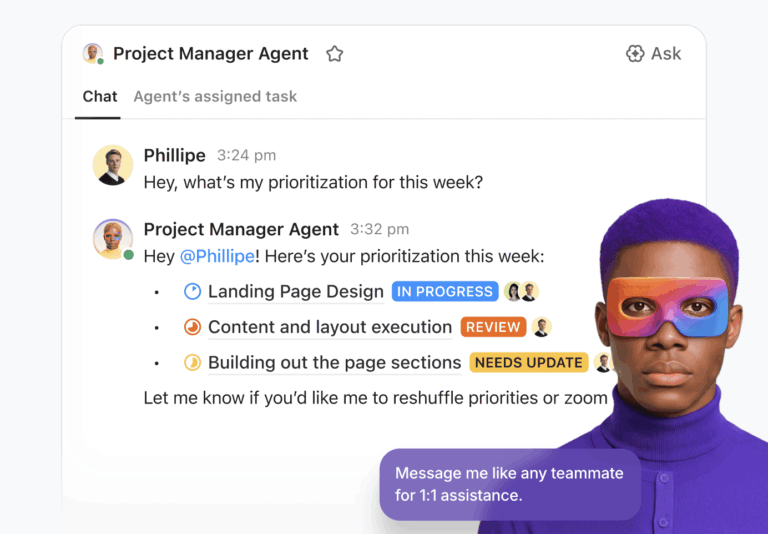
Super Agents do not operate like background scripts that trigger on conditions and produce outputs. You work with them the same way you work with people on your team. Basically, assign them tasks, include them in conversations, and expect them to be accountable for outcomes.
📌 For example, when you @mention a Super Agent in a document, it:
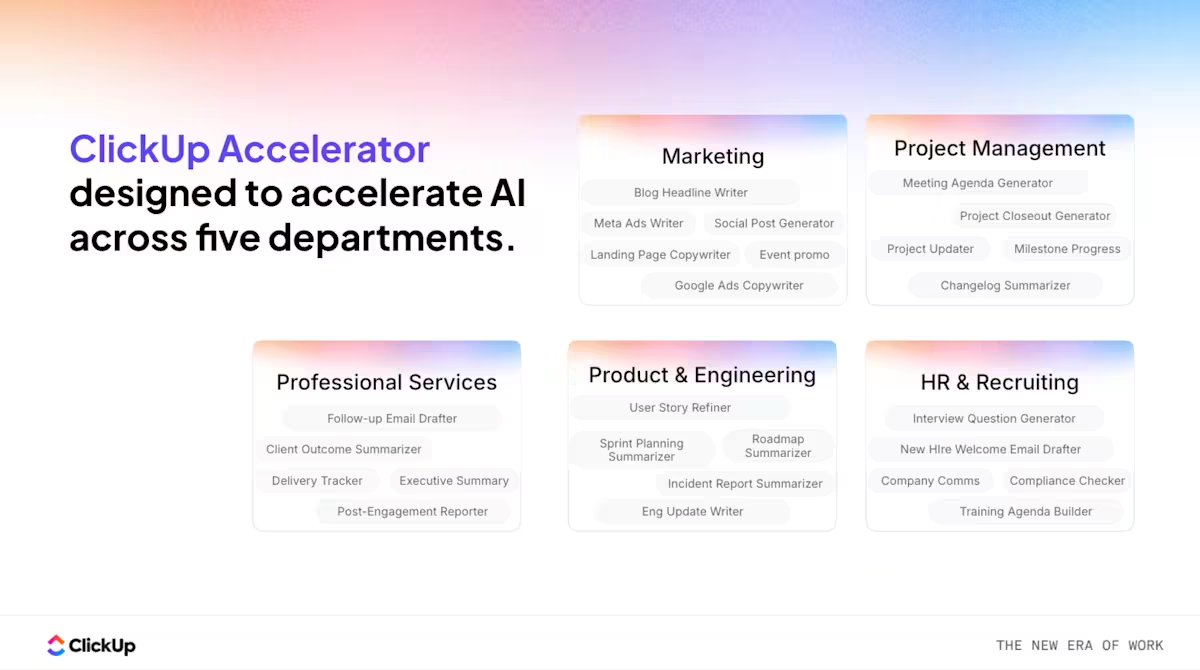
Want to see which Super Agents apply to your team? Explore ClickUp Accelerator to get pre-built agent packs for every department: from product and engineering to marketing and HR!
This changes how delegation works.
Instead of breaking work into instructions, you define the outcome you want. ClickUp handles the orchestration behind the scenes by activating the right agents with the right capabilities. A single request can trigger a multi-agent workflow across planning, execution, and reporting, without you having to stitch tools together manually.
🧠 Each Super Agent operates with memory, which includes short-term, long-term, and episodic awareness of what it has worked on before. This means it does not repeat mistakes, lose context, or require re-briefing. It builds on prior work the same way a human teammate would.
🔓 Each agent also operates with permission-based, secure access to your workspace knowledge. It can pull information from tasks, documents, chat history, connected tools, and historical decisions to produce outputs grounded in your work, not generic patterns.
💪🏼 Autonomy is built into how these agents function. They do not wait for constant approval to move forward. They can prioritize tasks, update statuses, generate reports, and respond to changes in real time. At the same time, they remain fully aligned with your permissions and controls, so they operate within the same boundaries as any human user in your workspace.
Because Super Agents are embedded directly into ClickUp, they operate with ambient awareness. They continuously track changes across your workspace and act on them without requiring explicit triggers. Work does not stall because someone forgot to follow up or update a task. The system keeps moving.
👀 The best part: As a team, you stop managing tasks or coordinating between tools. Instead, it helps you beat tool sprawl and start working inside a single system that already understands what needs to happen. It gets easier to run entire workflows without manual handoffs. You can maintain real-time visibility without status meetings and scale output without increasing coordination overhead. All of this progresses even when you are not actively pushing work forward.
🤝 Case study: How Bell Direct boosted operational efficiency by 20% with ClickUp Super Agents
Bell Direct proves that you don’t need a technical team to adopt proprietary agentic AI meaningfully.
Using ClickUp Super Agents, the team automated an entire intake and triage workflow—end to end—without writing code or adding new tools. Their AI Agent, Delegator, operates autonomously inside ClickUp, handling incoming client emails the same way a human would, but faster and at scale.
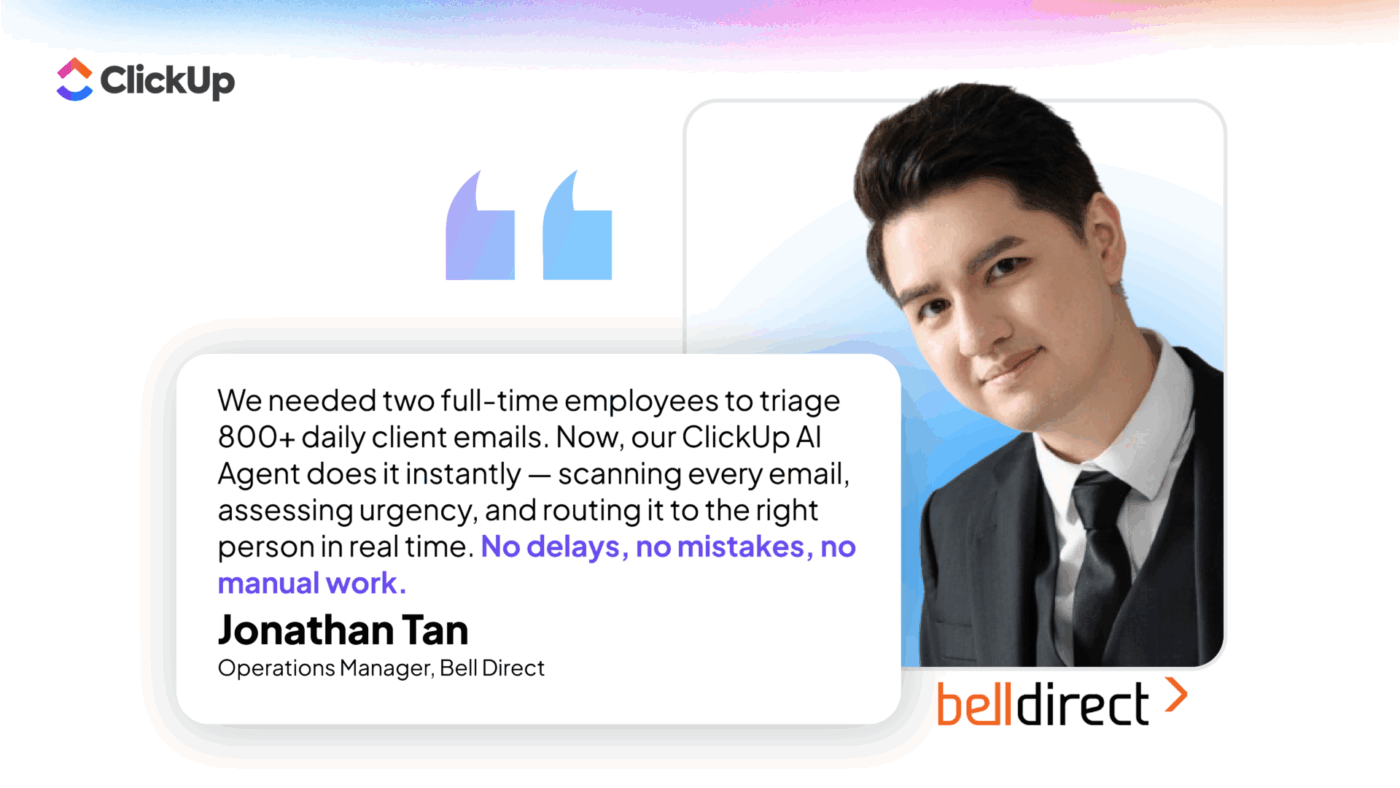
The results speak for themselves:
👉🏼 Want similar results for your team?
You should evaluate agentic technology by how deeply it’s integrated into your work, rather than by its features.
Why?
🤝 When asked what would make AI agents truly useful, the top answer wasn’t speed or power. Nearly 40% of ClickUp survey respondents said they need an agent with a perfect understanding of their work context.
Before you commit to any agentic AI solution, use this checklist to see if it’s the real deal:
Start by testing a potential solution with a use case where context is critical, like generating project status updates or preparing for a client meeting. If you find yourself having to feed the agent information that already exists elsewhere in your workspace, the agent lacks true context.
ClickUp Super Agents offer the perfect starting point. They access your team’s full context instantly, so nothing needs to be stitched together or reintroduced. Explore how Super Agents can transform your team’s workflow.
Proprietary agentic technology is built into a platform’s native architecture, allowing AI agents to access the same data model, permissions, and context as human users. Generic AI agents operate externally, relying on APIs and prompts, which limits their memory, context awareness, and ability to execute work autonomously.
Yes, in proprietary agentic systems, AI memory is often stored in human-readable formats like documents or knowledge bases. This allows teams to review, edit, and correct what the agent knows. In contrast, many generic AI tools store memory in opaque systems that cannot be inspected or controlled.
AI agents in proprietary systems inherit the same permission structure as human users, such as role-based access control (RBAC). This ensures agents can only view or act on data they are authorized to access, preventing exposure of sensitive information and maintaining compliance with organizational security policies.
Agentic AI operates autonomously within your workspace, maintaining context across sessions and taking actions like updating tasks or generating reports. Tools like ChatGPT or Copilot are prompt-based assistants that generate responses but lack persistent memory, deep integration, and the ability to execute workflows independently.

Praburam Srinivasan
Max 10min read

Manasi Nair
Max 22min read
Manasi Nair
Max 24min read

© 2026 ClickUp




