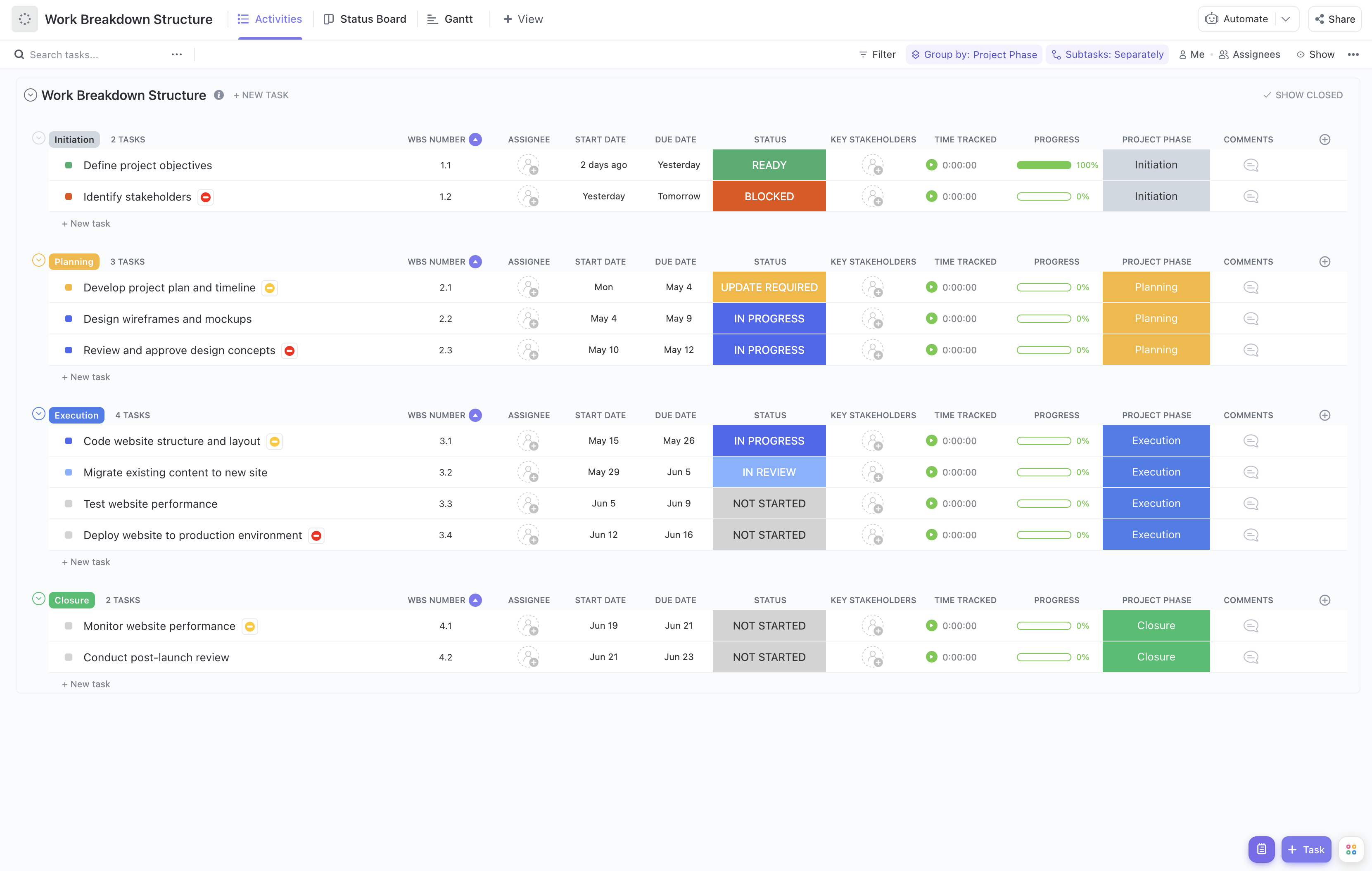
Coordinating public utilities projects involves managing multiple stakeholders, regulatory requirements, and technical tasks. Breaking down these complex activities into manageable components is essential for success. This Public Utilities Coordination Work Breakdown Structure Template provides a structured approach to organizing and overseeing every aspect of your utilities project.
This specialized template helps you:
- Segment utility coordination tasks such as permitting, design reviews, and inspections for clear oversight
- Assign responsibilities to engineering teams, contractors, and regulatory bodies efficiently
- Monitor project milestones and compliance deadlines with real-time progress tracking
Best of all, no specialized software or coding skills are required. Simply use ClickUp to implement this template and streamline your public utilities coordination efforts.
Benefits of a Public Utilities Coordination Work Breakdown Structure Template
Utilizing a WBS template tailored for public utilities coordination offers numerous advantages:
- Clearly defines and organizes deliverables such as utility mapping, permit acquisition, and stakeholder approvals
- Clarifies roles and responsibilities among utility companies, contractors, and municipal agencies
- Enhances communication between project teams, utility providers, and regulatory authorities to prevent delays
- Improves overall project efficiency by identifying dependencies and potential bottlenecks early
Main Elements of the Public Utilities Coordination Work Breakdown Structure Template
This template is structured to cover all critical phases of public utilities coordination:
- Project Initiation:
Define project scope, identify key stakeholders including utility companies and regulatory agencies, and establish communication protocols.
- Permitting and Approvals:
Manage permit applications, track submission deadlines, and coordinate with municipal authorities for timely approvals.
- Design and Engineering:
Oversee utility design reviews, conflict resolution between utilities, and compliance with engineering standards.
- Construction Coordination:
Schedule utility installations, coordinate with contractors, and monitor safety and quality inspections.
- Testing and Commissioning:
Plan utility system testing, address punch list items, and obtain final acceptance from stakeholders.
- Project Closeout:
Compile documentation, finalize reports, and conduct post-project evaluations to capture lessons learned.
By following this detailed WBS template, public utilities projects can be managed with greater clarity, accountability, and efficiency, ensuring successful coordination and delivery.