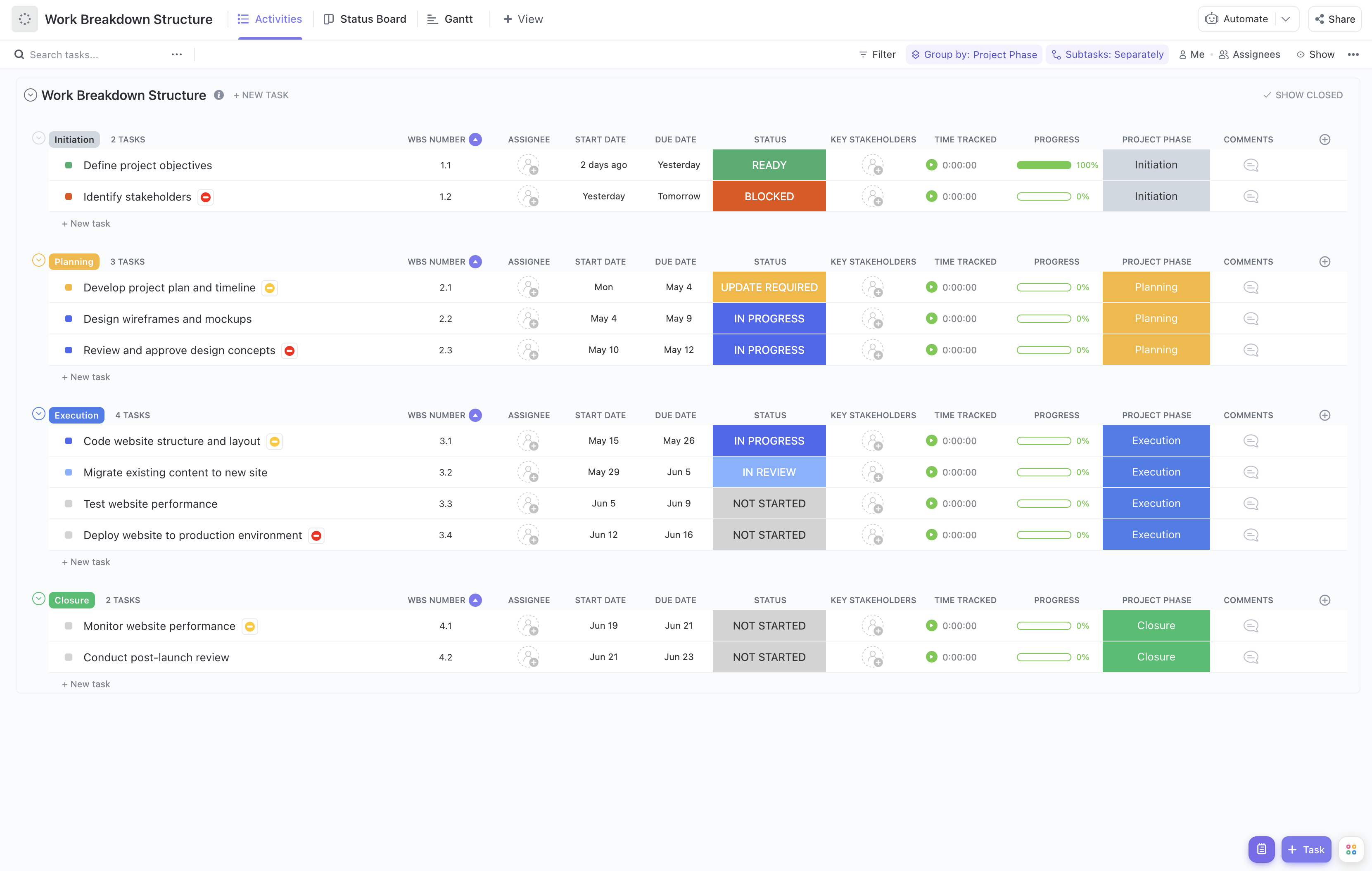
Implementing process standardization across an organization can be a complex endeavor involving multiple departments, stakeholders, and detailed steps. To navigate this complexity, the Process Standardization Execution Work Breakdown Structure (WBS) Template provides a structured framework to decompose the standardization project into clear, actionable components.
This specialized template enables you to:
- Systematically organize standardization tasks into logical phases and work packages for enhanced clarity
- Assign responsibilities to process owners and team members to ensure accountability
- Monitor progress in real-time to identify bottlenecks and maintain momentum
With no need for coding or advanced software skills, this template leverages ClickUp's intuitive platform to empower your team to execute process standardization initiatives effectively and efficiently.
Benefits of Using the Process Standardization Execution WBS Template
Adopting this WBS template for process standardization execution offers several advantages:
- Clear Definition of Deliverables: Break down the standardization goals into specific, measurable deliverables such as standardized operating procedures, training materials, and compliance checklists.
- Role Clarity: Clearly delineate responsibilities among process owners, quality assurance teams, and stakeholders to avoid overlaps and gaps.
- Enhanced Communication: Facilitate transparent communication channels between departments and management to ensure alignment and swift issue resolution.
- Improved Efficiency: Streamline the execution by tracking dependencies, timelines, and resource allocation, reducing delays and redundancies.
Main Elements of the Process Standardization Execution WBS Template
This template is structured to cover all critical aspects of process standardization execution, including:
- Project Phases: Initiation, Analysis, Design, Implementation, Validation, and Continuous Improvement.
- Work Packages: Detailed tasks such as process mapping, gap analysis, documentation development, training rollout, and audit scheduling.
- Task Assignments: Allocation of responsibilities to specific team members or departments with clear deadlines.
- Progress Tracking: Status indicators to monitor task completion, risks, and issues in real time.
- Stakeholder Engagement: Identification and involvement of key stakeholders to ensure buy-in and support.
By leveraging this template, organizations can systematically execute process standardization projects, ensuring that all necessary steps are accounted for and tracked, ultimately leading to consistent and optimized operational workflows.