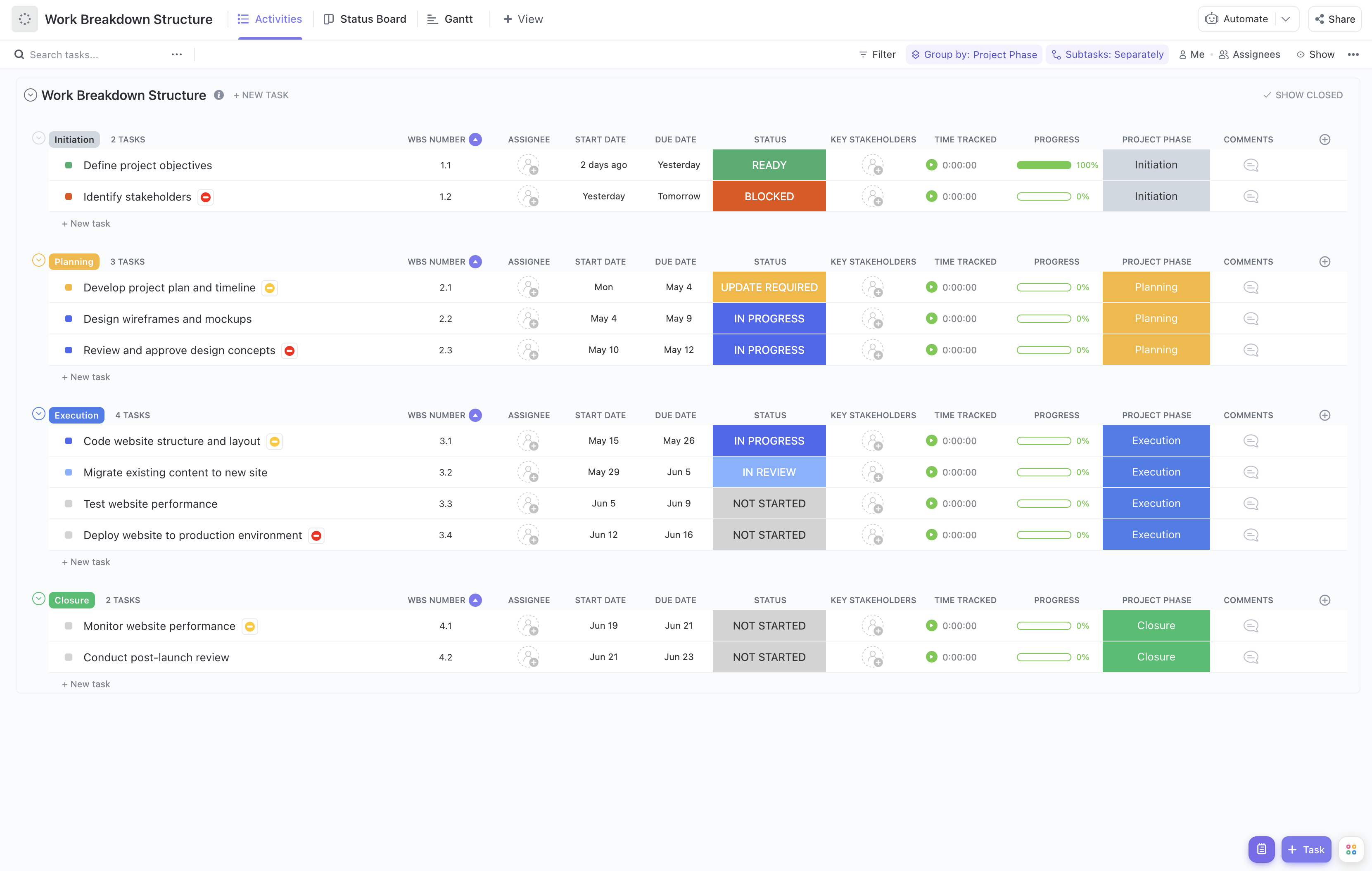
Implementing a payroll system involves numerous interconnected tasks that must be carefully coordinated to ensure compliance, accuracy, and efficiency. This Payroll System Work Breakdown Structure Template provides a structured approach to decompose the entire payroll system project into clear, manageable sections.
With this template, you can:
- Organize payroll project tasks into distinct phases such as requirements gathering, system design, development, testing, and deployment for enhanced clarity.
- Assign responsibilities to HR, IT, finance, and compliance teams effectively, ensuring each stakeholder understands their role in the payroll implementation.
- Monitor progress with real-time updates to keep the project on schedule and within budget.
Best of all, you can utilize this template within ClickUp without any need for coding or specialized software, making it accessible for teams of all sizes and technical backgrounds.
Benefits of a Payroll System Work Breakdown Structure Template
Using a structured WBS for your payroll system project offers several advantages:
- Clearly defines and organizes deliverables such as payroll calculations, tax compliance modules, and reporting features.
- Provides transparency on team roles, from payroll specialists to software developers, facilitating better collaboration.
- Enhances communication between HR, finance, IT, and external vendors, reducing misunderstandings and errors.
- Improves project efficiency by identifying dependencies and potential bottlenecks early in the process.
Main Elements of a Payroll System Work Breakdown Structure Template
This template breaks down the payroll system project into key components including:
- Project Initiation: Defining objectives, scope, and stakeholder identification.
- Requirements Analysis: Gathering payroll policies, tax regulations, and employee data requirements.
- System Design: Creating architecture for payroll processing, tax calculations, and reporting modules.
- Development: Coding, configuring payroll software, and integrating with existing HR and finance systems.
- Testing: Conducting unit tests, user acceptance testing, and compliance verification.
- Deployment: Rolling out the system, training users, and transitioning from legacy systems.
- Post-Implementation Support: Monitoring system performance, addressing issues, and making improvements.
By following this detailed work breakdown structure, your team can systematically tackle each phase of the payroll system project, ensuring a smooth implementation that meets organizational needs and regulatory requirements.