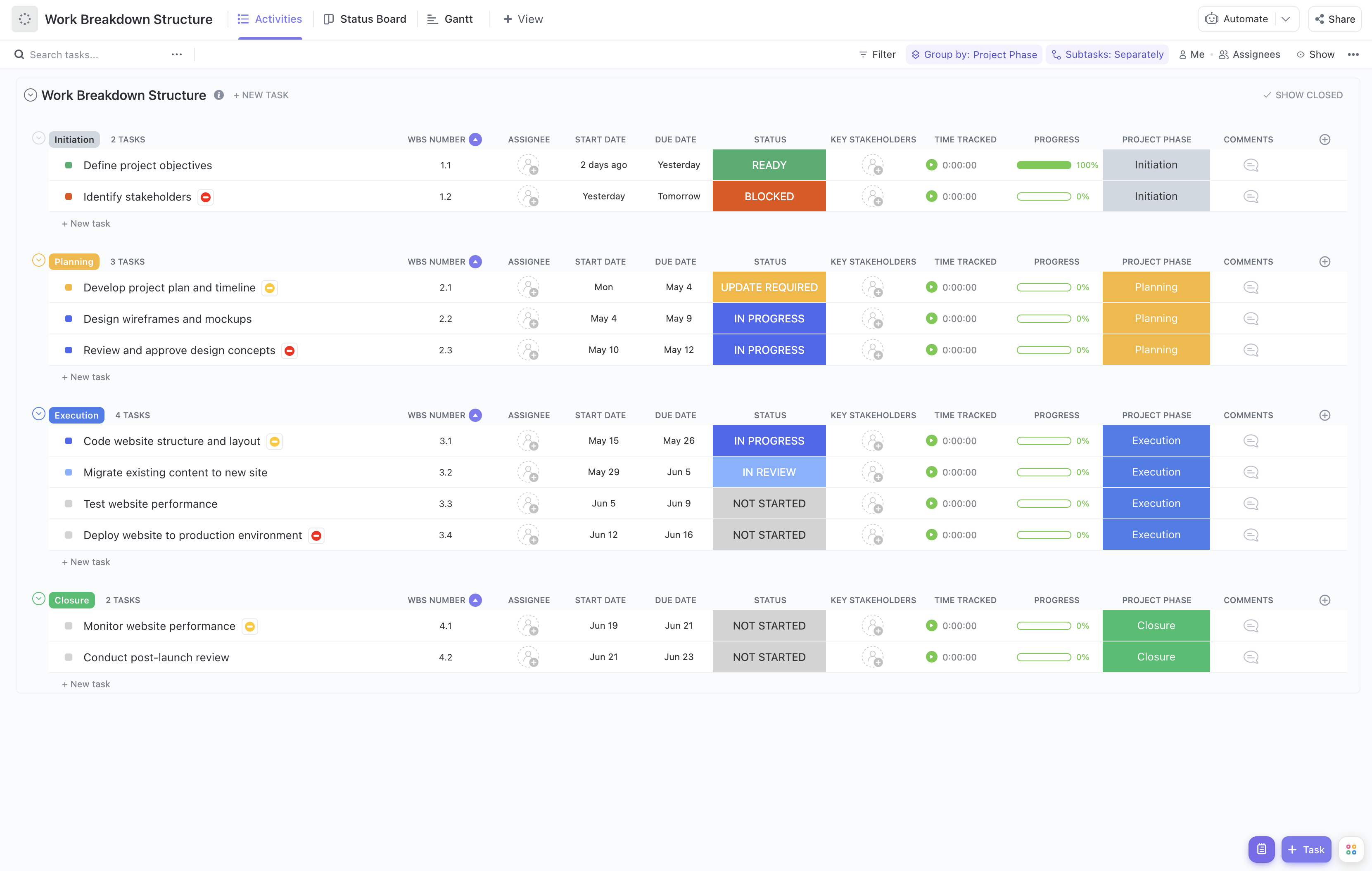
Managing IT service requests can be complex, involving multiple teams, technical steps, and tight deadlines. To streamline this process, the IT Service Request Execution Work Breakdown Structure Template provides a structured approach to decompose service requests into actionable tasks.
This specialized template enables you to:
- Segment IT service requests into detailed tasks such as diagnosis, approval, implementation, and testing
- Assign responsibilities to IT support staff, network engineers, and other stakeholders efficiently
- Monitor progress in real-time to ensure SLAs are met and service quality is maintained
Best of all, no advanced technical skills are needed to use this template—just ClickUp and your IT team's expertise!
Benefits of an IT Service Request Execution Work Breakdown Structure Template
This WBS template is a vital tool for IT service management teams aiming to improve request handling and execution. Key benefits include:
- Clearly defines the scope and deliverables for each service request, reducing ambiguity
- Clarifies roles and responsibilities among IT staff, ensuring accountability
- Enhances communication between IT teams, end-users, and management through transparent task tracking
- Improves efficiency by breaking down complex service requests into manageable steps, facilitating faster resolution
Main Elements of the IT Service Request Execution Work Breakdown Structure Template
The template is structured to cover all critical phases of IT service request execution:
- Request Intake and Validation:
Documenting the initial request details, verifying completeness, and prioritizing based on impact and urgency.
- Diagnosis and Impact Analysis:
Assigning technical staff to analyze the issue, identify root causes, and assess potential impacts on systems and users.
- Approval and Scheduling:
Coordinating with stakeholders for necessary approvals and scheduling the implementation window to minimize disruption.
- Implementation and Testing:
Executing the service changes or fixes, followed by thorough testing to confirm resolution.
- Closure and Documentation:
Finalizing the request by updating documentation, notifying stakeholders, and collecting feedback for continuous improvement.
Each task can be assigned with due dates, priorities, and dependencies to ensure a smooth workflow. Integration with communication tools and automated notifications keeps everyone aligned throughout the process.
By leveraging this template, IT teams can transform service request execution into a transparent, efficient, and collaborative process that meets organizational standards and user expectations.