
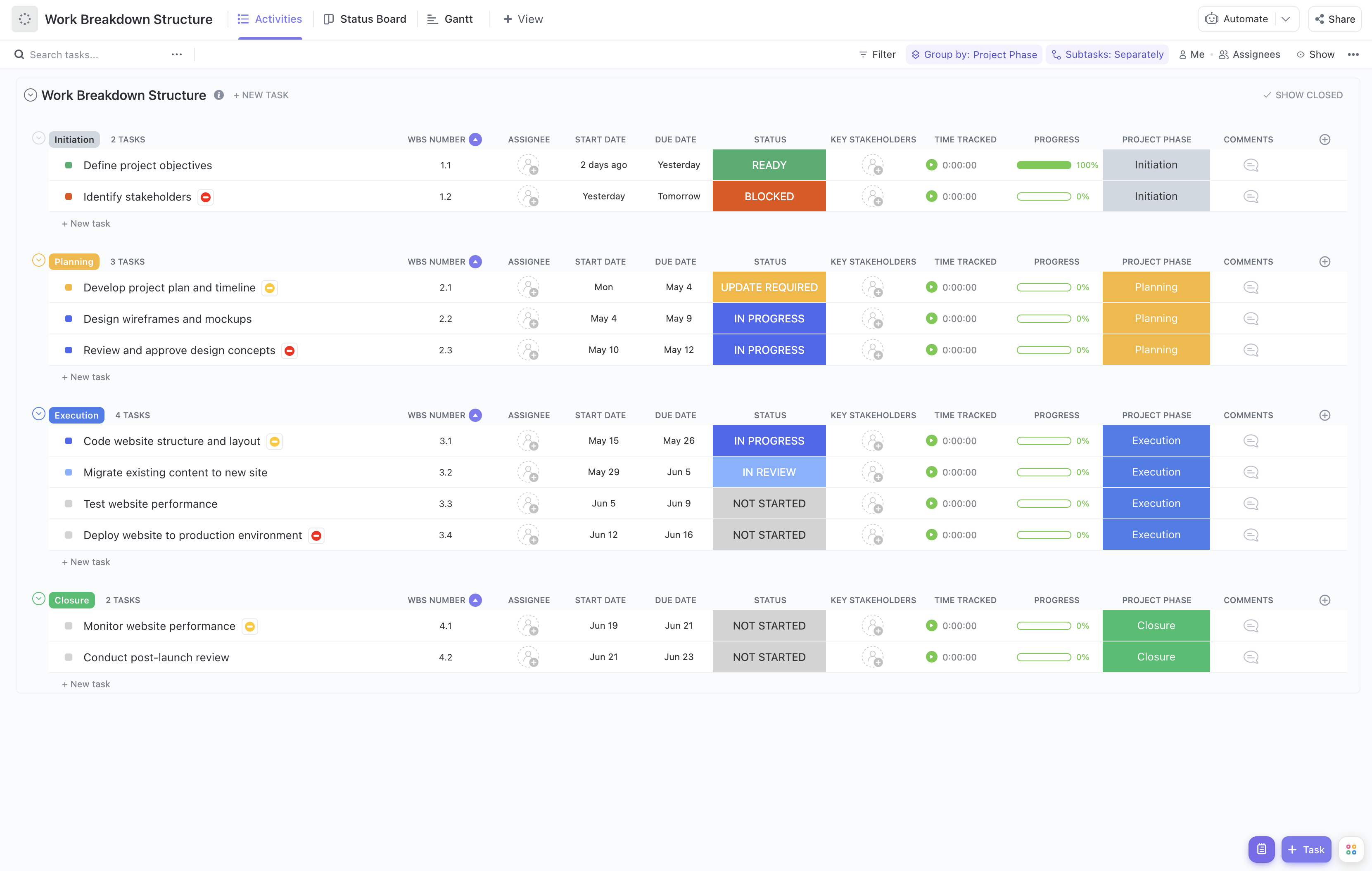


Implementing an effective information lifecycle rollout requires meticulous planning and coordination across multiple departments. This template is crafted to help you decompose the rollout into clear, actionable components, ensuring every phase from data classification to archiving is managed seamlessly.
With this Information Lifecycle Rollout Work Breakdown Structure Template, you can:
- Segment the rollout into distinct phases such as policy development, system configuration, training, and compliance audits for enhanced clarity
- Assign responsibilities to key stakeholders including IT, legal, and records management teams to foster accountability
- Monitor milestones and deliverables with real-time progress tracking to keep the rollout on schedule
Best of all, this template integrates smoothly with ClickUp, requiring no specialized technical skills—just your team's commitment to effective information management.
Benefits of an Information Lifecycle Rollout Work Breakdown Structure Template
Utilizing a structured WBS for your information lifecycle rollout brings numerous advantages:
- Clearly defines and organizes the rollout's deliverables, such as policy documentation, system updates, and user training sessions
- Clarifies roles and responsibilities across departments, reducing overlap and ensuring comprehensive coverage
- Enhances communication between project teams and stakeholders, facilitating timely issue resolution and feedback incorporation
- Improves overall efficiency by providing a transparent roadmap and enabling proactive risk management
Main Elements of the Information Lifecycle Rollout Work Breakdown Structure Template
This template is structured to guide you through the critical components of the rollout:
- Project Phases:
Break down the rollout into phases such as Initiation, Planning, Execution, Monitoring, and Closure, each with specific tasks and milestones.
- Task Hierarchy:
Organize tasks hierarchically to reflect dependencies and priorities, from high-level deliverables to detailed activities.
- Stakeholder Assignment:
Assign tasks to relevant team members and departments, ensuring clear ownership and accountability.
- Progress Tracking:
Utilize status indicators and progress metrics to monitor task completion and identify bottlenecks promptly.
- Documentation and Compliance:
Include checkpoints for policy reviews, compliance audits, and documentation updates to maintain regulatory adherence.
By leveraging this template, your organization can confidently manage the complexities of information lifecycle rollout, ensuring data is handled responsibly throughout its existence.










