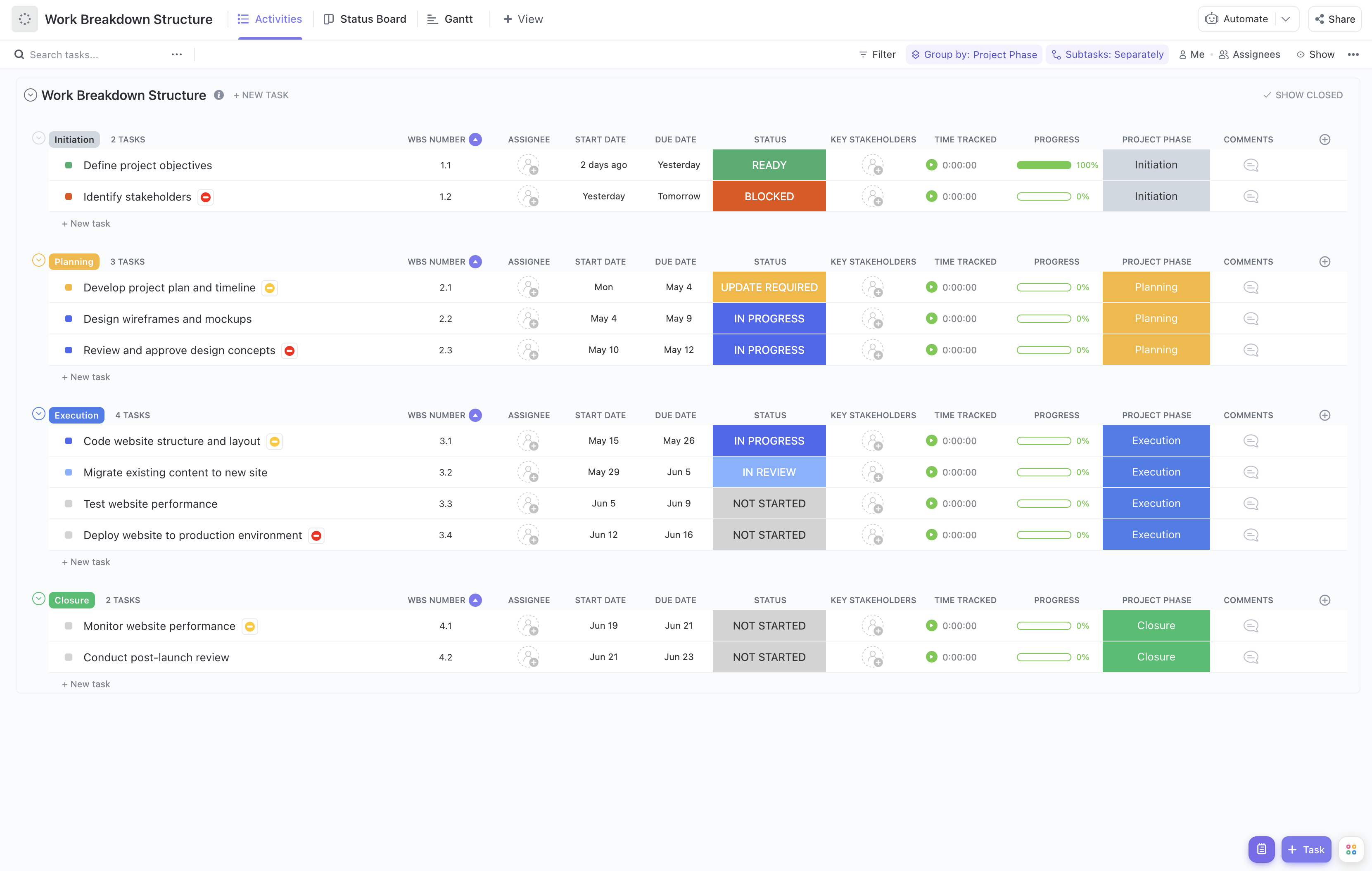
Delivering an application successfully requires meticulous planning and coordination across multiple teams and phases. This Application Delivery Execution Work Breakdown Structure Template empowers you to decompose your delivery project into clear, actionable tasks, facilitating smooth execution and collaboration.
With this template, you can:
- Structure application delivery tasks into logical segments such as requirements gathering, development, testing, deployment, and post-launch support
- Assign responsibilities to development, QA, operations, and business teams efficiently
- Monitor progress in real-time to quickly identify and address bottlenecks
Best of all, no specialized software or coding skills are needed—just use ClickUp to organize and drive your application delivery to success!
Benefits of an Application Delivery Execution Work Breakdown Structure Template
This specialized WBS template offers project managers a clear roadmap for application delivery, helping to:
- Define and organize all critical deliverables, from initial requirements to final deployment and maintenance
- Clarify roles and responsibilities across cross-functional teams including developers, testers, and operations
- Enhance communication between stakeholders such as product owners, development teams, and end-users
- Improve efficiency by breaking down complex delivery phases into manageable, trackable tasks
Main Elements of the Application Delivery Execution Work Breakdown Structure Template
This template is structured to cover all key phases of application delivery execution, including:
- Initiation and Planning:
Define project scope, objectives, and stakeholder roles to set a solid foundation.
- Requirements Analysis:
Gather and validate functional and non-functional requirements with business and technical teams.
- Development:
Organize coding tasks, feature builds, and integration efforts with clear ownership.
- Testing and Quality Assurance:
Plan and execute unit, integration, system, and user acceptance testing to ensure application quality.
- Deployment:
Coordinate release activities, environment setup, and rollback plans for smooth launch.
- Post-Deployment Support:
Monitor application performance, handle user feedback, and manage maintenance tasks.
By following this structured approach, your application delivery team can maintain alignment, track progress effectively, and deliver high-quality software on schedule.