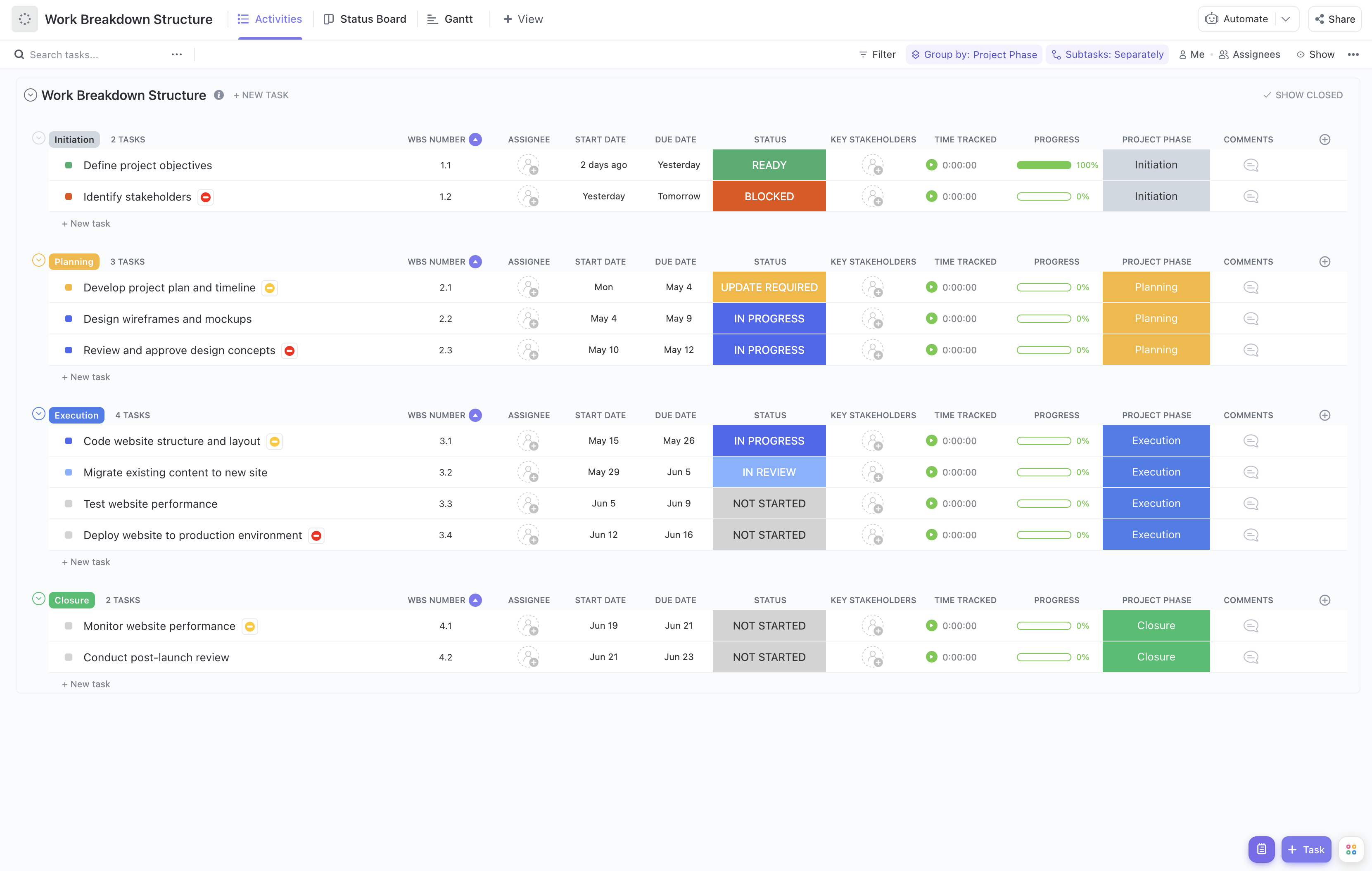
Managing academic governance involves coordinating multiple committees, policies, and compliance requirements. Breaking down these complex governance activities into manageable components is essential for successful execution. This Academic Governance Work Breakdown Structure Template provides a structured approach to organizing and overseeing governance tasks within educational institutions.
This specialized template helps you:
- Segment governance responsibilities into clear, actionable tasks for committees and administrators
- Assign roles and responsibilities to faculty, staff, and governance bodies efficiently
- Monitor policy development, review cycles, and compliance deadlines with real-time updates
Best of all, no advanced technical skills are needed to implement this template—just use ClickUp to streamline your academic governance processes.
Benefits of an Academic Governance Work Breakdown Structure Template
Utilizing a work breakdown structure tailored for academic governance enhances clarity and accountability across your institution's governance framework. Key benefits include:
- Clearly defining governance deliverables such as policy drafts, committee reports, and accreditation documentation
- Providing transparency on roles and responsibilities among faculty senates, administrative bodies, and external stakeholders
- Improving communication flow between governance committees, academic departments, and leadership teams
- Increasing efficiency in managing complex governance timelines and regulatory compliance requirements
Main Elements of the Academic Governance Work Breakdown Structure Template
This template is structured to reflect the unique components of academic governance projects, including:
- Governance Framework Definition:
Establishing the scope, objectives, and key stakeholders involved in governance activities.
- Committee Task Breakdown:
Detailing tasks for various governance committees such as curriculum committees, ethics boards, and accreditation teams.
- Policy Development and Review:
Scheduling drafting, consultation, approval, and revision phases for academic policies.
- Compliance and Reporting:
Tracking deadlines for regulatory submissions, audit preparations, and internal reporting requirements.
- Stakeholder Engagement:
Coordinating communication and feedback loops with faculty, students, and external bodies.
By leveraging this template, academic institutions can ensure a systematic approach to governance execution, fostering transparency, accountability, and continuous improvement in their academic operations.