Fix campaign intake when nobody owns the calendar
Sorry, there were no results found for “”
Sorry, there were no results found for “”
Sorry, there were no results found for “”
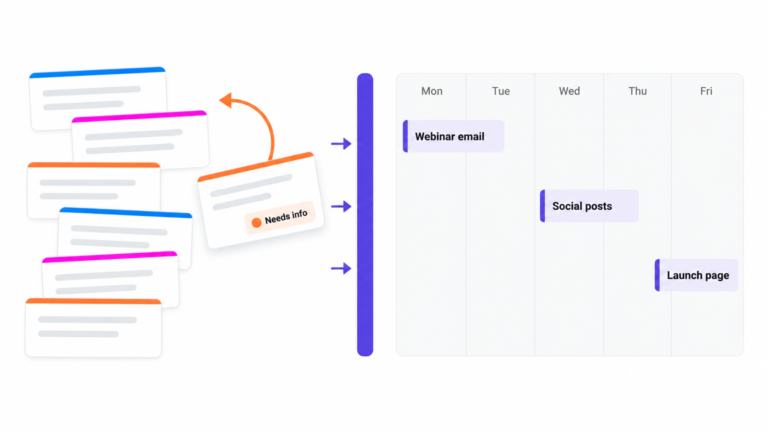
When there is no master calendar and no traffic manager, campaign requests can arrive without the details or decisions needed to plan them. The fix is one agreed intake process, not necessarily one form: a named intake steward checks each request, returns missing details, and routes complete requests to the people authorized to decide priority and capacity. The shared calendar shows only work the team has approved and dated.
Anonymized September 2026 marketing-call excerpts supplied for this guide describe the problem plainly: “There’s not really a master calendar across teams.” Another person said, “We don’t have a traffic manager, somebody to review the requests, push back if the information is not enough.” The method below makes that review someone’s job without turning it into a new full-time role.
Key Takeaways
- One intake steward checks completeness and routes requests. That role can rotate.
- The requester can state urgency, but an authorized marketing lead decides priority and tradeoffs.
- A requested due date is context, not a delivery commitment.
- Only approved work with a confirmed date belongs on the shared calendar.
A calendar cannot fix a request that has no owner, goal, deadline reason, or decision path. It can only show what the team has entered, and teams cannot plan reliably from requests that are missing the information needed to assess them.
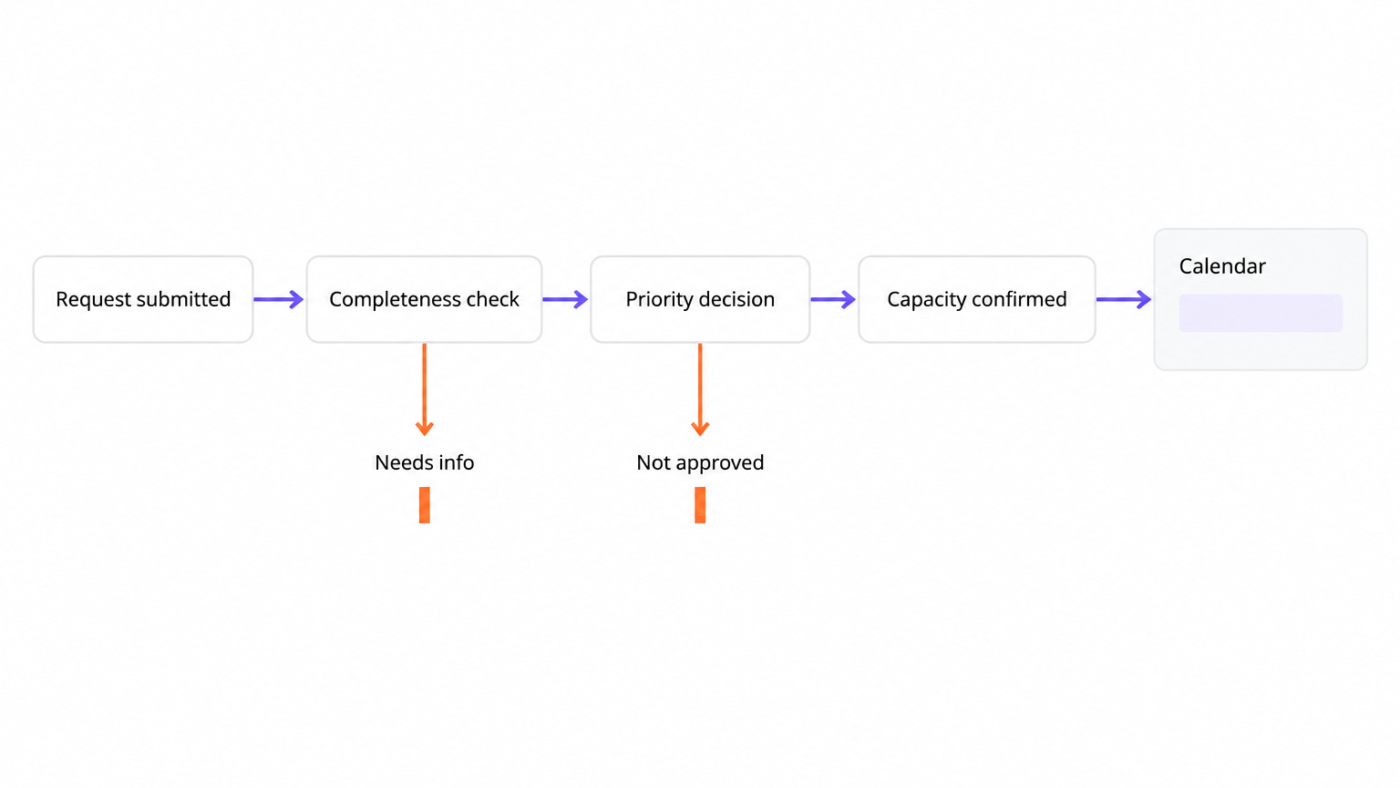
The supplied call excerpts point to a recurring tangle: teams do not see one calendar, details can be missed, work arrives late, and nobody has an agreed job to return incomplete requests. Those are different symptoms of the same missing handoff. A request needs a clear route from submission to review, from review to a priority decision, and from an approved plan to a calendar entry.
The process does not require a dedicated traffic manager. It does require someone to own the next decision at each point.
Keep four responsibilities visible, even if one person holds more than one of them:
The intake steward does not need authority to approve every campaign. They need authority to say, “This request is missing the audience and the reason for the deadline. Please add those before we schedule it.” The priority owner decides whether the work should happen. The person responsible for capacity confirms when the team can take it on.
Keep priority and scheduling as separate decisions. A request can matter and still wait for a capacity slot.
Use this template when a request is new, spans teams, or needs a date on the shared calendar. Trim fields that do not help your team make a decision. Do not ask requesters to invent answers that another role must supply; let them mark those items as unknown and route them for scoping.
Keep one agreed intake process, even if marketing and creative requests use separate Form views. Different forms can ask for the details each request type needs; they are entry points to the same decision process, not separate triage systems. Each submission creates a task in a chosen List, so decide where each Form should send requests and who checks them. For the available question types, see Forms for marketing teams and Intro to Forms and Form view.
CAMPAIGN REQUEST
Request title:
Requester and team:
Business owner:
What outcome or business need should this work support?
Who is the intended audience?
What type of work is requested?
What deliverables and channels are known?
Requested launch or delivery date:
Why does that date matter?
Which parts of the timing are fixed, and which can move?
Links to the brief, source material, or approved assets:
Known dependencies, approvals, or decisions still needed:
What will count as complete?
How will the team check whether the work did its job? (If known)
Requester’s urgency and what happens if the work is delayed:
TRIAGE RECORD
Completeness: Ready for review / Needs information / Needs scoping
Intake steward:
Priority decision owner:
Decision: Approve for scheduling / Defer / Decline
Reason for the decision:
Capacity owner:
Confirmed delivery or launch date: (leave blank until agreed)
Next action:
Next owner:
Next review date:
Campaign or calendar group:
Make only the fields that are essential to a decision mandatory. A small request may need a short brief. A cross-channel launch may need a scoping conversation before anyone can estimate the work. The form should reveal what is known and what decision comes next, not force every request into the same level of detail.
The intake steward can use four checks to decide where each submission goes:
Is the request complete enough to review? Check for a business need, audience, known deliverables, a date reason, and a business owner. If an essential item is missing, return the request with the exact questions and the person who can answer them. Keep it out of the committed calendar until the information arrives.
Does the work need scoping? If the requester knows the outcome but not the right channel, deliverable, or dependencies, route it to the people who can shape the plan. Mark it as needing scoping, not as approved work.
Who can make the priority decision? Compare the request with current commitments using criteria the team has agreed to, such as business impact, fixed external dates, dependencies, and effort. The requester’s preferred priority helps explain their case. It does not decide what moves ahead.
Can the team commit to a date? A requested date becomes a commitment only after the responsible capacity owner agrees to the scope and timing. If the answer is no, return a realistic next action: reduce scope, move the date, defer the request, or decline it.
Keep the language simple. A useful set of intake outcomes is: Needs information, Needs scoping, Ready for a priority decision, Approved for scheduling, Deferred, or Declined. Adapt those labels to your existing workflow instead of adding a second status system.
This fictional example shows how the form and triage rules work together. It is not a customer story or a report of a real campaign.
| Field | Example answer |
|---|---|
| Request | Promote an upcoming customer webinar |
| Business owner | Webinar lead |
| Outcome | Help the intended customer audience register |
| Deliverables | One registration email and social posts; channel details still need confirmation |
| Requested date | Before registration opens |
| Date reason | The event lead says the registration window is tied to the event plan |
| Source material | Draft event brief and landing page link |
| Missing input | The event date and final landing page are not approved yet |
| Triage result | Needs scoping, then return for a priority decision |
| Decision owner | Marketing lead |
| Calendar commitment | None yet |
| Next action | Event lead confirms the date and landing page; intake steward routes the updated request |
The request has enough context to see what is missing, but not enough to promise a launch date. Once the event details are approved, the priority owner can assess it against other work. The capacity owner can then confirm whether the requested timing is possible.
Keep the intake queue and the calendar connected, but do not treat them as the same thing. The queue holds requests and decisions. The calendar shows what the team has agreed to deliver and when.
Create one calendar item for each deliverable that needs its own owner or date. Link each item to its parent campaign so people can see both the campaign and its work. Every scheduled item should carry:
Use the confirmed date for the calendar commitment. Keep the original requested date and its reason in the intake record so the team can explain what changed. When a date moves, record who made the decision and which other work it affects. Do not quietly overwrite the request and lose the history.
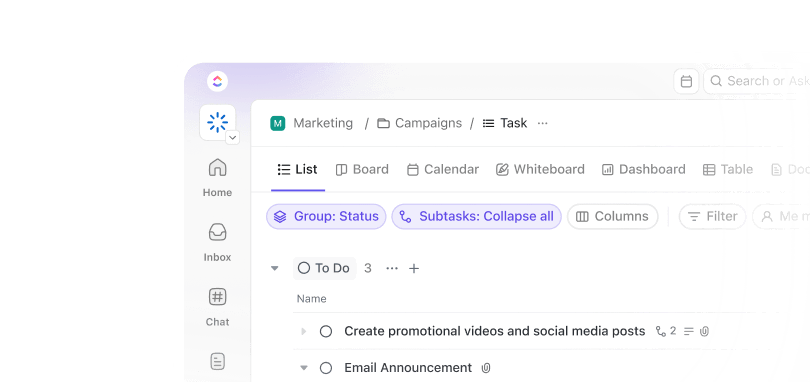
When the team is ready, put only approved work with confirmed dates on the shared planning calendar. ClickUp Calendar view displays tasks with a start or due date and offers day, four-day, week, or month views. See Intro to Calendar view. Check that the view includes each team’s approved work before treating it as the cross-team calendar; the view alone does not decide priority or confirm capacity.
For more on coordinating marketing projects, see marketing project management. If your team is still choosing planning software, use the separate marketing planning software guide for that decision. Those pages cover adjacent jobs; this guide focuses on how a request becomes approved work on the calendar.
Week one: agree on the decisions. Choose the intake steward and backup rotation. Name who can make priority decisions and who confirms capacity. Review the last few requests your team can access and use them to set the minimum information needed for review. Adapt the template and label outcomes using the workflow you already have.
Week two: use it on incoming work. Route new requests through the agreed entry point. Return incomplete requests with a specific question and next owner. Hold a triage review on a cadence the team can actually cover. Add only approved, dated work to the shared calendar. At the end of the week, note which fields were unclear and which decisions had no owner, then revise the instructions before adding more complexity.
The first pass is a working agreement, not a promise that every request will be accepted or scheduled. Keep a short decision note when you defer or decline work. That makes the tradeoff visible to the people affected by it.
If your team wants a starting structure for campaign work, adapt the Marketing Campaign Management Template to match your intake fields and decision rights.
Brett Helling
Max 8min read
Brett Helling
Max 8min read

Pavitra M
Max 10min read

© 2026 ClickUp