Top AI Prompts for Employee Lifecycle Management
 25,000+ reviews from
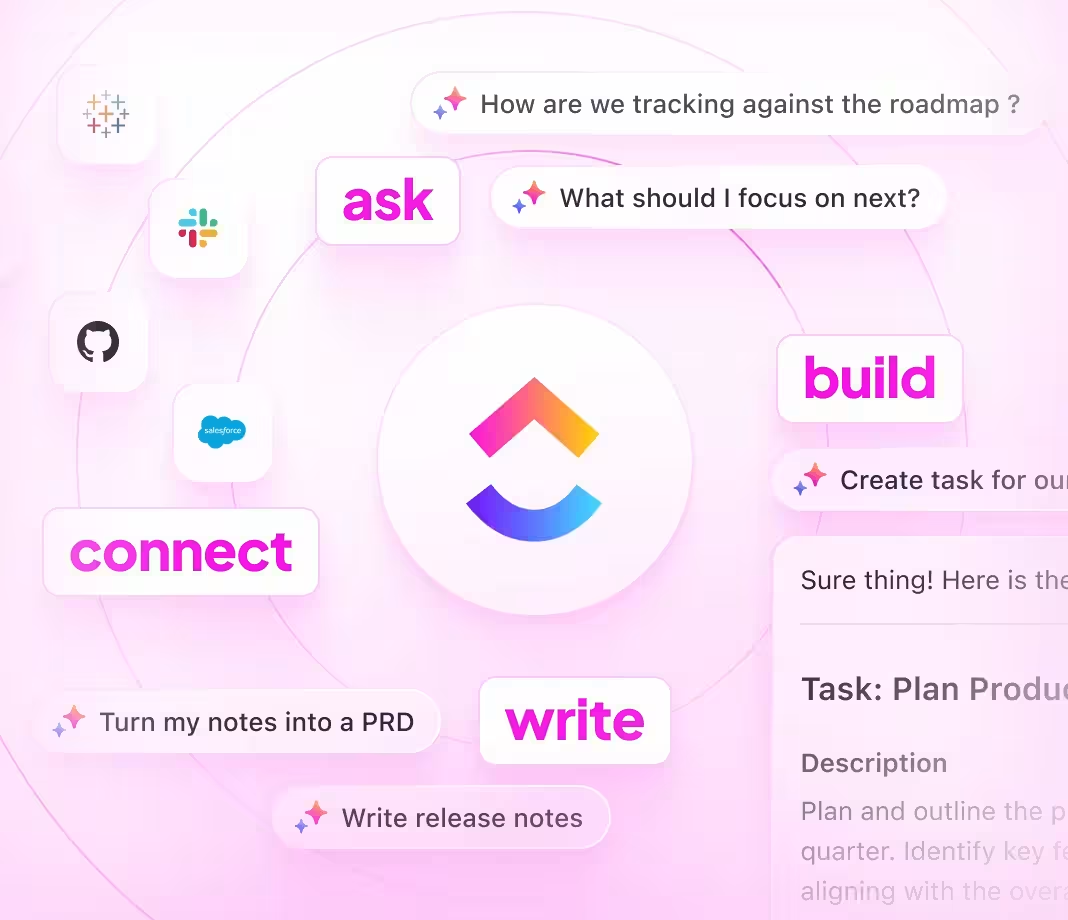
Revolutionizing Employee Lifecycle Management with AI Prompts
Managing every phase of an employee's journey requires precision and coordination—from recruitment and onboarding to development and offboarding.
Human resources teams juggle countless documents, feedback forms, and compliance standards daily. AI prompts are now stepping in to simplify these complex processes.
HR professionals leverage AI to:
- Quickly identify candidate fit and streamline interview prep
- Generate personalized onboarding plans and training outlines
- Extract key insights from performance reviews and feedback
- Transform meeting notes into clear action items and follow-ups
Integrated into familiar tools like docs, task boards, and collaboration platforms, AI in ClickUp Brain doesn’t just assist—it actively organizes and propels your HR workflows forward.
Why ClickUp Brain Stands Apart
Conventional AI Platforms
- Constantly toggling between apps to collect information
- Repeating your objectives with each query
- Receiving generic, irrelevant replies
- Hunting through multiple platforms for a single document
- Interacting with AI that only processes input passively
- Manually switching between different AI engines
- Merely an add-on in your browser
ClickUp Brain
- Deeply connected to your projects, documents, and team communications
- Retains your past interactions and targets
- Delivers precise, context-driven guidance
- Offers consolidated search across all your resources
- Enables voice commands with Talk to Text
- Automatically selects the optimal AI engine: GPT, Claude, Gemini
- Dedicated desktop app for Mac & Windows designed for efficiency
15 Essential AI Prompts for Employee Lifecycle Management
List 5 exterior design directions for a compact electric SUV, inspired by the ‘Spring 2025 Concept’ doc.
ClickUp Brain Behaviour: Summarizes descriptions and design themes from the linked doc to suggest direction ideas.
What interior layout features are trending in sub-$25K EVs in North America?
ClickUp Brain Behavior: Synthesizes insights from internal research docs; Brain Max can enhance this with relevant public data if available.
Create a design brief for a minimalist dashboard inspired by Scandinavian principles. Reference Sketch File #8 descriptions and prior concept notes.
ClickUp Brain Behavior: Extracts relevant notes and textual references from linked docs to build a formatted design brief.
Summarize front suspension benchmarks between Tesla Model Y and VW ID.4 using our ‘Suspension Q2’ doc.
ClickUp Brain Behavior: Extracts tabular and written data from internal documents and outputs a summarized comparison.
List top thermal management materials used in high-performance EVs, referencing R&D notes and supplier spec docs.
ClickUp Brain Behavior: Scans internal documents and lists recurring material types and their associated performance notes.
From the ‘Steering System Validation’ doc, generate a DVP&R-style checklist for component testing.
ClickUp Brain Behavior: Identifies test criteria and converts them into a structured checklist inside a task or doc.
Summarize 3 gesture control trends in infotainment UX from post-2024 user research and tech review docs.
ClickUp Brain Behavior: Extracts patterns and repeated observations from linked research docs or notes.
From the ‘Gen Z UX Survey Q1’ doc, summarize key preferences for in-car app interfaces.
ClickUp Brain Behavior: Reads survey responses and identifies recurring design themes or feedback patterns.
Write playful and concise UX copy for the eco-mode toggle screen using the voice guide in ‘ProductTone.pdf’.
ClickUp Brain Behavior: Pulls tone/style references from the doc and suggests variations for interface copy.
Summarize key changes in EU 2025 pedestrian safety norms and how they might impact our fascia design.
ClickUp Brain Behavior: Summarizes linked internal compliance documents; Brain Max can pull in updates if public-facing files are added.
Generate placement and dimension guidelines for EV charging indicators, referencing India-specific compliance docs in our workspace.
ClickUp Brain Behavior: Extracts measurements, positioning rules, and notes from internal docs to form a compliance checklist.
Create a frontal crash-test checklist using US NCAP 2025 PDFs and our chassis design folder.
ClickUp Brain Behavior: Identifies requirements from readable PDF content and outputs tasks grouped by test zone or severity.
Compare interior sustainability features like recycled materials across Tesla, Lucid, and Rivian using our competitive analysis docs.
ClickUp Brain Behavior: Summarizes documented comparisons into a clean, readable format (brief/table).
What interior design trends are emerging in autonomous vehicles since 2023?
ClickUp Brain Behavior: Synthesizes trends from internal research notes, concept summaries, and uploaded reports.
Summarize key cabin usability gaps from the Southeast Asia EV feedback folder (materials, layout, interactions).
ClickUp Brain Behavior: Extracts and prioritizes user-reported issues across survey responses, feedback notes, and tagged tickets.

LLMs vs. Workflow Intelligence: How ClickUp Brain Enhances Employee Lifecycle Management
Prompts for ChatGPT
- Outline the key stages of onboarding new hires, focusing on engagement and compliance.
- Compose an internal announcement template for employee promotions highlighting achievements.
- Suggest 3 innovative training program ideas tailored for remote employees.
- Draft a stepwise plan for conducting performance reviews with actionable feedback.
- Summarize exit interview feedback to identify common themes and improvement areas.
Prompts for Gemini
- Propose 3 alternative mentorship program structures based on employee development goals.
- List creative employee recognition ideas that boost morale and retention.
- Generate a mood board description for a collaborative workspace promoting inclusivity.
- Recommend ergonomic office layouts for hybrid teams, ranked by productivity impact.
- Create a comparison chart of onboarding software options focusing on user experience and scalability.
Prompts for Perplexity
- Identify 5 effective strategies for improving employee engagement and rank by impact.
- Compare benefits administration platforms, highlighting cost, usability, and compliance.
- Summarize global trends in talent acquisition and their influence on recruitment.
- List 5 innovative wellness program ideas and evaluate their practicality.
- Analyze past employee retention initiatives and extract top 3 lessons for future programs.
Prompts for ClickUp Brain
- Transform this employee feedback thread into clear HR action items with deadlines.
- Summarize meeting notes from the talent development session and assign follow-up tasks.
- Review annotated onboarding documents and generate a checklist for compliance verification.
- Compile a task list from cross-department discussions on performance management improvements, prioritizing actions.
- Analyze exit interview transcripts and create actionable tasks for retention strategy updates within ClickUp.
Transform Initial Thoughts Into Polished Plans
- Convert scattered notes into detailed employee lifecycle strategies quickly.
- Generate innovative approaches by analyzing previous HR initiatives.
- Develop standardized templates to accelerate onboarding and offboarding processes.
Brain Max Boost: Effortlessly access historical employee data, feedback, and process documents to guide your next HR project.

Accelerate Employee Lifecycle Management
- Break down onboarding challenges into manageable tasks.
- Transform HR feedback into actionable assignments.
- Automatically compile progress reports and transition summaries without extra effort.
Brain Max Boost: Quickly access historical hiring data, role evaluations, or training records across departments.

How AI Prompts Enhance Every Phase of Employee Lifecycle Management
Create Tailored Onboarding Plans Quickly
HR teams craft personalized onboarding experiences, engage new hires effectively, and reduce ramp-up time.
Improve Talent Development Strategies
Identify Issues Early and Proactively
Align Teams Around People Goals
Drive Continuous Workforce Innovation
Integrated AI Support Within ClickUp